What Does the Battery Light Mean on Your Dashboard?
If the battery light stays on after the engine starts, treat it as a charging-system fault, not a battery-only warning, and plan to stop soon. Ignoring it can leave you stranded when the battery is no longer being charged. This guide shows how to tell battery, alternator, belt, and connection problems apart in under two minutes.
How the warning light behaves
The battery light is a charging-system warning, not a battery-only warning. A brief light at startup can be normal, but a light that stays on while driving may mean the charging system is not supplying enough voltage to charge the battery and run accessories.
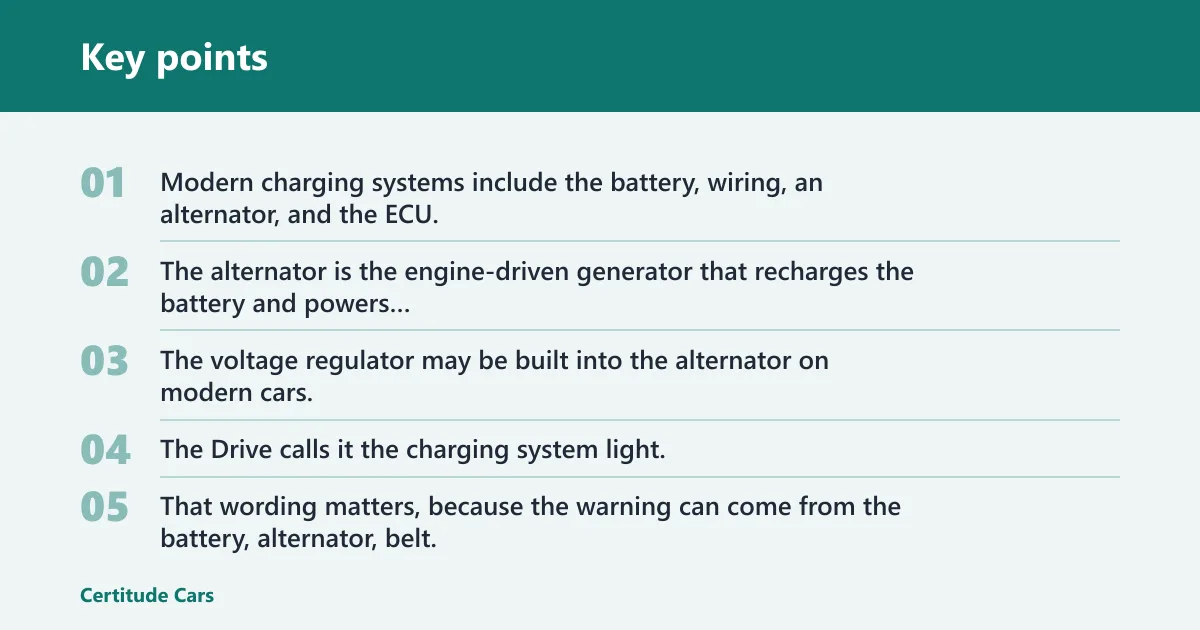
Modern charging systems include the battery, wiring, an alternator, and the ECU. The alternator is the engine-driven generator that recharges the battery and powers electrical loads while the engine runs. The voltage regulator may be built into the alternator on modern cars.
Battery light versus charging-system light
The Drive calls it the charging system light. That wording matters, because the warning can come from the battery, alternator, belt, wiring, terminals, or regulator. A battery can be fine and still trigger the light if charging voltage drops.
Why a brief startup light can be normal
Many cars illuminate the warning light during key-on or startup checks, then turn it off once the engine is running and charging resumes. If it goes out quickly, that is usually the normal pattern. If it remains on, flickers, or returns under load, treat it as a fault.
What a steady light means while driving
A steady light during driving points to an active charging problem. Common causes include a slipping or broken serpentine belt, alternator failure, loose or corroded battery terminals, a bad voltage regulator, or wiring trouble. The longer it stays on, the less reserve the battery has.
📊 The Drive says a fully charged battery should register 12.6 volts or more. Source: Symptoms of a Battery Light On.
Battery light diagnosis at a glance
This table helps you sort the likely cause before you open the hood. Use the symptom pattern first, then check the most likely parts in order. If you see steering-assist loss, dim lights, or a no-start after shutdown, treat the problem as more urgent.
| Symptom pattern | Most likely cause | What to check first | Is it safe to drive? |
|---|---|---|---|
| Light at startup only | Normal bulb check or brief charging delay | Confirm it goes out within moments after start | Yes, if it turns off and stays off |
| Light stays on | Charging-system fault, often alternator or belt | Check belt, terminals, and charging voltage | Only a short drive to testing, if other symptoms are absent |
| Light flickers at idle | Weak alternator output, belt slip, or poor connection | Look for loose clamps and belt wear | Use caution; avoid traffic if it worsens |
| Light plus dim headlights | Low system voltage or failing alternator | Reduce loads and test battery and alternator voltage | Risky; drive only if needed for testing nearby |
| Light plus loss of power steering or AC | Broken or slipping serpentine belt | Inspect the belt immediately under the hood | No, stop and avoid further driving if steering assist is gone |
| Light plus no-start after shutdown | Battery not being charged, or battery is failing | Check battery voltage and terminal condition | No; arrange testing or a jump only if safe |
What should you check first?
Start with the quickest checks. Turn off extra electrical loads, note whether the light is steady or flickering, inspect the battery terminals, and look at the serpentine belt. That order helps you spot the fault pattern before the battery drains farther.
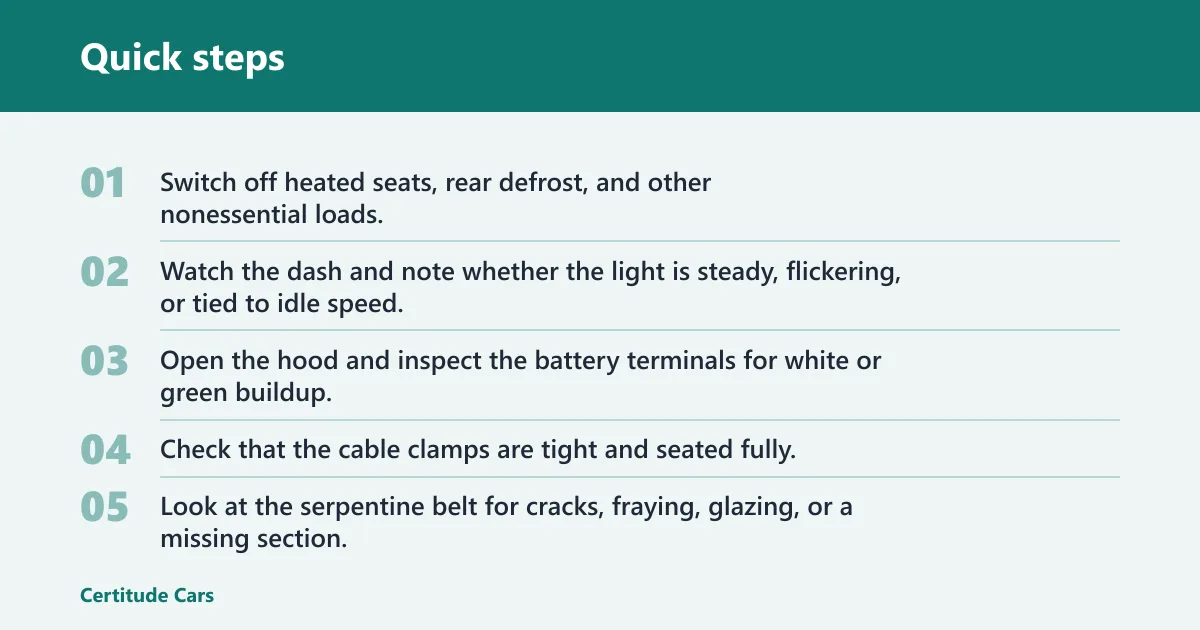
- Switch off heated seats, rear defrost, and other nonessential loads.
- Watch the dash and note whether the light is steady, flickering, or tied to idle speed.
- Open the hood and inspect the battery terminals for white or green buildup.
- Check that the cable clamps are tight and seated fully.
- Look at the serpentine belt for cracks, fraying, glazing, or a missing section.
- Arrange voltage testing if the light stays on or returns.
Say your battery light comes on only when the engine idles at a stoplight, then fades when you rev the engine slightly. That pattern points more toward belt slip, a weak alternator, or a loose connection than toward a dead battery alone.
Battery terminals and cable clamps
Loose or corroded battery cable connections can interrupt charging or starting. White or green buildup is a common clue. If the clamps are loose, tightening them may restore contact. If corrosion is heavy, cleaning may help, but the underlying issue still needs a proper test.
Serpentine belt condition
The serpentine belt drives the alternator on many vehicles. A broken or slipping belt can stop charging, and it can also take power steering and AC with it. If those systems fail at the same time as the battery light, the belt moves near the top of the suspect list.
Note when the problem appears
A light that appears under load, at idle, or when several electrical accessories are on often points to a charging weakness rather than a battery that simply aged out. A light that appears right after shutdown and is followed by a no-start can mean the battery was never replenished.
Common causes behind the warning
The most common causes are alternator failure, a weak or damaged battery, loose or corroded terminals, belt slip or breakage, voltage regulator problems, and wiring faults. The warning light is doing its job when it forces you to separate those possibilities before the car quits.
Alternator failure
The alternator is a common failure point behind the warning light. The Drive says most alternators last 100,000 to 150,000 miles, but age, heat, and load can shorten that. If the alternator cannot keep voltage up, the battery will slowly discharge while you drive.
Weak or damaged car battery
A battery with a shorted cell or one that can no longer hold a charge can also trigger the light. Batteries typically last 3 to 5 years. A battery near the end of that window can show up as slow cranking, repeated low-voltage warnings, or a no-start after a short stop.
Loose or corroded terminals and cable clamps
Jiffy Lube lists loose or corroded battery cable as a cause. That kind of resistance can make charging voltage unstable, especially at idle or during higher electrical demand. Check the clamps before assuming the alternator is finished.
Serpentine belt slip or breakage
Battery lights can be caused by a broken or slipping serpentine belt. If the belt is glazed, cracked, or missing, the alternator may spin too slowly or not at all. If the belt is broken, stop driving.
Voltage regulator fault
The voltage regulator keeps charging voltage in range. On many modern cars it is built into the alternator, which makes the alternator assembly the repair point. If the regulator fails, voltage may run too low or too high and trigger a charging warning.
Wiring or connection problems
Wiring damage, loose connectors, and ground problems can all create a charging warning even when the battery and alternator are serviceable. That is why a full diagnosis looks at the whole charging circuit, not one part in isolation.
How do you tell if it is the battery or alternator?
A multimeter gives the quickest split between a weak battery and a charging failure. A fully charged battery should register 12.6 volts or more with the engine off. With the engine running, the alternator should read between 13.8 and 14.2 volts. (Thedrive)
What a multimeter can tell you
If the engine is off and the battery reads well below 12.6 volts, the battery may be weak or discharged. If the engine is running and voltage does not rise into the 13.8 to 14.2 volt range, the charging system is not doing its job. That points toward the alternator, belt, wiring, or regulator.
How voltage checks fit the diagnosis
One reading does not prove a part is bad on its own. A low engine-off reading can reflect a drained battery from a charging fault. A good battery-voltage reading with the engine off does not rule out an alternator that fails under load.
When battery testing is not enough
Battery inspection and testing often means a visual check plus a voltage test. That can identify obvious faults, but it may miss intermittent alternator, belt, or wiring problems. Some shops and auto parts stores offer this kind of testing, which can save time if you need a quick answer.
Is it safe to keep driving?
Sometimes you can limp home, but not always. If the light is steady and the car still charges enough for a short, direct trip to testing, that may be reasonable. If the light flickers, the headlights dim, or steering assist drops out, the risk is much higher.
When you can limp home
If the car still runs normally, the light is steady, and there are no other warning signs, a short drive to a nearby repair shop or parts store may be acceptable. Keep the route short, avoid heavy traffic, and shut off extra electrical loads.
When to stop driving now
Stop driving if the belt is broken, the battery light appears with major electrical loss, or the car begins to run rough as voltage falls. A failing charging system can strand the car when the battery is depleted. Towing is the safer choice when the symptoms are escalating.
Why loss of steering assist changes the risk
Loss of power steering or AC together with the battery light points hard toward a belt-driven problem. Steering effort can rise quickly if the belt fails on a vehicle that uses belt-driven assist, and that changes the safety picture fast. Treat that as urgent, not optional.
How do you fix the battery light on your dashboard?
Fixes range from simple cleaning to parts replacement. Tightening or cleaning terminals may solve a loose-connection problem. A worn battery, failed alternator, broken belt, or bad regulator needs part replacement. The right fix depends on which symptom pattern and voltage reading you have.
Cleaning or tightening terminals
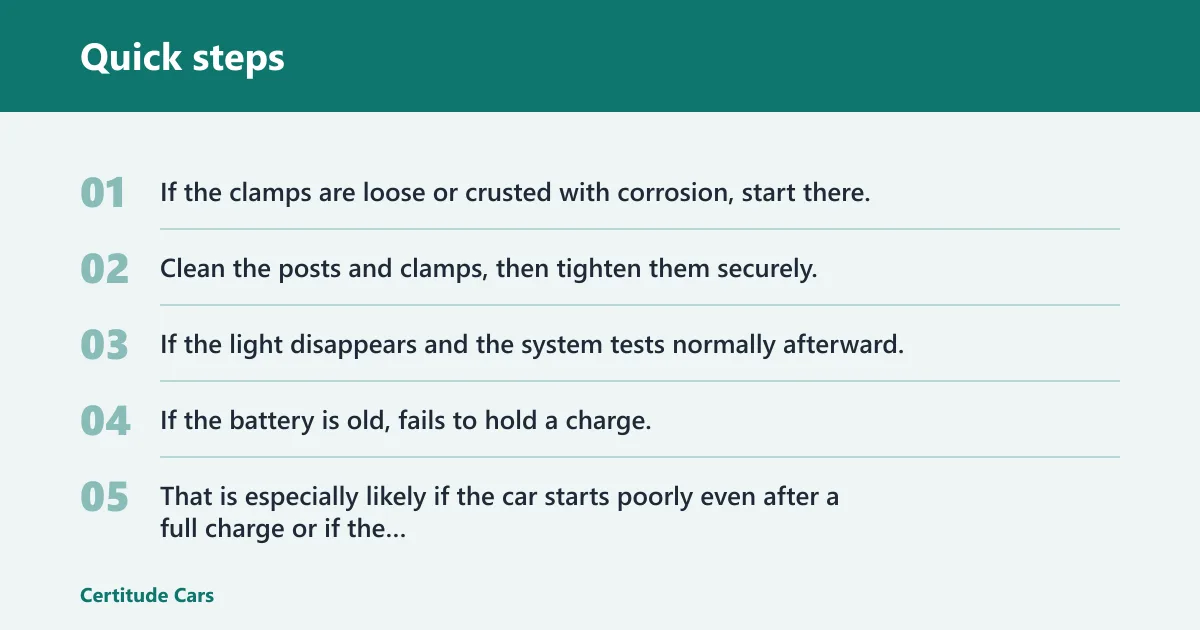
If the clamps are loose or crusted with corrosion, start there. Clean the posts and clamps, then tighten them securely. If the light disappears and the system tests normally afterward, the connection was likely the problem.
Replacing a worn battery
If the battery is old, fails to hold a charge, or shows signs of internal damage such as a shorted cell, replacement may be necessary. That is especially likely if the car starts poorly even after a full charge or if the battery is already near the 3 to 5 year range.
Repairing or replacing the alternator or belt
If running voltage is low, the alternator or voltage regulator may be failing. If the belt is slipping, cracked, or broken, replace it and inspect the pulleys and tensioner. A belt problem can mimic alternator trouble until you look closely.
When professional testing is the next step
If the warning returns after a basic check, or if the cause is not obvious, get a full battery and charging-system test. That is the fastest way to separate a battery fault from an alternator, belt, or wiring problem without replacing good parts.
Suppose the battery light comes on at night, the headlights are visibly dimmer at idle, and the car starts normally after a five-minute stop. That pattern still points to charging trouble, because the battery may have enough reserve for one restart but not enough to cover repeated electrical load.
Frequently asked questions
What does the battery light mean on your dashboard?
It means the car has detected a battery or charging-system issue. The light is meant to warn you before the battery is drained completely. If it stays on after the engine starts, the charging system needs attention soon.
What does the red battery light mean on my dashboard?
Red usually means a serious warning rather than a routine reminder. In this case, it points to a charging-system fault that may involve the battery, alternator, belt, wiring, or regulator. If it stays on while driving, limit the trip and get the system tested.
Why is my battery light on my dash?
Common reasons include alternator failure, a weak battery, loose or corroded terminals, a slipping serpentine belt, or a voltage regulator problem. The best clue is when the light appears, such as only at startup, at idle, or with other electrical symptoms.
What causes the battery light to come on while driving?
While driving, the light usually means charging voltage has dropped below what the car needs. That can happen if the alternator stops outputting enough power, the belt slips, or a poor connection interrupts current flow. Dim lights and accessory loss make that more likely.
Can I keep driving with the battery light on?
Only for a short, cautious trip if the car still runs normally and there are no major symptoms. If the light flickers, the headlights dim, or steering assist drops, stop driving. A failing charging system can leave you stranded without warning.
What should I check first when the battery light comes on?
Check the battery terminals, then inspect the serpentine belt, and note whether the light is steady or flickering. Next, reduce electrical loads and arrange voltage testing. That order catches the most common faults without wasting time on guesswork.