How Much Should My Car Repair Cost?
A fair repair quote should show exactly what you pay for: diagnosis, parts, labour, and any tax or VAT. Treat the estimate with care if it hides a scan fee inside the repair price, leaves out labour hours, or skips parts quality. This guide shows how to judge whether an estimate is fair, inflated, or incomplete before you approve the work, and it gives a practical check against the car’s value and the likely repair outcome.
What should a repair quote include?
A proper quote should separate diagnosis from repair and list the parts, labour, and tax on their own lines. It should also say what is excluded, such as seized fasteners, extra fluid, disposal charges, or follow-up work if the fault proves bigger than expected. If any of that is missing, ask before you sign.
Diagnostic fee versus repair fee
Some shops charge a diagnostic scan before they quote the repair. That fee can cover fault codes, a road test, a fluid check, and a visual inspection, but the scope varies by fault and by shop. A repair fee should be the cost to fix the confirmed problem, not the cost to find it.
Parts, labour, VAT or taxes
Your quote should say whether the parts are new, pattern, genuine, or remanufactured. It should also show the labour time and hourly rate, plus VAT or other local tax if it applies. If the quote says only “brakes” or “gearbox” with one total, it is too vague to check properly.
What should be itemised and what may be excluded?
Ask for itemised parts, labour hours, labour rate, fluids, shop supplies, tax, and any diagnostic charge. Then ask what is excluded. Common exclusions include wheel alignment after brake work, adaptions after transmission work, and extra labour if rusted bolts or broken clips slow the job down.
- Check whether the quote separates diagnosis from repair.
- Look for parts, labour hours, labour rate, and tax.
- Ask what brand and grade of parts will be used.
- Ask whether the scan fee will be deducted if you approve the repair.
- Get a few local quotes for the same job and compare the totals.
What is a fair repair quote at a glance?
As a quick answer, a fair quote usually lands in the middle of the local market for the same repair, the same vehicle, and the same parts quality. Broadly, brake repairs can run from £100 to £600 in the UK, with an average brake repair price of £155.36, while automatic transmission service and major repairs can range from $150-$300 for a fluid change or flush to $3,000-$5,500 for a remanufactured replacement in the US. Those figures are useful only when the geography and repair type match the quote you are checking; labour rates, parts supply, and tax rules vary by region and date. Sources: UK brake repair averages from BookMyGarage’s national pricing data for UK drivers (published 2024-2025); US transmission ranges from RepairPal and national service-cost guides used in 2024-2025 estimates, with local market variation by ZIP code and shop type.
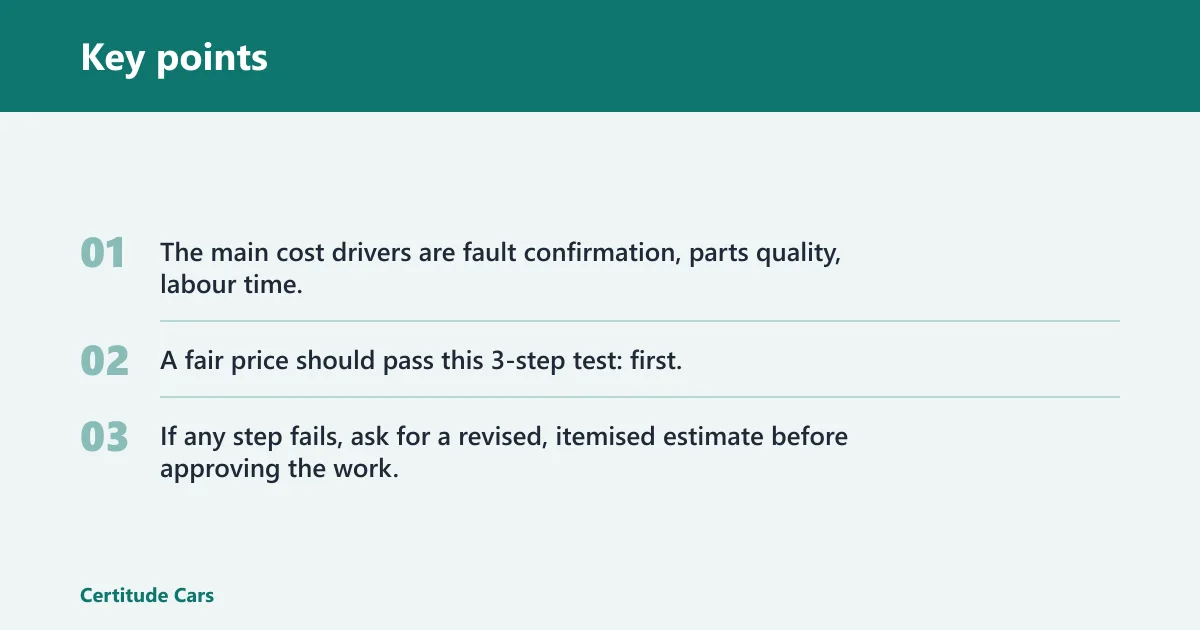
The main cost drivers are fault confirmation, parts quality, labour time, vehicle make and model, access complexity, and whether the repair needs coding, calibration, or specialist tooling. A fair price should pass this 3-step test: first, the quote should identify the fault and what is included; second, the line items should explain the total; third, the price should make sense against the vehicle’s value and the cost of alternative fixes. If any step fails, ask for a revised, itemised estimate before approving the work.
How much should your repair cost?
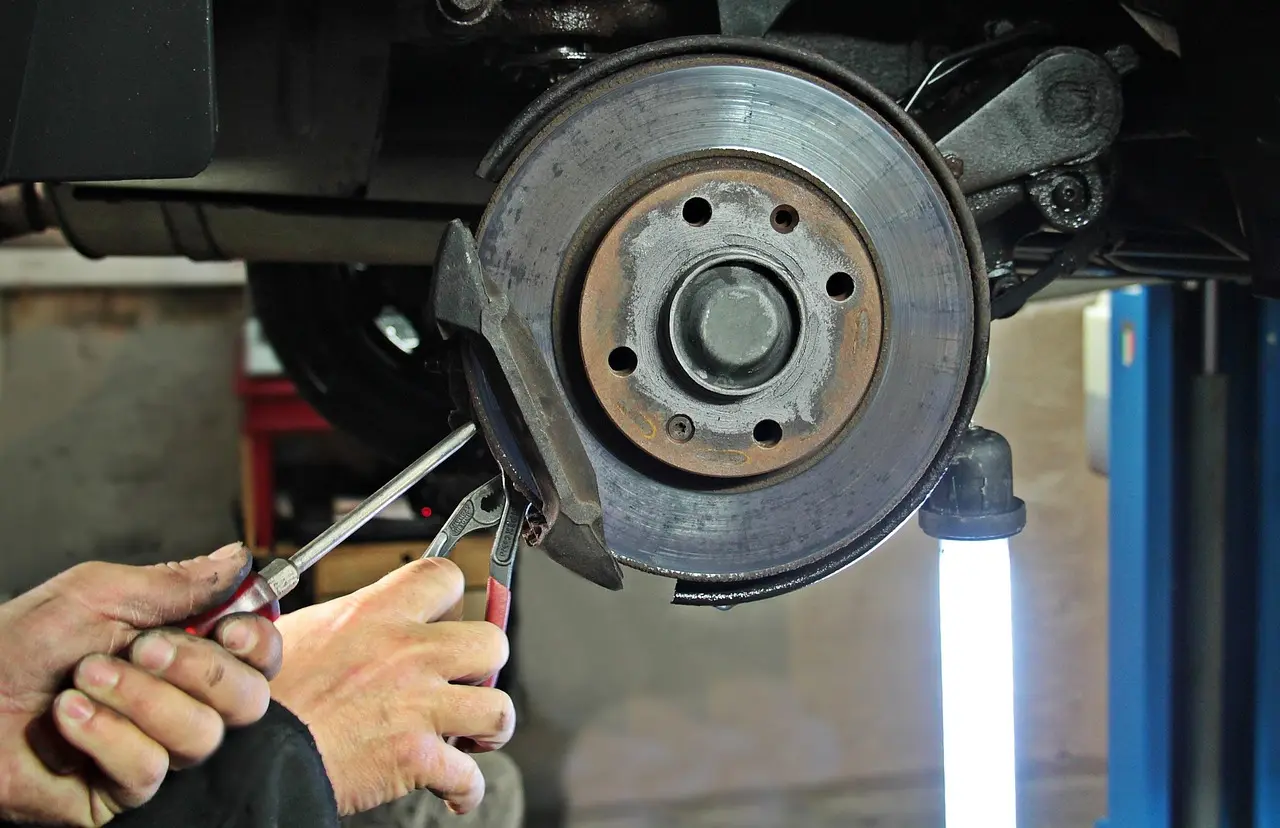
There is no single fair price for every car, because make, model, parts availability, and labour rates change the bill. A small repair may be cheap enough to approve quickly, while a complex job may be normal only if the quote shows specialist parts, diagnostic time, and extra labour for access or calibration. For repair-cost context across common jobs, compare the estimate with a local car repair benchmark rather than a single all-cars average.
Why there is no single average for every car
The same fault can cost very different amounts on a Ford, a BMW, or a Toyota because the parts catalogue, labour time, and availability are different. Luxury brands usually cost more because the parts are dearer and the labour often needs more specialist tooling or access steps. That premium is not just a markup; it often reflects model-specific programming, trim removal, and longer access times.
Broad cost bands by repair size and complexity
Brake fluid changes average £62.39, brake calipers average £305.02, pads and discs average £265.76, and replacing front and rear brake pads and discs averages £554.50 across all makes and models. These are UK market figures based on BookMyGarage’s national pricing data, which reflects quoted repair work across the country and will vary by region, vehicle age, and parts choice.
That same brake job can land at different points in the range depending on the car. BMW brake pad and disc replacement averages £738.86, while Toyota averages £451.99. Those figures show why a quote can be fair for one model and high for another. Source basis: UK make-specific averages compiled from BookMyGarage pricing data for 2024-2025, with higher-cost examples typically reflecting brand parts, access time, and specialist labour.
For automatic transmissions in the US, a fluid change or flush can cost $150-$300, a rebuild can cost $2,000-$4,000, and a remanufactured replacement can cost $3,000-$5,500. These are broad US national estimates used by major repair-cost guides in 2024-2025; local shop pricing can move higher in metro areas and for import or luxury vehicles. Luxury vehicles may add 30-50% to transmission repair estimates, so a specialist quote can be normal if the car needs unique parts or programming. The premium is a general US estimate and should be read as a market adjustment, not a fixed surcharge.
When a quote is low, normal, or high
A low quote may be only a diagnostic fee, or it may leave out parts, fluid, tax, or labour for related work. A normal quote should match the fault, the car, and the local rate. A high quote is more worrying when it is vague, uses vague part names, or includes duplicate labour for the same task.
Say your hatchback needs rear pads and discs, and one shop quotes the brake job at the low end while another quotes near the average for your make. The higher number may still be fair if it includes a proper scan, new fluid, and tax. The lower one may be incomplete if it leaves those out.
How much car repair table
| Repair type | Usual cost drivers | Diagnostic fee red flags | Quote components to verify | Decision rule |
|---|---|---|---|---|
| Brake repair | Pads, discs, calipers, fluid, rust, sensor wear, labour access time | Charge for a scan when the fault is already obvious; no note of road test or inspection | Parts grade, labour hours, labour rate, brake fluid, tax, any caliper or sensor charge | Approve if the quote matches the fault and lists everything; ask more questions if it is only one lump sum |
| Transmission repair | Fluid condition, fault codes, valve body, rebuild parts, software coding, gearbox access | Bill for a “diagnosis” without codes, road test, or fluid check; diagnosis price rolled into repair without separation | Scan findings, fluid service, labour hours, remanufactured or rebuild option, warranty terms, tax | Ask more questions if the job jumps straight to replacement; decline if no fault confirmation is shown |
| Minor repair | Small parts, fast access, simple fitting, local rate, tax | High diagnostic fee for a simple fault; repeated inspection charges for the same issue | Fault description, one diagnostic charge, labour time, parts source, exclusions | Approve if the total is itemised and the fault is clear; decline if the bill is padded with duplicate checks |
| Rebuild | Strip-down labour, internal parts, cleaning, machining, reassembly, programming | Quote says rebuild but omits strip-down or test charges; no written scope for reused parts | What is rebuilt, what is replaced, warranty length, labour hours, tax, fluids | Ask more questions unless the scope is written in full and the warranty is clear |
| Replacement | Unit cost, fitting labour, fluids, coding, availability, delivery delays | Quote does not say whether the unit is new, used, or remanufactured; no warranty detail | Unit type, labour, coding, tax, warranty, return policy on the old unit | Approve only if the replacement cost is justified and the car’s value supports it |
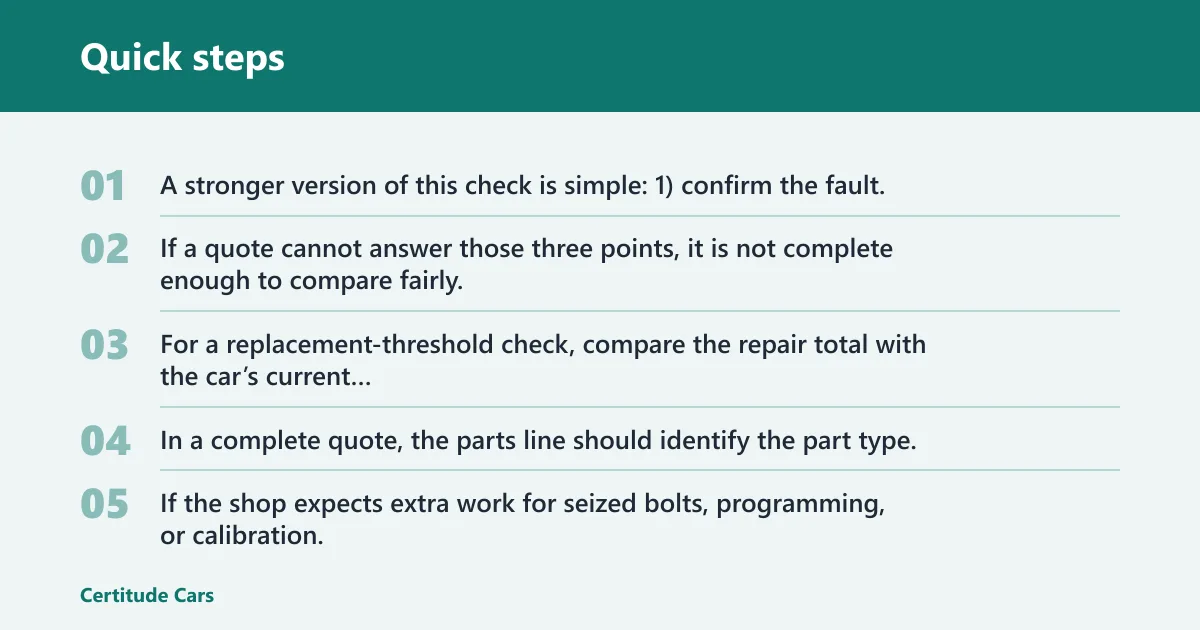
A stronger version of this check is simple: 1) confirm the fault, 2) confirm the line items, 3) confirm the car’s value can justify the fix. If a quote cannot answer those three points, it is not complete enough to compare fairly. For a replacement-threshold check, compare the repair total with the car’s current market value and the cost of a comparable replacement vehicle before you decide.
What a complete quote should show before you pay
In a complete quote, the parts line should identify the part type, the labour line should show hours and hourly rate, and the tax line should be visible. If the shop expects extra work for seized bolts, programming, or calibration, that should be stated in advance or capped in writing. A quote that only gives one grand total is harder to judge and easier to dispute.
Why does your car make and model change the bill?
Make and model matter because parts pricing, labour time, and availability are not the same across brands. A quote for a BMW may be higher than one for a Toyota even when the fault sounds similar. The difference often comes from part cost, specialist access, and whether the shop can source the right unit quickly.
Brand-specific labour and parts differences
Some models need more labour to reach the same component. Others use parts that cost more because the manufacturer has fewer suppliers or more exact specifications. That is why two cars with the same symptom can produce very different estimates.
Luxury brand premium and specialist tooling
Luxury-brand work often needs higher labour rates because the shop may need brand-specific diagnostic tools, programming access, or extra time for trim removal and calibration. That premium is not automatically a rip-off. It becomes suspicious only when the bill is vague or the extra charge is not explained.
Manufacturer parts availability and back-order delays
If a part is on back order, the shop may quote a higher price for a faster source or a remanufactured unit. That can be sensible when the car is off the road and the owner needs it back soon. The quote should say whether the delay or premium comes from availability, not from guesswork.
Picture a diesel saloon that needs a transmission fault diagnosis. One shop quotes a straightforward fluid service, while another recommends a replacement unit. The second quote may be justified only if the scan shows internal damage, the fluid is contaminated, or the car’s gearbox has known failure signs.
What drives labour rates and diagnostic fees?
Labour rates rise and fall with location, the type of shop, and the complexity of the job. City labour rates are higher than rural rates in the brake guide, and rural labour rates are lower. Specialist shops also tend to charge more because they carry expensive tools, training, and brand-specific software. In UK pricing data, this regional spread is one of the main reasons quoted repairs differ from one postcode to another; in the US, metro labour and dealer labour are often above independent rural-shop pricing.
City versus rural labour rates
A city workshop usually has higher overheads, so its hourly rate can be higher than a rural garage. That does not make the quote unfair on its own. It means you should compare like with like: same repair, same parts quality, same tax, same warranty.
Specialist shop premium
A specialist premium can be sensible for difficult jobs, especially on luxury cars or complex transmissions. The shop may need model-specific diagnostics, calibration time, or a more expensive remanufactured unit. The premium should still be visible on the quote, not hidden inside one large total.
What a diagnostic scan should check
A good diagnostic process may include fault codes, a road test, a fluid check, and a physical inspection before the shop prices the repair. It may also include a follow-up scan after the test drive. Scope varies by fault, so a proper quote should explain what was checked and why.
When is repair cheaper than replacement?
Repair makes more sense when the quoted bill is small relative to the car’s value and the fault is limited to one part of the system. Replacement becomes harder to justify when the vehicle is old, high mileage, or already near the point where another major repair is likely soon.
Value of the car versus repair cost
Compare the estimate with the car’s likely resale value, not the price you paid years ago. If the bill is large compared with what the car is worth now, ask whether a rebuild, used part, or remanufactured unit would make more sense. The quote should explain those options clearly.
Age and mileage as decision factors
A high-mileage car often needs more than one worn component, so a large repair can be less attractive than a lower-cost fix or a replacement vehicle. Age matters too, because older cars may have extra wear on hoses, mounts, sensors, and seals that do not show up in the first quote.
When a rebuild or replacement makes more sense
For a transmission, a rebuild may be a better middle ground than a full replacement if the casing is sound and only internal wear is the issue. A replacement makes more sense when the unit is badly damaged, the old unit is unreliable, or the remanufactured option comes with better warranty protection.
What warranty coverage should you check?
Warranty terms matter because a cheap quote with no cover can cost more later. Check whether the repair has parts-and-labour warranty, whether a remanufactured unit has its own warranty, and what limits apply. The shortest quote is not always the best value if the coverage is thin.
Parts-and-labour warranty
Ask how long the shop covers both the part and the fitting work. Some repairs cover only the defective part, while others cover the labour again if the same fault returns. The quote should state whether the warranty is on the whole job or only on the item installed.
Remanufactured unit warranty
A remanufactured transmission or similar unit often comes with warranty-like cover, but the length and terms vary. Check whether it applies to the part only or to the part plus labour. Also check whether the warranty depends on oil changes, installation by an approved shop, or proof that the old fault was not caused by abuse.
Common exclusions and limits
Common limits include race use, overheating, missed maintenance, towing abuse, and damage caused by unrelated faults. Some warranties also exclude seals, gaskets, fluids, and incidental labour. If the quote does not spell this out, ask for the exclusions before you agree to the repair.
Frequently asked questions
How much should my car repair cost?
There is no single answer, because the cost depends on the make, model, fault, and local labour rate. A brake repair can sit between £100 and £600, while a transmission repair can run from a few hundred dollars for service work to several thousand for a rebuild or replacement. Those figures are not universal; they are region-specific and should be matched to the same market, vehicle type, and date.
How much does a car repair cost?
A car repair can cost very little for a minor fault or a great deal for a major one. The quote should show parts, labour, diagnosis, and tax separately so you can see where the money goes. If it does not, you cannot tell whether the price is fair.
How much to repair a car
Start by checking whether the estimate is for diagnosis only or for the full repair. Then compare the total with local quotes and with the vehicle’s value. If the repair is close to the car’s worth, ask for a rebuild, remanufactured unit, or other lower-cost option.
How much is the average car repair?
There is no useful single average for every car repair, because the job type matters too much. A brake repair average of £155.36 gives context for brake work only, and transmission figures are much higher for major jobs. Use the average for the same repair type, not a general car average.
How much do car repairs cost?
Car repairs can range from simple fluid work to major component replacement. The most useful check is whether the quote lists the confirmed fault, the parts to be fitted, the labour hours, and the warranty. If a quote is missing those details, the total is not ready for approval.
How much for my expensive car repair
Luxury cars usually cost more to fix because parts are pricier and labour can need specialist tools or software. That does not mean every high quote is fair. It means you should compare the estimate against model-specific pricing, ask whether the part is genuine or remanufactured, and check the warranty terms.