What Is a Car Insurance Deductible and How Does It Work?
A car insurance deductible is the amount you pay on a covered claim before your insurer pays the rest. If repairs cost less than your deductible, or only a little more, filing may not save you money. Choose it badly, and a small repair can turn into a claim that barely pays after your out-of-pocket cost. This guide explains when deductibles apply, when they do not, and how to decide whether to file a claim.
How deductibles affect claim payments

A deductible is the part of a covered loss you pay first. The insurer then pays the remaining covered amount. It is usually a per-claim amount, not an annual fee, and it is separate from your premium, which is the amount you pay to keep the policy active.
That difference matters. A premium is an ongoing policy cost. A deductible is a claim cost. Raise the deductible, and your premium often falls. Lower the deductible, and your premium often rises.
How a deductible works on a claim
The claim order is simple: repair estimate first, deductible second, insurer payment last. The shop does the work, the claim is settled, and the deductible is the amount you absorb before coverage pays the remainder.
- Get a repair estimate or loss estimate.
- Confirm which coverage applies to the loss.
- Subtract the deductible from the covered amount.
- The insurer pays the remainder, up to policy limits.
- You pay the deductible to the shop or as part of settlement, depending on how the claim is handled.
For example, if the repair bill is $1,200 and the deductible is $500, about $700 would be covered under that payout. The covered payout is $700. You pay the first $500, and the insurer pays the remaining $700 if the damage is covered under that part of the policy.
For example, if the repair bill is $450 and the deductible is $500, There is no insurer payment under that coverage because the loss does not exceed the deductible. In that case, filing the claim often does little except add paperwork and possibly a claim record.
Where deductibles apply
Deductibles typically apply to collision, comprehensive, uninsured motorist, and personal injury protection coverages. Liability coverage usually does not have a deductible. The exact rules depend on your policy form and, in some cases, your state.
Collision coverage pays for damage from a crash. It commonly has a deductible and is the coverage you use for damage to your own car after a collision, including when you are at fault.
Comprehensive coverage pays for non-collision losses such as theft, vandalism, weather, and falling objects. It commonly has a deductible too.
Uninsured and underinsured motorist coverage may include a deductible, depending on the state and policy language. It can cover injuries, and in some cases car damage, when the other driver has little or no insurance.
Personal injury protection may also have a deductible in some states. It usually pays medical expenses and lost wages within the policy terms.
Do deductibles apply to liability claims?
Liability coverage typically does not have a deductible. If you cause damage to someone else’s vehicle or property, liability coverage is generally the part that pays, subject to your policy limits. Your out-of-pocket exposure there is usually the premium, not a deductible.
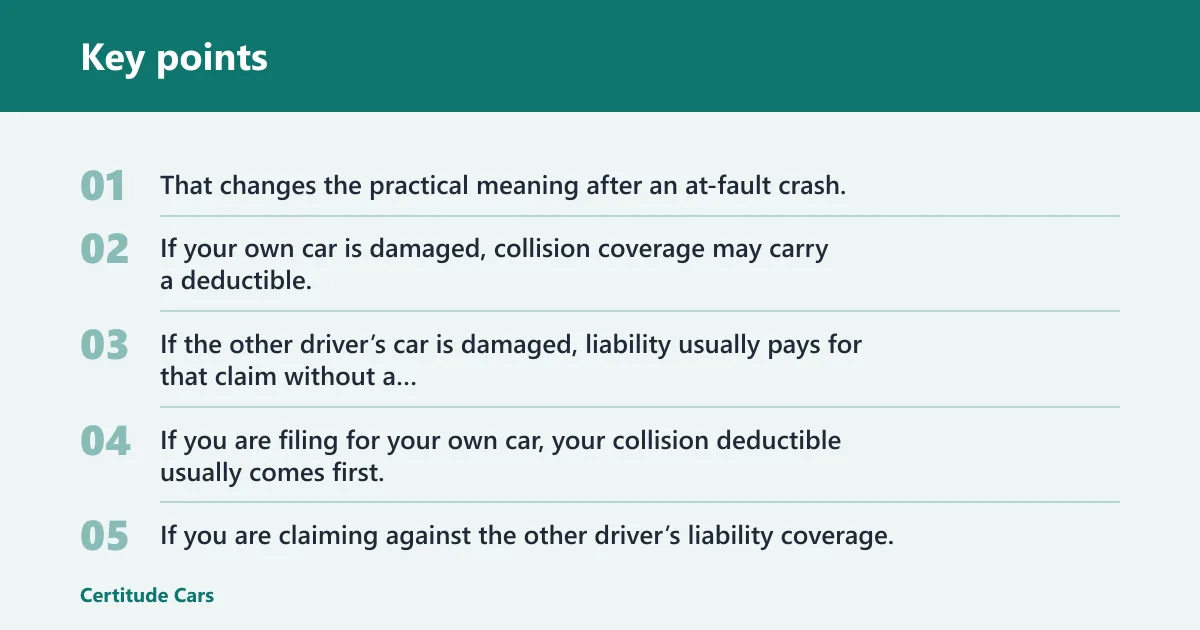
That changes the practical meaning after an at-fault crash. If your own car is damaged, collision coverage may carry a deductible. If the other driver’s car is damaged, liability usually pays for that claim without a deductible. The two claims can run side by side.
Who pays first after a crash
If you are filing for your own car, your collision deductible usually comes first. If you are claiming against the other driver’s liability coverage, that insurer generally pays the covered loss without a deductible. If fault is disputed, the claim path can take longer.
A common mistake is assuming that if a parked car gets sideswiped in a grocery store lot, the insurer will waive the deductible just because the other vehicle left the scene. That is not always true. You may still need to use your own coverage first, then seek reimbursement later through subrogation or a reimbursement process if the facts and the insurer’s handling support it.
When a claim is not worth it
If the repair estimate is below your deductible, a claim usually does not pay anything for that coverage. If the estimate is only slightly above it, the insurer’s share may be so small that filing is not worth the possible premium effect, claim record, or time spent on the process.
Small repair tradeoffs
Use the deductible as a break point. A $600 repair with a $500 deductible leaves only $100 for the insurer to pay. That small payment may not justify a claim if you can handle the repair yourself.
Picture a $900 bumper repair with a $1,000 deductible. The insurer pays nothing under that coverage. Filing the claim would usually be a bad fit unless another part of the policy applies or the claim is needed for a separate reason.
A practical rule: if the estimate is below the deductible, or within a narrow margin above it, compare the possible payout against the chance of a premium increase and the effort of the claim. If the insurer would pay very little, paying out of pocket can be the cleaner choice.
Common deductible amounts

Common deductible choices often include about $250, $500, $1,000, and $2,000. Typical car insurance deductibles can range from $100 to $2,000, and some policies go above that. The most common choice is $500, which sits near the middle of many shopping decisions.
A larger deductible usually lowers the premium. A smaller deductible usually raises the premium. The tradeoff is simple: pay more up front each month, or pay more later if you file a claim.
| Deductible | Premium effect | Best fit |
|---|---|---|
| $250 | Usually higher premium | Drivers who want lower out-of-pocket cost on a claim |
| $500 | Often the middle-ground choice | Drivers who want balance between premium and claim cost |
| $1,000 | Usually lower premium than $500 | Drivers with cash available for a larger repair bill |
| $2,000 | Usually the lowest premium of these choices | Drivers who can absorb a large loss without strain |
Raising a deductible from $250 to $500 can save about 7 percent on premiums. Raising it from $500 to $1,000 can save about 9 percent. Raising it from $500 to $2,000 had a national average premium saving of 15 percent. Those are real tradeoffs, but they only help if you can actually pay the higher deductible when a claim happens.
Deductible decision table
This table maps common loss types to the usual deductible treatment, who pays first, and whether filing is likely to make sense at three common deductible levels.
| Claim scenario | Coverage type | Deductible applies? | Who pays first | Example payout math | $250 deductible | $500 deductible | $1,000 deductible |
|---|---|---|---|---|---|---|---|
| Rear-end crash damage to your car, $1,800 repair bill | Collision | Yes | You pay deductible first | $1,800 minus $500 = insurer pays $1,300 | Likely worth it | Likely worth it | Likely worth it |
| Hail damage, $700 repair bill | Comprehensive | Yes | You pay deductible first | $700 minus $500 = insurer pays $200 | Possibly worth it | Maybe not worth it | Not worth it |
| Stolen side mirror, $400 repair bill | Comprehensive | Yes | You pay deductible first | $400 minus $250 = insurer pays $150 | Maybe not worth it | Not worth it | Not worth it |
| Windshield crack, $320 glass claim | Comprehensive or glass coverage | Sometimes waived or reduced | Depends on policy form | $320 with $0 glass deductible = insurer pays $320 | Often worth it | Often worth it if waived | Often worth it if waived |
| Other driver damages your bumper, their insurer accepts fault | Liability from the other driver | Usually no | The other insurer pays | $1,500 repair bill = other insurer may pay $1,500 | Likely worth pursuing | Likely worth pursuing | Likely worth pursuing |
| Your car damage after an uninsured driver hits you | Uninsured motorist property damage, where offered | May be yes | You may pay deductible first | $2,400 minus $500 = insurer pays $1,900 | Likely worth it | Likely worth it | Possibly worth it |
| Medical bills and lost wages after a crash, where PIP applies | Personal injury protection | May be yes | Deductible may come first | $3,000 covered loss minus $1,000 = insurer pays $2,000 | Likely worth it | Likely worth it | Likely worth it |
Some policies offer a $0 deductible for glass replacement. That can make a windshield claim much easier to file, especially when the crack threatens visibility or spreads fast. Other policies still apply the comprehensive deductible, so you need to check the policy language before you assume glass is free.
How do I choose between a $500 and $1,000 deductible?
Choose the $1,000 deductible only if you can comfortably pay it on short notice. Choose the $500 deductible if a sudden repair bill would strain your budget. The decision is less about the lowest premium and more about which out-of-pocket bill you can absorb without stress.
The gap between $500 and $1,000 can lower premiums, but it also doubles the amount you owe on a covered claim. If you can set aside the difference and still keep an emergency cushion, the higher deductible can make sense. If not, the lower one is usually the safer fit.
A simple decision rule
Start with the amount you could pay today without borrowing. If $1,000 would create a shortfall, the $500 option is the better practical choice. If both are manageable, compare the annual premium difference against the chance of filing a claim and the size of the likely repair bill.
For many drivers, the better question is not which deductible is cheapest on paper. It is which deductible turns a bad day into a manageable bill rather than a financial scramble.
Frequently asked questions
What is a car insurance deductible?
A car insurance deductible is the amount you pay on a covered claim before your insurer pays the rest. It is usually applied per claim, not once per year. Collision, comprehensive, uninsured motorist, and PIP policies may include one, while liability usually does not.
How does a car insurance deductible work when I file a claim?
The claim starts with the repair estimate or loss amount. Your deductible is subtracted first, and the insurer pays the remaining covered balance. If the damage is less than the deductible, the insurer usually pays nothing under that coverage.
Do I pay a deductible on collision and comprehensive claims?
Usually yes. Collision and comprehensive are the most common coverages with deductibles. Collision generally applies to crash damage to your car, and comprehensive usually applies to theft, vandalism, weather, and falling objects. The deductible amount is set by your policy.
How much is a typical car insurance deductible?
The most common choice is $500. The right choice depends on how much cash you can cover if a claim happens.
Does a higher deductible lower my car insurance premium?
Usually yes. A higher deductible often lowers the premium because you are taking on more of the loss yourself.
Do I pay a deductible if the other driver was at fault?
Not always, but sometimes yes. If the other driver’s liability insurer accepts responsibility, that claim often pays without a deductible. If you file through your own coverage first, such as collision, you may still owe your deductible and seek reimbursement later if the other party is found liable.
Does a windshield replacement have a deductible?
Sometimes no, sometimes yes. Some policies offer a $0 deductible for glass replacement, while others apply the comprehensive deductible. Check the glass language in your policy, because windshield claims are handled differently from ordinary collision damage in many policies.