How to Find Your Wheel Size on the Rim or Door Sticker
Read the tire sidewall or wheel stamp for width, aspect ratio, and rim diameter. The door sticker gives the factory size, and the last number must match the wheel diameter. If you choose the wrong size, the fit can be off, the speedometer can read wrong, or the tire may not mount at all. This guide shows how to find your wheel size on the rim or door sticker, then compare it with the tire sidewall and sort out mismatches.
Wheel size basics
Wheel diameter and wheel width are the core measurements. Diameter is measured in inches and is the bead-seat diameter the tire must match. Width is also measured in inches and appears in wheel listings as something like 6.5, 7.5, 9, or 9.5. The bolt pattern and offset are separate fitment details.
Diameter vs width
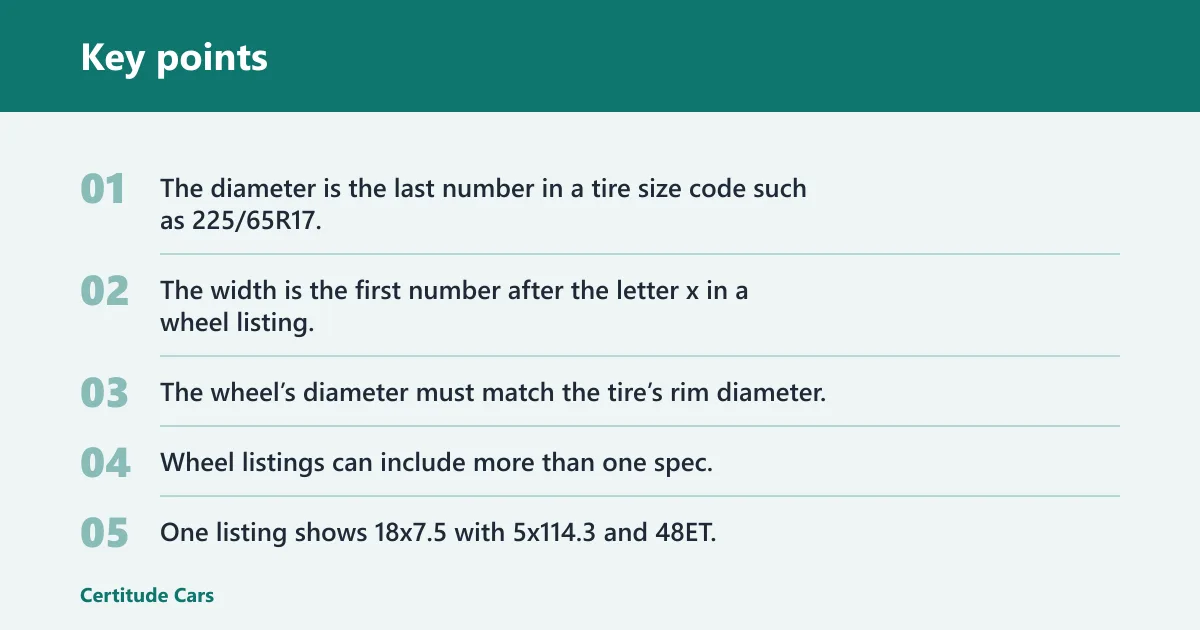
The diameter is the last number in a tire size code such as 225/65R17. That 17 means the tire fits a 17-inch wheel. The width is the first number after the letter x in a wheel listing, such as 16 x 6.5-inch or 18×7.5. The wheel’s diameter must match the tire’s rim diameter.
Wheel listings can include more than one spec. One listing shows 18×7.5 with 5×114.3 and 48ET. Another shows 22×9 with 6×5.5 /6 x 139.7. A different listing shows 17×9 with 4.53 bs, and a Shelby wheel listing shows 19 x 9.5 in. with 34mm offset. Those numbers are not interchangeable.
What the tire code means
A tire code often includes section width in millimeters, aspect ratio as a percent, construction letter R, and rim diameter in inches. The section width is the tire’s nominal width. The aspect ratio is the sidewall height as a percentage of that width. The rim diameter is the wheel size it fits.
Examples from product listings make the format easier to spot. Goodyear Reliant All-Season uses size 225/65R17 102H. Douglas Touring A/S is listed as 235/60R18 103V. Goodyear Assurance RangeMax Winter is listed as 205/65R16 95H. Each code ends with a wheel diameter in inches.
Why wheel size and tire size are related but not identical
The wheel and tire must agree on bead-seat diameter, but the tire code does not tell you wheel width, bolt pattern, or offset. A tire can fit the diameter and still be a poor match for the wheel width or the vehicle’s clearance. That is why a single number from a sidewall is not enough for rim shopping.
Door sticker and sidewall
The door jamb tire-and-loading placard is the factory reference for recommended tire size and pressures. The tire sidewall shows the size that is currently mounted. Use the placard to start with the stock baseline, then use the sidewall to confirm the current tire diameter before you buy anything.
Find the tire-and-loading placard
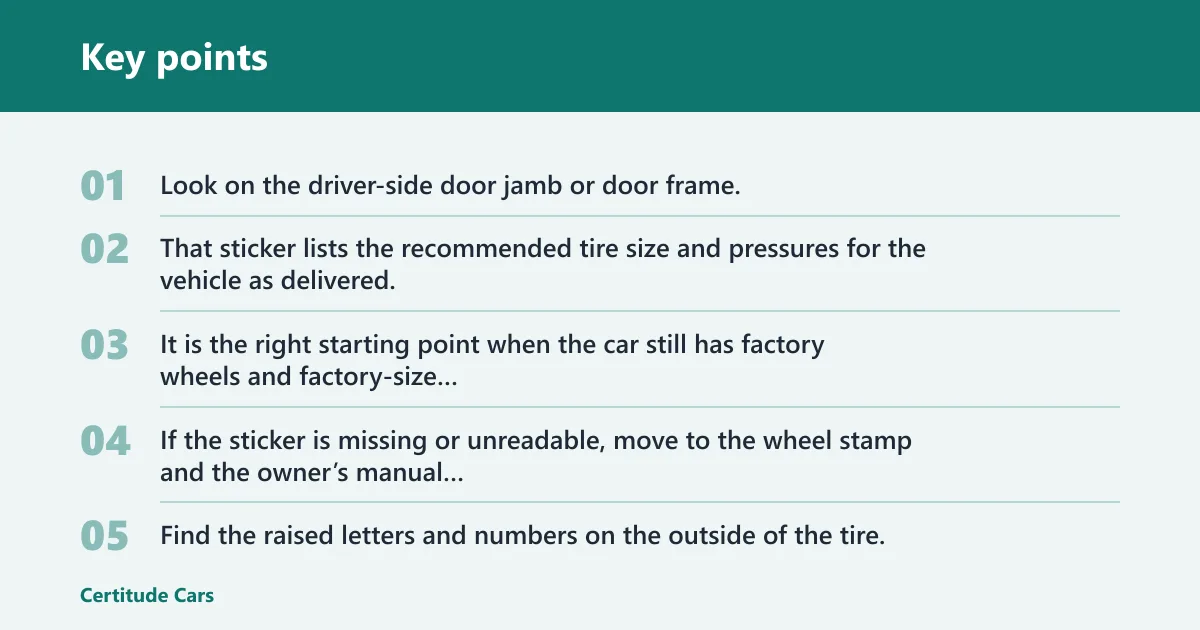
Look on the driver-side door jamb or door frame. That sticker lists the recommended tire size and pressures for the vehicle as delivered. It is the right starting point when the car still has factory wheels and factory-size tires. If the sticker is missing or unreadable, move to the wheel stamp and the owner’s manual or OEM spec.
Read the tire sidewall code
Find the raised letters and numbers on the outside of the tire. The sidewall code usually gives the tire size in a format such as 225/65R17. That last number tells you the rim diameter in inches. If the tire is mounted correctly, that number must match the wheel it sits on.
Say your door placard lists 205/65R16, and the tire sidewall also reads 205/65R16. That confirms the mounted tire diameter matches the wheel. If the current wheel was swapped for a different size, the placard may still show the original factory spec, so the sidewall and wheel stamp become more important for the current setup.
What each source can and cannot tell you
The placard tells you the factory recommendation. The tire sidewall tells you the size of the mounted tire. The wheel stamp can tell you the wheel’s actual diameter and width, and sometimes offset or bolt pattern. None of those sources alone always gives the whole fitment picture.
How to read wheel stamps
Wheel stamping or backside marking can show diameter, width, offset, and bolt pattern, though markings vary by wheel. They are often on the inside barrel, the back side of a spoke, or another hidden surface. Clean the area first so you can read the stamp without guessing.
Where the markings usually
Check the inner barrel, the back of the spokes, and the hub-facing side of the wheel. Dirt, brake dust, and corrosion can hide the stamp. Wipe the surface clean, then look for cast or stamped numbers. OEM wheels do not always put every spec in one easy line, so you may need to inspect more than one spot.
How to clean the wheel to find them
- Park safely and let the wheel cool if it was recently driven.
- Wipe loose dirt from the inside barrel and spoke backs.
- Use a soft brush or cloth on the stamped area.
- Look again for diameter, width, offset, and bolt pattern markings.
- Write down every number before you compare it to the placard or tire code.
Common formats and what they mean
| Marking | What it tells you | How to read it |
|---|---|---|
| 16 x 6.5 | Wheel diameter and width | 16-inch bead-seat diameter, 6.5-inch width |
| 17×9 | Wheel diameter and width | 17-inch diameter, 9-inch width |
| 5×114.3 | Bolt pattern | 5 lugs on a 114.3 mm bolt circle |
| 48ET | Offset | 48 mm offset; ET is common on some wheel markings |
| 34mm | Offset | Offset given in millimeters |
| 4.53 bs | Backspacing | 4.53 inches of backspacing |
Which source should you trust?
Trust depends on whether the vehicle still has stock wheels or has been modified. For stock wheels, the door placard is the factory baseline and the wheel stamp confirms the current rim. For aftermarket wheels or mixed parts, the stamp and tire sidewall describe the current setup more accurately than the door sticker alone.
Stock wheels
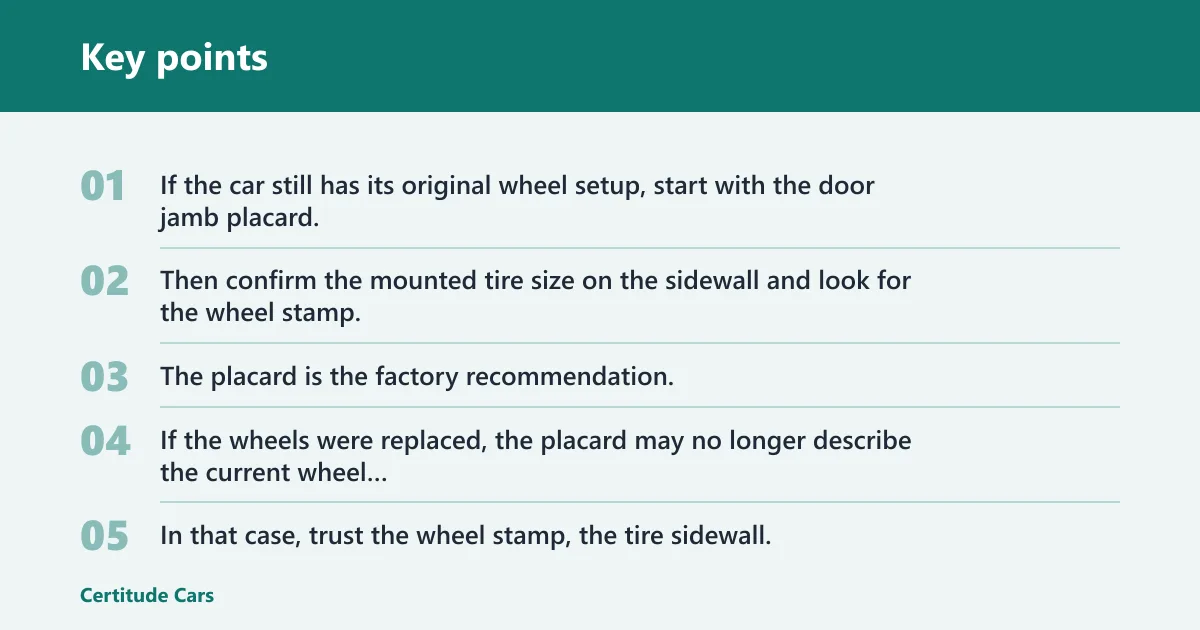
If the car still has its original wheel setup, start with the door jamb placard. Then confirm the mounted tire size on the sidewall and look for the wheel stamp. The placard is the factory recommendation, while the stamp tells you what is actually on the car. If they agree, that is the cleanest path.
Aftermarket wheels
If the wheels were replaced, the placard may no longer describe the current wheel diameter or width. In that case, trust the wheel stamp, the tire sidewall, and the actual fitment on the vehicle. Offset and bolt pattern matter more here, because they affect whether the wheel clears the brakes and suspension.
Picture a car with a door sticker for 17-inch factory wheels but a current wheel stamp showing 18×7.5 with 5×114.3 and 48ET. The placard still helps as a factory reference, but the wheel stamp is what tells you the current rim size and fitment. That is the spec to use when ordering a replacement wheel for the setup now on the car.
Missing or unreadable placard
If the door sticker is gone or damaged, rely on the wheel stamp and the tire sidewall, then check the owner’s manual or OEM spec before you buy replacements. The manual can confirm what the vehicle left the factory with, especially if a trim change altered wheel size between versions.
Mixed or replaced wheels
Mixed sets and prior replacements can create a mismatch between the sticker and the hardware on the car. If the sidewall, stamp, and placard do not all agree, do not assume the sticker is wrong or the wheel is wrong without checking the vehicle’s trim and history. Use the current wheel stamp for wheel fitment and the placard for factory baseline.
Wheel size worksheet
Use this worksheet to collect the numbers before you shop. Fill in the door sticker, the tire sidewall, and the wheel backside marking. Then decide which source fits the vehicle’s current setup and which one is only a factory reference.
| Source | Diameter | Width | Bolt pattern | Offset | Tire code |
|---|---|---|---|---|---|
| Door-sticker reading | _____ in | _____ in | _____ | _____ mm / _____ ET | _____ |
| Tire-sidewall reading | _____ in | _____ in | _____ | _____ mm / _____ ET | _____ |
| Wheel-backside reading | _____ in | _____ in | _____ | _____ mm / _____ ET / _____ bs | _____ |
Decision rule for the final spec
If the car still has stock wheels and stock-size tires, use the door placard as the factory baseline and confirm the current wheel stamp. If the wheels are aftermarket or the placard does not match the hardware on the car, trust the wheel stamp and mounted tire size for the current setup. If anything conflicts, check the owner’s manual or OEM spec before ordering.
What if the sizes do not match?
Trim changes and prior replacements are the most common reasons the sticker, tire, and wheel stamp disagree. A higher trim may have left the factory with a different wheel diameter than the base model. A previous owner may also have changed the wheels without updating the placard, so the current setup can differ from the original factory spec.
Trim changes and prior replacements
Suppose the door sticker lists 16-inch factory tires, but the vehicle now wears 18-inch wheels with 18×7.5 stamped on the back. That does not mean the tire sidewall is wrong. It means the current setup no longer matches the original sticker, and you should shop by the wheel and tire that are actually on the car.
When to check the owner’s manual or OEM spec
Check the owner’s manual or OEM spec when the placard is missing, unreadable, or clearly tied to a different trim. That step helps you confirm whether the current wheel swap was an approved factory option or a later change. It also helps when you need a replacement wheel and the stamp is incomplete.
Frequently asked questions
What size is my wheel?
Your wheel size is the diameter and width in inches, plus the fitment details if you need a replacement. Start with the tire code for the diameter, then read the wheel stamp for width and any offset or bolt pattern. If the wheel is aftermarket, the manufacturer’s listing may be the clearest source.