Insurance Deductible Explained for Car Insurance
A car insurance deductible is the amount you pay on each covered claim before your insurer pays the rest. Many drivers pick about $500 or $1,000, because the right deductible is one you could cover today without going into debt. Set it too high and one claim can squeeze your budget. Set it too low and you may spend more in premiums year after year. This guide explains when deductibles apply, when they do not, how collision and comprehensive deductibles differ, and how to choose an amount that fits your budget.
What does an insurance deductible mean on car insurance?

A car insurance deductible is the amount you pay on a covered claim before the insurer pays the remaining covered loss. It usually applies per claim, not per year, and it is separate from your premium. That makes it a cash-flow decision as much as a pricing decision.
Per claim, not per year
Deductibles for car insurance require you to pay the deductible amount each time you file a claim. Auto insurance policies do not make you meet an annual deductible. If you have two separate covered claims in one policy term, the deductible can apply twice.
That catches many drivers off guard. A $1,000 deductible is not a once-a-year hurdle. It is a per-loss amount tied to each covered claim.
Why the deductible is separate from the premium
Your premium pays for the insurance contract. Your deductible is the slice of a covered loss you keep. If you raise the deductible, your car insurance rate usually drops because you are taking on more of each covered claim yourself. If you lower the deductible, the rate usually rises.
Common deductible choices include $250, $500, $1,000, and $2,000. Car insurance deductibles typically range from $100 to $2000. The most common deductible Progressive drivers choose is $500.
Insurance deductible explained for car insurance, in practical terms, means this: choose the largest deductible you could pay tomorrow if the car needed repairs before your next paycheck.
Which car insurance coverages have a deductible?
Collision and comprehensive usually carry deductibles, while liability generally does not. Glass may use the comprehensive deductible, or it may follow its own rule, such as a $0 deductible if your policy or state allows it. Deductible terms can vary by coverage type, insurer form, and state.
Collision coverage
Collision coverage typically has a deductible. It applies when your car is damaged in a crash, such as hitting another vehicle, backing into a pole, or sliding into a guardrail. Drivers often use collision when they are at fault or partly at fault, or when fault is still being sorted out.
Comprehensive coverage
Comprehensive coverage also typically has a deductible. It applies to non-collision damage such as theft, hail, falling objects, vandalism, fire, weather damage, and animal strikes like hitting a deer.
Because collision and comprehensive cover different causes of loss, many policies let you choose different deductible amounts for each.
Liability coverage
Liability coverage generally does not have a deductible and pays for injury or property damage you cause to other people. Ratehub says there are no deductibles for liability in car insurance. That is why an at-fault driver usually does not pay a collision-style deductible for the damage they caused to someone else’s car.
Glass coverage and endorsements
Windshield replacement is one area where policy details matter. Some policies treat glass as part of comprehensive, using the comprehensive deductible. Others offer separate glass coverage by endorsement, and some allow a $0 glass deductible depending on the state and insurer.
If glass has a separate endorsement, the decision can change fast. A driver who would never file a $600 comprehensive claim under a $1,000 deductible may still file a windshield claim if the glass endorsement has a $0 deductible.
How does a deductible work on a claim?
The math is simple: covered loss minus deductible equals insurer payment, as long as the loss is above the deductible. If the repair bill is below the deductible, the insurer pays nothing. In practice, the deductible is often withheld from the claim payment or collected by the repair shop.
The basic payout formula
With a $500 deductible and $3,000 in damage, the insurer pays $2,500 and you pay $500. With a $300 deductible and $1,200 in damage, the insurer pays $900 and you pay $300. The rule stays the same every time: your deductible comes off the covered amount first.
When the loss is below the deductible
If the repair cost is less than your deductible, filing may produce no payment at all. Say your bumper repair estimate is about $450 and your collision deductible is about $500. That is still a covered type of damage, but the insurer payment is $0 because the loss does not exceed the deductible.
This is where many small claims stop making financial sense. Even when a claim is covered, the deductible can make it pointless to file.
When the loss is above the deductible
Once the repair cost clears the deductible, the insurer pays the rest of the covered amount. Suppose hail damage totals about $2,400 and your comprehensive deductible is about $1,000. Your share is $1,000, and the insurer share is $1,400.
That does not mean filing is always the right move. A small insurer payment on a modest claim can still be poor value if it may affect future rates or claims history.
How payment is handled in practice
Claims are usually settled one of two ways. The insurer may issue payment minus your deductible, leaving you to pay the repair shop your share. Or the insurer may pay the shop directly for the covered amount, with the shop collecting the deductible from you before releasing the car.
Picture a repair estimate of $1,800 with a $500 deductible. If the shop is paid directly, the insurer sends $1,300 and you pay $500 at pickup. If the claim is paid to you, the check is often reduced by the same $500.
When a deductible changes the cost of filing
A deductible is the part of a covered claim you pay before insurance contributes, so it directly affects whether a claim is worth submitting. The supporting article on car insurance deductibles explains how that out-of-pocket amount works, when it applies, and why a small repair may not justify filing if the deductible uses up most of the payout.
That matters because the same claim can produce very different results depending on your deductible amount. The article also helps you think through common deductible choices and when coverage types treat claims differently, so you can better judge repair costs against your risk of paying more upfront.
Deductible decision table
Repair-cost breakpoints
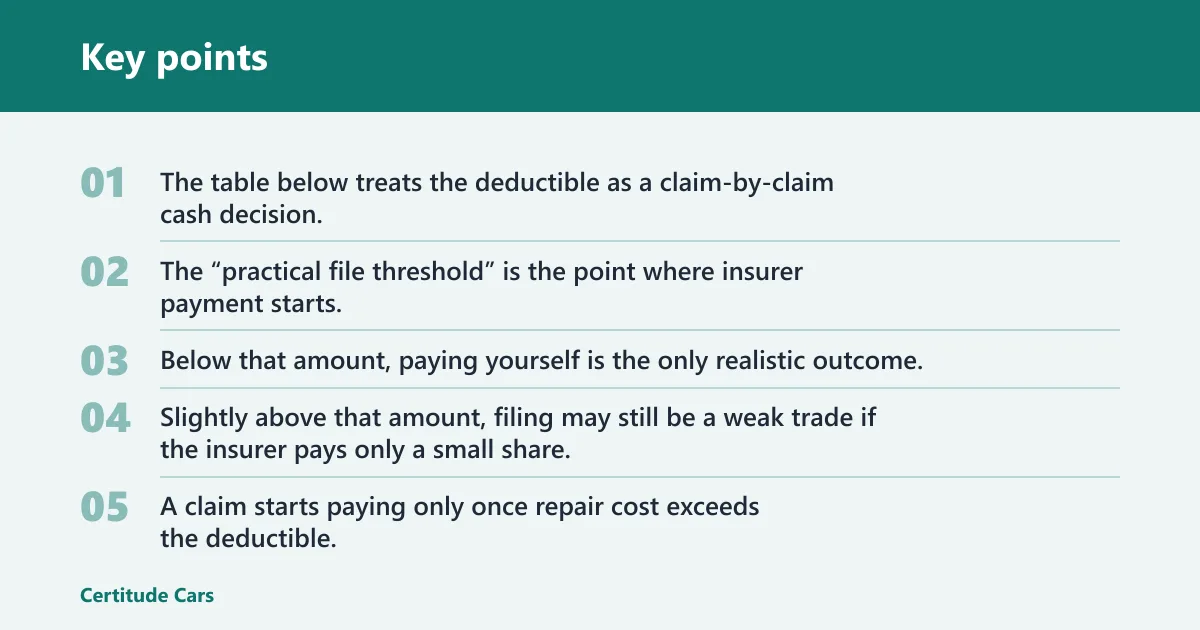
The table below treats the deductible as a claim-by-claim cash decision. The “practical file threshold” is the point where insurer payment starts. Below that amount, paying yourself is the only realistic outcome. Slightly above that amount, filing may still be a weak trade if the insurer pays only a small share.
| Repair cost | $250 deductible | $500 deductible | $1,000 deductible | $2,000 deductible |
|---|---|---|---|---|
| $200 | Insurer pays $0; driver pays $200; practical file threshold: pay yourself below $250 | Insurer pays $0; driver pays $200; practical file threshold: pay yourself below $500 | Insurer pays $0; driver pays $200; practical file threshold: pay yourself below $1,000 | Insurer pays $0; driver pays $200; practical file threshold: pay yourself below $2,000 |
| $600 | Insurer pays $350; driver pays $250; practical file threshold: claim can pay once loss exceeds $250 | Insurer pays $100; driver pays $500; practical file threshold: filing gives little value until repairs rise well above $500 | Insurer pays $0; driver pays $600; practical file threshold: pay yourself below $1,000 | Insurer pays $0; driver pays $600; practical file threshold: pay yourself below $2,000 |
| $1,200 | Insurer pays $950; driver pays $250; practical file threshold: clear claim value above $250 | Insurer pays $700; driver pays $500; practical file threshold: solid claim value above $500 | Insurer pays $200; driver pays $1,000; practical file threshold: filing gives limited value just above $1,000 | Insurer pays $0; driver pays $1,200; practical file threshold: pay yourself below $2,000 |
| $3,000 | Insurer pays $2,750; driver pays $250; practical file threshold: strong claim value | Insurer pays $2,500; driver pays $500; practical file threshold: strong claim value | Insurer pays $2,000; driver pays $1,000; practical file threshold: strong claim value if $1,000 is affordable | Insurer pays $1,000; driver pays $2,000; practical file threshold: only works if $2,000 is manageable now |
How to use the table
The key breakpoint is simple. A claim starts paying only once repair cost exceeds the deductible. But “worth filing” usually starts later, because a claim with a tiny payout may still leave most of the bill on your side.
A common first-timer mistake is comparing premiums without comparing repair-cost breakpoints. A $2,000 deductible can lower premium, but it also means a $1,800 deer-strike repair produces no insurer payment at all.
Do you pay a deductible if the accident was not your fault?
Sometimes yes, sometimes no. If the other driver’s insurer accepts liability and pays directly, your deductible may not apply. If you use your own collision coverage first to get repairs moving, your deductible usually applies up front, and reimbursement may come later if your insurer recovers from the at-fault party.
Using the other driver’s insurance
If fault is clear and the at-fault driver is insured, you may file a third-party claim against that driver’s liability coverage. In that route, there is generally no deductible charged to you because liability coverage usually does not have one.
The tradeoff is timing. Third-party claims can take longer if liability is disputed or if the other insurer needs more evidence before approving repairs.
Using your own collision coverage first
If you need the car fixed quickly, you may use your own collision coverage even when another driver appears responsible. That often speeds up inspection and payment, but your collision deductible usually applies at the start.
Suppose another driver rear-ends you, fault looks obvious, and your repair estimate is $4,200. If you use your own collision with a $1,000 deductible, you may pay that $1,000 now and wait to see whether your insurer later recovers it.
Subrogation and deductible reimbursement
After paying your claim, your insurer may seek repayment from the at-fault driver’s insurer. This recovery process is commonly called subrogation. If recovery succeeds, your deductible may be reimbursed in full or in part, depending on the result and the state rules that apply.
Reimbursement is not guaranteed on a specific timeline. That matters if your deductible is large and cash is tight.
Partial fault and state-rule variations
Partial fault can change the outcome. If your own policy pays first, your deductible may still apply even though another driver shares blame. Later reimbursement may be reduced if fault is split.
State handling also matters. Some places use direct compensation or no-fault style systems for certain losses, and insurer forms can differ by state. That changes who pays first, which coverage responds, and whether deductible reimbursement is simple or delayed.
How do collision and comprehensive deductibles differ?
Collision deductibles apply to crash damage to your car, while comprehensive deductibles apply to non-collision losses such as theft, hail, falling objects, vandalism, fire, weather, and deer strikes. Because the risks differ, many drivers choose different deductible amounts for each coverage.
When collision applies
Collision is tied to impact. It usually covers damage from hitting another car or object, rolling over, or being struck in a way that falls under your collision coverage. This is the deductible that often matters most for at-fault crashes and single-car accidents.
When comprehensive applies
Comprehensive is tied to events other than a crash with another vehicle or object. Think theft, hail, a tree limb, flood damage where covered by the policy form, vandalism, fire, or an animal strike such as hitting a deer.
Say your hood and windshield are damaged by hail, with repairs estimated at $2,100. That is usually a comprehensive claim, not collision. If your comprehensive deductible is lower than your collision deductible, filing may make sense even if a similar-sized at-fault crash claim would feel too expensive to start.
Why drivers sometimes separate them
Some drivers accept a higher collision deductible because at-fault crash frequency feels lower than day-to-day comprehensive risks in their area. Others do the opposite if theft, hail, or falling-object risk is low but commuting miles are high.
The point is not to make both numbers match. The point is to match each deductible to the kind of loss you are more likely to absorb yourself.
What deductible should you choose?
Choose the highest deductible you could pay tomorrow without borrowing, missing rent, or carrying a balance you cannot clear. Then compare the premium savings against the extra claim-time exposure. The best deductible is the one that keeps insurance affordable now and a claim survivable later.
Start with the amount you could pay now
If a $1,000 deductible would force credit-card debt, it is too high even if the premium looks attractive. A deductible helps only if you can actually absorb it when a claim happens.
Compare premium savings with claim-time risk
Get quotes at $250, $500, $1,000, and $2,000. Then ask one blunt question: how much premium do you save by taking on each extra layer of claim risk?
- Price each option. Quote the same policy at $250, $500, $1,000, and $2,000 deductibles. Keep liability limits, vehicle, address, and drivers the same so the deductible change is the only variable.
- Mark your cash limit. Write down the highest amount you could pay within a day or two of an accident. Use available savings, not hoped-for money, because repair shops and claim settlements move faster than future paychecks.
- Check small-claim value. Compare likely repair bills with the table above. If many plausible claims would fall below your deductible, you are effectively self-insuring those losses.
- Decide with both numbers. Pick the lowest premium only if the deductible still fits your real emergency budget. Saving on rate does not help if the first covered loss stalls repairs.
Factor in vehicle value, financing, and driving pattern
Vehicle value matters because a high deductible takes a larger bite out of a modest claim on an older car. Loan or lease contracts may also require collision and comprehensive coverage, which means the deductible choice still matters even when dropping coverage is not an option.
Driving frequency matters too. More miles, dense parking, severe weather exposure, and higher theft risk all raise the odds that you will use the deductible you picked.
Is a $500 deductible better than a $1,000 deductible?
Neither is universally better. A $500 deductible may be the smarter choice if the extra premium is moderate and $1,000 would be hard to produce quickly. A $1,000 deductible may be the smarter choice if the premium savings are meaningful and a $1,000 hit would not disrupt your budget.
The real comparison is not “which number is lower.” It is “which number keeps both the annual premium and the next claim payable from cash.”
When do glass, accident forgiveness, and disappearing deductible change the decision?
These features can change whether filing a claim makes sense, but they do not all work the same way. A $0 glass deductible can make a small windshield claim practical. Accident forgiveness may help with rates after an at-fault claim, but it does not erase the deductible. Some insurers offer a disappearing deductible program, but only under its stated terms.
$0 glass deductible options
If your policy has separate glass coverage or your state allows special glass treatment, windshield replacement may not use the main comprehensive deductible. That can turn a claim from pointless to practical.
Do not assume all glass is free. Some policies still apply the standard comprehensive deductible, which can wipe out the value of a small windshield claim.
Accident forgiveness
Accident forgiveness is a rate feature, not a deductible waiver. It may prevent or reduce a premium increase after an at-fault accident, but it does not remove the amount you owe toward the repair under collision.
That distinction matters. A driver with accident forgiveness and a $1,000 collision deductible still has a $1,000 cash obligation on a covered at-fault crash claim.
Disappearing deductible
Some insurers offer a disappearing deductible program. These endorsements generally reduce the deductible over claims-free years, but only according to the policy terms. It does not apply automatically to every policy, and it does not always reduce every coverage deductible the same way.
Used well, a disappearing deductible is a rate-management feature. It can make filing a moderate claim more attractive later, because the out-of-pocket share may be lower than the original deductible shown on the declarations page.
Frequently asked questions
When do I have to pay the deductible on car insurance?
You usually pay the deductible when the claim is settled, not when you first call it in. The insurer may subtract it from your claim payment, or the repair shop may collect it when you pick up the car after the insurer pays the covered balance.
Do you pay a deductible for windshield replacement?
Sometimes. If glass falls under your comprehensive coverage, the comprehensive deductible may apply. Some policies or states allow a $0 glass deductible, and some insurers offer separate glass coverage by endorsement, which can make a windshield claim worth filing even when other small claims are not.
Do deductibles apply to liability claims on car insurance?
Generally no. Liability coverage pays for injury or property damage you cause to other people, and it usually does not require you to pay a deductible first. That is different from collision and comprehensive, which usually do apply a deductible to damage to your own vehicle.
How does changing my deductible affect my car insurance rate?
Raising the deductible usually lowers the premium because you agree to cover more of each covered loss yourself before insurance pays. Lowering the deductible usually raises the premium. The right move depends on whether the premium savings are worth the extra cash you may need at the time of a claim.
How does a deductible apply to collision vs comprehensive?
Collision deductibles apply to crash damage to your vehicle, often in at-fault or partly at-fault accidents. Comprehensive deductibles apply to non-collision losses such as theft, hail, vandalism, weather, falling objects, and deer strikes. Many policies let you choose different deductible amounts for each coverage.
What deductible should I choose for car insurance?
Choose the highest deductible you can pay immediately from savings without debt or disruption.