
Are Car Maintenance Costs Fixed or Variable?
Car maintenance costs usually fall into three buckets: fixed, variable, and mixed. Routine service is partly fixed, while oil changes, tires, brakes, and fluid top-ups move with use. If you sort them wrong, budgets, trim comparisons, and cost-per-mile figures drift off target. This guide separates maintenance from repairs and ownership costs, then shows how to sort each expense.
How to classify car ownership expenses

Car maintenance is not one cost type. Some items stay fairly steady from month to month, some rise with mileage and wear, and some sit between the two because the timing is scheduled but the bill still changes. The practical answer is simple: sort each expense by what drives it, not by the fact that it relates to a car.
In maintenance terms, fixed costs are the ones you pay on a set schedule whether you drive 200 miles or 2,000 miles. Variable costs rise when you drive more, or when wear, road conditions, and driving style make parts wear faster. Mixed costs have a schedule, but the actual spend still shifts with use.
Fixed costs in car ownership
Car insurance is usually treated as a fixed cost because the premium is due even in a low-mileage month. The amount still depends on coverage level and vehicle power, so a higher-spec car can cost more to insure before you drive it.
Road tax, registration tax, and similar license fees also belong on the fixed side for most budgets. They recur on a set schedule and do not change with mileage, though they vary by jurisdiction, canton, or region.
FAVR separates vehicle expenses into fixed and variable costs. In that model, fixed costs include depreciation or lease payments, insurance, registration and license fees, and personal property taxes. That fits monthly ownership budgeting well.
Variable costs in car ownership
Fuel is often the clearest variable operating cost. More driving means more fuel use, and local prices change the cash total as well. Fuel type matters too: gasoline, diesel, and electricity all sit on the usage side of the budget.
FAVR lists gasoline, oil, tires, and routine maintenance and repairs as variable costs. Elvia also describes fuel as the most important variable cost and says these costs vary according to how many kilometers you drive per year.
Where mixed costs fit
Mixed costs sit between the two. A service visit may be due on a time interval, yet the exact bill depends on the vehicle, the shop, and which items are due. That is why oil changes, inspections, and service packages often belong in a mixed category.
Manufacturer service schedules help you plan preventive maintenance. They use time and mileage intervals, so they are useful for budgeting, but they do not make every service cost fixed. A car can need a 12-month visit because the calendar says so, while the bill still changes if the air filter, brake fluid, or cabin filter is due at the same time.
Which car expenses are fixed?
The most stable car expenses are the ones that recur regardless of mileage. Insurance, registration, road tax, parking permits, and some lease-related charges usually belong in the monthly ownership column. They are not tied to how far you drive, even if they change when you switch cars or move to a different jurisdiction.
Insurance premiums
Insurance is usually a fixed cost for budgeting purposes. The premium is set by policy terms, vehicle value, claim risk, and coverage choices. A higher-power vehicle can carry a higher premium, which is why the make and power of the car affect total ownership cost.
Road tax and registration fees
Road tax and registration fees are fixed recurring charges in most ownership budgets. They can vary by region, canton, or jurisdiction, but they do not rise because you drove farther this month. That makes them part of your baseline car cost.
Parking permits and other recurring charges
Parking permits, resident parking cards, and some toll or access permits are recurring ownership charges. They are usually fixed for a period of time, even though the exact fee depends on where you live and where the car is kept.
Which costs change with mileage?
Mileage-sensitive costs rise as the car gets used. Fuel is the simplest example, but it is not the only one. Oil changes, tires, brake pads, and many fluid-related services wear with time and distance, so they belong on the variable or mixed side of the budget.
Fuel
Fuel rises with distance driven and with the price at the pump or charger. That is why fuel belongs in a per-mile or per-kilometer budget, not in a fixed monthly ownership line. More driving means more fuel cost, full stop.
Oil changes and filters
Oil changes are routine maintenance, and their frequency can vary with driving conditions. Short trips, stop-and-go traffic, towing, dusty roads, and cold starts can shorten the interval. FixMyCar lists oil change prices and notes that service intervals vary by vehicle and use.
Oil changes belong on the variable side in several competitor frameworks because they move with use. Filters often follow the same pattern. A cabin filter or engine air filter may be due on time, mileage, or both, which makes it a practical mixed item for owners.
Tires, brake pads, and other wear items
Tires wear with miles driven and with driving style. Aggressive acceleration, hard cornering, poor inflation, and rough roads can shorten their life. Elvia says wear parts such as tyres, brake pads, or lights need replacement after a certain period of time.
Brake pads are a common maintenance expense for the same reason. The more the car is used, the sooner the pads wear. Brake fluid is similar but less frequent; FixMyCar lists an average brake fluid change price of £89.92, which is why many owners treat it as a scheduled service item rather than a monthly fixed charge.
Routine maintenance and repairs are often grouped as variable in business reimbursement models because both are driven by mileage and wear. Still, they are not the same thing. Routine maintenance is planned. Repairs are corrective.
Classify any car maintenance cost in 30 seconds
This table gives a quick rule for common owner-facing line items. Use the cost driver first, then sort the expense into fixed, variable, or mixed.
| Expense type | Fixed/variable/mixed | What drives the cost | One-line example |
|---|---|---|---|
| Insurance | Fixed | Policy terms, coverage level, vehicle power | A comprehensive policy is due every month even if the car barely moves. |
| Road tax | Fixed | Jurisdiction, vehicle class, recurring registration rules | Your annual road tax stays due whether you drive about 1,000 or 15,000 miles. |
| Parking permit | Fixed | Location, permit period, local pricing | A city parking permit costs the same for the permit term. |
| Scheduled service | Mixed | Time and mileage interval, model, shop labor | A 12-month service may be due on the calendar, but the bill changes with the listed work. |
| Oil change | Variable | Mileage, driving conditions, oil spec | A car driven mostly on short trips may need oil sooner. |
| Tire rotation | Mixed | Service interval, tire wear pattern | A rotation may be scheduled every 6,000 to 8,000 miles, depending on the maker’s plan. |
| Tire replacement | Variable | Miles driven, road surface, driving style | Front tires may wear out faster on a heavy commuter car. |
| Brake pads | Variable | Brake use, traffic, load, terrain | City stop-and-go driving can shorten pad life. |
| Brake fluid | Mixed | Time interval, service schedule, system condition | Brake fluid may be due on a two-year interval even if the car has low mileage. |
| Inspection fee | Mixed | Legal interval, mileage rules, testing authority | An annual inspection fee is time-based, but extra testing can change the total. |
| Diagnostic test | Variable | Symptoms, fault codes, labor time | A warning light triggers a scan and diagnosis charge only when needed. |
| Unexpected repair | Variable | Breakdown, part failure, labor, vehicle age | A failed alternator or water pump creates an unplanned bill. |
How do maintenance and repairs differ?
Maintenance is planned work that helps prevent problems. Repairs fix a fault after something fails or stops working correctly. They are related, but they should not be merged in your budget, because maintenance is predictable enough to plan around while repairs are often irregular and sudden.
Routine service versus corrective repair
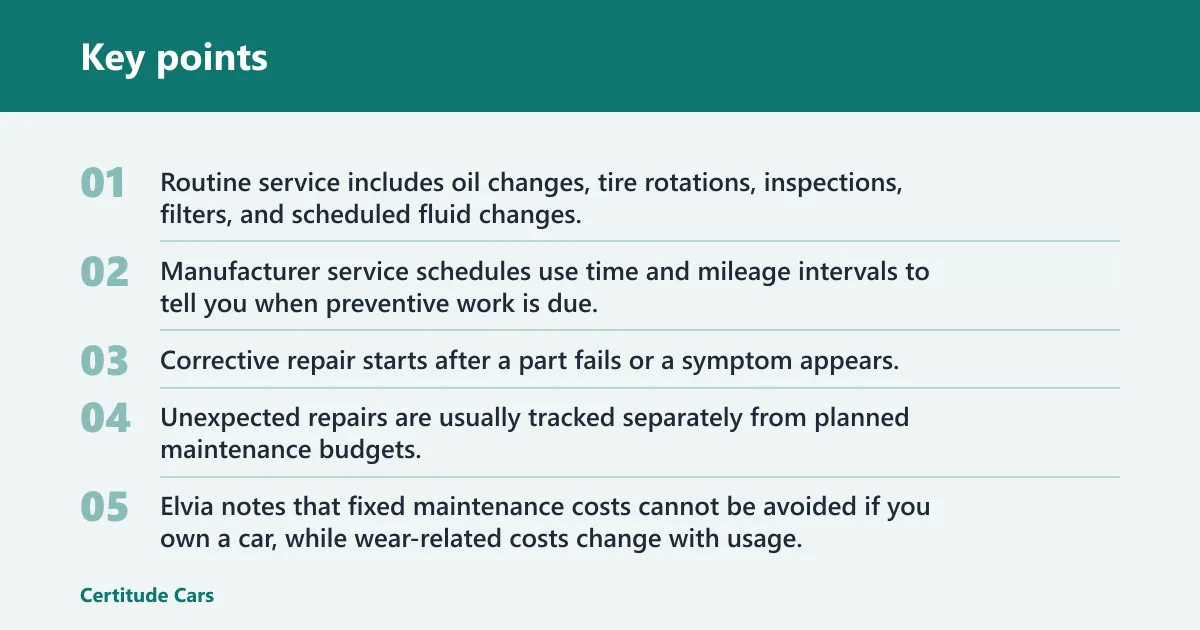
Routine service includes oil changes, tire rotations, inspections, filters, and scheduled fluid changes. Manufacturer service schedules use time and mileage intervals to tell you when preventive work is due. That is the cleanest way to budget for future service.
Corrective repair starts after a part fails or a symptom appears. A noisy wheel bearing, a leaking radiator, or a dead alternator belongs in the repair bucket, not the planned maintenance bucket. That separation matters because repairs can hit hard in one month and be absent in the next.
Unexpected breakdowns
Unexpected repairs are usually tracked separately from planned maintenance budgets. They can happen even on a well-kept car, but higher mileage, harsh conditions, and skipped service often raise the odds. The same source notes that fixed maintenance costs cannot be avoided if you own a car, while wear-related costs change with usage.
CarVertical says maintenance cost depends on make, model, and where the vehicle is serviced. It also gives Toyota Corolla and Toyota RAV4 as an example where maintenance cost is not the same, and lists 10-year maintenance of $5,996 for Toyota and $16,802 for RAM. That is a clear reminder that model choice changes the budget even before repairs enter the picture.
Where diagnostics and inspection fees fit
Diagnostic tests and inspection fees are edge cases. A diagnostic test is usually variable because it only appears when a fault or warning light needs investigation. An inspection fee is often mixed because the check itself may be calendar-based, while repairs or re-tests can change the total.
Say your dashboard shows a check engine light after about a 40-mile commute. The scan tool fee is a variable repair-related cost because it depends on the symptom being checked. The same car may also need an inspection renewal next month, and that fee is a fixed or mixed ownership charge depending on local rules.
How to budget by month and by mile

Use two separate buckets. Put fixed ownership costs in a monthly budget, and put variable operating costs in a per-mile or per-kilometer budget. That split gives you a cleaner view of what the car costs to keep and what it costs to drive.
Monthly ownership budget
Your monthly budget should include insurance, road tax or registration fees, parking permits, and any lease or depreciation charge you track as ownership cost. If you use a prepaid maintenance plan, count the prepaid fee here, then spread it across the months it covers.
Per-mile operating budget
Your per-mile budget should include fuel, tires, oil changes, brake wear, and regular maintenance. A common first-timer mistake is putting all service into one monthly lump sum. That hides the fact that a low-mileage month and a road-trip month do not cost the same.
List fixed charges first. Write down insurance, road tax, permits, and any lease or ownership fee you pay on a schedule. These are the backbone of a monthly car budget.
Mark mileage-driven items next. Add fuel, oil changes, tires, and brake pads to a per-mile line. If the cost rises when mileage rises, it belongs here.
Split mixed items separately. Put scheduled services, inspections, tire rotation, and brake fluid in a mixed bucket. Their timing may be fixed, but the total still changes with the car and the work due.
Set aside repair reserves. Create a separate line for unexpected repairs and diagnostics. Keep it outside planned maintenance so a sudden failure does not wipe out the service budget.
Using the service schedule
Manufacturer service schedules are the best planning tool for preventive maintenance. If the schedule says a service is due by time or mileage, budget for it before the warning light or worn part appears. That is especially useful for leased cars, where missed service can create end-of-term charges, and for warranty-covered cars, where proof of service may matter.
EVs and hybrids need the same sort of sorting, even though the item list changes. An EV may skip engine oil, but it still has tires, brake components, cabin filters, coolant, and inspection fees. Hybrids sit between the two: some service items are shared with combustion cars, while others are reduced by electric drive.
Prepaid maintenance plans deserve special treatment. They behave like a fixed ownership charge once purchased, even though the service they cover would otherwise be variable or mixed. Warranty-covered maintenance is similar: the owner may not pay at the moment of service, but the underlying item still belongs in the maintenance budget category.
Frequently asked questions
Is maintenance a fixed or variable cost?
Maintenance is usually mixed. Some service items are scheduled, while others change with use and wear. Fixed ownership costs such as insurance or road tax are separate from maintenance, while wear-related work sits on the variable or mixed side. Scheduled service sits in the middle because the timing can be fixed even when the bill changes with mileage and parts due.
Is maintenance a variable cost?
Many maintenance items behave like variable costs because they rise with driving and wear. Fuel is the clearest example, followed by tires, brake pads, and oil changes. But maintenance as a whole is not purely variable, since some services are time-based and some are scheduled.
What maintenance costs are fixed on a car?
Scheduled service items can be fixed in timing, though not always in price. Routine checks, annual inspections, and other planned maintenance visits can recur on a set schedule, but the final bill depends on the work due. Ownership charges such as insurance, road tax, registration fees, and parking permits are separate from maintenance.
What maintenance costs change with mileage?
Fuel changes with mileage first, and then oil changes, tires, brake pads, and many wear items follow. The same source says variable maintenance costs vary according to how many kilometers you drive per year. More driving means more wear, more consumables, and more service visits over time.
How do fuel and maintenance differ in cost behavior?
Fuel is a direct operating cost tied to distance driven and local prices. Maintenance is broader: some items are fixed, some are variable, and some are mixed. That is why fuel belongs in a per-mile budget, while maintenance needs a split view that separates scheduled service from wear-related work.
Are repairs included in maintenance costs?
Repairs are related to maintenance, but they should be tracked separately. Planned maintenance covers service items due by time or mileage. Repairs cover faults and breakdowns, which makes them harder to predict and better suited to a separate reserve.