When Do You Pay the Deductible on Car Insurance Claims?
You pay the deductible when the insurer settles the claim and approves repair payment. The shop usually takes it when you pick up the car, or it is taken out of a direct payment to you. If you miss that step, repairs can stall, a balance can remain unpaid, or the claim can pay less than you expected. This guide explains who collects the deductible, when it is due, and how fault affects what you pay.
Deductible claim timeline
The deductible comes due after the insurer reviews the damage, confirms coverage, and approves payment. It is not an annual fee. It applies to each covered claim, and the timing depends on whether the payment goes to a repair shop, to you, or to a lender or lienholder.
Estimate and coverage check
The process starts with an estimate. The insurer then checks whether the loss fits collision coverage, comprehensive coverage, or another part of the policy, and whether the repair cost is above the deductible. If the estimate is below the deductible, the insurer pays nothing.
Deductible collection point
In many repair claims, the deductible is collected after the estimate is approved and before the car is released. Shops often want the deductible paid before pickup because the insurer’s draft or direct payment covers only the insured portion of the bill. That timing can vary by shop and insurer workflow.
Insurer payment and vehicle release
Once the claim is settled, the insurer pays its share and subtracts the deductible from the covered amount. A common example is a $500 deductible on $3,000 damage, which leaves $2,500 covered. Progressive also uses a $300 deductible and $1,200 damage example, which leaves $900 covered.
When do you pay it?
Usually, you pay after the claim is approved and before the shop releases the car. If the insurer sends payment directly to you, the deductible may already be withheld from that check. If the repair is handled through a preferred shop, the shop may ask for the deductible at pickup.
Before repairs start
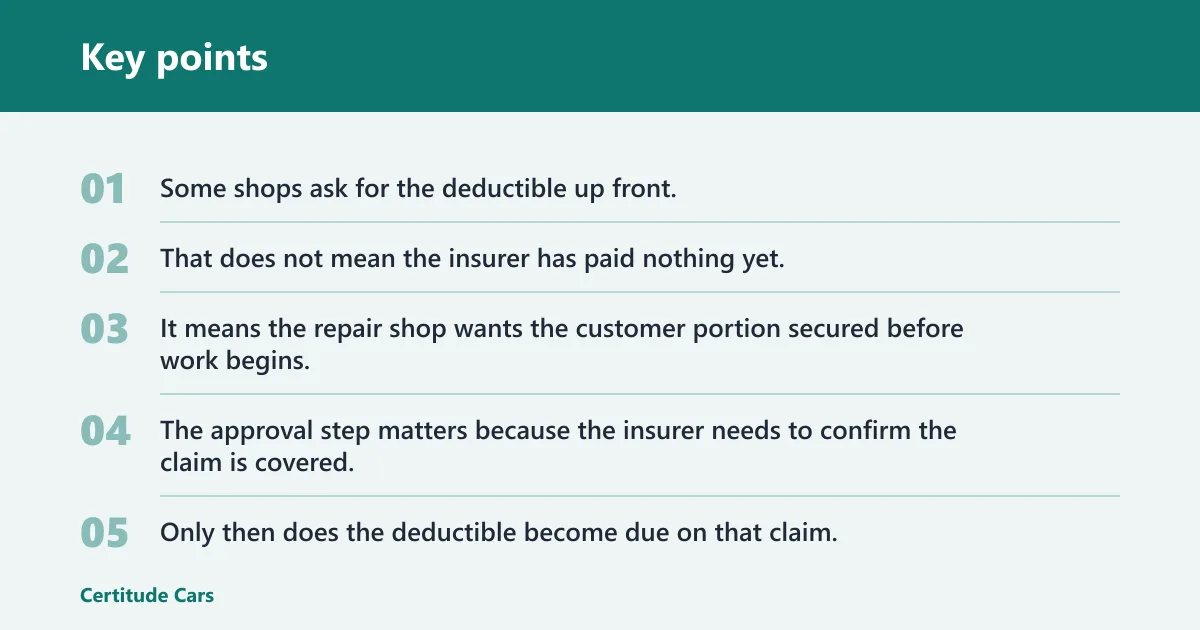
Some shops ask for the deductible up front, especially if parts must be ordered or the vehicle will be disassembled. That does not mean the insurer has paid nothing yet. It means the repair shop wants the customer portion secured before work begins.
After the claim is approved
The approval step matters because the insurer needs to confirm the claim is covered. Only then does the deductible become due on that claim. If coverage is denied, there may be no deductible to pay because there is no covered claim payment at all.
When the shop gets paid
The deductible is often paid to the repair shop, not directly to the insurer. The shop then invoices the insurer for the covered amount. If the insurer issues a check to you instead, the deductible may be subtracted from that payment rather than collected at the counter.
When reimbursement may come later
If another driver was at fault, your insurer may still ask you to pay your deductible first on your own collision claim. Reimbursement may come later if the at-fault insurer pays your carrier back through subrogation. That repayment is possible, but it is not guaranteed.
What claims use a deductible?
Collision and comprehensive claims usually have deductibles. Liability coverage usually does not. Some policies also apply deductibles to special coverages, and state rules can change the answer for personal injury protection or uninsured and underinsured motorist coverage. Check the declarations page and the policy wording.
Collision coverage deductible
Collision applies when your car hits another vehicle or an object. Common deductible examples are $250, $500, and $1,000. Progressive says common deductible coverage includes collision, and the deductible is paid every time you file a covered claim.
Comprehensive coverage deductible
Comprehensive applies to theft, vandalism, fire, hail, flood, animal strikes, and many glass losses. Progressive and Experian both note that deductibles can apply to comprehensive claims. Some glass claims may carry a $0 deductible, but that depends on the policy and state rules.
Liability coverage usually has no deductible
Liability insurance usually does not have a deductible. AutoInsurance.com says liability coverage does not carry one. That matters because liability pays for other people’s injuries and property damage when you are at fault, not for damage to your own vehicle.
State-specific coverage exceptions
Coverage rules vary by state. The same source says some states require deductibles for personal injury protection or uninsured and underinsured motorist property damage. Experian notes that uninsured or underinsured motorist deductibles can range from $100 to $1,000. Check the declarations page before you assume a deductible does or does not apply.
Can the other driver pay?
If another driver caused the loss, you may still have to pay your own deductible first if you file through your insurer. That is common on collision claims. The deductible may be returned later if your insurer recovers money from the at-fault carrier, but that recovery is not automatic.
Not-at-fault claim path
When the other driver is at fault, you can often choose between filing with your own insurer or with the other driver’s liability insurer. AutoInsurance.com says drivers usually do not pay a deductible when another driver is at fault. In practice, though, that depends on which claim path you use.
Subrogation and reimbursement
If your insurer pays for your repairs first, it may seek repayment from the at-fault driver’s insurer through subrogation. If that recovery succeeds, your deductible may be refunded. If the recovery fails or is partial, you may not get the deductible back in full.
When you still pay first
Say your car is hit in a parking lot and the estimate is $2,100 with a $500 collision deductible. If you claim through your own insurer, you may still owe $500 before the car leaves the shop. Later reimbursement is possible only if the other insurer accepts fault and pays back your carrier.
Deductible payment methods
Most drivers pay the deductible as part of the repair transaction, but the method can change. Some shops take a card or cashier’s check, some accept split payments, and some insurers send a settlement check that already reflects the deductible. Financing terms can also affect the amount you are allowed to choose.
Paying the repair shop
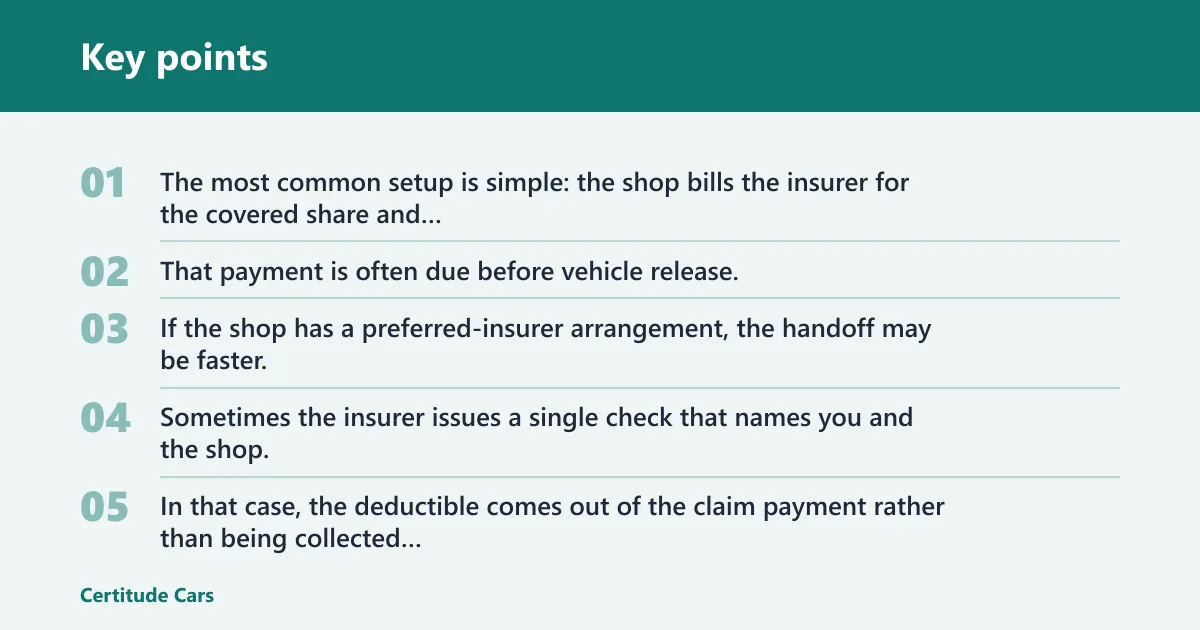
The most common setup is simple: the shop bills the insurer for the covered share and asks you for the deductible. That payment is often due before vehicle release. If the shop has a preferred-insurer arrangement, the handoff may be faster, but the customer portion still has to be paid.
Split checks and insurer drafts
Sometimes the insurer issues a single check that names you and the shop, or it sends a draft that already deducts your share. In that case, the deductible comes out of the claim payment rather than being collected separately. The result is the same: you cover the deductible portion.
Installments and payment plans
Can i make payments on my car insurance deductible? Sometimes, but only if the repair shop agrees. Neither the insurer nor the carrier is required to finance the deductible. A shop may allow a short payment plan, but many require full payment before release because the repair bill is their invoice, not the insurer’s.
Lender and shop limits
If the car is financed or leased, the lender may cap the maximum deductible on collision and comprehensive coverage. That limit can appear in the loan or lease terms and on the declarations page. A lender may reject a deductible that is too high for the vehicle’s financing arrangement.
Deductible claim examples
These examples show where the deductible lands in the claim workflow. The key question is not whether a deductible exists in the abstract. It is who pays first, whether the insurer pays anything at all, and whether reimbursement is possible later.
| Scenario | Who pays first | Deductible due now or later | Reimbursement possible | Plain-English example amount |
|---|---|---|---|---|
| At-fault collision | You, through your own collision claim | Usually due when repairs are approved and the shop is paid | Possible if subrogation succeeds | $500 deductible on $3,000 damage |
| Comprehensive theft or vandalism | Your insurer, after coverage is confirmed | Due when the claim is settled | Usually no reimbursement issue unless another party is identified | $250 deductible on a $1,750 covered loss |
| Not-at-fault third-party claim | The at-fault driver’s liability insurer, if accepted directly | Often none if paid by the other insurer; may be due first if you use your own policy | Possible if you paid first through your carrier | $0 out of pocket if the other insurer pays the repair bill |
| Total loss | Your insurer or the at-fault insurer, depending on the claim path | Deductible is taken from the settlement amount | Possible only if another insurer later reimburses your carrier | $500 deductible on a $12,000 settlement |
| Glass-only claim | Your insurer or the shop, depending on the policy | May be due immediately, later, or not at all if the glass deductible is $0 | Usually not relevant unless another party caused the breakage | $0 for a windshield under a special glass rule |
| Repair estimate below deductible | You | No insurer payment if the covered repair is under the deductible | No, because there is no payout to recover | $400 repair with a $500 deductible |
At-fault collision
Suppose the front bumper repair is quoted at about $2,400 and your collision deductible is $500. The insurer pays $1,900 and you pay $500. If the claim is later recovered from another carrier, that deductible may come back, but only if subrogation succeeds.
Comprehensive theft or vandalism
Comprehensive losses work the same way, but the cause is different. A stolen side mirror, broken window, hail damage, or vandalism claim can still have a deductible. The insurer subtracts that amount from the covered settlement before payment goes out.
Total loss
If the vehicle is totaled, the deductible comes out of the settlement check. That can reduce the amount you receive or the amount paid to a lender. If the actual cash value is near the loan balance, the deductible can make a shortfall feel larger.
Glass claim
When does a deductible apply to windshield or glass claims? It depends on the policy and state rules. Some policies set a $0 glass deductible, while others use the same comprehensive deductible that applies to other covered losses. The declarations page is the cleanest place to confirm it.
Repair estimate below deductible
What happens if the repair costs less than my deductible? The insurer pays nothing. A small ding, cracked trim piece, or minor scratch may not be worth filing because the payout would be zero and the claim could still be recorded on the policy.
- Get the estimate and confirm the coverage type.
- Check whether the repair amount is above the deductible.
- Ask who will collect the deductible: shop, insurer, or lender-controlled process.
- Confirm whether the car can be released before payment clears.
- Ask whether a not-at-fault claim leaves room for reimbursement later.
Frequently asked questions
When do you pay deductible for car insurance claim?
You pay it after the claim is approved and before the repair shop releases the car. In a direct payment setup, the insurer may subtract it from your settlement check instead. The exact timing depends on whether the payment goes to you, the shop, or a lender.
Can I pay my deductible in installments?
Sometimes, but only if the repair shop agrees. The insurer usually does not finance the deductible for you. If the shop allows installments, it is a private arrangement between you and the shop, and the vehicle may still be held until the balance is settled.
Do you pay the deductible before or after the repair is approved?
Usually after approval. The insurer first confirms coverage and estimates the loss, then applies the deductible and pays its share. Many shops then collect the deductible before releasing the vehicle, so the practical payment point is often after approval but before pickup.
Do you pay a deductible if the other driver was at fault?
Not always. If the other driver’s insurer pays your claim directly, you may owe nothing. If you file through your own insurer first, you may still pay your deductible and wait for possible reimbursement later through subrogation. That reimbursement is not guaranteed.
Does the deductible come out of the check or do you pay the shop?
Either can happen. Some claims are paid with a check or draft that already subtracts the deductible. In other cases, the shop collects the deductible separately before releasing the car. The payment method depends on the insurer, the repair shop, and how the claim is set up.
What happens if the repair costs less than my deductible?
The insurer usually pays nothing because the covered loss does not clear the deductible threshold. You would pay the full repair bill yourself. If the claim is small, filing may not help, and repeated claims can still affect renewal or future premium pricing.
Do I owe a deductible if my car is totaled?
Usually yes, if the claim runs through collision or comprehensive coverage. The deductible is typically subtracted from the total-loss settlement, which lowers the payout. If another insurer pays you directly for the loss, the deductible may not apply in the same way.
When does a deductible apply to windshield or glass claims?
It depends on the policy. Some comprehensive claims carry the normal deductible, while some glass-only claims have a $0 deductible. State rules can also change the answer, so the declarations page and policy wording matter more than a general rule.
Will filing a claim still count if the payout is below my deductible?
Yes, the claim can still be filed and recorded even if the insurer pays nothing because the loss is below the deductible. That is why small claims are often poor candidates for filing. The claim may still be visible in your policy history or renewal review.