Full Coverage Car Insurance Explained
Full coverage usually means liability, collision, and comprehensive; keep it when paying to repair or replace your own car out of pocket would strain your finances. Get this wrong and you can owe thousands after a crash, theft, hailstorm, or a loan balance shortfall after a total loss. This guide explains each coverage layer, what it pays, what it excludes, and when the added cost still makes sense.
What full coverage usually includes
Full coverage is an informal label, not a standard policy form filed and sold in one fixed way by every insurer. It usually means liability, collision, and comprehensive together, but the exact mix can vary by company and state, so two drivers can both say “full coverage” while carrying meaningfully different protection.
Why the phrase causes confusion
One insurer may use the phrase for liability plus physical damage coverage, while another may use it more loosely during quoting. That difference matters because “full coverage” is not a legal category and it is not a promise that every loss will be paid.
Those descriptions point to the same broad idea, but they also show why you need to read the actual coverages listed on the declarations page.
The usual three-layer stack
It usually begins with liability coverage, bodily injury liability and property damage liability. That is the part that pays when you injure other people or damage their property in a crash you cause.
Then comes collision coverage, which pays to repair or replace your vehicle after a crash, subject to a deductible. That includes at-fault crashes and single-car accidents such as sliding into a pole.
Comprehensive sits beside collision, not inside it. It pays for losses other than a road-impact crash, like theft, hail, flood, fire, vandalism, falling objects, glass damage, and animal strikes, also subject to a deductible.
Why state minimum coverage is different
State minimum coverage usually means only the liability limits a state requires. That may satisfy the law, but it does not pay to repair your own vehicle after a crash, hailstorm, or theft. State minimums and full coverage solve different problems.
The legal minimum keeps you from driving uninsured under state law. The larger stack helps protect your own car and, in some states, your own injuries.
What makes car insurance full coverage?
What makes a policy “full coverage” in everyday use is the combination of liability for damage you cause and physical damage coverage for your own car, usually collision and comprehensive. Many drivers then add self-protection layers such as uninsured motorist coverage, MedPay, or PIP because the basic three-part stack still leaves gaps.
Liability: where the stack starts
Liability coverage pays others, not you. It can pay other people’s medical expenses and the property damage you cause, up to your policy limits. It does not pay to fix your own car.
That limit matters. If repairs, lost income claims, or injury bills exceed your liability limits, the unpaid amount can still become your problem.
Collision: your car after a crash
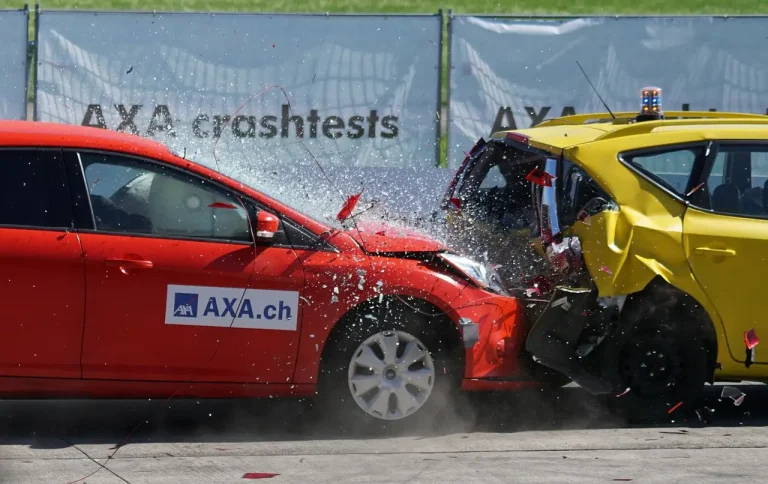
Collision coverage pays for crash damage to your vehicle after an impact with another vehicle or object, or after an overturn. It generally applies whether you were at fault, partly at fault, or the only vehicle involved, but you pay the deductible first.
A lower deductible usually means a higher premium. A higher deductible usually lowers the premium but leaves more out of pocket when you file a claim.
Comprehensive: non-collision losses
Comprehensive covers losses other than collision with another vehicle or object. Common examples include theft, vandalism, hail, flood, fire, broken glass, falling tree limbs, and hitting an animal. It also uses a deductible.
Comprehensive is often required by lenders on financed or leased vehicles because the lender has money at risk in the car.
Optional layers many drivers add
Uninsured and underinsured motorist coverage helps when the other driver has no insurance or too little. Depending on the state and the policy form, it may cover bodily injury, property damage, or both. Availability and requirements vary by state.
Medical payments coverage, often called MedPay, can cover medical and funeral expenses for insured people and passengers after an accident regardless of fault. Personal injury protection, or PIP, can go further in some states by paying medical costs and lost wages, but the rules differ sharply from state to state.
Separate conveniences are often mistaken for part of full coverage when they are not. Rental car reimbursement and emergency road service are commonly separate optional coverages.
Liability vs full coverage
Liability-only insurance is built to pay for injuries and property damage you cause to others. Full coverage usually adds collision and comprehensive so your own vehicle can be repaired or replaced after covered losses. The difference shows up fast after an at-fault crash, a hit-and-run, or a weather claim.
Legal minimums versus financial exposure
State law usually cares that you carry the required liability coverage. Your wallet cares whether you can absorb damage to your own car, a theft loss, or a total loss settlement that does not erase your loan balance.
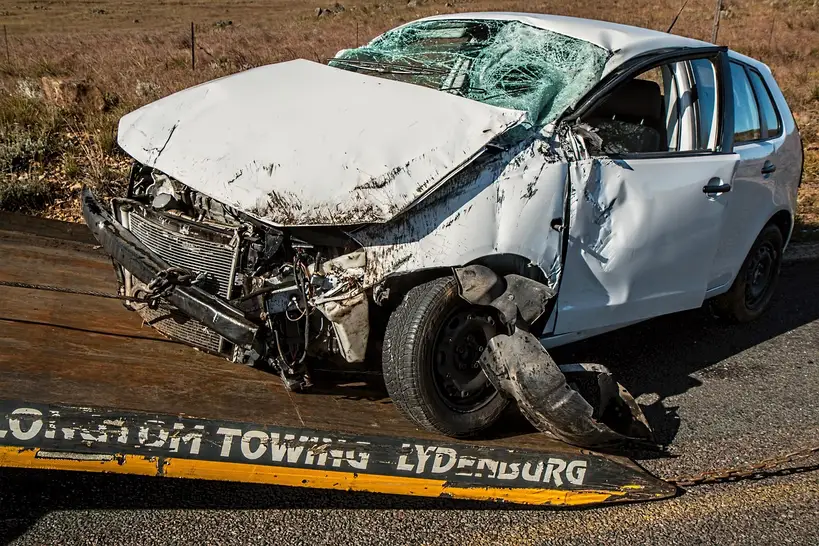
Suppose a driver carries only the state minimum liability limits and rear-ends an SUV at a stoplight. Liability may pay the other driver’s repairs and medical bills up to the policy limits, but it still pays nothing for the at-fault driver’s own hood, radiator, and airbags.
What changes after an at-fault crash
With liability only, the policy pays others if the claim is covered. Your own repairs come from savings, a loan, or the decision to stop driving the damaged car. With collision added, the same crash can produce a payout for your vehicle after the deductible is subtracted.
That is the practical dividing line. Liability keeps you legal. Collision and comprehensive keep a covered loss from becoming a full replacement bill for your own car.
Why low limits can still leave a balance
Even a policy that people casually call full coverage can leave a major unpaid amount. If your liability limits are too low, the policy can run out before the claim does. If your collision or comprehensive deductible is high, you still fund that portion yourself.
What does full coverage not cover?
Full coverage does not mean every loss is insured. The stack usually leaves out routine maintenance, wear and tear, mechanical breakdowns, intentional damage, losses above your policy limits, and expenses that belong to separate endorsements such as rental reimbursement, roadside help, gap insurance, or custom equipment coverage.
Losses outside the policy language
Oil leaks from age, a worn clutch, a failed transmission, old tires, and brake jobs are maintenance or mechanical issues, not collision or comprehensive claims. Insurance is built around sudden covered losses, not upkeep.
Intentional damage is also outside the basic stack. So are many business-use situations if the policy excludes the way the vehicle was being used when the loss happened.
Costs above limits and below deductibles
Your deductible is always your share first on collision and comprehensive claims. If the repair bill is lower than the deductible, the insurer pays nothing. If the bill is higher, the deductible is still subtracted from the payout.
Policy limits create another gap. Liability pays only up to the bodily injury and property damage limits shown on the policy. Serious injuries can exceed those limits quickly.
Gaps for loans, custom parts, and extras
Actual cash value can be lower than what you still owe on a loan. That difference is where gap insurance may matter, and standard full coverage usually does not include it.
Custom wheels, audio systems, wraps, work tools, or aftermarket accessories may have low built-in limits or no coverage unless specifically added. A similar issue comes up with rental costs while your car is in the shop, rental reimbursement is commonly separate.
Picture a financed sedan with a fresh set of premium wheels and a balance larger than the car’s market value. After a theft recovery total loss, comprehensive may pay the car’s actual cash value less the deductible, but the loan shortfall and part of the wheel cost can still remain unpaid.
How does full coverage work after a claim?
After a claim, the payout depends on the cause of loss, who was at fault, your deductibles, your limits, and the car’s actual cash value. Liability pays others when you cause damage; collision handles crash damage to your car; comprehensive handles non-collision losses such as theft or hail.
Who pays in common claim types
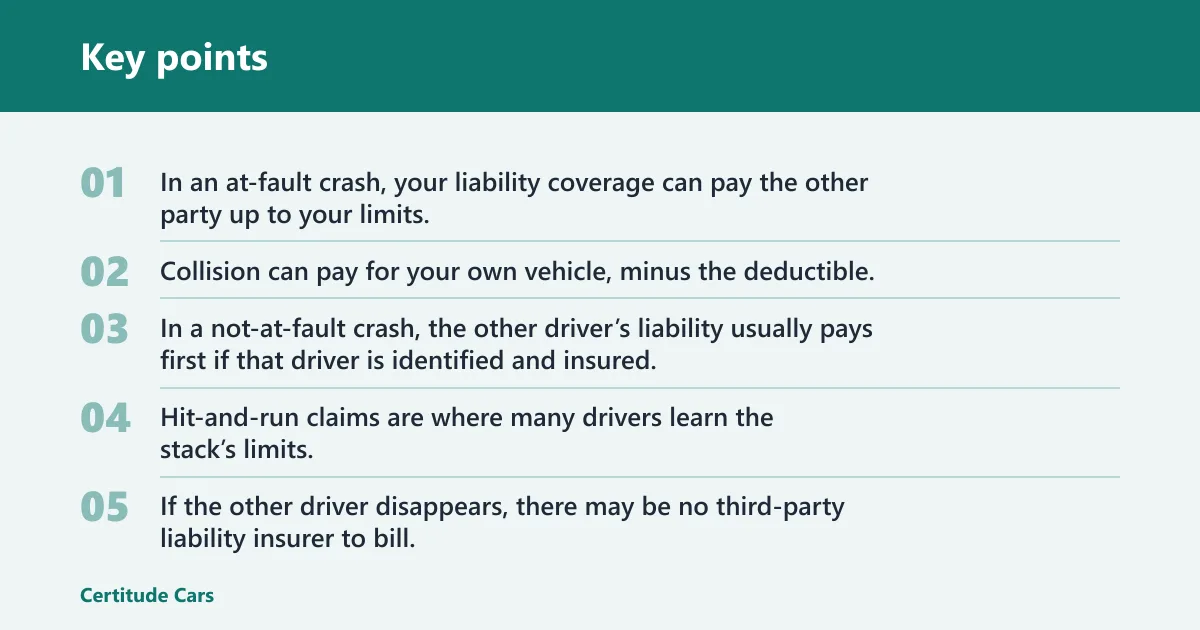
In an at-fault crash, your liability coverage can pay the other party up to your limits. Collision can pay for your own vehicle, minus the deductible. In a not-at-fault crash, the other driver’s liability usually pays first if that driver is identified and insured.
Hit-and-run claims are where many drivers learn the stack’s limits. If the other driver disappears, there may be no third-party liability insurer to bill. Your own collision coverage may become the practical source for your car damage, and uninsured motorist property damage may help in some states if you carry it and the rules fit the loss.
Say your parked crossover is hit overnight in a grocery store lot and the other driver leaves. There is no other insurer to call, so collision may cover the body damage after your deductible, while a rental car may remain your problem unless you bought separate rental reimbursement.
How deductibles change the outcome
Collision and comprehensive usually require deductibles; liability, MedPay, PIP, and many uninsured motorist bodily injury claims generally do not work the same way.
Choosing the deductible is a tradeoff. A higher deductible can reduce premium, but it also means smaller claims become less useful because more of the bill stays with you.
Total losses, actual cash value, and salvage
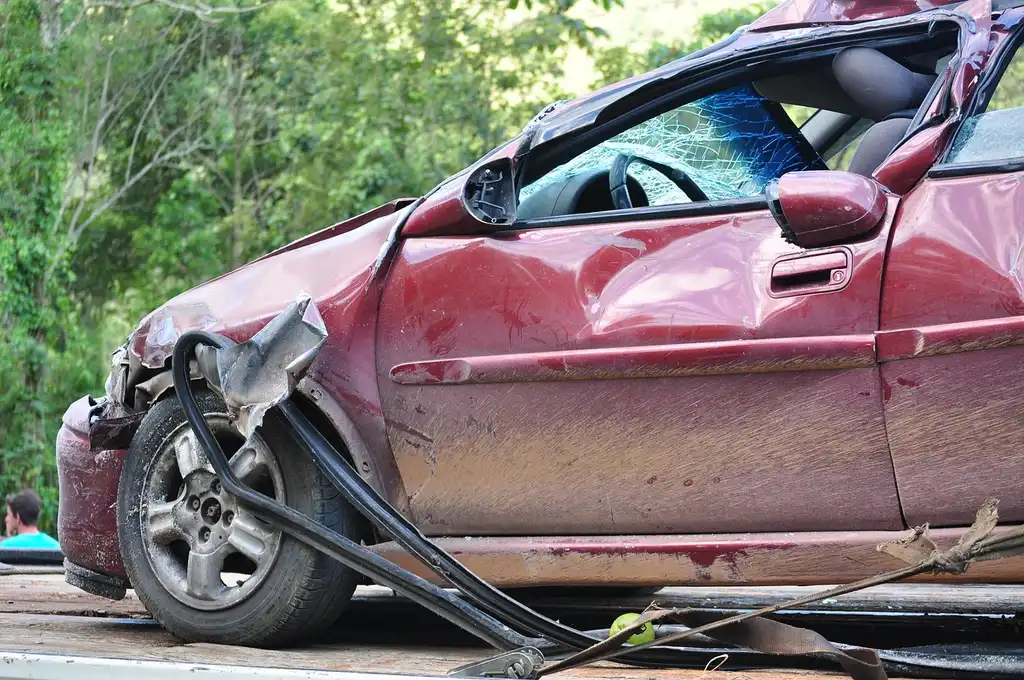
When repair costs approach or exceed the vehicle’s value under the policy rules, the insurer may declare a total loss and pay actual cash value rather than the full cost of repair. Actual cash value reflects the vehicle’s market value just before the loss, not what you paid for it and not the price of a brand-new replacement.
If there is a loan or lease, the lienholder is usually paid first from the settlement. If the settlement is smaller than the remaining loan balance, you still owe the difference unless separate gap coverage applies.
Salvage matters too. If a totaled car is retained rather than surrendered, the payout is usually reduced to account for the salvage value. The exact method depends on the policy and state rules.
Where medical coverages fit
Injury payments can come from several places at once or in sequence. The at-fault driver’s bodily injury liability may pay first. In some states, PIP or MedPay can pay quickly for insured people and passengers regardless of fault, then other coverages resolve later.
Uninsured and underinsured motorist bodily injury coverage can step in when the other driver lacks enough insurance. That can matter more than collision if the main loss is medical bills rather than vehicle damage.
How full coverage handles crash losses
After a collision, full coverage does not mean every cost is paid automatically. The supporting article breaks down what full coverage usually includes, what it may pay for after a crash, and where limits still apply, such as deductibles, medical expenses, and total-loss payouts. It also explains which crash outcomes are typically covered by collision and comprehensive protection versus which costs often fall outside the policy.
That matters because the difference between repair bills, medical bills, and a totaled car can change what you owe out of pocket. If you want a clear, scenario-by-scenario explanation, see full coverage crash guide.
Full coverage car insurance decision table
| Scenario | Minimum stack needed | Likely payout source | Common deductible | Gap left uncovered |
|---|---|---|---|---|
| At-fault crash into another car | Liability for others; collision if you want your own car covered | Your bodily injury and property damage liability for the other driver; your collision for your vehicle | Collision commonly $0 to $1,000 or more | Your collision deductible, any loss above liability limits, rental car unless separately added |
| Hit-and-run damages your parked car | Collision; uninsured motorist property damage may help in some states | Your collision claim if the other driver is unknown | Collision commonly $0 to $1,000 or more | Deductible, rental, and any state rule that limits uninsured motorist property damage use |
| Theft of the vehicle | Comprehensive | Your comprehensive claim up to actual cash value | Comprehensive commonly tracks the same deductible choices many insurers offer, often in the $0 to $1,000 or more range | Deductible, loan balance above actual cash value, custom parts beyond policy limits |
| Hail damage dents hood and roof | Comprehensive | Your comprehensive claim for covered weather damage | Comprehensive deductible applies | Deductible and any cosmetic repair cost beyond what the policy recognizes |
| Total loss on a financed car | Liability plus collision or comprehensive depending on cause; gap coverage if loan exceeds value | Your collision or comprehensive settlement paid toward the lienholder first | Collision or comprehensive deductible applies | Loan shortfall if actual cash value is below balance, unless separate gap coverage pays it |
| Driving an older paid-off car | State-required liability at minimum; collision and comprehensive only if the car is still worth protecting | Liability pays others; no payout for your car if collision and comprehensive are dropped | No deductible if only liability remains | All damage to your own car comes out of pocket |
Do you need full coverage on a financed car?
Financed and leased vehicles usually need more than state-minimum liability because the lender or lessor wants the car itself protected. Collision and comprehensive protect the lender’s collateral, while state law generally focuses on liability. Gap insurance is separate and may matter if the loan balance is higher than actual cash value.
What lenders usually require
Lenders often require collision and comprehensive for as long as the loan is outstanding. In practice, that requirement often appears as physical damage coverage with maximum deductible rules in the finance contract.
If you let those coverages lapse, the lender may buy force-placed insurance and bill you for it. That coverage often protects the lender’s interest, not your full set of needs.
Why the loan balance changes the decision
A financed car creates two separate risks. One is damage to the car itself. The other is owing more than the car is worth after depreciation. Standard collision and comprehensive address the first risk, but not necessarily the second.
Gap insurance fits between the actual cash value settlement and the remaining loan or lease balance when that balance is higher. It is separate from standard full coverage, so a driver can have liability, collision, and comprehensive and still face a loan shortfall after a total loss.
A practical financed-car setup
For most financed cars, the baseline stack is liability, collision, and comprehensive. Then the decision moves to deductibles, uninsured or underinsured motorist coverage where available, and whether gap coverage is sensible because of a small down payment, a long loan term, or rapid depreciation.
Is full coverage worth it on an older car?
Full coverage on an older car makes sense only when the likely payout still matters relative to the premium, the deductible, and the car’s actual cash value. As value falls, collision often becomes the first part of the stack to reconsider, while comprehensive may still make sense on a theft-prone or weather-exposed car.
When the math starts working against you
Collision and comprehensive never pay more than the covered vehicle’s actual cash value, and the deductible is subtracted. So the older the car gets, the smaller the ceiling on the insurer’s payout.
Suppose a paid-off car has modest market value and carries a high collision deductible. If one major at-fault crash would produce only a limited net payout, years of collision premium may buy less useful protection than many drivers expect.
The reverse is the key test for older vehicles: low value, easy replacement, and enough savings to self-fund a loss often point away from keeping the full stack.
Why dropping collision can make more sense than dropping comprehensive
Collision claims are tied to driving risk and often cost more than comprehensive on older cars. Comprehensive may still cover theft, hail, fire, vandalism, or animal strikes for a lower premium, depending on the vehicle and zip code.
That is why older-car decisions are rarely all-or-nothing. A paid-off car might keep liability and comprehensive but drop collision if the owner could replace the car after a crash but would rather stay protected against theft or weather.
A simple decision method
- Check actual value. Estimate what the car would likely be worth just before a loss using current local sale listings and valuation tools. The goal is to see the rough payout ceiling, because collision and comprehensive do not pay replacement cost for an older used car.
- Subtract your deductible. Compare that probable value with your collision and comprehensive deductibles. This gives you the rough maximum net payout on a total loss.
- Review annual premium. Look at the yearly cost of collision and comprehensive separately, not as one bundle. If a year of premium for a coverage is close to the rough maximum net payout from that coverage, its value may be fading.
- Test replacement ability. Ask whether you could pay to repair or replace the car without taking on harmful debt. If the answer is no, keeping more coverage can still make sense even on an older vehicle.
- Match local risks. Keep comprehensive longer if theft, hail, falling branches, or animal strikes are realistic where the car is parked or driven. Consider dropping collision first if the car is paid off and low in value.
Frequently asked questions
What does full coverage auto insurance entail?
It usually means liability, collision, and comprehensive on one policy, with optional layers such as uninsured motorist coverage, MedPay, or PIP added depending on state rules and driver needs. It is still a nickname, not a uniform package, so the actual coverages and deductibles must be checked line by line.
What is the difference between full coverage and comprehensive?
Comprehensive is one piece of the stack, not the whole stack. It pays for non-collision losses such as theft, fire, vandalism, weather damage, falling objects, and animal strikes, while “full coverage” usually refers to liability plus collision plus comprehensive together.
Does full coverage cover everything after a car accident?
No. It still does not pay for routine maintenance, wear and tear, mechanical breakdowns, intentional damage, or amounts above your policy limits. After an accident, deductibles still apply to collision and comprehensive, and separate items like rental reimbursement may require separate coverage.
How does full coverage car insurance work?
The insurer matches the cause of loss to the coverage layer. Liability pays others when you cause damage, collision pays for crash damage to your car, and comprehensive pays for non-collision losses. The payout is then reduced by any deductible and capped by policy limits or actual cash value.
Car insurance liability vs full coverage: what’s the difference?
Liability-only insurance pays for injuries and property damage you cause to other people. Full coverage usually adds collision and comprehensive so your own car can also be repaired or replaced after covered crashes, theft, hail, fire, vandalism, or similar non-collision losses.