Why Is Gas Mileage Better on Highway Than in the City?
Highway mileage is often better because the engine idles less, you spend less fuel on repeated acceleration, and steady speeds waste less energy than stop-and-go driving. Miss that gap, and you can misread fuel costs, trip range, and the effect of your driving habits. This guide explains the three main causes of the gap and the cases where highway driving stops being the more efficient choice.
Why highway MPG is usually better

Highway driving usually helps fuel economy because the car can hold a steadier load, brake less often, and avoid long idle periods. Fuel economy is the distance traveled divided by the fuel used, so fewer wasted inputs usually mean more miles from each gallon.
At a steady cruise, the engine can sit closer to an efficient operating point. In city traffic, the car keeps leaving that point. Every brake light, merge, and red light forces another burst of acceleration, and that is where fuel disappears.
Less braking means less wasted energy
When you brake, the vehicle sheds kinetic energy. In a conventional gas car, most of that energy leaves as heat in the brakes. On the highway, traffic flow is steadier, so you usually throw away less motion and need fewer fuel-heavy accelerations to replace it.
That is why stop-and-go driving hurts so much. Frequent braking and acceleration raise fuel use even if the trip distance stays the same, and the penalty grows when the average speed is low.
Steady speed needs less throttle change
A smooth cruise lets the throttle stay more stable. Rapid changes in pedal position ask the engine for richer, less efficient operation more often, especially during quick launches from a stop. The result is a larger fuel bill for the same route.
Steady speed is not magic. It is simply easier for the powertrain to maintain. The less often you ask the car to speed up and slow down, the fewer losses you create.
What hurts city mileage most
The biggest city fuel-economy penalty usually comes from repeated acceleration after stops, followed by idle time and cold-engine operation. Short urban trips can stack all three at once, which is why city MPG often falls below highway MPG on the EPA label.
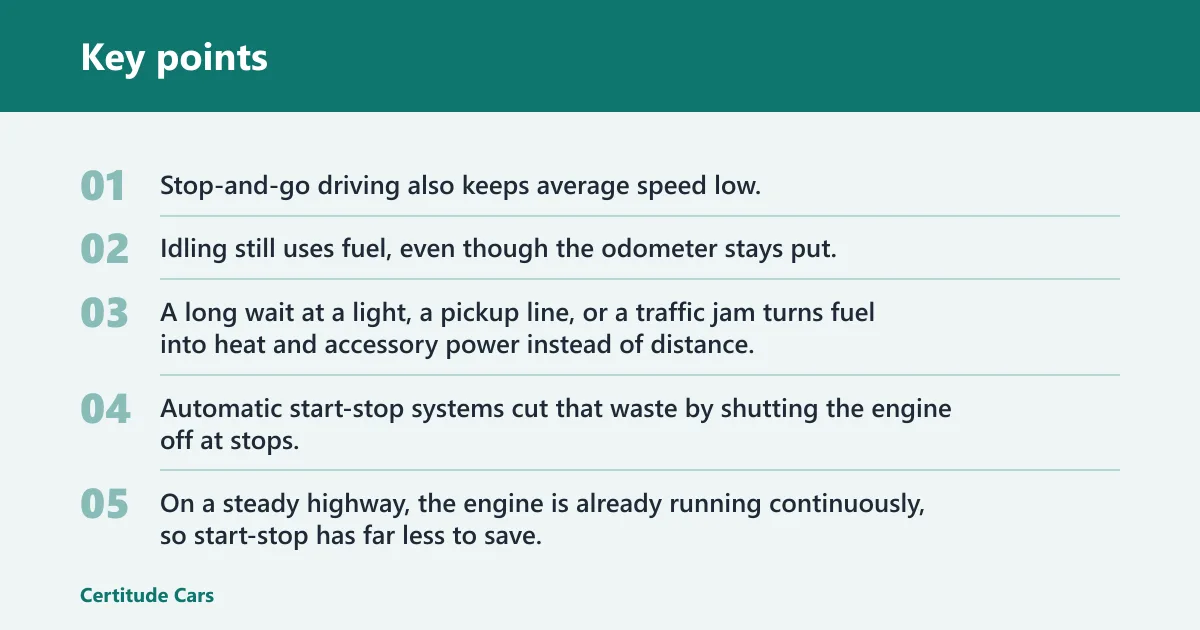
Stop-and-go driving also keeps average speed low. That matters because a trip with many stops can use nearly the same fuel as a longer, smoother route while covering fewer miles.
Idle time burns fuel without moving the car
Idling still uses fuel, even though the odometer stays put. A long wait at a light, a pickup line, or a traffic jam turns fuel into heat and accessory power instead of distance. Automatic start-stop systems cut that waste by shutting the engine off at stops.
The gain is strongest in city traffic. On a steady highway, the engine is already running continuously, so start-stop has far less to save.
Cold starts make short trips worse
Engine warm-up and cold-start enrichment increase fuel use before the engine reaches normal operating temperature. On a short trip, that penalty can take up a large share of the total fuel used. A short errand of about 3 miles can cost more per mile than a longer commute of about 20 miles with the same car.
That is one reason a short highway hop can sometimes disappoint. If the engine stays cold for most of the trip, the highway advantage shrinks fast.
Rolling resistance matters in both settings
Rolling resistance is the tire-to-road friction that resists motion in every driving pattern. It is affected by tire pressure and tire type, so underinflated or soft-compound tires can raise fuel use in both city and highway driving. The effect is usually smaller than idle, acceleration, or drag, but it never disappears.
Picture a 6-mile school run with four full stops, a cold engine, and a long light at the end. The car spends only a few minutes moving, and much of the fuel goes into warm-up, idling, and repeated launches instead of distance.
How speed changes fuel use
Speed changes MPG because fuel use does not rise in a straight line with road speed. Steady cruising is often efficient up to a point, but aerodynamic drag climbs quickly as speed rises, and that drag can become the main fuel-economy penalty on the highway.
Rapid acceleration also matters. A calm cruise at 60 mph can use less fuel than frequent bursts from 45 to 70 mph, even on the same road. Trip-average speed is what the car feels, not the posted limit alone.
Aerodynamic drag rises quickly
Aerodynamic drag increases with speed, and it matters more at highway speeds than at city speeds. Above moderate cruising speeds, the engine must work harder just to push air out of the way, so MPG drops even if traffic is light.
That is why a car may get better mileage at about 55 mph than at about 75 mph. The jump in air resistance can outweigh the small gain from smoother traffic.
Highway speed is not one speed
Steady cruising is usually more efficient than rapid acceleration, but the exact cruise speed still matters. The farther you move above a moderate cruising range, the more drag cuts into fuel economy. A calm 60 mph cruise is often kinder to MPG than a fast 80 mph run.
Wind shifts the picture too. A headwind acts like extra road speed, so fuel use can climb even when the speedometer stays fixed.
Gas mileage decision table
This table shows why your MPG changed and what to do about it. It uses the same fuel-loss logic across common driving patterns, so you can match the symptom to the likely cause.
| Driving pattern | Likely fuel-loss mechanism | Expected effect on MPG | Practical fix |
|---|---|---|---|
| City commuting | Frequent braking and acceleration, plus idle time at lights and traffic | Lower MPG from repeated launches and low average speed | Leave more space, smooth starts, avoid long idles, and use start-stop if equipped |
| Short highway hops | Cold-start enrichment and engine warm-up losses before normal temperature | MPG can stay below expectations, even on a freeway route | Combine errands into one longer trip when possible |
| High-speed freeway driving | Aerodynamic drag rises sharply as speed increases | MPG drops above moderate cruising speeds | Trim speed to a steadier, moderate cruise and remove roof racks when not needed |
| Hilly routes | Extra throttle on climbs and energy lost during braking on descents | MPG can fall even if traffic is light | Use smoother throttle on climbs and avoid unnecessary speed changes |
| Hybrid vehicles | Regenerative braking and electric-only low-speed operation change where fuel is used | City MPG often improves more than highway MPG | Favor gentle acceleration and maximize regenerative braking without abrupt stops |
Do hybrids and start-stop systems change the answer?
Yes. Hybrids and start-stop vehicles change where fuel is lost, so city driving does not punish them the same way it punishes a conventional gas car. Hybrids can recover some braking energy, and start-stop systems reduce idle waste at stops.
That does not erase the city-vs-highway gap. It shifts it. A hybrid can look especially strong in stop-and-go traffic, while a start-stop system mostly helps when the car is forced to wait.
Hybrid braking recovery changes city driving
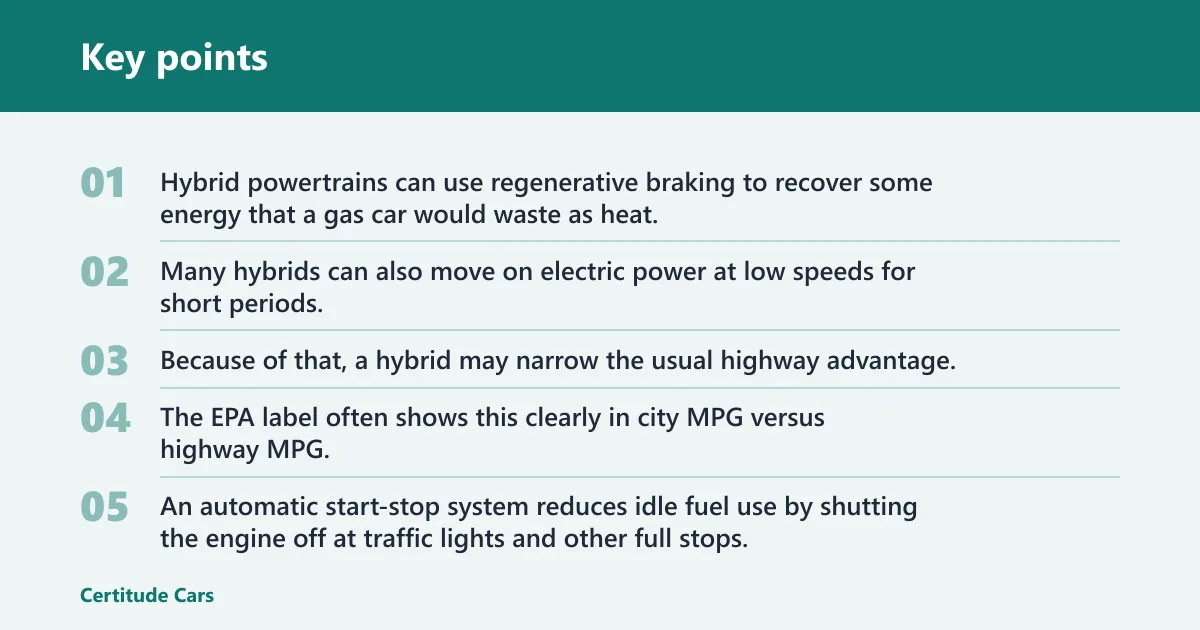
Hybrid powertrains can use regenerative braking to recover some energy that a gas car would waste as heat. Many hybrids can also move on electric power at low speeds for short periods. Those two traits give them a city-driving advantage, especially in traffic with frequent slowing and starting. (Caranddriver)
Because of that, a hybrid may narrow the usual highway advantage. The EPA label often shows this clearly in city MPG versus highway MPG.
Automatic start-stop only helps when the car stops
An automatic start-stop system reduces idle fuel use by shutting the engine off at traffic lights and other full stops. It has little effect on steady highway driving because there are fewer stop events to eliminate.
If the commute includes many red lights, the system can help more than on an open freeway. If the route is mostly steady-speed travel, the difference will be smaller.
Suppose a compact sedan and a hybrid both face the same 8-mile trip. The sedan spends three minutes idling and re-accelerating after six stops, while the hybrid recovers some braking energy and shuts down at each red light. The hybrid’s city MPG advantage comes from those exact losses, not from a vague “better efficiency” claim.
Can highway driving be worse than city driving?
Yes. Highway driving can lose its MPG advantage when speed rises, when the car fights wind or hills, when traffic turns into stop-and-go, or when the trip is too short for the engine to warm up. In those cases, the road type matters less than the forces acting on the car.
Roof racks, heavy loads, and poor tire pressure can also make highway mileage drop. Those factors increase resistance or drag, so a highway trip can end up less efficient than a smoother city route under the right conditions.
Wind, hills, and traffic can erase the gain
Headwinds increase the air the car must push through, which raises drag. Hills add load on climbs and often force braking on descents. Traffic jams on the freeway reintroduce the same idle and acceleration losses people usually associate with city driving.
If a freeway trip has all three, the route may no longer be the fuel-saving choice.
Short highway hops can underperform
Short trips can lower real-world MPG because the engine stays cold longer. That penalty does not vanish just because the route uses a highway. If the drive is only long enough to reach cruising speed for a few minutes, warm-up losses can outweigh the highway advantage.
A common first-timer mistake is assuming that any freeway segment must improve MPG. A short highway trip with a cold engine can be worse than a longer, slower city route that lets the engine reach normal temperature.
How to improve fuel economy in both conditions
Keep speeds steady. Smooth cruising is easier on fuel than frequent speed changes. On the highway, trim unnecessary bursts above moderate cruising speeds because drag rises quickly there.
Limit idle time. Shut off the engine when the car will sit for a while, and let start-stop do its job if the vehicle has it. This helps most in city traffic where stops are common.
Combine short trips. Cold starts hurt MPG the most before the engine warms up. Fewer cold starts means less enrichment loss and a better average over the whole drive.
Check tire pressure. Low tire pressure can raise rolling resistance and hurt mileage in many driving patterns. Use the placard pressure on the door jamb, not the maximum number on the tire sidewall.
Remove extra drag. Roof racks, cargo boxes, and bulky loads can cut highway MPG because they disturb airflow. Take them off when you do not need them.
Frequently asked questions
Why does my car get better mileage on the highway than in stop-and-go traffic?
Because steady highway driving usually cuts idle time and repeated acceleration, both of which waste fuel in stop-and-go traffic. The car also spends less time at low average speed, where each stop and restart hurts MPG more than a smooth cruise does.
Why is city driving worse for fuel economy than highway driving?
City driving usually includes more braking, more acceleration, and more idling. Short trips can add cold-start enrichment on top of that. The result is lower MPG because the car spends more fuel changing speed and warming up instead of covering distance.
Does cruising speed affect gas mileage on the highway?
Yes. Fuel economy usually drops as highway speed rises because aerodynamic drag increases quickly. A moderate, steady cruise is often more efficient than a faster one, and rapid speed changes can hurt MPG even more than the cruise speed itself.
How much fuel do you waste from idling and braking in the city?
There is no single fixed number, because it depends on traffic, engine size, and trip length. The key point is that idling uses fuel without moving the car, and braking throws away motion that the engine then has to rebuild during the next acceleration.
Do hybrids and EVs behave differently from gas cars in city driving?
Yes. Hybrids can recover some braking energy and may run on electric power at low speeds, so city driving often helps them more than it helps a conventional gas car. EVs also avoid engine idling, so stop-and-go traffic is usually less punishing for them.
Can wind, traffic, or hills make highway mileage worse than city mileage?
Yes. Strong headwinds raise aerodynamic drag, traffic jams add idle time and repeated acceleration, and hills add extra load on climbs. A short highway trip can also stay cold enough that warm-up losses erase the usual advantage over city driving.