How to Compare Two Cars with Similar MPG and Fuel Costs
Compare cars by fuel cost per mile: divide price per gallon by mpg, then multiply by annual miles. If the gap is small, say under about 1 to 2 cents per mile, fuel alone rarely decides the buy. Ignore fuel type, maintenance, and depreciation, and the “better mpg” car can become the costlier one to own. This guide shows the math, the questions to ask, and how to compare total running costs side by side.
Why similar mpg can cost different amounts
Two cars can post the same or similar mpg and still cost different amounts to fuel because mpg is only one input. Fuel price, annual mileage, body style, powertrain, and the way you drive all change the result. The sticker gives a standardized estimate, not a bill.
Fuel price changes the dollar result
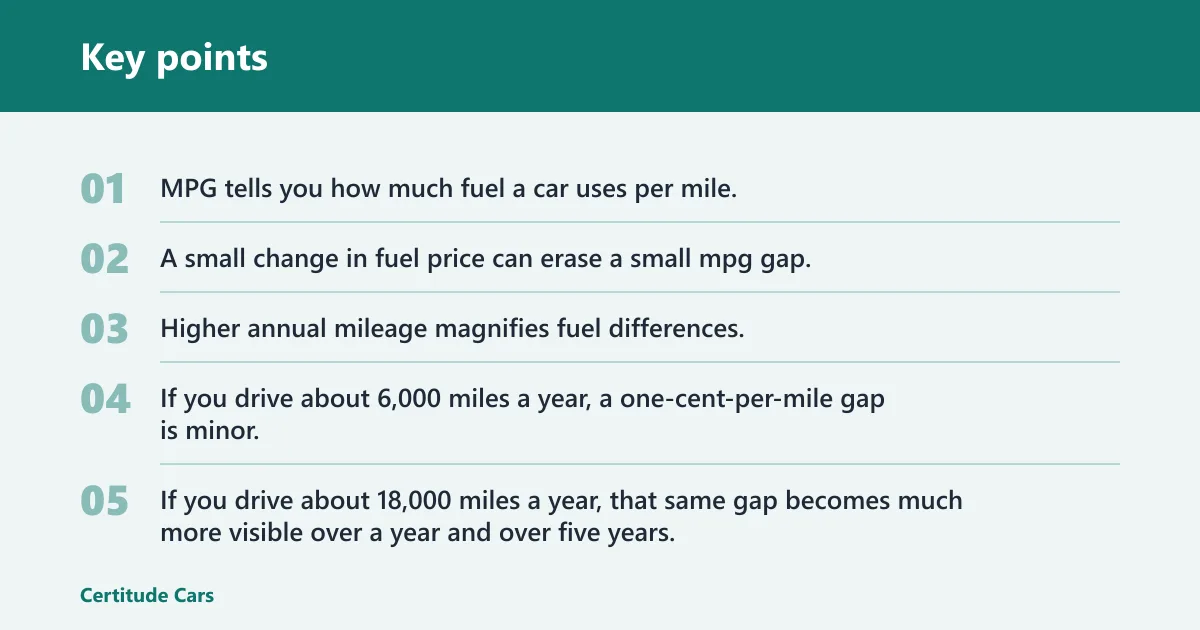
MPG tells you how much fuel a car uses per mile. It does not tell you what that fuel costs where you live. A car that returns the same mpg in two regions can have different running costs if one driver pays more per gallon or per kWh than the other.
That is why a cost-per-mile check matters. A small change in fuel price can erase a small mpg gap. It can also flip the winner when two cars sit close together on the sticker.
Annual mileage changes the gap
Higher annual mileage magnifies fuel differences. If you drive about 6,000 miles a year, a one-cent-per-mile gap is minor. If you drive about 18,000 miles a year, that same gap becomes much more visible over a year and over five years.
That is also why low-mileage owners often care more about purchase price and insurance than fuel alone. High-mileage owners should pay more attention to fuel spend, because the math compounds faster.
Vehicle type and powertrain can shift costs
Body style and powertrain matter even when mpg looks similar. A sedan and an SUV with close combined mpg may still differ in tire size, curb weight, repair costs, and depreciation. A hybrid, plug-in hybrid, gasoline car, and EV can also split on fuel cost because they do not use energy in the same way.
For electric vehicles, MPGe is the EPA’s comparison metric for electric vehicles and gas cars. The EPA uses city, highway, and combined MPGe ratings, and combined MPGe is described as a weighted average of city and highway use. GreenCars defines one gallon of gasoline as 33.7 kWh of electricity.
Use the right mpg number
Choose the rating that matches your driving pattern. City, highway, and combined mpg are standardized EPA estimates, and combined is usually the best starting point for mixed use. If your commute is mostly highway or mostly stop-and-go, the city or highway number may fit better.
City, highway, and combined ratings
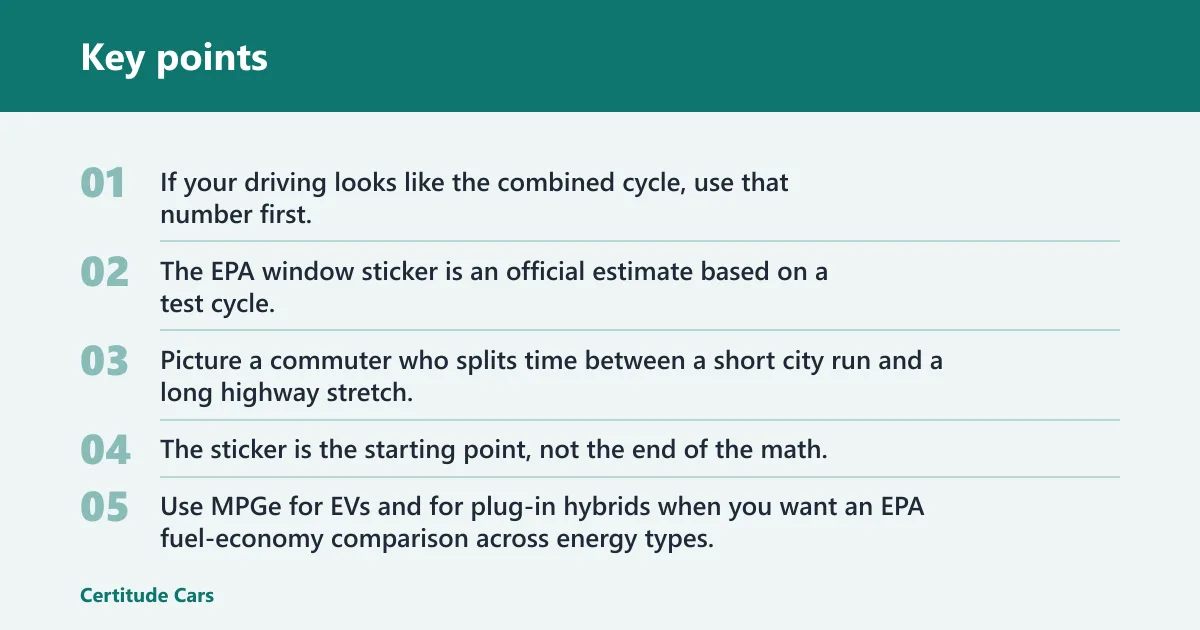
The EPA label gives all three for a reason. City mpg reflects lower-speed and stop-and-go conditions, highway mpg reflects steadier cruising, and combined mpg blends them. If your driving looks like the combined cycle, use that number first.
If one car has strong highway mpg and weak city mpg, while the other is the reverse, a single combined number can hide the tradeoff. In that case, compare the rating that matches your route, then check whether your driving pattern leans more urban or more open-road.
Real-world mpg versus EPA estimates
The EPA window sticker is an official estimate based on a test cycle. Real-world mpg can be higher or lower. Normal driving, economical driving, and sportive driving all change consumption, sometimes a little and sometimes enough to alter the cost ranking.
Picture a commuter who splits time between a short city run and a long highway stretch. A car rated well on the sticker may still return worse real-world mpg if the driver brakes late, idles often, or spends time in cold-weather traffic. The sticker is the starting point, not the end of the math.
When MPGe applies instead of mpg
Use MPGe for EVs and for plug-in hybrids when you want an EPA fuel-economy comparison across energy types. It lets you compare electric and gasoline vehicles on a common EPA label, but it still does not tell you the local electricity price or the full ownership cost.
GreenCars gives a sample EV efficiency of 25 kWh for 100 miles as 134.8 MPGe. GreenCars also says most EVs today range from 90 to 135 MPGe, and states that the Lucid Air Pure, Tesla Model 3, and Hyundai IONIQ 6 can score well over 120 MPGe.
How to compare fuel cost per mile

Convert mpg into dollars per mile, then scale it to your mileage. That turns a fuel economy label into a budget number. If two cars are close on cost per mile, the better fuel economy headline may not matter much after taxes, insurance, and depreciation.
Convert mpg to gallons per mile
Use this formula: gallons per mile = 1 ÷ mpg. If a car gets 30 mpg, it uses 0.0333 gallons per mile. You can also express fuel use as gallons per 100 miles by dividing 100 by mpg, which makes the comparison easier when you want a distance-based view.
Turn gallons into dollars per mile
Multiply gallons per mile by your fuel price. GreenCars estimates a 30 MPG gas sedan at $0.13 per mile using $4.00 per gallon. It also estimates a 120 MPGe electric sedan at $0.04 per mile using $0.14 per kWh.
That gap is why fuel type matters. Two cars can look similar on a broad efficiency chart and still sit far apart in dollar terms once fuel or electricity price enters the calculation.
Estimate annual and 5-year fuel spend
Multiply cost per mile by your annual miles for yearly spend. Then multiply that figure by five for a rough five-year fuel total. Five years is a useful horizon because many shoppers hold a car that long, and it shows whether a small monthly gap becomes a bigger ownership decision.
Pick a realistic mileage. Use your annual miles, not a generic guess. If you drive 10,000 miles a year, plug in 10,000; if your commute is longer, use the higher figure because the difference scales directly with mileage.
Choose the matching rating. Use city, highway, or combined mpg, or MPGe for an EV or plug-in hybrid. Match the label to how you actually drive, because a route that is mostly highway should not use a city-only number.
Calculate fuel per mile. Divide 1 by mpg, then multiply by fuel price. For EVs, convert energy use to cost using the electricity price you pay. This step turns efficiency into dollars, which is easier to compare across models.
Scale to a year. Multiply cost per mile by annual miles. Then multiply again by five if you want a simple five-year fuel total. This reveals whether the mpg difference is large enough to matter.
What else changes total ownership cost
Fuel is only one part of the bill. Total cost of ownership also includes purchase price, depreciation, insurance, maintenance, and taxes. A car with slightly lower mpg can still cost less overall if it loses value more slowly or carries lower insurance and service costs.
Purchase price and depreciation
Purchase price sets the starting point, but depreciation often dominates long-term ownership. If one car costs more to buy and loses value faster, the fuel savings may not catch up. That is especially true when two cars have similar mpg but very different trim levels or body styles.
Insurance, maintenance, and taxes
Insurance can vary with vehicle class, repair cost, and claim patterns. Maintenance can differ between gasoline, hybrid, plug-in hybrid, and EV setups. Taxes and registration fees can also differ by location, vehicle value, or weight.
The European comparison tool includes purchase price, road tax, insurance, maintenance, and residual value. That is a useful reminder: a fuel-only view is incomplete.
Why an efficient car can still cost more overall
A high-mpg car is not automatically the cheaper car to own. If it carries a higher purchase price, steeper depreciation, or pricier insurance, the total cost can exceed a less efficient rival. The right question is not “which uses less fuel?” but “which costs less across the ownership period you care about?”
Suppose a compact sedan and a small SUV both sit near the same combined mpg. If the SUV is cheaper to insure in your market and the sedan has higher depreciation, the sedan can lose its fuel advantage quickly. The only reliable answer comes from adding the full cost stack.
Fuel cost worksheet
Use this text-only worksheet to compare two cars side by side. Fill in the actual figures from each window sticker or listing, then run the math for your driving pattern. If a line item is unknown, leave it blank until you can verify it.
| Field | Car A | Car B |
|---|---|---|
| Vehicle | Example: sedan | Example: SUV |
| Fuel type | Gasoline | Hybrid |
| MPG or MPGe | 30 mpg | 36 mpg |
| Fuel price | $4.00 per gallon | $4.00 per gallon |
| Annual miles | 12,000 | 12,000 |
| Gallons per year | 400 | 333.3 |
| Annual fuel spend | $1,600 | $1,333.20 |
| 5-year fuel spend | $8,000 | $6,666 |
| Annual insurance | Fill in | Fill in |
| Annual maintenance | Fill in | Fill in |
| Annual taxes/fees | Fill in | Fill in |
| 5-year total ownership | Fill in | Fill in |
Verdict rule: the cheaper car is the one with the lower five-year total ownership cost, not the one with the higher mpg alone. If fuel cost differs by less than 1 to 2 cents per mile, use depreciation, insurance, maintenance, and taxes to break the tie.
How to compare different body styles and powertrains
Compare like for like when you can, and then normalize the math when you cannot. A sedan and an SUV can be judged on the same cost-per-mile basis, but their body style may create different insurance, tire, and depreciation costs. Gasoline, hybrid, plug-in hybrid, and EV pairs also need a fuel or energy conversion that matches the powertrain.
Sedan versus SUV
Use combined mpg if both vehicles see mixed use, then convert to cost per mile and annual fuel spend. If the SUV has a larger tank or battery and the sedan has lower insurance, fuel savings alone may not decide the winner. The body style difference may matter more in ownership cost than in mpg.
Gasoline, hybrid, plug-in hybrid, and EV
For gasoline cars, use mpg. For EVs, use MPGe and electricity price. For plug-in hybrids, compare both the fuel side and the electric side, since daily charging can change the result sharply. Do not blur mpg and MPGe together; they are related comparison tools, not the same number.
Fuel consumption can also be viewed as gallons per 100 miles or as a distance-based electricity cost. That helps when you are comparing a gas car to an EV or a plug-in hybrid, because the math stays tied to distance instead of to the fuel source.
Using gallons per 100 miles or MPGe fairly
Gallons per 100 miles is useful when two gas cars are close together. MPGe is useful when one car uses electricity and the other uses fuel. Keep the same annual mileage and the same fuel or electricity price assumptions across both vehicles, or the comparison will drift.
A common first-timer mistake is comparing an EV on the sticker to a gas car at a guessed fuel price while ignoring charging cost and annual miles. That mixes units and usually gives the wrong answer. Use one mileage figure, one price assumption, and one ownership period.
Frequently asked questions
How can two cars with the same mpg have different fuel costs?
They can differ because mpg does not include fuel price, annual miles, or how the car uses energy in the real world. Two vehicles can post the same rating and still cost different amounts if one needs pricier fuel, is driven more often, or sees a different mix of city and highway use.
What else besides mpg affects fuel cost between cars?
Fuel type, local fuel price, annual mileage, and driving pattern all change the result. Body style and powertrain can also shift the numbers if they alter weight, drag, or efficiency in traffic. For EVs, use electricity cost, not gasoline cost, and compare on the same distance basis.
How do I compare fuel costs if one car is an SUV and the other is a sedan?
Use the same annual miles, then compare cost per mile and annual fuel spend. If their combined mpg is close, add insurance, maintenance, depreciation, and taxes before deciding. The SUV may cost more to run even if the sticker mpg gap looks small, but not always.
Should I use city, highway, or combined mpg when comparing cars?
Use combined mpg for mixed driving, city mpg for stop-and-go routes, and highway mpg for long steady trips. The EPA label gives all three because each tells a different story. If your use pattern is unusual, match the number to the route you actually drive most often.
How do fuel prices and annual mileage change the result?
Fuel price changes the cost per mile directly. Annual mileage changes how fast the difference adds up. A car that saves a little per mile can look nearly identical at low mileage, then become much cheaper or more expensive over a five-year period if you drive a lot.
Is a car with higher mpg always cheaper to own?
No. Higher mpg usually means less fuel use, but ownership cost also includes purchase price, depreciation, insurance, maintenance, and taxes. A car with better mpg can still cost more overall if those other items are higher by a wider margin than the fuel savings.
What’s the difference between mpg, MPGe, and real-world fuel cost?
MPG measures fuel economy for gas or diesel cars. MPGe is the EPA’s comparison metric for electric vehicles and gas cars, using 33.7 kWh as the gasoline-equivalent basis. Real-world fuel cost is the dollar amount you actually pay, which depends on fuel price, electricity price, and how you drive.
What tools can I use to compare two cars side by side?
Use a side-by-side comparison tool that shows pricing, ratings, and specs. MotorTrend positions car comparison as a side-by-side tool for vehicles and specs, and says its compare tool can show pricing, rankings, ratings, and more. That kind of view helps you compare more than mpg alone.
How do taxes, maintenance, and insurance change the comparison?
They can change the winner even when fuel spend is lower on one car. A cheaper-to-fuel vehicle may still cost more if insurance is higher, maintenance is more expensive, or taxes and registration fees are larger. Add those lines to the worksheet before making a final choice.
How do I compare electric and gasoline cars fairly?
Use MPGe for the EV side, mpg for the gas side, and convert both into dollars per mile with your local energy prices. Then compare annual fuel or electricity spend, not just the sticker numbers. Add purchase price, depreciation, insurance, maintenance, and taxes for a fair ownership view.