MPG Meaning: What It Is and How to Use It
MPG means miles per gallon: the distance a car covers on one gallon of fuel, and in UK listings the figure to compare first is the official combined WLTP MPG number, with higher figures meaning lower fuel use. Read it wrongly and you can overstate economy, compare cars badly, and miss your fuel budget by hundreds of pounds a year. This guide sets out what official MPG figures mean, how to compare petrol, diesel and hybrid cars on a fair basis, and how to turn WLTP MPG into realistic fuel-cost estimates.
What does MPG mean in cars?

MPG stands for miles per gallon. It shows how many miles a vehicle can travel on one gallon of fuel, so a higher MPG figure means less fuel used to cover the same distance. In UK car buying, MPG is mainly a comparison and budgeting tool for petrol and diesel vehicles.
What vehicle MPG measures
MPG is a distance-per-fuel unit, not a money figure. If a car returns 50 MPG, it can travel 50 miles on one gallon of petrol or diesel. That is why MPG matters when you compare running costs between similar cars.
For UK figures, the gallon is the Imperial gallon, which is 4.546 litres. That matters because US listings use the US gallon, which is 3.785 litres. A US MPG figure will therefore appear lower than a UK MPG figure for the same underlying fuel use, so the two are not directly equal.
What does MPG mean on a car listing?
On a listing, brochure, or spec sheet, MPG is the official fuel-economy figure for that version of the car. It applies to the exact engine, gearbox, driven wheels, trim, and wheel setup listed. Change any of those, and the MPG can change as well.
Why the higher number is better
Higher MPG means the car travels farther on each gallon. That usually means fewer litres bought over a year. Anything above 40 mpg is generally considered good fuel efficiency, and many modern petrol and diesel cars sit in the 40–50 mpg range. Hybrids and plug-in hybrids can sometimes exceed 60 or 70 mpg in ideal conditions, but that depends heavily on trip type and, for a plug-in hybrid, how often it is charged.
How does MPG work?
MPG works by dividing distance travelled by fuel used, so it measures efficiency rather than price. It changes because fuel use changes with speed, traffic, trip length, and vehicle setup. That is also why one car can have city, highway, and combined MPG figures instead of one fixed number.
Distance per gallon, not cost per mile
MPG does not tell you what a journey will cost until you add mileage and fuel price. Two cars can both show decent MPG, but the one driven farther each year will still cost more in fuel overall. Use MPG as the starting point, then convert it into litres and pounds.
Why MPG moves around in normal driving
Fuel use rises when the engine has to work harder or operate less efficiently. Common failure points are easy to name: cold starts, short trips, congestion, steep hills, heavy loads, towing, roof boxes, winter tyres, and higher cruising speeds. Those checks are far more useful than the vague line that “driving style affects economy.”
City MPG is usually the lowest figure because pulling away from junctions, idling in traffic, and repeated braking all waste fuel. Highway MPG comes from steadier running with fewer full stops and less repeated acceleration. Combined MPG folds several test phases into one figure and is the most useful single comparison number for most drivers looking at conventional cars.
Why one car has several MPG figures
Manufacturers publish several figures because a car does not use fuel at one fixed rate. Stop-start school runs, suburban A-road trips, and long motorway stretches place different demands on the powertrain. A sensible comparison uses the figure that best matches how the car will actually be driven.
Why MPG changes from one trip to the next
MPG is not a fixed car value; it changes with how and where you drive. The supporting guide breaks down the simple calculation behind miles per gallon, then shows why the number on your dashboard can differ from a hand-calculated result at the pump. It also explains the main real-world factors that move MPG up or down, including speed, traffic, idling, extra weight, route type, and weather. If you want to understand why the same car can seem frugal one week and thirsty the next, how MPG works gives the clearest breakdown.
Why are there city, highway, and combined MPG figures?
Cars have separate city, highway, and combined MPG figures because fuel economy changes with driving pattern. City MPG comes from lower-speed, stop-start running, highway MPG from longer steady-speed sections, and combined MPG from a weighted mix of the test phases. For most buyers, combined is the best first filter, then city or highway should refine the choice.
City or urban MPG
City or urban MPG is the figure to watch if most trips involve traffic lights, queues, junctions, idling, and repeated braking. Short trips can pull this figure down even more because the engine spends more time warming up and less time at its most efficient.
Say your commute is 5 miles each way through town, with six roundabouts and two school-drop queues. In that case, the city or urban figure matters more than the combined figure, because the car will spend much of its week in the least efficient part of its operating pattern.
Highway MPG
Highway MPG is the steadier-speed figure, usually helped by fewer stops and less repeated acceleration. It is more relevant if most mileage is long-distance motorway or dual-carriageway use. Even then, it is still only a test figure, not a promise at any chosen cruise speed.
Combined MPG
Combined MPG merges the WLTP test phases into one official comparison figure and is usually the best single number for comparing mainstream petrol and diesel cars. Under the UK WLTP system, it blends low-speed, medium-speed, high-speed, and extra-high-speed phases into one figure.
Quick rule for choosing the right figure
- If most driving is urban, school-run, delivery, or stop-start commuting, prioritise the city or urban figure.
- If most driving is long motorway or dual-carriageway mileage at steady speed, check the highway figure closely.
- If driving is mixed across town, suburbs, and motorway, use the combined figure as the main comparison number.
- If two cars look close on combined MPG, break the tie with the figure that matches the dominant journey type.
How is MPG measured in the UK?
In the UK, official MPG for new cars is measured under WLTP, the Worldwide Harmonised Light Vehicle Test Procedure. WLTP replaced NEDC for all new cars from 2017 in the UK, and it reports Low, Medium, High, Extra-high, and Combined phases to give a broader official picture.
What WLTP includes
WLTP figures include Low, Medium, High, Extra-high, and Combined phases. Those are designed to reflect a wider spread of speeds and driving conditions than the older NEDC approach.
What official figures are good
Official figures are best used to compare cars on the same standardised basis. If two rival hatchbacks are both tested under WLTP, the combined figure gives a fairer like-for-like starting point than owner anecdotes, dashboard snapshots, or one-off trip reports.
Where official figures fall short
WLTP is still a standardised test, not a guarantee. It cannot fully capture your local traffic, winter temperatures, roof rack, passengers, hill routes, or chosen motorway speed. Treat official MPG as the comparison benchmark, then leave some margin in the budget if your use is harsher than average.
Why can the same model have different MPG?
The same model can post different MPG figures because the test result belongs to a specific version, not to the badge alone. Engine choice, hybrid hardware, transmission, driven axle, wheel size, trim, and body configuration can all change weight, gearing, drag, and rolling resistance.
Engine, fuel type, and hybrid system
A 1.5-litre petrol hatchback and a 2.0-litre diesel hatchback may wear the same model name but return very different official MPG. A full hybrid can also score differently from a mild hybrid or plug-in hybrid, because each system uses fuel and stored energy in a different way.
Transmission and driven wheels
Automatic and manual versions often differ. So do front-wheel-drive and four-wheel-drive versions. Extra driven hardware can add weight and mechanical losses, while different gearing can shift the engine speed used in the test cycle.
Wheels, tyres, trim, and body style
Larger alloy wheels and wider tyres can affect rolling resistance and aerodynamic drag. Higher trims may also add weight through seats, glass, sound insulation, or equipment. Estate, SUV, and van-based body styles can also post different figures from a hatchback on the same platform.
Suppose two versions of the same SUV share the same power output, but one has four-wheel drive and larger wheels. On a listing page, it is easy to focus on horsepower and miss the MPG gap. For a high-mileage driver, that quieter detail can matter more every month than a small performance difference.
Load, accessories, and use case
Even before real-world driving starts, the intended setup matters. Towing use, a permanent roof box, bike carriers, or regularly carrying heavy tools can move actual MPG well away from the official figure. If those are normal parts of ownership, leave extra room in the fuel budget.
When will your real MPG differ from the official figure?
Real MPG differs from the official figure whenever your use differs from the test conditions. The biggest gaps usually come from cold starts, short journeys, congestion, winter conditions, high motorway speeds, hills, heavy loads, towing, and drag-adding accessories such as roof boxes.
Cold starts and short trips
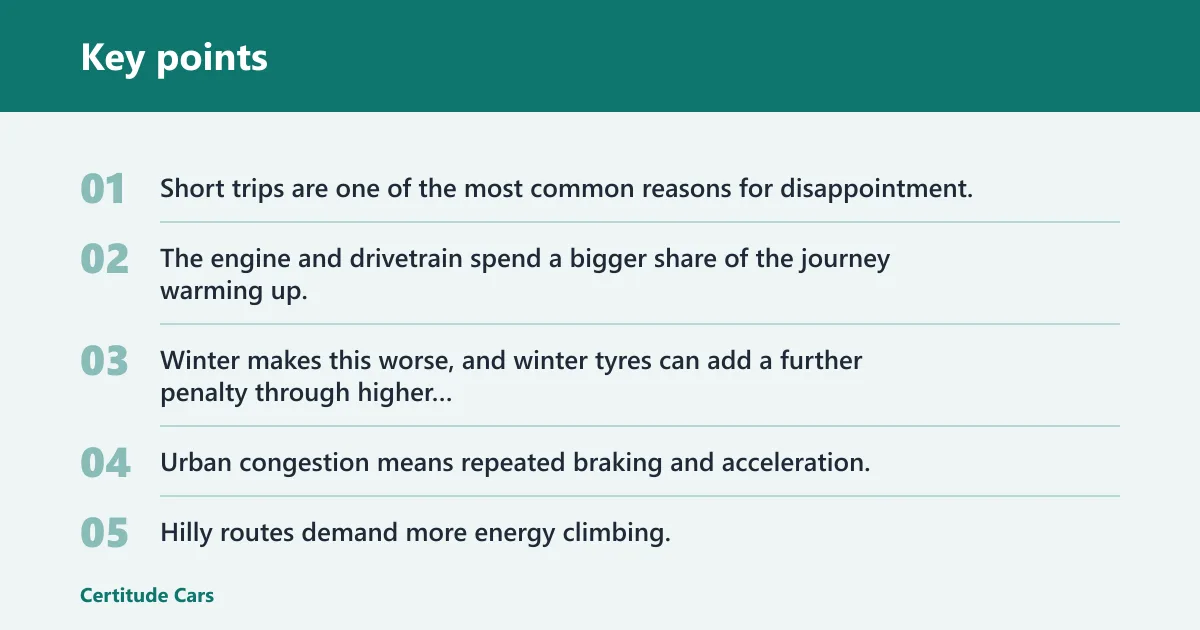
Short trips are one of the most common reasons for disappointment. The engine and drivetrain spend a bigger share of the journey warming up, so the car never sits in its most efficient range for long. Winter makes this worse, and winter tyres can add a further penalty through higher rolling resistance.
Traffic, hills, and speed
Urban congestion means repeated braking and acceleration. Hilly routes demand more energy climbing, and the gain on the descent rarely cancels the fuel used uphill. On the motorway, steadily rising speed usually hurts economy, and a car that looks strong on paper can lose ground quickly if it spends hours cruising fast.
Passengers, cargo, towing, and roof boxes
More weight means more fuel burned to move it. Towing adds both weight and drag, while a roof box adds drag even when the car is not heavily loaded. Those are high-impact cases that broad MPG guides often skip, but they matter in family and holiday use.
Dashboard MPG versus fuel-log MPG
The dashboard readout is useful for trends, but a fill-up log is better for accuracy. A single tank can be distorted by pump shutoff differences, partial fills, or one unusual trip. Several tanks give a cleaner picture of what the car actually returns in your pattern.
A common first-timer mistake is to buy on a strong combined figure, then judge the car after one cold week of 3-mile errands. That does not prove the official figure is false. It usually shows that the usage pattern is much harsher than the test cycle used for comparison.
Mpg meaning worksheet
Annual budget examples
Use the official combined MPG figure as the base number, then pair it with annual miles and an assumed pump price. The examples below use an assumed fuel price of £1.50 per litre. To compare two cars fairly, keep the annual mileage and fuel price the same for both.
| Official combined MPG | Estimated annual miles | Estimated yearly fuel cost |
|---|---|---|
| 45 mpg | 8,000 miles | £1,212 |
| 55 mpg | 12,000 miles | £1,488 |
| 65 mpg | 15,000 miles | £1,574 |
How to turn MPG into yearly fuel spend
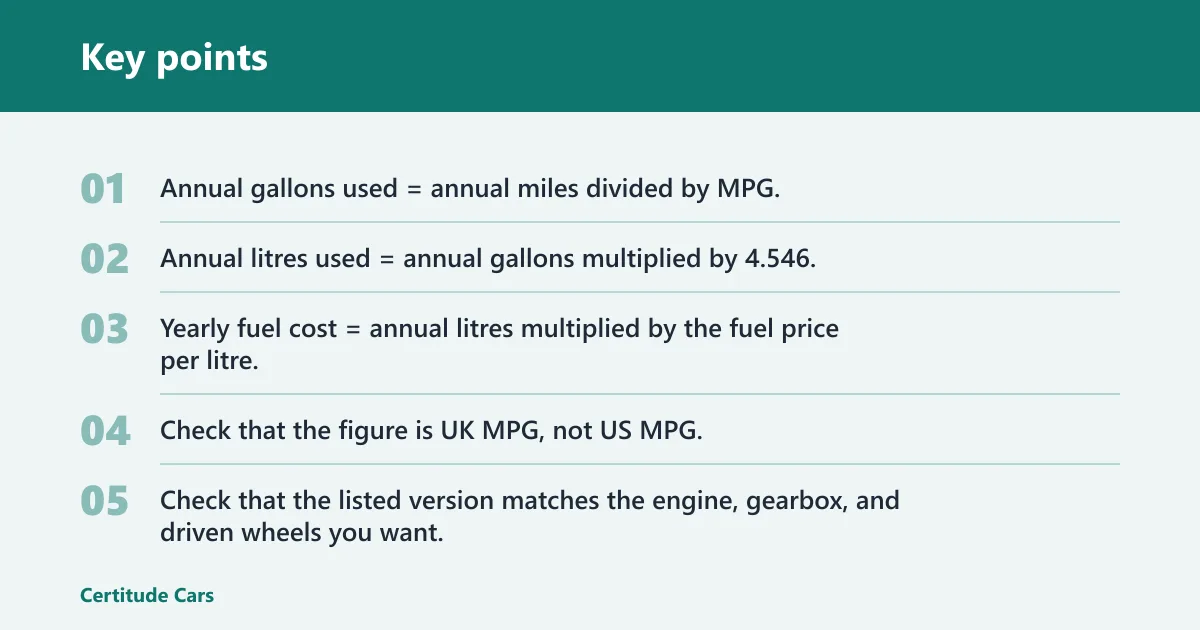
Start with annual miles. Divide that by the official MPG figure to get gallons used in a year. Convert gallons to litres using 4.546 litres per Imperial gallon, then multiply by the fuel price per litre.
- Annual gallons used = annual miles divided by MPG.
- Annual litres used = annual gallons multiplied by 4.546.
- Yearly fuel cost = annual litres multiplied by the fuel price per litre.
For example, 12,000 miles at 50 mpg works out to about 240 Imperial gallons. That equals 1,091.04 litres. At £1.50 per litre, the yearly fuel cost is £1,636.56.
How to match the worksheet to your commute
Use combined MPG if your driving is mixed. If the car will mainly do city work, budget with the city figure instead. If it will mainly do long motorway miles, use the highway figure. This avoids the common mistake of choosing one “best” MPG number that does not fit the real trip mix.
Checklist for listings, spec sheets, and fuel logs
- Check that the figure is UK MPG, not US MPG.
- Check that the listed version matches the engine, gearbox, and driven wheels you want.
- Use combined MPG for first-pass comparisons between conventional cars.
- Switch to city or highway MPG if your commuting pattern is heavily one-sided.
- Convert the chosen MPG figure into annual fuel cost using your own mileage.
- After buying, compare dashboard MPG with several full-tank calculations rather than one tank.
How do you calculate your own MPG after a fill-up?
To calculate your own MPG after a fill-up, record miles driven and the amount of fuel needed to refill the tank, then divide miles by gallons used. In the UK, that usually means converting pump litres into Imperial gallons before doing the final sum.
What numbers to record
Reset the trip meter after filling up, or note the odometer reading. At the next fill, record the miles travelled and the litres added to refill the tank to a consistent point. The more consistent the refuelling method, the better the result.
Imperial gallon conversion
In UK MPG, divide litres by 4.546 to convert fuel into Imperial gallons. Then divide miles driven by that gallon figure. This follows the standard DIY approach: miles travelled divided by gallons used to refill the tank.
Picture a refill of 45.46 litres after 500 miles. That is 10 Imperial gallons, so the result is 50 mpg. The arithmetic is simple, and the useful part is repeating it over several tanks rather than treating one tank as final.
Why several tanks matter
One tank can be skewed by a traffic-heavy week, an unusual motorway run, or slight differences in when the pump clicks off. Averaging several full-tank calculations gives a steadier result and helps you judge whether the official WLTP figure is realistic for your own use.
How should you compare MPG, MPGe, and charging cost?
Compare MPG when the car mostly burns petrol or diesel, compare MPGe only within EV and plug-in hybrid electric operation, and compare charging cost or pence per mile when electricity is part of the ownership decision. MPGe is useful, but it is not a straight swap for UK MPG.
What MPGe means
MPGe is the efficiency metric used for EVs and for the electric portion of plug-in hybrids. It uses 33.7 kilowatt-hours as the energy equivalent of one gallon of gasoline. That allows electric energy use to be shown in a familiar miles-per-gallon-style format.
Why MPGe is not directly interchangeable with MPG
MPGe is based on energy equivalence, not litres bought at a forecourt. MPG measures distance per gallon of fuel. MPGe measures electric efficiency on a different basis. Because the units start from different kinds of energy use, a higher MPGe number should not be read as directly “better than” a given UK MPG number.
Decision rule for hybrids, plug-in hybrids, and EVs
- For petrol and diesel cars, compare UK combined MPG first, then city or highway if needed.
- For full hybrids that are not plugged in, MPG is still the main shopping figure.
- For plug-in hybrids, compare both the fuel MPG figure and the electric range, then estimate how often the battery will actually be charged.
- For EVs, compare charging cost, usable range, and efficiency figures together rather than trying to force a one-to-one MPG comparison.
Say your daily round trip is 18 miles and home charging is available every night. A plug-in hybrid may spend much of the week using electricity, so electric range and charging cost matter more than its petrol-only MPG headline. Without regular charging, that same car should be judged much more like a conventional petrol car.
Frequently asked questions
What is the mpg?
MPG means miles per gallon. It shows how far a car can travel using one gallon of fuel, so it is a fuel-efficiency measure rather than a direct cost figure. For UK car buying, it is most useful when comparing official combined WLTP figures between similar petrol or diesel cars.
What does mpg stand for in cars?
In cars, MPG stands for miles per gallon. It describes the distance a vehicle covers on one gallon of petrol or diesel. A higher number means the car uses less fuel for the same journey, which usually means lower fuel spend if annual mileage stays the same.
What is mpg used?
MPG is used to compare fuel economy and to estimate running costs. Shoppers use it on listings and spec sheets to narrow down cars, then convert the figure into annual fuel spend using their own mileage, journey type, and local fuel price rather than relying on the headline number alone.
How is mpg measured?
In the UK, official MPG is measured under WLTP, which replaced NEDC for all new cars from 2017. WLTP reports Low, Medium, High, Extra-high, and Combined phases. These figures are standardised comparison tools, not guarantees of what every driver will get on the road.
How do I work out my mpg after a fill-up?
Record the miles driven since the last full tank, then divide that distance by the gallons needed to refill. If the pump shows litres, convert litres to Imperial gallons by dividing by 4.546 first. Repeat over several tanks for a result that is more useful than one fill alone.
Is mpg the same as mpeg?
No. MPG is a fuel-economy measure meaning miles per gallon. MPEG is a digital media format term and has nothing to do with cars, fuel use, or running costs. If a listing, dashboard, or review mentions MPG, it is referring to vehicle efficiency, not video files.