Registration Renewal: How to Renew and Fix Problems
Renew your registration after checking four things: your renewal window, inspection or emissions status, active insurance, and any title, toll, tax, or parking holds. If any one of those fails, skip online renewal and use in-person service. A missed step can lead to late fees, tickets, impound risk, or a period when you cannot drive legally. This guide shows you how online, mail, and in-person renewal work, what the total cost usually includes, and how to clear the most common renewal blockers.
How do you renew a registration?
Renew a registration by confirming that the record is open for renewal, that the vehicle and owner details match state records, and that no compliance hold is attached. Then use the channel that fits the record: online first if eligible, mail if the state allows it, and in person when a hold, mismatch, or expiry cutoff blocks remote renewal.
Choose the right channel first
The fastest option is not always the website. A clean, currently eligible record usually belongs online first. A record with a failed inspection, an insurance mismatch, unpaid property tax, toll debt, parking tickets, or a registration expired too long usually belongs in person.
Mail sits between those two. It can work when the state still accepts mail renewals for your registration type and your notice or form matches the record exactly, but it rarely fixes a failed online attempt caused by a compliance hold.
- Check the renewal window. Confirm that the state has opened your record for renewal and that the current registration has not aged past any online cutoff. Connecticut, for example, sends a renewal invitation 45 days before expiration, which gives a concrete example of how early access can begin.
- Match the record details. Compare the plate number, registration number, vehicle year, make, VIN characters, owner name, and address on the notice or current registration against what you plan to enter. A mismatch here often looks like a website failure when the real problem is the record.
- Clear compliance holds. Check emissions or inspection status, insurance, and any state or local debts tied to renewal. Connecticut specifically says emissions testing problems, insurance requirements, and unpaid property tax can prevent renewal.
- Pick the channel. Use online renewal only if the vehicle class and record are eligible. Switch to mail only when your state accepts it for your registration type and your notice or form is complete. Use in-person service when the record is blocked, expired too long, or excluded from remote renewal.
What information you usually need before you start
States usually ask for three kinds of information: record identifiers, vehicle details, and payment information. Common fields include the plate number, registration number, notice number, part of the VIN, owner name, date of birth, address, and insurance details in states that verify coverage.
Online systems can be stricter than paper forms. Connecticut’s online renewal asks for a Social Security Number and a credit or debit card. If the address or owner data no longer matches the vehicle record, the transaction may stop before payment.
When a renewal notice helps and when it is not required
A renewal notice helps because it usually carries the record identifiers the state wants, such as the plate number, registration number, renewal PIN, mailing instructions, and due date. It also signals whether the state expects online, mail, or in-person handling for that record.
It is not always required. Many states let you renew without the mailed notice if you can supply the needed record details. Mail renewal is more likely to depend on the notice or renewal form, because that document may also act as the payment form and routing sheet.
Say your notice never arrives, your registration expires next week, and your state portal already shows the vehicle as eligible. In that case, the missing notice is a hassle, not a blocker. Use the portal with the plate, registration number, and owner details instead of waiting on the mail.
Can you renew online, by mail, or in person?
Yes, but each channel has real limits. Online renewal is usually fastest for eligible records, mail renewal depends on the correct state form, mailing address, and payment instructions, and in-person service is the fallback for restricted vehicle classes, expired-too-long records, and cases with inspection, insurance, tax, or identity mismatches.
Online renewal eligibility and common exclusions
Online renewal usually works best when the record is ordinary and current: standard passenger registration, no open holds, and matching owner information. Connecticut says online renewal usually takes 3 to 5 minutes, which is a useful benchmark for a clean transaction.
Common exclusions include commercial or specialty registration types, fleet accounts, records with suspended insurance status, vehicles needing emissions or inspection clearance, and registrations expired beyond the state’s online limit. Some systems also reject a renewal if the owner has changed or the mailing address does not match the database closely enough.
- Open the state portal. Use the state’s registration renewal page rather than a general motor-vehicle homepage. Many states also place nearby tasks for status checks, replacement documents, and plate decal replacement; Massachusetts groups renewal, amendment, replacement, and status checks on its registration page.
- Enter the exact record fields. Type the plate number, registration or notice number, owner details, and any VIN characters exactly as shown on the current record. Small formatting errors can produce a false “not found” result.
- Confirm payment and print. Pay with an accepted method, often a credit or debit card. Connecticut requires a printer to print the renewed registration for the vehicle, so payment is not the last step if your state expects printed proof.
Mail renewal rules and when the notice matters
Mail renewal usually depends on the state-issued notice or a matching paper form, because the mailing address, payable amount, and processing instructions can vary by county, tax district, or registration class. If the notice is missing, first check whether the state accepts a downloaded replacement form or requires in-person handling instead.
Mail is often best for records that are already eligible and do not need immediate proof. It is a poor fix for an online denial caused by emissions, insurance, tax, toll, or ticket problems because those holds usually follow the record across channels.
- Read the notice carefully. Check whether the form is required, whether a check or money order is needed, and whether a signature, insurance information, or return-envelope rules apply. Missing one box can delay processing past the expiration date.
- Verify the total due. Separate the base renewal amount from any late fee, tax, plate charge, or mailing fee. If the amount looks higher than expected, compare it against any listed hold or penalty before sending payment.
- Mail with time to spare. Send it early enough to cover delivery and processing time. If the registration is close to expiring, a mail packet may still arrive on time but return too late to keep you legal on the road.
In-person renewal cases that usually need documents or an appointment
In-person service is usually necessary when a remote channel cannot verify the record, when the registration class is excluded from online renewal, or when the registration has been expired long enough to trigger a different process. Some states require appointments for branch visits, while others reserve appointments for selected services or locations.
Typical documents include the current registration, the renewal notice if available, proof of identity, proof of insurance, emissions or inspection proof if your state does not verify it electronically, payment, and any hold-release paperwork. The exact set depends on the reason remote renewal failed.
Suppose the website accepts your plate number but stops at “insurance not on file” even though the policy is active. That is the point to switch channels. Bring proof of insurance and the current registration to an office or state-approved service location, because re-entering the same record online rarely fixes a verification mismatch.
What does registration renewal cost?
Registration renewal cost has layers, not one number. Start with the base renewal fee for the vehicle’s registration type, then add any late fee, local tax, inspection-related charge, plate or decal fee, convenience fee, or debt hold that must be cleared before the state will release the renewal.
Base renewal fee by registration type
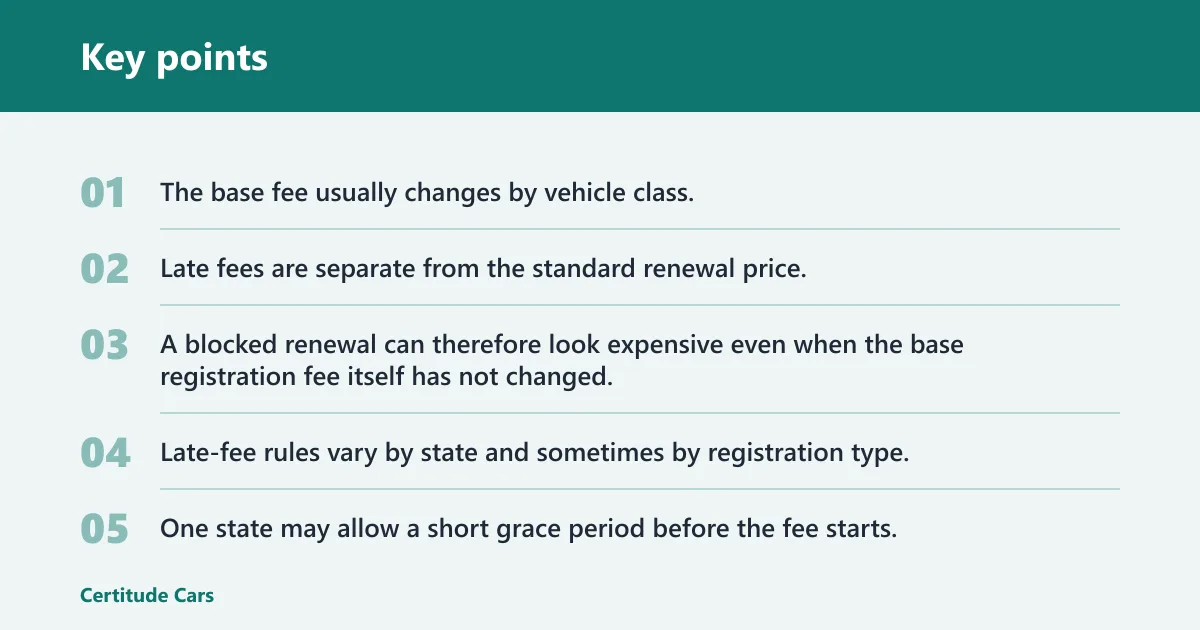
The base fee usually changes by vehicle class. Passenger cars, motorcycles, trailers, commercial vehicles, apportioned vehicles, and specialty plates often renew at different prices. That is why a neighbor’s cost can mean nothing even in the same state.
Registration type also affects eligibility. Some classes are excluded from online renewal altogether, so the fee question and the channel question are tied together from the start.
Late fees, penalties, and add-on charges
Late fees are separate from the standard renewal price. So are parking or toll debts, unpaid property tax holds in states that use tax compliance, county taxes, service fees, and replacement-document charges. A blocked renewal can therefore look expensive even when the base registration fee itself has not changed.
Do not treat every extra dollar as a “renewal fee.” If the state lists a toll balance, court hold, or local tax debt, that amount is a separate obligation tied to renewal eligibility, not part of the standard registration price.
Connecticut late-fee example and why it does not apply everywhere
The same source gives a clear example: a $10 late fee applies if renewal is more than five days after expiration, and the late fee is assessed on day 6 after expiration. That is useful because it shows both the trigger point and the flat amount, but it should not be treated as a national rule. (CT)
Late-fee rules vary by state and sometimes by registration type. One state may allow a short grace period before the fee starts. Another may cut off online renewal after a shorter or longer expired period. Always separate the state’s base renewal fee from any late fee when you compare costs.
A common first-timer mistake is adding a tax hold or a replacement decal charge to the standard renewal amount and assuming the base fee has jumped. Read each line item. A normal renewal price and a blocked-renewal total are often very different numbers.
What can block renewal?

Most renewal failures trace back to one of four causes: the notice or record details do not match, a compliance item such as emissions or inspection has not cleared, insurance cannot be verified, or the state has attached a debt or restriction hold. Diagnose in that order before changing channels.
Notice missing or vehicle record mismatch
A missing notice does not always stop renewal. What matters first is whether the state has opened the record and whether you can match the database fields exactly. A wrong apartment number, an owner suffix mismatch, a plate transposition, and VIN-character errors are common reasons a portal may reject an otherwise eligible vehicle.
If the notice arrives late or shows the wrong vehicle, stop and check status before paying. A notice tied to an old plate, old address, or transferred vehicle can send you into the wrong transaction path.
Emissions or inspection not cleared
Inspection rules are state-specific. Some states require emissions testing, some require a safety inspection, some require both, and some require neither for certain vehicles or counties. The key point is that the test result often has to clear in the state’s database before renewal becomes available.
Connecticut specifically says emissions testing problems can prevent renewal. That can mean the test was failed, missed, recorded under the wrong VIN, or not yet transmitted into the renewal system.
Insurance, property tax, toll, or ticket holds
Insurance verification is another common stop point. The same source says insurance requirements can block renewal. Even active coverage can fail verification if the insurer’s file, owner name, or vehicle identification data does not match the registration record closely enough.
Tax and debt holds vary by state and locality. The same source says unpaid property tax can prevent renewal. Other states or localities may tie renewal to tolls, parking tickets, court obligations, or similar public debts. Those amounts are usually separate from the base renewal cost.
Renewal blocker checklist table
| Blocker | Symptom | Likely cause | Fix | Online renewal still possible? |
|---|---|---|---|---|
| Notice missing | No mailed or emailed reminder, but expiration is near | Notice delay, wrong address, email filtering, or state uses notice as reminder only | Check registration status and renewal eligibility first. Renew with plate, registration, VIN, and owner details if the portal allows it. | Usually yes, if the record is otherwise eligible |
| Record mismatch | Portal says record not found or owner data does not match | Plate, VIN, name, suffix, or address mismatch; old plate or transferred vehicle | Compare current registration and notice line by line. Correct the record before retrying. | Sometimes, after correction |
| Emissions or inspection not cleared | Renewal blocked with testing or compliance message | Missed test, failed test, wrong VIN on test record, or database not updated | Complete or correct the required test, then wait for the result to post or bring proof in person if the state allows that | Often yes after the state system updates |
| Insurance issue | Coverage cannot be verified | Lapsed policy, wrong policy data, insurer file mismatch, owner mismatch | Confirm active coverage with the insurer and the state record, then retry or take proof in person | Often yes after verification |
| Unpaid tax, tolls, or tickets | Balance due or hold message during renewal | Property tax hold, toll debt, parking tickets, court-related balance, or local compliance hold | Pay or clear the obligation with the listed agency, then confirm the hold has been released | Sometimes, once the hold is removed |
| Expired too long | Portal refuses renewal for an expired registration | State cutoff for online or mail renewal has passed | Use in-person service and ask whether late renewal is still allowed or whether a different registration process now applies | No, in many states |
| Registration type restriction | Portal does not offer renewal for that vehicle class | Commercial, specialty, fleet, apportioned, or other excluded class | Use the channel the state assigns for that class, often mail or in-person | No, if the class is excluded |
Can you renew if the registration is expired?
Usually yes, but the answer depends on how long it has been expired and whether the state still treats the record as a normal renewal. A recently expired registration may still renew with a late fee, while a long-expired record often loses online access and may require in-person handling or a different registration process.
Recently expired registrations
Many states still allow renewal shortly after expiration, though the vehicle may already be unlawful to drive. The practical question has two parts: whether the state still permits renewal, and whether it still permits online renewal.
Connecticut provides a concrete late-fee example. A $10 late fee applies if renewal is more than five days after expiration, and the fee is assessed on day 6 after expiration. That shows how quickly a normal renewal can turn into a late renewal.
Expired too long for online renewal
States often cut off online renewal after a defined expired period or for records that trigger extra checks. Once that cutoff is reached, re-entering the portal usually wastes time. The barrier is policy, not a browser problem.
Picture a registration that expired months ago on a specialty vehicle class. The portal declines it without a payment screen. That points to a channel restriction or expiry cutoff, so the practical next step is to gather documents for in-person service rather than trying different devices.
When late renewal turns into an in-person or re-registration case
Use in-person service when the state says the record is no longer eligible online, when identity or ownership changed, or when the vehicle class is excluded. Ask whether the case is still a late renewal or whether the state now requires a new registration transaction, plates, or other record updates.
The longer the gap, the more likely the state will want original documents instead of an online payment alone. That can include proof of insurance, identity, address, and compliance clearance.
What do you receive after renewal?
After renewal, you usually receive an updated registration certificate, and in some states a plate decal or temporary printable proof while the physical document follows by mail. What matters is whether the state expects you to print and carry proof right away, because payment confirmation alone may not satisfy roadside proof requirements.
Renewal certificate and temporary proof
The normal result is an updated registration record plus a certificate you should keep with the vehicle. Some states also provide an interim printable confirmation or a temporary access window in the portal so you can retrieve the document again after payment.
Check the wording carefully. “Payment received” and “registration renewed” are not always the same screen, and a temporary confirmation is not always the same document as the registration certificate.
When you need to print and keep a copy in the vehicle
Some states expect immediate printed proof. Connecticut requires a printer to print the renewed registration for the vehicle. If you renew online without printer access, the transaction can still go through, but you may end up without the document the state expects you to carry.
That is why printer access belongs in the pre-renewal checklist, along with payment method and identity fields. It affects the practical value of online renewal, not just convenience.
How long online access or printable proof may remain available
Access windows vary by state. Some portals let you reprint for a limited period, while others direct you to replacement-document services afterward. Massachusetts, for example, groups status checks and replacement registration tasks with renewal-related services, which is a useful signpost when a document cannot be reprinted from the original transaction.
If you cannot print immediately, save the transaction confirmation number and check whether the state offers a replacement registration or plate decal task. Massachusetts includes a top task to replace a vehicle registration or plate decal and also includes a task to check registration status.
Frequently asked questions
How do I renew my car registration?
Start by checking that the renewal window is open, the vehicle record matches your current details, and there are no emissions, insurance, tax, toll, or ticket holds. Then use the channel your record supports: online for a clean eligible record, mail where allowed, or in-person service when a hold or restriction blocks remote renewal.
How much does registration renewal cost?
The total usually includes a base renewal fee plus any separate late fee, tax, decal charge, convenience fee, or public-debt hold that must be cleared first. Fees vary by registration type, so passenger, motorcycle, trailer, and commercial renewals should not be compared as if they share one standard price.
Why can’t I renew my car registration?
Most failed renewals come from record mismatch, emissions or inspection status, insurance verification, unpaid property tax where used as a hold, or other debts such as tolls or parking tickets. Check those before blaming the website. If the failure message points to a restriction, in-person service is usually the fastest fix.
Can I renew my registration online?
Usually yes, if your state has opened the record for renewal, your vehicle class is eligible, the registration is not expired beyond the state’s cutoff, and no compliance hold exists. Online systems often require exact identity and vehicle fields, accepted card payment, and immediate printing of the renewed registration or proof.
Do I need an inspection before registration renewal?
Only if your state or county ties renewal to emissions or safety inspection compliance. This is not universal. Where inspection or emissions applies, the result often must clear in the state’s database before renewal works, so completing the test and waiting for the record to update can matter as much as the test itself.
What happens if I miss the renewal deadline?
You may owe a late fee, lose online renewal access, and risk tickets or other enforcement if you keep driving on an expired registration. The same source gives one clear example: the state assesses a late fee on day 6 after expiration. The same source states use different triggers, amounts, and channel cutoffs.