When Does Car Depreciation Slow Down the Most?
Car depreciation often slows after the first few years, and resale values may settle further once a car reaches around four to five years old. Miss that timing, and you can lose far more in the first 36 months than the market will ever give back. This guide shows the age bands where the fall eases, why mileage and trim still matter, and when values start to plateau.
This guide is part of our Car depreciation explained series.
Why car depreciation slows at all
Depreciation is the difference between your purchase price and the amount a car can fetch later. The sharpest drop usually lands in the first year, or as soon as a car moves from new to used, because buyers no longer treat it as untouched stock. After that, the percentage loss usually eases.
That easing does not mean the car stops losing money. It means the rate changes. The cash loss can stay large in pounds while the percentage drop gets smaller each year, which is why the curve feels less severe even before it truly flattens.
Percentage loss versus cash loss
These are different measures. Percentage loss shows how much of the car’s current value disappears in a year; cash loss shows the actual pounds removed from the resale price. A car can lose a smaller share of value while still shedding a noticeable amount of money if it starts from a high base.
That distinction matters most after year three. A more expensive model may still lose more pounds per year than a cheaper hatchback, even if its percentage decline is similar or lower. Residual value matters here because a higher residual value lowers ownership cost and improves lease and resale comparisons.
When does car depreciation slow down most?
Depreciation usually slows most after the first three years, with a clearer flattening around years four to six. Many cars approach 50% loss by the three-year mark, and most new cars lose roughly 60% within five years, so the hardest hit often lands well before values begin to steady.
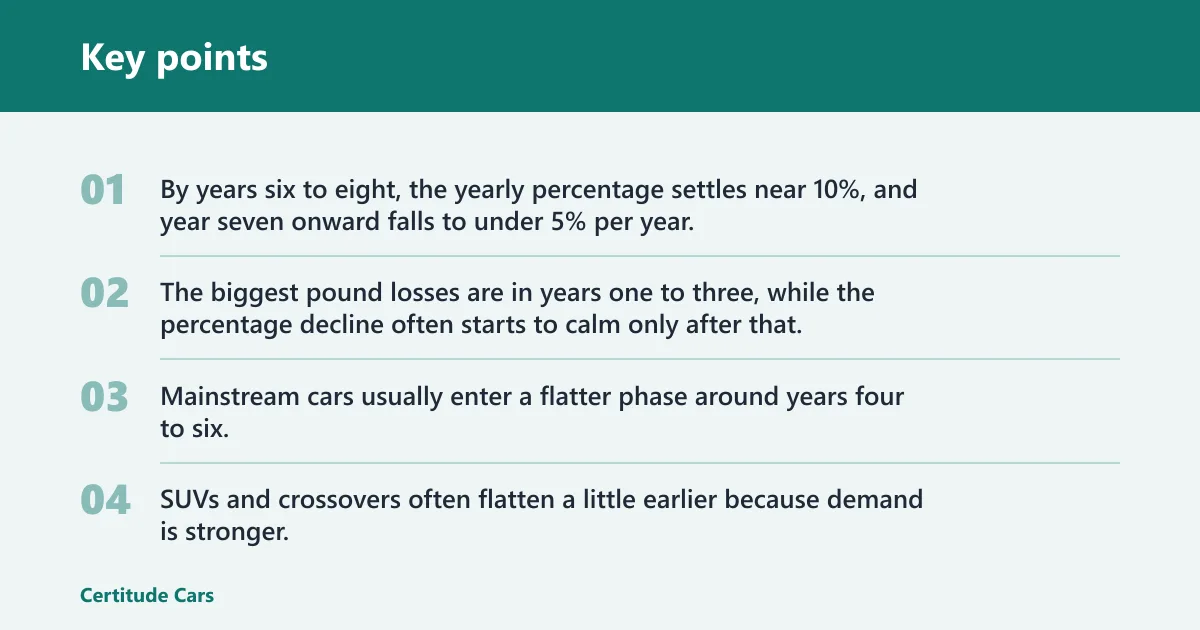
The curve changes again later. By years six to eight, the yearly percentage settles near 10%, and year seven onward falls to under 5% per year. That is the point where depreciation often feels more manageable, especially on used cars that already absorbed the early drop.
Why the curve feels flatter even before losses stop
The market does not move in a straight line. Early on, the car is losing value from a new-car starting point, so each year removes a larger slice of what buyers will pay. Later, the same market pressure is applied to a smaller base, so the annual change looks less severe even if the car still sheds value.
That is why a four- or five-year-old car can still depreciate, yet feel much easier to own than a brand-new one. The biggest pound losses are in years one to three, while the percentage decline often starts to calm only after that.
Car depreciation slowdown map
| Year | Mainstream hatchback value remaining | Mainstream hatchback annual loss | Mainstream hatchback cash loss | SUV/crossover value remaining | SUV/crossover annual loss | SUV/crossover cash loss | Luxury EV value remaining | Luxury EV annual loss | Luxury EV cash loss |
|---|---|---|---|---|---|---|---|---|---|
| 0 | 100% | 0% | £0 | 100% | 0% | £0 | 100% | 0% | £0 |
| 1 | 80% | 20% | £4,000 | 84% | 16% | £4,800 | 72% | 28% | £16,800 |
| 2 | 68% | 15% | £2,400 | 74% | 12% | £3,600 | 58% | 19% | £8,400 |
| 3 | 56% | 18% | £2,400 | 66% | 11% | £2,800 | 46% | 21% | £7,200 |
| 4 | 48% | 14% | £1,600 | 59% | 10% | £2,100 | 38% | 17% | £4,800 |
| 5 | 42% | 12% | £1,200 | 53% | 10% | £1,800 | 32% | 16% | £3,600 |
| 6 | 37% | 12% | £1,000 | 48% | 9% | £1,500 | 27% | 16% | £3,000 |
| 7 | 34% | 8% | £600 | 44% | 8% | £1,200 | 23% | 15% | £2,400 |
| 8 | 31% | 6% | £450 | 40% | 7% | £960 | 20% | 13% | £1,800 |
| 9 | 29% | 4% | £300 | 37% | 5% | £780 | 17% | 10% | £1,200 |
| 10 | 27% | 3% | £240 | 34% | 4% | £600 | 15% | 8% | £720 |
The table uses a simple starting price of about £20,000 for the hatchback, around £30,000 for the SUV or crossover, and about £60,000 for the luxury EV. The shape matters more than the exact starting price: the mainstream car flattens later than the SUV in this example, while the luxury EV keeps losing more in pounds even after its percentage loss begins to ease.
Mainstream cars usually enter a flatter phase around years four to six. SUVs and crossovers often flatten a little earlier because demand is stronger. Luxury EVs can stay volatile longer, mainly because new model releases, price cuts, and battery-related buyer caution can keep pressure on used prices.
Which cars depreciate the slowest?
Cars with strong demand, a broad buyer base, and a good reputation usually depreciate the slowest. In the UK, SUVs and 4x4s currently hold their value better than saloons and estates, while Porsche, Land Rover, Toyota and Lexus are cited as strong value holders. Trucks and body-on-frame SUVs can also retain more value than many passenger cars.
That does not make every SUV a safe bet. Segment matters, but trim, mileage, condition, and market timing still decide the final number. A popular model in the wrong configuration can still underperform a less fashionable rival with a stronger spec and service file.
Popular mainstream models
High-volume cars often hold up well because buyers know them, parts are easy to source, and the used market is deep. Strong brand reputation helps too, since buyers tend to trust models that have a track record for durability and predictable running costs. Residual value tends to be stronger when the car feels easy to resell.
SUVs, 4x4s, trucks, and body-on-frame vehicles
These vehicles often keep value better than saloons because demand is broad and practical use cases are clear. A body-on-frame SUV or pickup can also resist depreciation better than a soft-roader if the market sees it as tough and usable. That said, fuel costs and tax exposure can still affect the next buyer’s offer.
Luxury cars and EVs
Luxury cars often lose more in absolute pounds because they start from a higher sticker price. Luxury EVs can also depreciate faster when new models land with better range or lower list prices, since buyers compare used examples against the latest technology. A high starting price gives the market more room to cut.
Does mileage matter more after year three?
Yes, mileage often matters more after year three because age alone no longer explains the whole price. UK mileage benchmarks are roughly 7,500 to 12,000 miles per year, with 8,000 to 12,000 miles per year often cited. Once a car is older, buyers compare its mileage against that age band more closely.
Higher-than-average mileage usually lowers resale value, especially if the car is already beyond the first few years and the mileage starts to look heavy for its age. Low mileage can support stronger residual value, but only if the rest of the car backs it up with condition and service records.
Compare mileage to age. Check whether the car sits above or below the usual annual mileage band for its age. A seven-year-old car on 35,000 miles may look lightly used, while the same car at 90,000 miles will usually need a lower asking price.
Match mileage to condition. A low-mileage car with worn tyres, scuffed wheels, or old service gaps will not behave like a premium example. Buyers price in risk, so mileage only helps when the rest of the car looks properly maintained.
Use mileage to time a sale. If a car is close to a mileage milestone that used buyers watch closely, selling before that mark can help preserve value. The market often rewards cars that stay near the expected use pattern for their age.
Say your five-year-old hatchback has 28,000 miles and a full service history. It will usually look stronger than the same model on 65,000 miles, even if both are tidy, because the first example sits well below the UK mileage range for age.
What else changes the slowdown point?
Depreciation does not slow for every car at the same age because the market keeps changing. Condition, service history, brand reputation, model demand, new model launches, price cuts, interest rates, and policy changes can all move the used price curve. A car that should flatten can still drop again if the market shifts against it.
Condition and service history
Full service history protects value because it reduces buyer risk. Bodywork, paint, wheels, seat wear, and the state of the interior all matter, since visible neglect can push buyers to discount the car even when the mileage is sensible. Documented maintenance does the same job on paper that tidy condition does in person.
Market demand and policy changes
Supply and demand set the pace. A new generation of the same model, a trim-level refresh, or a price cut from the manufacturer can pull older stock down faster than expected. Interest rates can also reduce buyer appetite for finance, while tax or ULEZ rule changes can hit some models harder than others.
Check the model cycle. Look for a recent facelift, replacement, or price cut before you buy or sell. Older stock usually softens when the new version offers the same equipment for less money.
Review the paperwork. Keep invoices, service stamps, and MOT history together. Buyers pay more easily when they can see a clean record rather than having to guess how the car has been maintained.
Watch the local rules. If a tax or clean-air rule changes in your area, check whether it affects engine type, emissions standard, or body style. A policy shift can change the used market faster than age alone.
Suppose two identical SUVs are for sale at six years old. One has a full dealer history and straight panels, while the other has missing invoices and a scraped rear quarter. The second car will usually be valued lower, even if both have the same mileage, because the risk sits in the paperwork and the bodywork.
Frequently asked questions
When do cars depreciate the most?
Cars lose the most value in the first year and in the first three years overall. Most new cars in the UK lose 15% to 35% of value in the first year, and the steepest pound losses are in years one to three. The big drop comes when the car moves from new to used.
Why do new cars depreciate so fast?
New cars depreciate fast because the first buyer pays for new-car status, while the next buyer only pays for the car itself. The moment it becomes used, the market prices it differently. Most new cars lose about 20% in the first year, and many approach 50% loss by year three.
How fast do cars depreciate?
That depends on age, mileage, model demand, condition, and segment. A typical new car loses about 20% in the first year, many cars approach 50% loss by year three, and most new cars lose roughly 60% within five years. After year one, the rate slows but continues steadily.
When does car depreciation slow down?
Depreciation usually slows after the first three years and becomes more noticeable in years four to six. By years six to eight, the yearly percentage settles near 10%, and year seven onward falls to under 5% per year. That is where values often begin to feel more stable.
At what age does a car hold its value better?
A car often starts to hold its value better once it gets beyond the sharp new-to-used drop, usually around three to five years old. The exact point depends on the segment. SUVs and strong mainstream models may steady sooner, while luxury cars and EVs may take longer to flatten.