Can You Renew an Expired Car Registration?
Yes. In the United States, many states allow you to renew an expired car registration, but some states block online renewal after about 1–2 years, require inspections or fee payment first, or force reinstatement after longer lapses. If you ignore the lapse, late fees, citation risk, towing, and extra paperwork can follow. This guide lays out the renewal decision tree, common blockers, and the next step when renewal is not allowed.
Can you renew an expired car registration?
Yes, often you can. A simple lapse can still mean the record is renewable even after the due date, but the state may add late fees or require current insurance, an inspection, or both before processing the renewal. A longer lapse, a hold, or a suspended record can change the answer.
When renewal is still allowed after expiration
If the record is active and only overdue, the DMV or motor vehicle agency may still accept renewal through its regular channels. The key question is whether the file is merely expired or whether something else has blocked it, such as a failed emissions test, unpaid tolls, or lapsed insurance.
When renewal turns into reinstatement
Reinstatement applies when the record is no longer eligible for a plain renewal. That can happen after a suspension, a hold, or a required clearance that has not been resolved. In that situation, paying the normal renewal fee alone may not work.
Think of renewal as a routine extension and reinstatement as fixing the record before the extension can be processed. If the agency says the file is blocked, clear the issue first, then return to renewal.
Expired registration renewal checker
This table separates simple expiration from the most common blockers. Use it to decide whether you can renew now, need to clear an issue first, or must reinstate the record.
| State rule | Days past expiry | Insurance status | Inspection needed | Outstanding holds | Renewal channel | Likely outcome |
|---|---|---|---|---|---|---|
| Simple lapse, no block on record | 1-30 | Current | Not required | None | Online, mail, or in person | Renewal with late fee |
| Late renewal window still open | 31-90 | Current | Required by state | None | Online only if allowed; otherwise in person | Renewal with late fee |
| Record still renewable, but inspection failed | Any late window | Current | Failed or missing | None | After repair, then inspection site or DMV channel | Renewal blocked until inspection clears |
| Record blocked by insurance lapse | Any late window | Lapsed | May be current | None | Usually after proof of current insurance | Renewal blocked until insurance is active |
| Record has DMV or toll hold | Any late window | Current | May be current | Yes | In person or after clearance | Reinstatement or clearance first |
| Record has aged out of standard renewal | Beyond state window | Current or lapsed | May be required | Possible | In person after reinstatement steps | Reinstatement likely required |
| No renewal notice, but VIN lookup works | Any late window | Current | Depends on state | None | Online or agency lookup by VIN | Renewal if the record is clear |
| Scenario: no notice | 10 | Current | Not required | None | VIN or plate lookup | Renewal with late fee |
| Scenario: failed smog | 15 | Current | Failed | None | After repair and retest | Renewal blocked until clearance |
| Scenario: insurance lapse | 20 | Lapsed | Current | None | After insurance reinstates | Renewal blocked until proof of insurance |
| Scenario: DMV hold | 25 | Current | Current | Yes | After hold clears, often in person | Reinstatement or clearance first |
What blocks renewal after expiration?
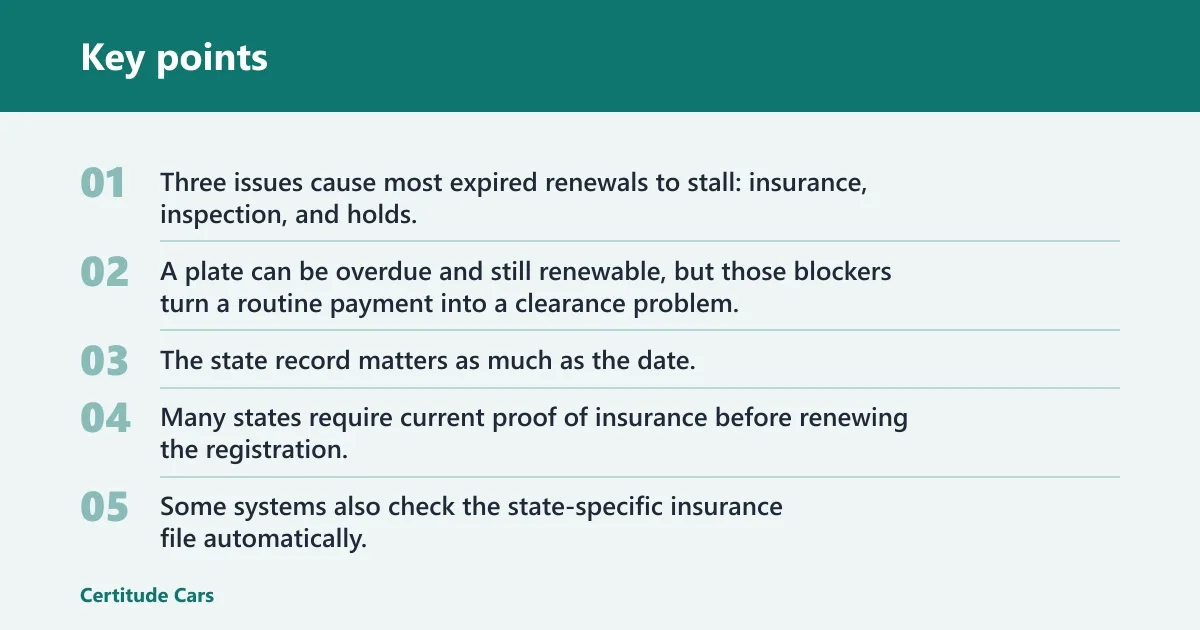
Three issues cause most expired renewals to stall: insurance, inspection, and holds. A plate can be overdue and still renewable, but those blockers turn a routine payment into a clearance problem. The state record matters as much as the date.
Expired registration can still lead to tickets, citations, or other legal trouble, so treat the lapse as an action item, not a delay.
Insurance problems
Many states require current proof of insurance before renewing the registration. If the policy lapsed, was canceled, or does not match the vehicle, the agency may refuse renewal until the coverage is active again. Some systems also check the state-specific insurance file automatically.
Once the policy is current, keep the proof ready in the same name and VIN as the vehicle record. A mismatch can slow the transaction even when the policy itself is active.
Inspection or smog failures
A failed inspection is separate from expiration. The car can be overdue and still eligible for renewal in theory, but a failed safety inspection or smog check blocks the process until the vehicle passes.
That is why a renewal notice matters. It may say whether an inspection is required before the agency will accept payment. If the notice is missing, a VIN lookup or plate lookup may still show the requirement.
DMV holds and suspended records
Unpaid tolls, fees, or other agency holds can block renewal even when everything else is current. Some records are also flagged because of suspensions or unresolved compliance issues. In those cases, the DMV or motor vehicle agency may require clearance first and only then allow the renewal or reinstatement.
A hold is not the same as a late fee. Late fees are added to an overdue but renewable record. A hold blocks the record itself.
How do you renew an expired registration?
Start by checking the record status, then use the channel your state allows. If the file is only overdue, renewal may be available online, by mail, or in person. If the record has a blocker, clear that issue first before trying again.
Online renewal
Online renewal is often the fastest route when the record is merely expired. Some states limit online access after a longer lapse, and some require a cleared inspection or current insurance before the system will accept payment. Do not assume the website will process every overdue record.
Pennsylvania allows renewal online, by mail, or through authorized PennDOT agents. For Pennsylvania online renewal, the listed items include plate number, title number, insurance details, odometer reading, and a credit card. Pennsylvania passenger vehicle registration increased from $45 to $48 on April 16, 2025, and Pennsylvania charges a county use fee of up to $5. Pennsylvania two-year registration costs $96.
In-person or mail renewal
Use in-person service when the record needs review, when a block is present, or when the state does not support the specific overdue transaction online. Mail can work for simple renewals in some places, but it is slower and depends on the state’s processing rules.
When a third-party location offers renewal help, confirm the total before you submit payment. The state agency is still the place to check first for the official fee and status.
When a temporary moving permit may apply
Some states issue a temporary moving permit or trip permit when the registration is expired and the vehicle must be driven to an inspection station, renewal site, or repair facility. The permit is there to legalize a narrow trip, not to replace renewal. If the state offers one, use it only for the approved purpose and date range.
Do not assume the vehicle can be driven anywhere just because a permit exists. The permit usually covers one specific route or a limited window, and the state may still expect the renewal steps to be finished promptly.
-
Check the record status.
Use the plate number or VIN to see whether the issue is only expiration or a blocker such as a hold, failed inspection, or insurance lapse. This tells you whether to renew now or clear something first.
-
Gather the required items.
Have the vehicle details, proof of insurance, and any inspection or emissions paperwork ready. If the state asks for an odometer reading or payment card, include those too.
-
Choose the right channel.
Use the online system if the record is eligible. If the file is blocked, go in person or follow the state’s clearance process before trying again.
-
Pay the full amount.
Expect the base renewal fee, any late fee, and the inspection or service charge if one applies. A third-party agent may add its own fee, so confirm the total before you submit payment.
What do you need to renew it?
Most states ask for the vehicle’s plate number or VIN, current proof of insurance, and any inspection or emissions documents required by that jurisdiction. If the renewal notice lists a title number, odometer reading, or other field, include that as well. Missing one required item can stop an otherwise valid renewal.
Plate or VIN details
The agency has to match the application to the correct record. A plate number often works, and some systems allow VIN lookup when the notice is missing. The lookup can also show the due date, fee amount, and any blocker on the account.
Proof of insurance
Many states require the policy to be current on the renewal date. If the insurance lapsed and was later restarted, the DMV may want proof that the active policy is in force now, not just evidence that the vehicle was insured at some point in the past.
Inspection or emissions documents
When a state requires a safety inspection or smog check, the renewal usually depends on passing it first. Keep the paperwork handy because some systems pull the result automatically, while others still want the printed certificate or reference number.
Say your renewal notice is missing, but the state system accepts a VIN lookup. If the record shows current insurance and a passed inspection, renewal may still go through without the paper notice. If the VIN lookup shows a hold, the missing notice does not change the problem.
Can you renew without a notice?
Yes, often you can. A renewal notice is helpful, but it is not always required because many agencies can search by VIN or plate. If the notice is missing, the main question is whether the agency’s record is complete enough to let you renew and whether any inspection or hold is already tied to the file.
VIN lookup and plate lookup
Use VIN lookup when the notice never arrived or was lost. This is common in systems that keep the registration record tied to the vehicle identification number rather than the paper notice. The lookup can show the due date, fee amount, and any blocker on the account.
When a notice is still useful
A notice can spell out whether the state expects an inspection, an emissions test, or a title update before renewal. It may also list fee amounts and payment options. If the notice is unclear or absent, check the state record directly instead of guessing.
What happens if your registration is expired?
An expired registration can lead to tickets, citations, and other legal trouble, and some states also treat the lapse as a separate problem from insurance or inspection. The main practical risk is being stopped while the record is overdue. The longer the lapse, the more likely extra fees or reinstatement steps become.
Driving risk and citations
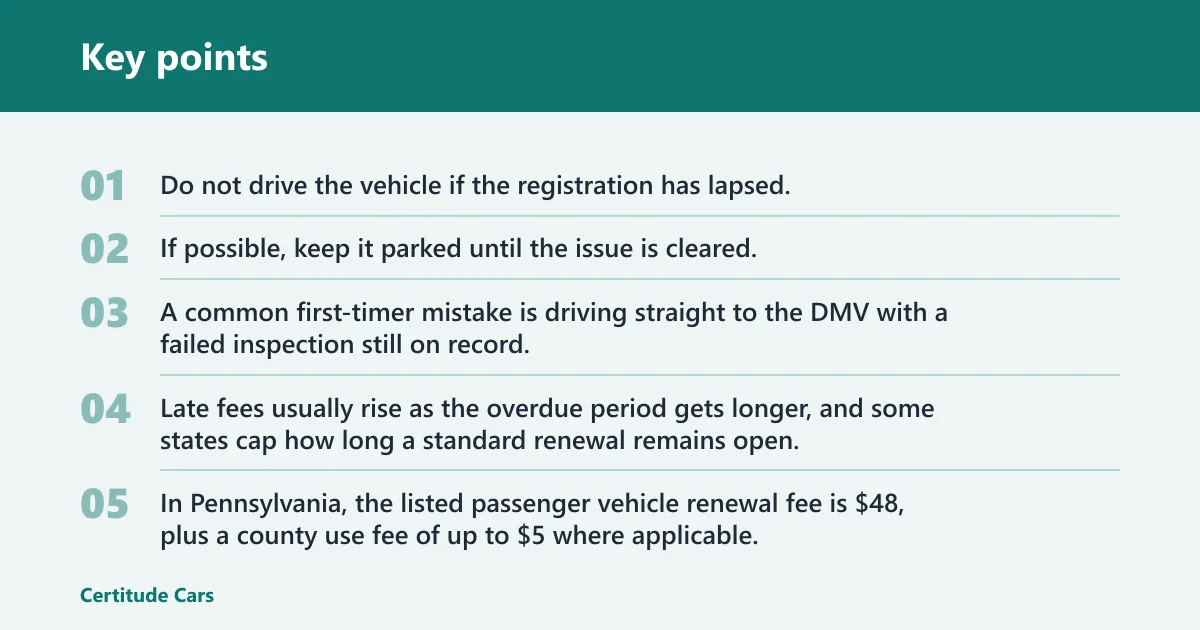
Do not drive the vehicle if the registration has lapsed. Some states allow a temporary moving permit, but otherwise the vehicle may be out of compliance until the record is renewed or reinstated. If possible, keep it parked until the issue is cleared.
A common first-timer mistake is driving straight to the DMV with a failed inspection still on record. The renewal window may exist, but the failed test blocks the process, so the trip only helps if the state has already issued a permit or the inspection is already passed.
Late fees and timing windows
Late fees usually rise as the overdue period gets longer, and some states cap how long a standard renewal remains open. That is why “how long after expiration can I renew” depends on the jurisdiction. Before the due date, renewal is routine; after the due date, the late window starts; after the state’s maximum window, reinstatement may be the only route.
Costs can stack up quickly: the base renewal fee, a late fee, inspection or smog charges, and any service fee from a third party. In Pennsylvania, the listed passenger vehicle renewal fee is $48, plus a county use fee of up to $5 where applicable.
Frequently asked questions
Can you renew your car registration after it expires?
Usually yes, but only within the state’s late window and only if the record is otherwise clear. If the DMV shows a hold, insurance lapse, or failed inspection, you may need to fix that problem first.
Can you renew an expired registration online?
Often yes, but not always. Online renewal depends on state rules and on whether the record is eligible. Some states block online processing after a long lapse or require clearance for inspection, insurance, or unpaid holds before the website will accept the payment.
Where do I renew an expired vehicle registration?
Use the state DMV or motor vehicle agency first, then follow the channel it allows: online, by mail, or in person. If the file has a block, the agency may send you to an in-person or clearance process.
Can I renew car registration in person if it’s expired?
Yes, and in-person service is often the best option when the record needs review or when online renewal is unavailable. Bring the plate or VIN details, proof of insurance, and any inspection paperwork. Some states also let you pay holds or corrected fees at the counter.
How long after expiration can I renew vehicle registration?
That depends on the jurisdiction. Some states allow a short late window, while others have a longer one. Once the state’s late window ends, you may need reinstatement rather than a standard renewal.
What do I need to renew an expired car registration?
Most states want the plate number or VIN, current proof of insurance, and any inspection or emissions paperwork. Some also need the title number, odometer reading, or payment card details. If the renewal notice is missing, a VIN lookup may still retrieve the file.