What Does Liability Insurance Cover on a Car?
What does liability insurance cover on a car? In plain terms, it covers others, not you: it helps pay for other people’s injuries and property damage when you cause a crash, up to your policy limits. Compared with full coverage, liability is the narrower layer; it does not pay for your own car repairs, and it does not automatically cover your own medical bills. For state-by-state minimums and policy basics, see your state insurance department, the NAIC, or the Insurance Information Institute: NAIC, III.
Bodily injury and property damage coverage
Bodily injury liability
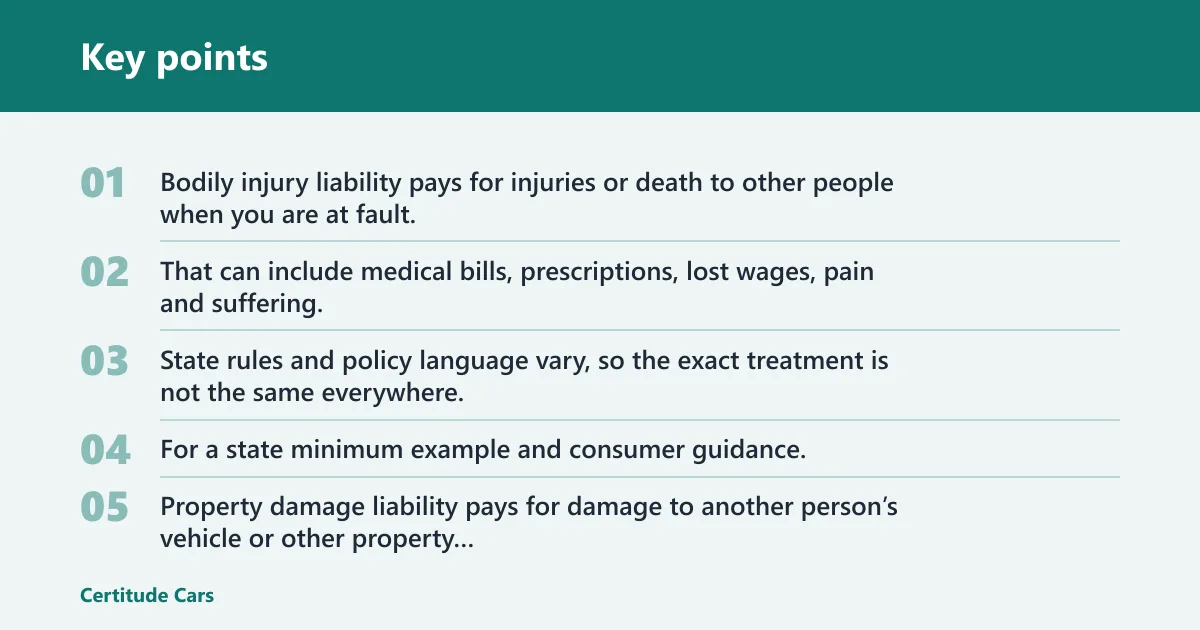
Bodily injury liability pays for injuries or death to other people when you are at fault, subject to your policy terms and limits. That can include medical bills, prescriptions, lost wages, pain and suffering, and sometimes defense costs, although many personal auto policies provide a duty to defend outside the liability limits while some policy forms or endorsements may treat defense differently. State rules and policy language vary, so the exact treatment is not the same everywhere. It does not pay your own medical bills. For a state minimum example and consumer guidance, see your state insurance department’s minimum-requirements page, such as the Washington Office of the Insurance Commissioner.
Property damage liability
Property damage liability pays for damage to another person’s vehicle or other property when you are at fault. That can include fences, buildings, signs, mailboxes, and, depending on the claim and policy language, reasonable rental-car loss-of-use charges for the other party. It does not pay to fix your own car. For split-limit basics and definitions, see the NAIC and your state insurance department’s consumer guide.
What it pays after an at-fault crash
In a covered loss, liability insurance is the part of the policy that pays for harm you caused to others. It is designed for third-party losses, not your own repairs. Nearly every state requires some form of liability coverage to drive legally, but the minimum amount and structure vary by state, and minimums can be too low for a serious crash. For current requirements, use State minimum liability requirements and your state insurance department’s published minimums.
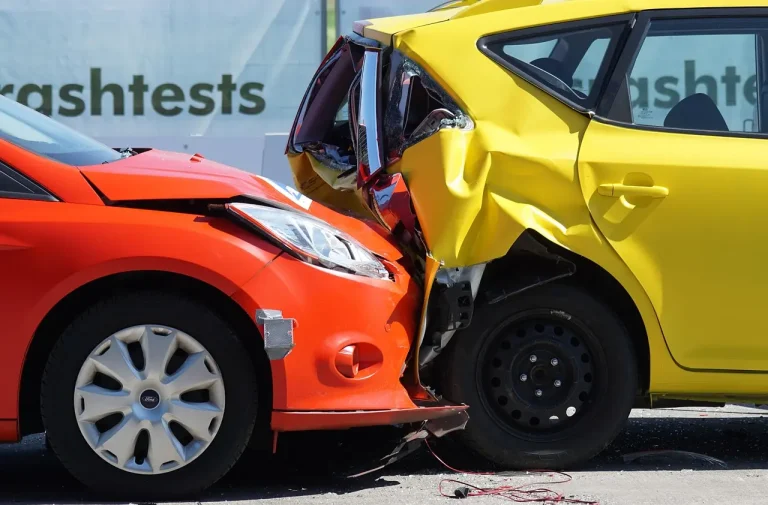
Say you rear-end a sedan and push it into a storefront window. Liability may pay the other driver’s ER bills, the storefront glass, and the other car’s repairs, up to your limits. If the losses exceed those limits, the remaining bill can come back to you. In many personal auto policies, defense counsel is provided by the insurer apart from the liability limit, but that is not universal, so policy wording matters.
📊 Minimum liability insurance may pay for as little as $25,000 in damage. Source: Consumerreports.
What liability insurance does not cover
What liability only cover on car insurance? It covers harm you cause to other people and their property. It does not cover your own car repairs, your own injuries, or losses that fall outside your liability limits. If you want protection for your car or your medical bills, you need separate coverages.
Your car repairs
Liability car insurance does not cover your own vehicle repairs. If you hit a pole, back into a wall, or your car is damaged in a crash you caused, liability does not pay for that damage. Collision coverage is the separate option for your car after a crash.
Your injuries
Liability insurance does not pay your own medical bills after a crash you caused. For that, drivers often look at medical payments coverage or personal injury protection, depending on the state and policy. Those coverages are separate from liability.
Coverage gaps after a claim
Once a liability limit is used up, the remaining loss is uninsured exposure for you. That may include unpaid medical bills, unpaid repair bills, collections, a civil judgment, or wages withheld after a court order, depending on state law and the claim outcome. Defense costs may or may not reduce the same limit bucket, depending on the policy form, so it is important not to assume every claim cost shares one pool.
What the three numbers mean
What do the three numbers on liability insurance mean? They are split limits, often written as 25/50/10 or 100/300/50. The first number is bodily injury per person, the second is bodily injury per accident, and the third is property damage per accident. Some insurers also offer a combined single limit instead. For a plain-language explanation, see the III and your state insurance department’s auto-insurance guide.
Split limits
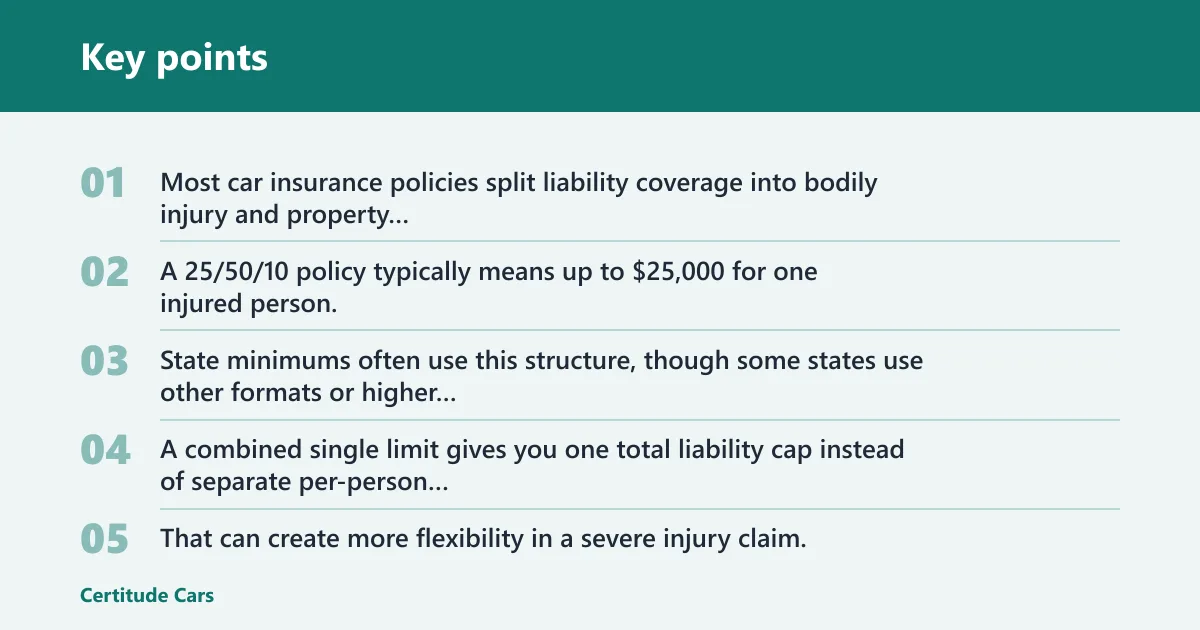
Most car insurance policies split liability coverage into bodily injury and property damage. A 25/50/10 policy typically means up to $25,000 for one injured person, up to $50,000 total for all injured people in one crash, and up to $10,000 for property damage in that crash. State minimums often use this structure, though some states use other formats or higher requirements.
Combined single limit
A combined single limit gives you one total liability cap instead of separate per-person and per-accident caps. That can create more flexibility in a severe injury claim, because the policy can be used across bodily injury and property damage up to one overall limit.
Why limits matter in serious crashes
Limits matter because accident costs can climb fast. A few ambulance rides, a hospital stay, a totaled vehicle, and claim handling expenses can use a minimum policy quickly. Once the cap is reached, you are responsible for what remains, even if the crash was a one-time mistake.
Liability insurance payout examples
The table below shows how claims can play out when the at-fault driver has different liability limits. Assumptions: the policy is a standard personal auto policy; defense costs are shown separately because some policies pay defense outside the liability limit while others do not; rental costs are shown separately because they may be included only if the claim and policy language allow it; and the examples do not assume med pay, PIP, collision, or umbrella coverage.
| Crash scenario | Losses in the claim | State minimum 25/50/10 | Mid-level 50/100/50 | High-limit 100/300/100 |
|---|---|---|---|---|
| Rear-end crash with one injured driver | Bodily injury: $15,000 Property damage: $8,000 Rental: $700 Defense costs: $1,500 | Bodily injury: paid up to $15,000 Property damage: paid up to $8,000 Rental: may be paid if covered under property damage or claim expenses Defense costs: may be outside the limit or may reduce it, depending on policy Out-of-pocket exposure: $0 to some defense or rental amount, depending on policy language | Bodily injury: paid Property damage: paid Rental: likely covered if policy/claim terms allow Defense costs: may be outside the limit or may reduce it Out-of-pocket exposure: likely $0 | Bodily injury: paid Property damage: paid Rental: likely covered if policy/claim terms allow Defense costs: may be outside the limit or may reduce it Out-of-pocket exposure: likely $0 |
| T-bone crash with one serious injury | Bodily injury: $38,000 Property damage: $22,000 Rental: $3,000 Defense costs: $6,000 | Bodily injury: $25,000 paid, $13,000 unpaid Property damage: $10,000 paid, $12,000 unpaid Rental: may or may not be available depending on policy terms Defense costs: may be inside or outside the limit bucket depending on policy form Out-of-pocket exposure: at least $25,000, and potentially more if defense reduces available limits | Bodily injury: paid Property damage: paid Rental: may be paid if covered and limits remain Defense costs: may be inside or outside the limit bucket depending on policy form Out-of-pocket exposure: could be $0 or some rental/defense amount, depending on policy wording | Bodily injury: paid Property damage: paid Rental: likely covered if policy terms allow Defense costs: may be outside the limit or may reduce it Out-of-pocket exposure: likely $0 |
| Multi-car chain reaction | Bodily injury: $72,000 total Property damage: $31,000 total Rental: $4,000 Defense costs: $8,000 | Bodily injury: $50,000 paid, $22,000 unpaid Property damage: $10,000 paid, $21,000 unpaid Rental: may be partially covered if remaining property damage or claim expense coverage exists Defense costs: may reduce available limits or may be outside them Out-of-pocket exposure: at least $43,000, and possibly more if defense is inside limits | Bodily injury: $50,000 paid, $22,000 unpaid Property damage: $31,000 paid Rental: may be limited by remaining coverage and policy language Defense costs: may be outside the limit or may reduce it Out-of-pocket exposure: at least $22,000, plus any uncovered rental or defense amount | Bodily injury: paid Property damage: paid Rental: likely covered if policy terms allow Defense costs: may be outside the limit or may reduce it Out-of-pocket exposure: likely $0 |
| Crash with building damage and one minor injury | Bodily injury: $9,500 Property damage: $27,000 Rental: $2,000 Defense costs: $4,500 | Bodily injury: paid Property damage: $10,000 paid, $17,000 unpaid Rental: may not fit after property damage uses the limit Defense costs: may be inside or outside the limit bucket depending on policy form Out-of-pocket exposure: at least $17,000, plus any defense or rental amount not covered | Bodily injury: paid Property damage: paid Rental: may be covered if claim and policy terms allow Defense costs: may be outside the limit or may reduce it Out-of-pocket exposure: likely $0 | Bodily injury: paid Property damage: paid Rental: likely covered if policy terms allow Defense costs: may be outside the limit or may reduce it Out-of-pocket exposure: likely $0 |
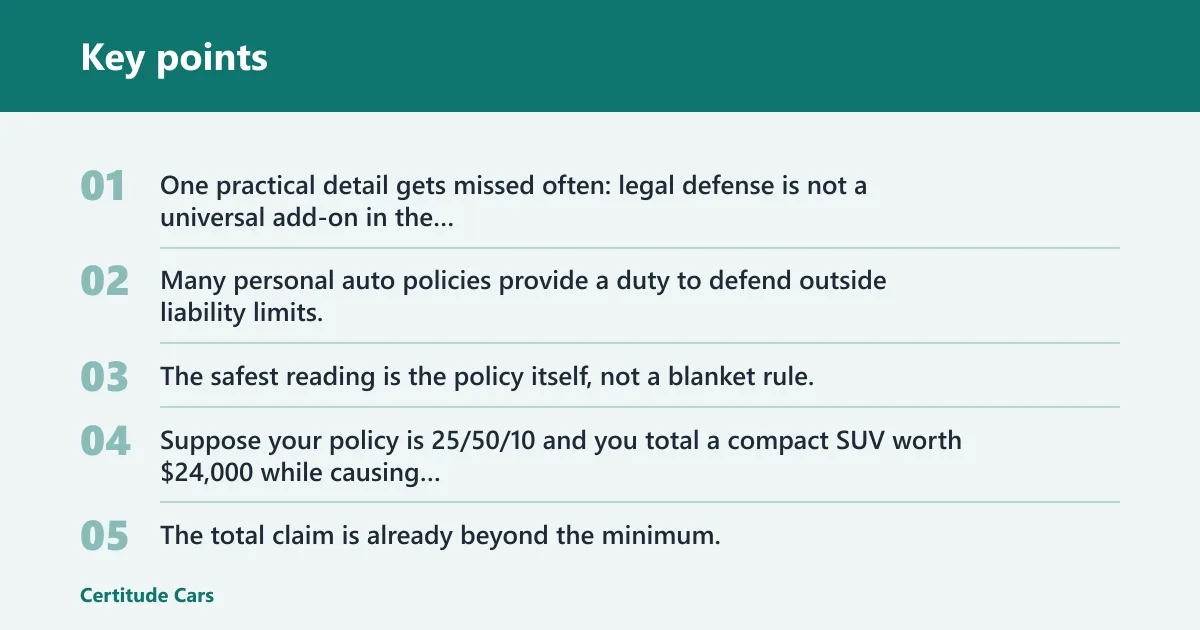
One practical detail gets missed often: legal defense is not a universal add-on in the same way for every policy. Many personal auto policies provide a duty to defend outside liability limits, but some forms, endorsements, or state-specific rules may change that outcome. The safest reading is the policy itself, not a blanket rule.
Suppose your policy is 25/50/10 and you total a compact SUV worth $24,000 while causing $18,000 in injuries. The total claim is already beyond the minimum. Even before any defense bill lands, the policy can run out and leave you with the remaining balance.
Is minimum liability enough?
Is minimum liability insurance enough? For some low-risk drivers with few assets, it may satisfy the law, but it can be financially risky after a severe crash. State minimum liability requirements exist in many states, yet they are often too low for a serious injury claim or a newer vehicle repair bill.
When state minimums fall short
Minimum coverage may pay for as little as $25,000 in damage. That can disappear quickly if one person needs surgery, if two cars are damaged, or if a crash involves a fence, a building, and a rental car. The problem is not whether the policy exists. The problem is whether it is large enough for the worst likely loss.
Asset exposure after limits run out
After limits are exhausted, the injured party can pursue you for the balance. That matters most if you have savings, a home, or wages that could be reached through a claim or judgment. A low premium is not much comfort if the accident creates a larger balance than the policy can absorb.
Checklist for higher limits
- Choose higher limits if you own a home or have meaningful savings.
- Choose higher limits if you drive often in dense traffic or near expensive vehicles.
- Choose higher limits if you regularly carry passengers.
- Choose higher limits if a crash could damage a building, sign, or fence.
- Choose higher limits if the minimum policy would not cover a moderate injury claim.
How liability differs from other coverages
What is the difference between liability and full coverage? Liability pays others for losses you cause, while the other coverages below help protect you, your car, or both. If your car is financed or leased, lenders often require more than liability alone.
Collision coverage
Collision coverage pays for your own car after a crash, regardless of fault in many situations, subject to the deductible and policy terms. It is separate from liability. If your vehicle is financed or leased, collision is often required by the lender or leaseholder, along with comprehensive coverage.
Comprehensive coverage
Comprehensive coverage pays for non-collision losses such as theft, fire, vandalism, or falling objects. It is also separate from liability. A hailstorm, a tree limb, or a stolen catalytic converter would fall outside liability and into comprehensive, if you have it.
Medical payments or PIP
Medical payments coverage, or PIP in some states, helps pay your own medical bills and sometimes passengers, depending on state rules and the policy. It can apply whether you caused the crash or not. Liability does not do that.
Uninsured and underinsured motorist coverage
Uninsured and underinsured motorist coverage protects you if the other driver has no insurance or too little insurance. That matters when the at-fault driver cannot pay for your injuries or repairs. It is separate from liability and fills a different gap.
Special cases to know
Borrowed cars, rental cars, and passengers raise the same basic question: whose policy pays, and for what? The answer depends on the policy language and the state, but the general rule is still the same. Liability covers the harm you cause to others, not your own car or your own injuries.
Borrowing a car
If you borrow someone else’s car and cause a crash, coverage can depend on the car owner’s policy, your policy, and whether you had permission. Liability usually follows the vehicle’s policy first, but a separate policy may also matter. The key point is that liability still pays the other party, not the damage to the borrowed car itself.
Rental cars
What does liability insurance cover on a rental car? Your personal auto liability policy may extend to a rental in many cases, but you need to check the policy and the rental agreement. Consumer and insurer guidance generally treats rental extension as a policy-specific issue rather than an automatic guarantee; check your insurer’s declarations page, coverage guide, or auto policy form. Liability can pay for damage you cause to other people, while damage to the rental car itself is usually a collision or comprehensive question, not a liability question.
Passengers and other drivers
Your own passengers are usually treated as third parties for liability purposes if you are at fault, so bodily injury liability may apply to their injuries within the policy terms. Another driver who is hurt in the crash is also covered the same way. Your own injuries are the separate issue.
Frequently asked questions
What does liability insurance cover on a car?
It covers damage you cause to other people and their property, up to your policy limits. That includes bodily injury liability and property damage liability. It does not pay for your own car repairs or your own medical bills, which need separate coverages.
What does liability insurance cover in a car accident?
After an at-fault accident, liability can pay the other driver’s medical bills, prescriptions, lost wages, pain and suffering, legal fees, and damage to their car or property. It can also help with rental costs for the other party, within policy terms and limits. Defense handling depends on the policy form.
Does liability insurance cover car damage?
Yes, but only damage to someone else’s car when you are at fault. Property damage liability can pay for the other vehicle, a fence, a building, a mailbox, or similar property. It does not pay to repair your own vehicle after the crash.
Does liability insurance cover my injuries after a crash?
No. Liability insurance does not pay your own medical bills after a crash you caused. Medical payments coverage or PIP may help with your injuries, depending on state law and your policy. Those coverages are separate from liability.
What do the three numbers on liability insurance mean?
The first number is bodily injury per person, the second is bodily injury per accident, and the third is property damage per accident. Those caps matter once a claim gets large.
Do I need liability insurance if my car is financed?
Yes, but liability alone is usually not enough for a financed vehicle. Lenders commonly require collision and comprehensive coverage too, because liability does not cover damage to your own car. The loan agreement, not just state law, drives that requirement.
What does liability insurance cover on a rental car?
Your liability coverage may extend to a rental car in many cases, but the exact answer depends on your policy and the rental contract. It can cover damage you cause to other people and property. Damage to the rental itself usually needs collision or comprehensive coverage.
Sources
- NAIC auto insurance consumer guide
- Insurance Information Institute: What auto insurance covers
- Washington Office of the Insurance Commissioner: minimum auto coverage
- Consumer Reports: what car insurance covers