Car Registration: What It Is, Costs, and How It Works
This is a general guide to car registration worldwide, with clearly marked EU-specific rules where they matter. In many systems, an active registration record is needed before you can legally drive, park on a public street, use toll roads, or enter restricted zones. Bad paperwork, lapsed cover, or missed inspections can trigger fines, impoundment, failed title transfers, or delays that keep the car off the road. This guide explains the documents, checks, fees, deadlines, and rule changes for used cars, imports, moves, and failed inspections.
The most useful way to read registration is as three linked checks. First, the authority gives the vehicle a legal identity through its VIN, plate, and registration record. Second, it checks whether the car is roadworthy through inspection or certificate rules. Third, it checks whether you may keep and insure that vehicle where it is actually used, especially after a move or a cross-border purchase.
What car registration actually does
Registration is the legal record that connects the car itself, the person or business responsible for it, and the plate attached to it. The plate is the visible marker. The record behind it is what police, insurers, tax authorities, and inspection systems rely on.
Registration, ownership, and title are different
Registration gives the car lawful road-use status. Proof of ownership shows who bought or legally received the car, often through an invoice, bill of sale, or transfer document. In some places, a title is the ownership document; in others, there is no separate title in the same form. These papers overlap in practice, but they do different jobs.
A car can be owned by one person and registered by another, depending on local rules, finance agreements, or company-car arrangements. That is why a transfer can fail even when the seller hands over the keys and the buyer has already paid.
The registration certificate matters after approval
When a car is registered, the authority issues a registration certificate. Under national rules, that certificate can have one or two parts in systems that follow the EU registration-certificate model (Directive 1999/37/EC). It is the document that proves the vehicle is on the register, and it is commonly expected to be kept with the vehicle or at least available when traveling.
Why registration reaches beyond the plate
Registration also ties into tax, insurance, and enforcement. Authorities may refuse registration if insurance cover is missing, if VAT status is unclear on a cross-border case, or if the roadworthiness record is out of date. A plate by itself proves very little unless the underlying file is complete.
Why do you need car registration?
You need car registration because public-road use depends on an official record that identifies the vehicle, shows it is allowed on the road, and links it to insurance and tax systems. Without that record, routine driving, parking, inspection booking, sale, export, and claims handling can all be blocked.
Lawful use on public roads
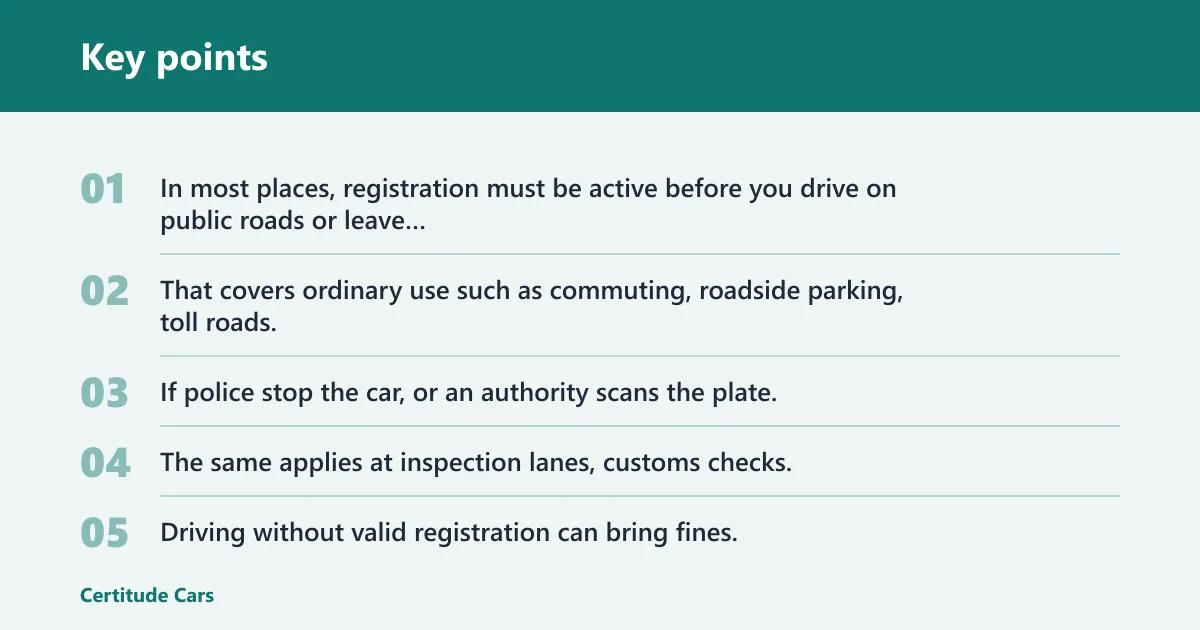
In most places, registration must be active before you drive on public roads or leave the car parked there. That covers ordinary use such as commuting, roadside parking, toll roads, low-emission zones, and border crossings where the plate is checked against databases.
Checks during stops, travel, and inspection
If police stop the car, or an authority scans the plate, registration is what confirms that the vehicle identity matches the file. The same applies at inspection lanes, customs checks, and many ferry or tunnel systems that validate the registration against the vehicle category.
What happens if the car is not registered
Driving without valid registration can bring fines, the car can be impounded or taken off the road, and an insurer may dispute a claim if the vehicle was being used unlawfully. It can also block the next steps. An unregistered or improperly registered car may be impossible to tax, inspect, sell, export, or transfer cleanly to a new keeper.
A signed bill of sale may not be enough to register a used car. The buyer leaves with the car, then learns the insurer will issue cover only after the registration application is accepted, while the authority wants proof of acceptable cover first. That loop is where many delays begin.
Where must you register the car?
This section is EU-specific. In EU cases, you are generally required to register your car in the country where you have your normal residence. There is no single EU-wide registration system, so the rule is broad but the paperwork, deadlines, and exceptions are national (Your Europe: registration formalities). Where the car is normally kept can also affect the answer.
Normal residence is the starting point
For most private owners in the EU, normal residence decides where registration belongs (Your Europe: registration formalities). That means the country where daily life is centered, not simply the place where the car was bought or where it was cheapest to insure.
Garaging and long-term use can matter
Some authorities also look at where the vehicle is normally kept or garaged. If the car lives in one country, works there every week, and stays there overnight, that can trigger questions even if the registered keeper still has paperwork tied to another address.
Foreign plates after a move
After a residency move, foreign plates are rarely a long-term solution. Local deadlines vary and are often short, so the right check is always the destination country’s registration authority or national citizen portal. One named example: Spanish tax guidance allows temporary use by non-residents of foreign-registered private vehicles for up to 6 months in a 12-month period (Agencia Tributaria: non-resident exemption guidance).
Say your car is still on Dutch plates, but you have moved your household, parking permit, and insurance arrangements to Spain. Even if the old registration is still valid on paper, the practical blocker is often residence and garaging evidence, not the plate itself.
What documents do you need to register a car?
The main documents are proof that you own or may register the vehicle, ID and address documents that match the application, proof of insurance cover, and any current or prior registration papers. Depending on the case, you may also need a roadworthiness certificate, inspection results, a certificate of conformity, VAT payment proof, or import documents.
Proof of ownership, identity, and address
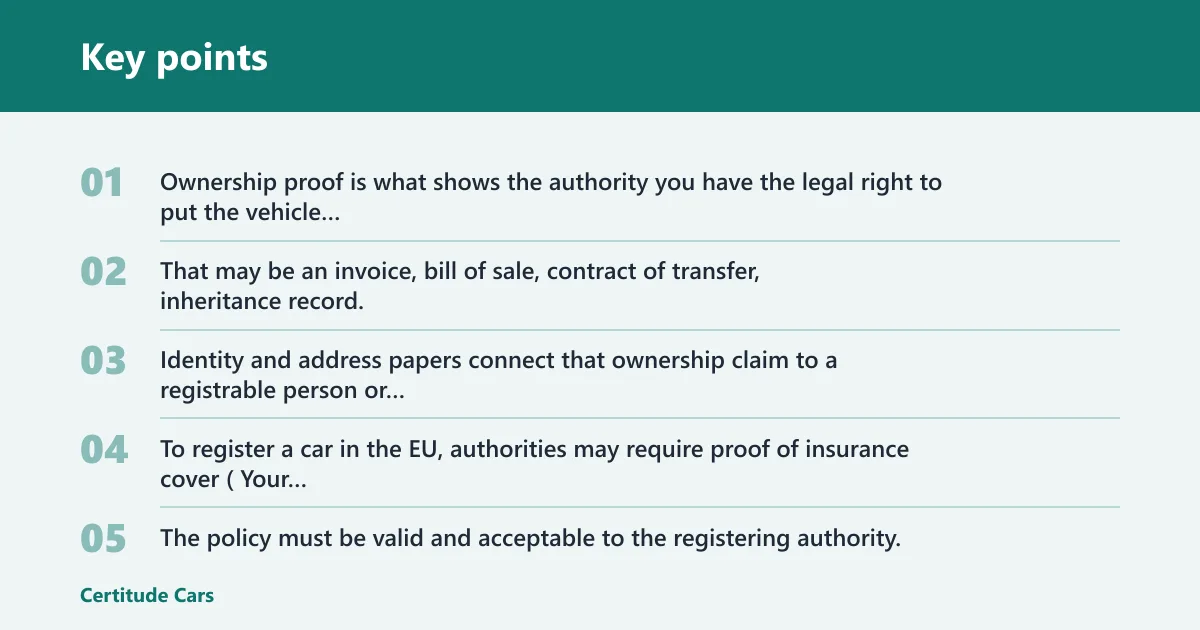
Ownership proof is what shows the authority you have the legal right to put the vehicle into your name or keeper record. That may be an invoice, bill of sale, contract of transfer, inheritance record, or another accepted transfer document. Identity and address papers connect that ownership claim to a registrable person or business.
Proof of insurance cover
To register a car in the EU, authorities may require proof of insurance cover (Your Europe: registration formalities). The policy must be valid and acceptable to the registering authority, which is not always the same thing as having a quote, a draft policy, or insurance valid only in another country.
Registration certificate and roadworthiness records
If the car is already on a register somewhere, the existing registration certificate is one of the key documents. That certificate can have one or two parts depending on national rules in systems using the EU registration-certificate format (Directive 1999/37/EC). A roadworthiness certificate may also be required for re-registration, and it should be visible in the file presented to the authority, including the test results and next test date where local rules require that information.
Roadworthiness timing differs by country. In the EU, one common baseline for passenger cars is inspection 4 years after first registration and then every 2 years, but member states can set stricter intervals for age, vehicle type, or commercial use (Your Europe: roadworthiness tests; Directive 2014/45/EU).
Certificate of conformity, VAT proof, and import papers
For many new or imported vehicles, the certificate of conformity is what proves the technical type-approval data. An EU certificate of conformity is intended to support registration across EU countries for vehicles covered by EU type approval, which can reduce demands for extra technical documentation (Your Europe: registration formalities). Some vehicles instead rely on a national certificate that may be country-specific.
VAT payment proof matters most in cross-border registration. For VAT purposes inside the EU, a new means of transport includes a car with no more than 6,000 km or one supplied within 6 months of first entry into service (Your Europe: VAT when buying or selling a car; VAT Directive 2006/112/EC). That threshold can change which country checks the tax treatment and what evidence the authority wants to see.
How does car registration work step by step?
Registration usually starts before you reach the counter or online portal. You line up ownership proof, arrange acceptable insurance, check whether inspection is current, and gather prior registration papers. The authority then checks the vehicle identity, technical data, and eligibility before issuing plates and a registration certificate.
Before you apply
- Confirm where the car must be registered based on normal residence and where it is normally kept.
- Collect proof of ownership, ID, address, and any existing registration certificate.
- Arrange proof of insurance cover that the registering authority will accept.
- Check whether a roadworthiness certificate or registration inspection is required.
- For a new or imported car, gather the certificate of conformity and any VAT or customs records.
The authority check
The authority then checks whether the file matches the vehicle and whether the vehicle may enter the register. A vehicle registration check verifies whether the file data matches the car itself, especially the VIN and other identifying details. In plain terms, it is primarily a comparison of data in the registration certificate with the vehicle.
That comparison can include VIN stamping, engine or body data where relevant, weights, fuel type, emissions class, and dimensions already held in the official file. If those records conflict, the case often stops until the mismatch is explained or corrected.
Inspection and roadworthiness
The registration inspection is different from ownership transfer. It is the technical or identity check that confirms the right car is standing in front of the inspector, and that any required roadworthiness standard has been met. Cost and validity depend on local rules, so the right source is the local registration or inspection authority rather than a general EU guide.
Where a separate identity or registration inspection exists, the fee and validity period are set nationally or regionally. Always verify those details on the local registration authority, transport ministry, or approved inspection-station website before you book.
Issuing plates and certificate
Once the authority accepts the file, it issues or confirms the plate record and registration certificate. Plates may be metal or plastic depending on local format rules. The certificate is what you keep available for travel, stops, and later transfer or export steps.
How much does car registration cost?
Registration cost is easier to estimate if you split it into fixed charges and variable charges. Fixed items usually include registration, transfer, plate, and admin fees. Variable items usually include inspection, emissions-related checks, road or circulation tax, and VAT-related costs on cross-border cases.
Fixed charges
Fixed charges are the fees you can usually identify before the authority reviews the car. These often include:
- registration fee
- ownership transfer fee
- plate issue or replacement fee
- document or admin fee
- broker or agent fee if you use one
These charges are predictable because they do not depend much on the car’s emissions, value, age, or tax history.
Variable charges
Variable charges are where budgets go wrong. These can include roadworthiness inspection, emissions or technical checks, road tax or circulation tax, customs handling, VAT-related charges, and the cost of correcting a failed inspection item before you can return.
Imported vehicles and failed inspections usually cost more because they stack categories. You may need conformity evidence, a technical check, a tax review, and a second inspection appointment instead of a single filing.
A practical estimate method
Use this sequence:
- Add the fixed registration, transfer, plate, and admin fees.
- Add the inspection or registration check fee if the case needs one.
- Add any road or circulation tax due at registration.
- Add VAT-related or customs items only if the case is cross-border or treated as a new vehicle for tax purposes.
- Add a repair buffer if the roadworthiness status is uncertain.
Picture a used hatchback bought privately in the next town. The fixed side may be only transfer, admin, and possibly plates. Change one variable by making it an import from another EU country, and the same car can now need conformity evidence, VAT review, and an identity check before anything is issued.
Registration cases decision table
Scope note: the scenarios below are country-agnostic. Exact forms, deadlines, and fee names vary by jurisdiction, so use the final column to check the right local source before you pay or book an inspection.
| Scenario | Documents usually needed | Likely fee categories | Usual blocker that causes delays | Where to verify locally |
|---|---|---|---|---|
| New car | Invoice or dealer transfer record, ID and address proof, proof of insurance cover, certificate of conformity, tax filing record if required | Registration fee, plate fee, admin fee, first road or circulation tax, broker fee if used | Missing or incorrect certificate of conformity, insurance not yet active in the authority system | Vehicle registration authority, transport ministry, dealer delivery paperwork checklist |
| Used private-sale car | Bill of sale or equivalent transfer document, seller’s registration certificate, buyer ID and address proof, proof of insurance cover, roadworthiness certificate if required | Transfer fee, registration fee, admin fee, inspection fee if status expired, plate fee if plates change | Ownership chain gap, seller forgot to provide both parts of the registration certificate where a two-part system applies | Vehicle registration authority, title or vehicle records office, used-vehicle transfer checklist |
| Imported car | Foreign registration certificate, proof of ownership, proof of insurance cover, certificate of conformity or national technical document, VAT payment proof, customs papers where applicable, inspection record | Registration fee, inspection fee, technical data entry fee, plate fee, VAT-related charge, customs or agent fee | VIN or technical data mismatch, VAT proof missing, no acceptable conformity document | Customs authority, vehicle registration authority, tax authority, approved inspection service |
| Move to another EU country | Current registration certificate, proof of normal residence, proof of insurance cover accepted locally, proof of ownership, roadworthiness certificate, certificate of conformity if requested | Re-registration fee, plate fee, inspection or identity-check fee, local road or circulation tax, admin fee | Residence evidence conflicts with old registration address or garaging location | Destination-country registration authority, national citizen portal, tax office if a vehicle tax applies |
| Car already registered elsewhere | Existing registration certificate, release or transfer record if required, proof of ownership, ID and address proof, proof of insurance cover, inspection record where required | Transfer fee, duplicate-record check fee if any, registration fee, possible new plate fee, admin fee | Open record in another authority, unresolved lien or export status, duplicate vehicle file | Current register, destination register, lien or secured-transactions record where available |
| Failed inspection | Prior registration papers, failure report, repair invoices if requested, new inspection pass record, proof of insurance cover, ownership proof if transfer is pending | Reinspection fee, repair cost, admin fee, storage or temporary permit fee if the car cannot stay on the road | Repairs incomplete, retest window missed, failed item affects VIN visibility or safety-critical systems | Approved inspection station, vehicle registration authority, local retest rules and permit page |
What changes for used cars, imports, and failed inspections?
These cases change registration because they add proof problems. A used private sale can fail on ownership transfer. It also helps to work from a paperwork-focused checklist such as title transfer documents before filing. An import can fail on conformity or VAT evidence. A failed inspection can pause the whole file even when ownership and insurance are correct. The extra cost usually comes from document repair, not the plate itself.
Used private-sale cars
Private-sale transfers often fail because the buyer receives keys and one paper, but not the full documentary chain. Check whether the seller’s registration certificate is complete, whether there are one or two parts, and whether the roadworthiness status is still current enough for transfer or re-registration.
Also verify the existing plate and status before paying. If the vehicle is marked exported, scrapped, suspended, or subject to unresolved finance or lien rules under local law, the registration office may stop the transfer.
Imported cars
Imports add two recurring issues: technical identity and tax treatment. The authority may want a certificate of conformity, and an EU certificate can reduce demands for extra technical paperwork in eligible cases (Your Europe: registration formalities). VAT checks become sharper when the vehicle falls within the new-car threshold of no more than 6,000 km or no more than 6 months in use (Your Europe: VAT when buying or selling a car).
Cars already registered elsewhere
Some vehicles are caught between two systems. The old register may still show the car as active while the new authority expects a release, export note, or surrendered certificate. Duplicate-record issues can delay plates even when every document looks genuine.
Failed inspections
A failed inspection is often the most expensive version of a routine registration because the file is already open while the car is unusable. Safety defects, emissions faults, lighting problems, brake imbalance, or unreadable VIN markings can all stop re-registration until corrected and retested.
If the failed item affects identity, such as a damaged VIN plate or unreadable stamp, the authority may treat it as more than a repair issue. That can trigger a deeper verification process before the roadworthiness question is even reached.
Can you drive before registration or check status online?
You sometimes can drive before full registration, but only where local rules allow a temporary permit, temporary plates, or a dealer transit arrangement. Insurance alone usually does not replace registration. Status checks are often available online or through the authority using a plate number, VIN, or certificate reference.
Temporary use before full registration
Temporary movement is a narrow exception, not a general right. Some places issue short-term plates or permits for delivery, inspection trips, export, or travel to the registration office. Others limit dealer transit use to specific routes or dates. The permit conditions matter as much as the permit itself.
Why insurance does not replace registration
Insurance answers the liability question. Registration answers the lawful-road-use question. A valid policy may be required before registration can be completed, but that does not mean the car may legally be used on public roads without plates or without an active registration record.
How to check registration status online
Many authorities offer status checks online or by phone. Typical inputs are the plate number, VIN, registration certificate number, or a transfer reference. The result may show whether the vehicle is currently registered, taxed, inspected, exported, or blocked by a pending transfer.
If the online system is limited, ask for the exact status label used by the authority. Terms such as active, suspended, exported, pending inspection, or transfer in progress tell you far more than a generic message that the vehicle is merely “found” in the database.
Frequently asked questions
What is car registration and why do I need it?
Car registration is the official record that links the VIN, plate, keeper details, and road-use status of a vehicle. You need it because public-road driving, parking, enforcement checks, taxation, and many insurance processes rely on that record, not only on ownership papers or a bill of sale.
Do I need insurance to register a car?
Often, yes. In the EU, authorities may require proof of insurance cover before registration is approved (Your Europe: registration formalities). The key point is that the cover must be valid and acceptable to the registering authority, which may reject a policy that is inactive, mismatched, or issued for another jurisdiction.
How do I register a used car from a private seller?
Start with the ownership transfer document, the seller’s registration certificate, and your ID, address, and insurance papers. Then check whether the roadworthiness status is current and whether the vehicle file is active, exported, suspended, or otherwise blocked before paying transfer and registration fees.
What is the difference between car registration and title?
The same source gives the car lawful status for public-road use and connects it to plates and official records. Title, where used, is the ownership document. Proof of ownership may also be an invoice or bill of sale, so registration and title should not be treated as the same paper.
How long can I drive on foreign plates before re-registering?
There is no single answer across Europe because the detailed rules are national, even though EU guidance points you to the country of normal residence for registration (Your Europe: registration formalities). Local deadlines can be short after a move. Spain is one named example where tax guidance allows temporary use by a non-resident for up to 6 months in a 12-month period (Agencia Tributaria: non-resident exemption guidance).
How do I check my car registration status online?
Use the local authority’s vehicle-status tool if one exists, or contact the registration office directly. You will usually need the plate number, VIN, or registration certificate reference. Check for the exact status result, including active, pending transfer, exported, inspection-blocked, or suspended.
Sources
- Your Europe: registration formalities
- Your Europe: roadworthiness tests
- Your Europe: VAT when buying or selling a car
- Directive 1999/37/EC on the registration documents for vehicles
- Directive 2014/45/EU on periodic roadworthiness tests
- Council Directive 2006/112/EC on the common system of value added tax
- Agencia Tributaria: non-resident exemption guidance for foreign-registered vehicles