
How much is car registration and what fees do you pay?
Byline: Written by a staff editor. Editorial review: Reviewed for fee terminology, state-tax handling, and dealer paperwork language. Methodology: This guide uses DMV and state tax-agency fee schedules, plus dealer doc-fee cap rules where states publish them, to summarize common registration-cost categories. Because registration, title, tax, late fees, and local surcharges change frequently, readers should verify the current rule with their state DMV before buying or renewing.
Car registration usually costs about $20 to $400 or more, but the total can climb once sales tax, title fees, plate fees, and local add-ons are included. Miss one charge, and you can miss the out-the-door total by hundreds or even thousands. This guide breaks down each fee, who collects it, and which charges are fixed, negotiable, or state-specific. Figures below are presented as broad ranges because state DMV formulas, tax treatment, and local surcharges change often and vary by vehicle type.
What car registration usually costs
The base registration or license fee is often the smallest line on the bill, but it is rarely the whole bill. In many states, the recurring registration charge is a modest annual or biennial amount, but the total can rise sharply once title, sales tax, and local fees are added. State DMVs commonly publish these charges on fee schedules; the exact number depends on vehicle class, weight, age, value, fuel economy, and address.
That means two buyers in the same state can see different totals. A heavier SUV may pay more than a small sedan, and some states also add county or city surcharges. State fee schedules and tax agencies are the source of truth, so even a same-day quote can differ from the final DMV bill if the vehicle or address changes.
What drives the base fee
Some states use a flat registration fee, while others use a formula tied to the vehicle. DMV schedules may base the charge on weight, age, value, horsepower, fuel efficiency, or a combination of these factors. Some states collect license fees annually, while others bill them every two years. For state-specific examples, check your DMV’s registration fee page and fee calculator if available.
The label on the bill can vary too. In some states, people say “registration fee”; in others, “license fee” is the main term used for the same core government charge. The name changes, but the budgeting job is the same: identify the recurring state fee separately from tax and title. A state DMV may also separate “plate,” “registration,” and “service” charges in different line items.
Registration fee map
This fee map separates the main lines you may see on a DMV bill or dealer quote. Use it to tell a government charge from a dealer pass-through, and to spot which items are fixed, variable, or optional to negotiate. State sources are strongest here: DMVs publish registration and title schedules, state revenue departments publish sales-tax rules, and state consumer or licensing agencies may publish doc-fee caps.
| Fee name | Who collects it | One-time or recurring | What drives the amount | Negotiable? |
|---|---|---|---|---|
| State DMV registration fee | State DMV or motor vehicle agency | Recurring, often annual or bi-annual | State formula; may depend on vehicle weight, value, age, horsepower, or fuel efficiency | No |
| License fee | State DMV or motor vehicle agency | Recurring, often annual or bi-annual | May be flat or variable; can depend on cost, weight, age, or fuel efficiency | No |
| Title fee | State DMV or motor vehicle agency | One-time | Ownership transfer and state title rules | No |
| Vehicle sales tax | State and sometimes local tax authority | One-time at purchase | Tax rate, locality, and taxable amount; some states tax the full price, others use a different base | No |
| County or city surcharge | Local government or DMV | Recurring or one-time, depending on state | Address, county, or city rules | No |
| Doc fee | Dealer | One-time | Dealer policy and state cap, if any | Sometimes |
| Registration renewal | State DMV or motor vehicle agency | Recurring | State fee schedule; may include inspection or emissions steps in some states | No |
| Late renewal fee | State DMV or motor vehicle agency | One-time penalty | How late the renewal is and state penalty rules | No |
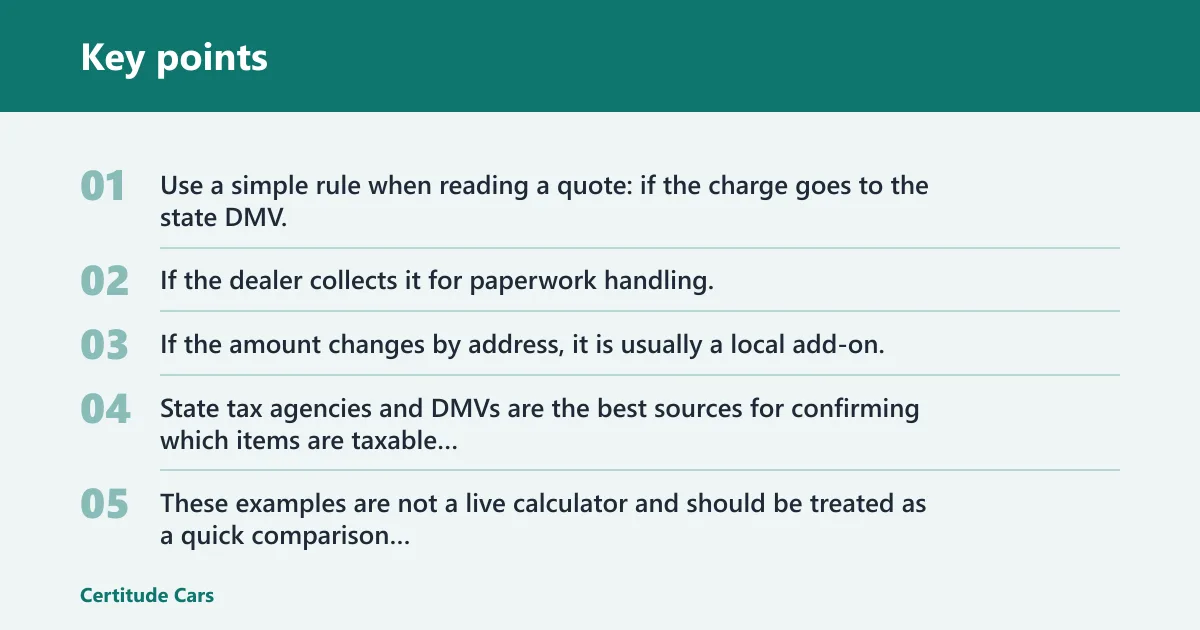
Use a simple rule when reading a quote: if the charge goes to the state DMV, it is usually a tax, title, registration, or license item. If the dealer collects it for paperwork handling, it is usually a doc fee or a pass-through line. If the amount changes by address, it is usually a local add-on. State tax agencies and DMVs are the best sources for confirming which items are taxable and which are not.
Sample state fee and tax patterns
These examples are not a live calculator and should be treated as a quick comparison guide only. They show how state rules can differ on the same basic purchase. Verify the current amount with the relevant DMV or tax agency before budgeting.
| State | Registration pattern | Title cost pattern | Tax handling pattern | Renewal cycle | Local surcharge / note |
|---|---|---|---|---|---|
| California | Fee depends on vehicle value, county, and other DMV factors; vehicle license fee applies in many cases | DMV title/transfer fees apply on ownership change | Sales tax is administered with local rates that can vary by address; tax treatment depends on transaction type | Usually annual | County and district taxes/surcharges can materially change the total; check DMV and tax board guidance |
| Texas | Registration includes a state fee plus county component in many cases | Title application/transfer fees apply | Motor vehicle sales/use tax is collected under state rules | Usually annual | County fees and inspection-related charges can apply depending on location and vehicle type |
| Florida | Registration often varies by weight and vehicle type | Title fees apply on transfer | Sales tax/use tax is handled under state rules | Usually annual | Local discretionary surtax can apply in some counties; confirm with the Florida Department of Revenue and DHSMV |
| New York | Registration fee is typically based on vehicle type, weight, and other DMV factors | Title fee applies to ownership transfer | Sales tax is due under state and local rules, with locality affecting the total | Usually annual | County/city taxes and plate-related fees can change the final amount |
| Oregon | Registration is typically based on vehicle type and use; some areas add transportation-related charges | Title fee applies on transfer | Oregon generally does not impose a general statewide sales tax on vehicle purchases | Usually annual or biennial depending on vehicle and use | Metro or local transportation fees may apply in some areas |
What fees do you pay at registration?
At registration, you usually pay the state DMV registration or license fee, the title fee if ownership is changing, and any required sales tax or local surcharge. If you are buying from a dealer, the dealer may collect some of these amounts for remittance. The bill can also include plate or renewal-related charges. State rules vary, so a dealer quote should be treated as an estimate until the DMV confirms it.
State DMV registration or license fee
This is the recurring government charge for putting a vehicle on the road in that state. It may be flat or variable, and some states collect it yearly or every two years. Annual car registration fees often fall somewhere in the tens to several hundreds of dollars depending on the state and vehicle class; the figure on a quote should be checked against the current DMV fee chart rather than guessed from a national average.
Title fee
The title fee is the ownership-transfer charge. It is separate from registration and usually appears only when the vehicle changes hands. If you renew an existing registration without changing ownership, title is usually not part of the renewal bill. State title offices or DMV pages typically list this as a separate fee from registration and from any tax due.
Sales tax
Sales tax can be the largest upfront fee. It can range from no tax in some states to well over 8% when state and local rates are combined. Some states also tax the vehicle in ways that are not based only on the sticker price, so the taxable amount can differ from one state to another. The state revenue department or tax board is the source to confirm whether tax is due at purchase, title transfer, or registration.
County or city surcharge
Some states add local surcharges on top of the state fee. These can change with the vehicle’s garaging address, county, or city, which is why a nearby ZIP code can produce a different total. Readers often miss this line because it is buried under a larger registration estimate. When the rule is local, the state DMV or county tax office usually publishes the add-on separately.
A common first-timer mistake is treating the dealer quote as the same thing as the DMV bill. Suppose a buyer in one county sees a low base registration fee, then gets surprised by a local surcharge and sales tax at closing. The base fee was real; the quote was incomplete. A clean out-the-door estimate should separate government charges from dealer fees and local add-ons.
Are registration and title fees the same thing?
No. Registration is the recurring charge that keeps the car legally on the road in that state, while title is the ownership record transfer fee. Registration can be renewed every year or every two years, but title is usually a one-time government charge paid when ownership changes. DMV guidance in most states treats them as separate transactions with separate fees.
That difference matters because many buyers see them listed together in a quote and assume they are one bill. They are separate charges, collected for different reasons, and they do not repeat on the same schedule. If a quote lumps them together, ask for each line item by name and compare it with the state fee schedule.
What title covers
Title is the state’s record of who owns the car. When you buy a used car, the title work updates that record. When you renew a registration, title usually does not change unless ownership or other state-specific details are changing too. In most states, title work is handled by the DMV or equivalent agency, not by a sales tax office.
Why title is usually one-time
Because title tracks ownership, it is usually charged once per transfer rather than every year. That is why title often belongs in the “purchase” total, not the “annual ownership” total. Once you separate it from registration, first-year and renewal budgeting becomes much clearer. A state title fee may still apply on a transfer even if tax is reduced by a trade-in or exemption.
Do you pay tax when you register a car?
Often, yes. Vehicle sales tax is a mandated payment in many purchases, and it can be due when the car is registered or titled, depending on state procedure. The tax rate can vary by state and locality, and some states apply it to the full price while others use another base. State revenue departments are usually the best source for confirming whether the tax is due at sale, title, or registration.
Trade-in tax treatment
Whether a trade-in comes off before tax is one of the big state differences. In some states, the trade-in value reduces the taxable amount, which can save hundreds. In others, it does not reduce the tax bill in the same way, so the out-the-door total stays higher. That rule is state-specific and can affect the buyer’s final DMV/payment amount more than the base registration fee does.
Private-sale timing
Private-sale buyers still handle the registration paperwork and payment at the DMV. The private seller can collect money from the buyer, but the seller does not remit DMV fees as a dealer would. Expect to pay the government charges yourself when you complete the transfer and registration steps. In many states, the DMV will not issue the new registration until tax and title paperwork are complete.
Say your state taxes a used car on the sale price minus a trade-in, and your trade-in is worth $8,000. That credit can lower the taxable amount right away. Move to a state without that offset, and the same purchase can produce a meaningfully higher tax bill even if the car price does not change. The difference is a tax rule, not a dealer discount.
Why first-year registration can cost more
First-year registration is often more expensive than renewal because it can bundle several charges at once: title, sales tax, initial registration, and sometimes plate or county add-ons. Renewal usually strips the bill down to the recurring registration fee and any inspection-related steps that your state requires. Some states also assess transfer or specialty plate costs in year one only.
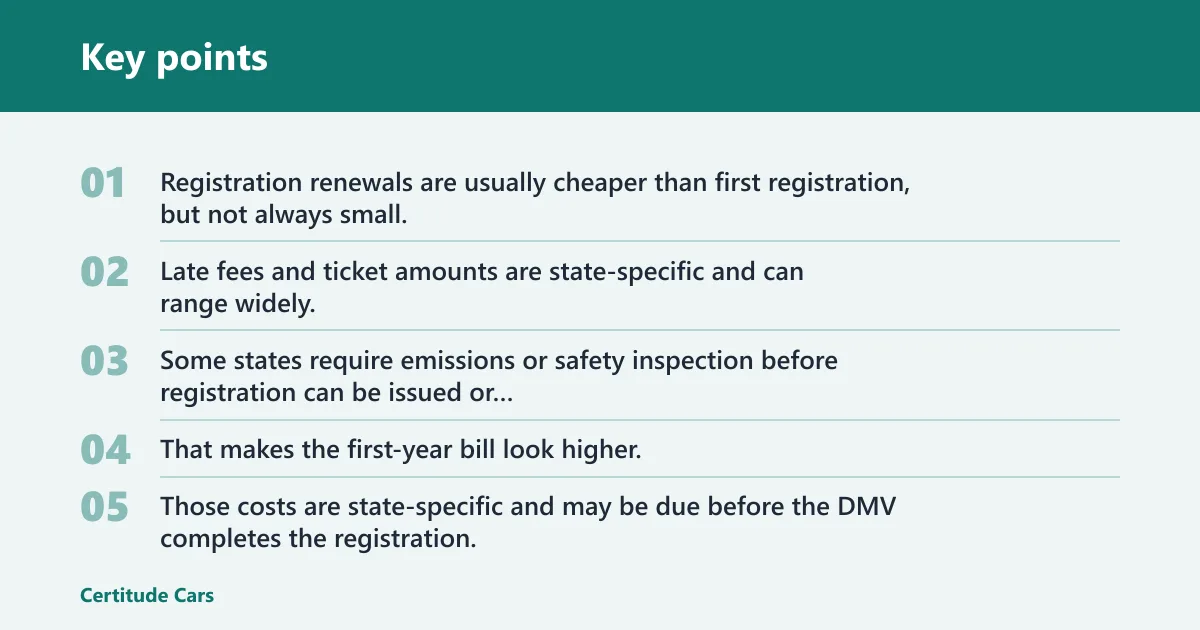
Registration renewals are usually cheaper than first registration, but not always small. Late renewal can trigger fines. Late fees and ticket amounts are state-specific and can range widely, so a DMV or law-enforcement page should be checked for the current penalty schedule before assuming a single national number.
Inspection or emissions fees
Some states require emissions or safety inspection before registration can be issued or renewed. That makes the first-year bill look higher, especially if you are transferring an out-of-state vehicle or a used car that needs compliance checks. Those costs are state-specific and may be due before the DMV completes the registration. In states with mandatory inspection programs, the inspection station and DMV may each have separate charges.
First-year vs renewal example
Picture a buyer in a state with about a $150 annual registration fee, a one-time title fee, and sales tax due at purchase. In year one, the bill can include registration, title, sales tax, and any local surcharge. At renewal, the same owner may pay only the recurring registration fee and any required inspection or emissions charge. The exact amount should be verified against the current DMV fee schedule and revenue department tax rule.
| Example line item | First registration | Renewal |
|---|---|---|
| Registration/license fee | Yes | Yes |
| Title fee | Yes | No |
| Sales tax | Yes | No |
| Local surcharge | Maybe | Maybe |
| Inspection or emissions step | Maybe | Maybe |
How to estimate your total before you pay
Start with four lines: sales tax, title fee, registration or license fee, and any local surcharge. Then add dealer doc fee if you are buying from a dealer, and add inspection or emissions costs if your state requires them. If the car is new to you, assume the first-year total will be higher than the renewal total. For an exact figure, use your state DMV’s fee calculator or fee schedule where available.
That simple method works because it separates unavoidable government charges from dealer-collected paperwork charges. It also prevents a common mistake: assuming the advertised sale price is the final number. For budgeting, the final number is the out-the-door price, not the sticker price. A state tax agency or DMV page should confirm whether any fees are taxable before you sign.
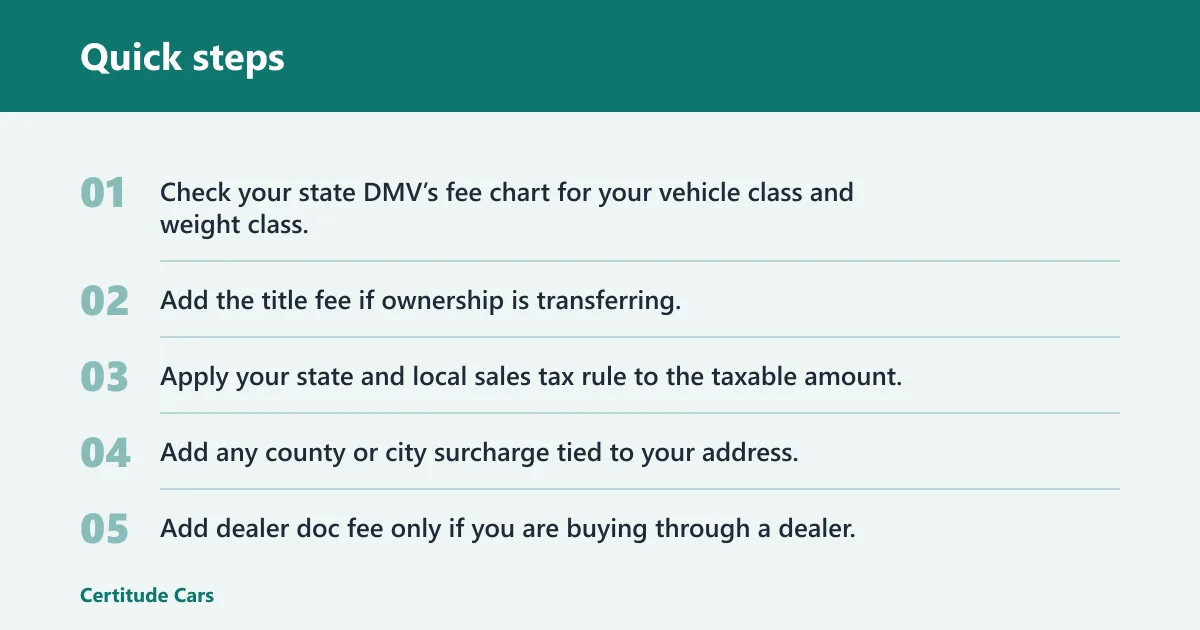
- Check your state DMV’s fee chart for your vehicle class and weight class.
- Add the title fee if ownership is transferring.
- Apply your state and local sales tax rule to the taxable amount.
- Add any county or city surcharge tied to your address.
- Add dealer doc fee only if you are buying through a dealer.
- Include inspection, emissions, plate, or late-renewal fees if they apply.
- Compare the first-year total with the renewal total so you do not budget renewal numbers for a first registration.
What to ask the dealer before paying registration fees
Ask for an itemized out-the-door price that lists sales tax, title, registration or license fee, doc fee, and any local surcharge separately. Ask whether the trade-in reduces the taxable amount in your state, and ask which charges are dealer pass-throughs versus state charges. That makes negotiation possible where it actually exists. It also helps you confirm whether the dealer is charging the state amount exactly or adding its own handling fee.
| Dealer question | Why it matters | What to verify |
|---|---|---|
| Can you show the full out-the-door price line by line? | Prevents hidden bundling of tax, title, and fees | Sales tax, title, registration, doc fee, local surcharge |
| Is the doc fee capped by state law? | Some states cap doc fees or require disclosure | State dealer-licensing or consumer-agency rules |
| Does my trade-in reduce taxable amount here? | Trade-in treatment can materially change tax | State revenue department rule |
| Are these DMV fees estimated or exact? | Estimates can change by address or vehicle details | Current DMV fee schedule and county add-ons |
| Are plate, inspection, or emissions charges included? | These are often forgotten in first-year totals | Separate state or local charges |
Registration fees themselves are not normally negotiable. Doc fees can run from under a hundred dollars to several hundred, and they may be capped by state law or set by the dealer. If the dealer cannot lower the doc fee, ask whether a matching price reduction or credit is available elsewhere in the deal. Dealer doc-fee caps, where they exist, are published by state consumer, motor vehicle, or licensing agencies and should be checked before agreeing to the quote.
Frequently asked questions
How much does car registration cost in my state?
There is no single number that fits every state. Annual car registration fees range from modest flat charges to several hundred dollars depending on the state and vehicle class. Some states use formulas based on weight, value, age, or fuel efficiency, and some add local charges. The most accurate answer comes from your state DMV’s fee chart or calculator.
What fees do you pay when you register a car?
The core items are the registration or license fee, the title fee if ownership is changing, and any sales tax due under your state’s rules. Some bills also include county or city surcharges, plate charges, inspection or emissions costs, and late fees if the registration is overdue. Because state rules differ, the line items should be verified one by one.
Can registration fees be rolled into a car loan?
Often the lender can finance taxes, title, and registration as part of the purchase amount, but that depends on the lender and the transaction. Ask whether the loan covers government fees, dealer doc fees, and any local surcharges. Do not assume every charge can be financed. The lender’s funding rules and the DMV’s payment timing can differ.
What fees can vary by county or local area?
County or city surcharges are the main ones that change by address. In some states, local taxes or add-ons also affect the bill, so nearby buyers can pay different totals for the same car. That is why a state quote alone is not always enough for an exact estimate. Local tax and DMV pages often list these add-ons separately.
What should I ask the dealer before paying registration fees?
Ask for a line-by-line out-the-door price, not a single blended number. Make the dealer separate sales tax, title, registration or license fee, doc fee, and any local surcharge. Also ask whether a trade-in changes the taxable amount, because that rule can lower or leave unchanged the amount you owe. If the dealer says the doc fee is fixed, ask for the state cap or disclosure rule in writing.
Sources
- State DMV fee schedules and title/registration pages for registration, title, plate, and renewal charges.
- State departments of revenue or taxation for vehicle sales/use tax, trade-in treatment, and locality-based tax rules.
- State dealer licensing, consumer protection, or motor vehicle agency pages for doc-fee caps, disclosure rules, and administrative fee guidance.
- State inspection and emissions program pages for any registration-linked inspection requirements or fees.
- State traffic or court resources for late registration penalty and ticket schedules.