What Do You Need to Renew Your Car Registration?
You usually need your plate or renewal notice, proof of insurance if your state does not verify it electronically, and proof of inspection or emissions only where required. Missing one item can delay renewal, add late fees, or leave your registration expired. This guide gives you a quick checklist for the channel you use, the checks your state runs automatically, and any record changes since last year that trigger extra paperwork. If you need the site’s broader context first, start with vehicle registration.
What you need before renewal
Start with the vehicle record, then sort out anything that changed since last year. The items you need most often are your plate number, VIN, payment method, and any proof your state cannot verify on its own. The renewal notice helps, but you do not always need it.
Choose your renewal path first: online or in person
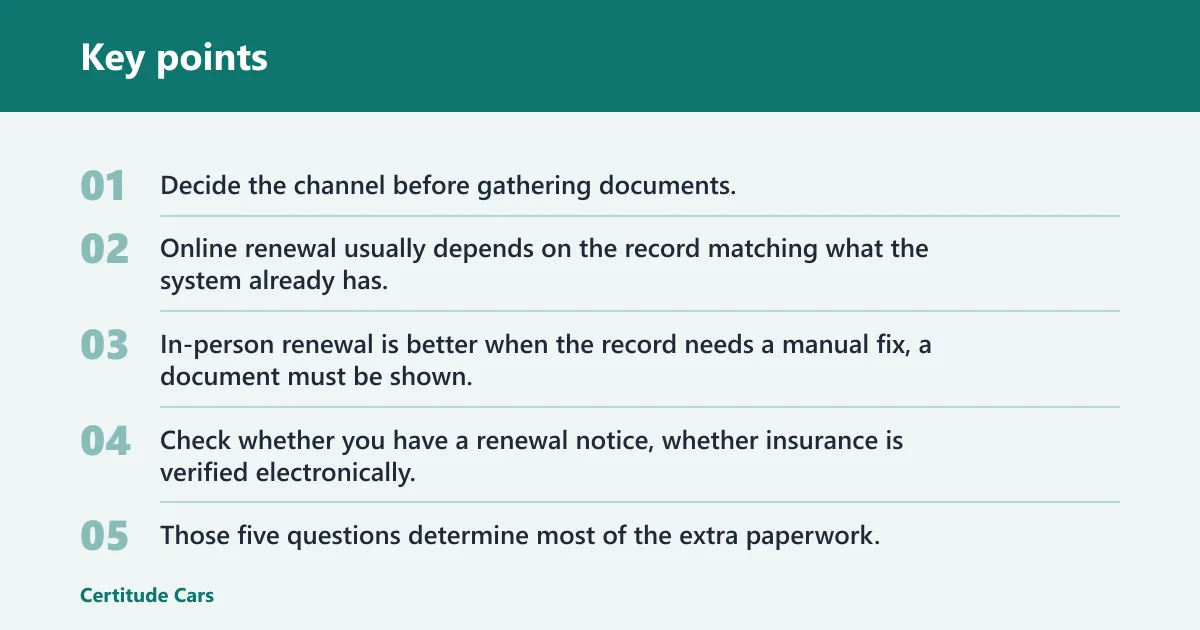
Decide the channel before gathering documents. Online renewal usually depends on the record matching what the system already has, plus a working payment method. In-person renewal is better when the record needs a manual fix, a document must be shown, or the state asks for identity confirmation at the counter.
Then branch by the main checks
Check whether you have a renewal notice, whether insurance is verified electronically, whether inspection or emissions is required, whether your address changed, and whether the registration is expired. Those five questions determine most of the extra paperwork. If one answer is “yes,” gather the matching proof before you start.
Start with the vehicle record
Your renewal usually begins with one identifier tied to the vehicle file: the license plate number, the VIN, or the notice mailed or emailed before expiration. Some systems can find the record with the plate alone. Others ask for the VIN, or the last five digits of it, plus a renewal code. (CA)
Check whether anything changed since last year
Look for changes in address, insurance, inspection status, or ownership details. A moved address can send the sticker to the wrong place. An insurance lapse or a missed emissions test can stop renewal even if the payment is ready. If the vehicle registration is already expired, late fees or in-person handling may follow.
Separate information you need from items you must present
Some renewal details are only information. Others must be entered exactly or shown at the counter. Plate number, VIN, and current address are usually information fields. A government-issued ID, insurance card, or inspection proof may need to be presented in person, depending on the state and the channel.
Renew car registration checklist
This checklist separates what is always useful from what depends on the state, the renewal channel, and any change since last year. Use it as a preflight check before you start online or leave for an office. The biggest failure points are mismatched records, unresolved compliance holds, and expired status.
| Item | Required when | Usually optional when | Common blocker | Stop before you pay: error-check |
|---|---|---|---|---|
| Renewal notice | Often needed to start the process, especially if it includes a renewal ID, amount due, or mailing code | May be optional if your state lets you search by plate or VIN | Missing code, old address, or a notice that cannot be matched to the current record | Confirm the notice matches the current plate, VIN, and mailing address before entering payment details |
| Plate number | Commonly required for online renewal and record lookup | May be replaced by VIN or a notice number in some systems | Typing the wrong plate, using a plate from the wrong vehicle, or entering it with extra spaces | Recheck every character against the plate before submitting the renewal form |
| VIN | May be required instead of or alongside the plate number | Some systems use only part of it, such as the last five digits | Wrong digit, transposed characters, or entering a partial VIN where a full VIN is required | Match the VIN exactly to the vehicle record and the insurance file, then verify any partial-entry instructions |
| Driver identification | Often needed in person; some states ask for driver license or non-driver ID details online | May not be needed if the renewal record already matches and the channel is fully online | Name mismatch, expired ID, or address that does not match the vehicle record | Make sure the ID is current and that the name and address match the registration file |
| Proof of insurance | Required in many states when insurance is not verified electronically | May be confirmed automatically by the state | Policy not active, policy not linked to the vehicle, or a name and VIN mismatch | Check the policy status, VIN, and effective dates before paying |
| Inspection or emissions compliance | Required in states or counties that run these checks before renewal | Not required where the vehicle is exempt or where the state does not run the check | Missed inspection, failed emissions test, or a record that has not updated yet | Confirm the inspection result is posted and that the renewal record shows the clearance |
| Address changes | Needed if you moved since the last renewal | Usually optional if the mailing address has not changed | Sticker or notice sent to the wrong address, or a record that does not match the current residence | Verify the mailing address is updated before you submit payment so the sticker goes to the right place |
| Payment method | Always needed to complete renewal | Card, bank draft, check, or another accepted method depends on the state and channel | Card declines, wrong fee amount, unpaid penalties, or a method not accepted for that channel | Confirm the accepted payment type and amount due before final submission |
| Stop before you pay: error check | Needed every time before submission | Never optional if you want to avoid a failed transaction | One wrong digit, an expired insurance record, an unpaid ticket or fee hold, or a change of address not updated first | Do a final scan for plate, VIN, address, insurance, inspection, and fee accuracy before clicking pay |
What do you need to renew online?
Online renewal usually starts with the plate number, VIN details, and a payment method. Many states also check insurance, inspection, or tax records in the background, so you may not need to upload papers unless the system flags a problem. If your state asks for a notice code or address confirmation, keep that nearby.
Plate number and VIN details
Online systems often use the plate number first. Connecticut DMV says you can renew online 45 days before expiration, asks for a license plate number, and requires a credit or debit card; it also asks for a printer to be ready after renewal. California online renewal may need the last five digits of the VIN or HIN.
Insurance and inspection checks that happen in the background
Some states confirm insurance or inspection electronically instead of asking you to upload proof. That can save a step, but it can also create a hidden failure if the record has not updated. California renewal may need insurance on file and may need electronic smog certification. If the system cannot verify the record, it may stop the renewal until the issue clears.
Payment method and address confirmation
Have the accepted payment method ready before you begin. A card that is declined, expired, or blocked for online use will end the session. If the notice or online form asks for an address match, make sure the mailing address and the record match before you submit. A bad address can send the sticker to the wrong place.
Say your state lets you renew online with plate and VIN only, but the insurance file shows an old policy number. The site may reject the renewal even though your card is fine. The fix is not a new payment card; it is correcting the record that the system could not verify.
What do you need to renew in person?
In person, you usually need the vehicle record details plus a government-issued ID if the office needs to match the person to the file. Paper copies matter more at the counter because staff may need to see insurance, inspection, or address documents directly. Bring every item that could be a hold, not just the renewal notice.
Driver identification and record matching
Bring a driver license or non-driver ID if your state or office asks for it. The name and address should match the registration record as closely as possible. If the renewal is being handled for someone else, the office may ask for that person’s details, not just the plate number and payment.
When paper copies still matter
Paper or printable proof still matters when the state does not verify a record electronically. That includes insurance cards, inspection slips, emissions reports, and address update forms in some states. Keep them together before you go. If one document is missing or unreadable, the counter visit may end without a renewal.
What to bring if the record is blocked
If the record shows a hold, bring anything that can resolve it: proof of insurance, inspection paperwork, tax or fee payment proof, and a current ID. If the issue is an address mismatch, bring a document that shows the new address. If the issue is an expired registration, ask the office what extra steps or penalties apply before you pay.
A common first-timer mistake is showing up with the renewal notice and payment only, then learning that the office needs a current address update and an insurance card that matches the vehicle VIN. Two extra papers can turn a second trip into a same-day finish.
What if your notice is missing?
You can often renew without the notice. Many states can search the vehicle record with the plate number or VIN, and some let you recover the renewal amount another way. If the system still cannot find the record, or if the notice was tied to a moved address, contact your state office before the expiration date.
Use the plate or VIN instead
If the renewal notice is lost, the plate number is usually the first fallback. Some states also accept the VIN or the last five digits of it. If the notice included a renewal code or the record cannot be found, you may need to use another lookup path.
Find the renewal amount another way
The amount due can still be available through the state portal, a mailed notice reissue, or an office lookup. Do not guess the fee. Every state charges a base renewal fee, and some add vehicle-specific charges. Use the state calculator or office lookup so you do not overpay or miss a required amount.
When to contact your state office
Contact the office if the record does not match your plate, if the system cannot confirm your identity, or if the notice was sent to an old address. That is especially important when the registration is close to expiring. A short delay can turn a simple renewal into a late renewal with extra fees.
What can stop renewal?
Insurance verification problems, inspection or emissions holds, address mismatches, unpaid fees, and expired registration are the most common blockers. A failed renewal usually means the state could not confirm one part of the record, not that every part was wrong. Fix the blocked item first, then try again with the same channel or a different one.
Insurance verification problems
If your state checks insurance electronically, a policy that is active but not updated in the database can still fail. If you must upload proof manually, the policy must match the vehicle details. The common fixes are simple: confirm the policy is current, check the VIN, and make sure the insurer has the correct plate or vehicle record.
Inspection or emissions holds
If your area requires inspection or emissions testing, an unresolved record can block renewal until the system updates. California renewal may need electronic smog certification. If you live in a place that still requires annual inspection or emissions clearance, confirm the current rule before you pay so you do not rely on outdated advice.
Address mismatch, unpaid fees, or expired status
A moved address can misroute the notice or sticker and can also trigger a record mismatch. Unpaid tickets, taxes, or other fees may hold the renewal in some states. If the registration is already expired, grace periods vary by jurisdiction, and late fees may apply. Connecticut says a $10 late fee starts after day five past expiration. (CT)
Suppose your plate is correct, but the renewal screen says the address is invalid. That usually means the vehicle record and the mailing record do not agree. Update the address first if your state requires a separate change, then return to renewal once the file matches.
State examples: Texas and California
Texas and California are examples, not universal rules. Use them as models for how state rules can differ. Texas renewal can involve inspection or fee questions that are specific to the vehicle and the current rule set. California renewal can depend on how the record is pulled, whether insurance is on file, and whether smog is already recorded.
Texas example
If you are renewing in Texas, check the current inspection and renewal rules before you pay. State requirements change, so older advice may be outdated. Use the current Texas DMV or tax office guidance for any inspection, fee, or renewal-step question before you submit payment.
California example
If you are renewing in California, confirm the exact renewal path on the DMV site before starting. A renewal notice with your current address can be required in some cases, and online renewal may need the last five digits of the VIN or HIN. Insurance on file and electronic smog certification may also be part of the process.
Frequently asked questions
What documents do you need to renew your car registration?
Most renewals need the plate number or VIN, a payment method, and any compliance proof your state cannot verify automatically. Depending on the channel, you may also need an ID, insurance, inspection or emissions proof, and a renewal notice. The exact list changes by state and by whether you renew online or in person.
Do you need the renewal notice to renew car registration?
Not always. The notice is helpful because it can include the renewal code, amount due, and mailing details, but losing it does not always block renewal. Many states can search by plate or VIN instead. If the notice is tied to an old address, use the state lookup path or contact the office.
Do you need proof of insurance for registration renewal?
Many states require it, but some verify it electronically. If your state cannot verify the policy automatically, you may need to show a current insurance card or upload proof online. The policy should match the vehicle details. A mismatched VIN or lapsed policy is a common reason a renewal stops.
Do you need an inspection before registration renewal?
Only where your state or county requires it. Some places ask for inspection or emissions clearance before renewal; others do not. If the inspection is required and unresolved, renewal can be blocked until the record updates. Check your current state rules before you pay so you do not rely on outdated guidance.
What do I need to renew my car registration online?
Usually the plate number, VIN details, and a payment method are the starting point. Some systems also ask for a renewal code, insurance confirmation, or address confirmation. The same source says online renewal can begin 45 days before expiration and needs a credit or debit card, while California may ask for the last five digits of the VIN or HIN.
What happens if my registration is already expired?
You may face late fees, added steps, or an in-person requirement, depending on your state. Connecticut applies a $10 late fee after day five past expiration. Some jurisdictions allow a short grace period, while others do not. Do not drive on an expired registration unless your state clearly allows it.