How Tire Size Is Measured: Width, Aspect Ratio, and Rim
Byline: Written by a tire-fitment editor with hands-on experience comparing OE placards, service-manual specs, and replacement tire dimensions. A tire size like 225/45R17 typically indicates a 225 mm section width, a 45% aspect ratio, and a 17-inch rim diameter; sidewall height is width × aspect ratio, and the final size should match the vehicle placard and wheel clearance. If you guess, you can get rubbing, speedometer error, overload risk, or a tire that will not fit the wheel. This guide shows what each marking measures, how to calculate sidewall height and overall diameter, and how to check it against placard and fitment limits. Published dimensions can vary by measuring rim and manufacturer spec sheet, so treat any catalog number as a standard reference, not a universal guarantee.
What do the numbers in a tire size mean?
A full tire size string tells you more than one measurement. The width, aspect ratio, construction, rim diameter, load index, and speed rating each answer a different fitment question, and you should read them from left to right rather than treat the whole string as a single code. For a standards-based definition, the Tire and Rim Association and ETRTO set the sizing conventions that tire makers follow, while the vehicle’s door-jamb placard remains the OE recommendation for your exact vehicle.
How do you read P225/65R17 102T?
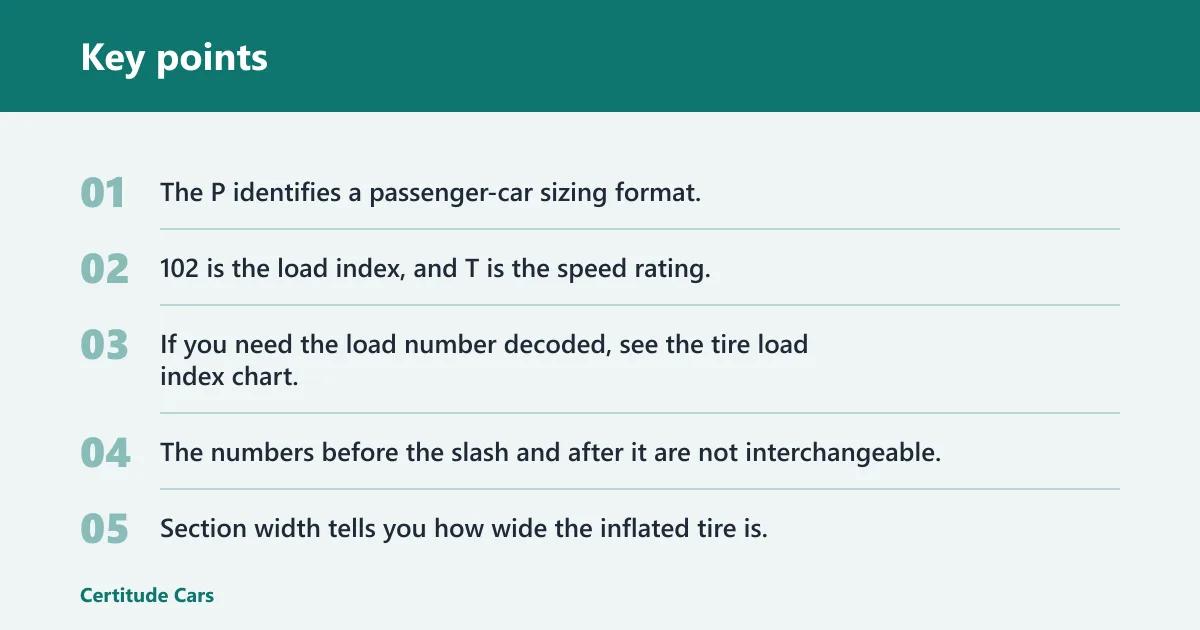
Take P225/65R17 102T. The P identifies a passenger-car sizing format. 225 is the section width. 65 is the aspect ratio. R means radial construction. 17 is the rim diameter. 102 is the load index, and T is the speed rating. If you need the load number decoded, see the tire load index chart, and for the letter code, use the speed rating guide.
That order matters. The numbers before the slash and after it are not interchangeable, and the last number is not the tire’s total height. It is the wheel diameter the tire must fit.
What do section width, aspect ratio, rim diameter, load index, and speed rating each tell you?
Section width tells you how wide the inflated tire is. Aspect ratio tells you how tall the sidewall is relative to that width. Rim diameter tells you what wheel size it mounts on. Load index tells you how much weight the tire can carry at its rated pressure, and speed rating tells you the maximum speed capability under the standard test conditions described by tire makers.
How is tire width measured?
Section width is the first size number. On most cars, SUVs, CUVs, and light trucks, it is measured in millimeters for an inflated tire. Flotation tire widths are measured in inches instead and usually include a decimal point. The labeled width is the tire’s sidewall-to-sidewall width, not the width of the tread alone.
What is the difference between section width and tread width?
That distinction trips people up. Tread width is the contact patch or the visible rubber across the top, while section width is the tire’s widest point on its inflated body. The nominal section width is the widest point of the tire, but the exact measured width can vary with the measuring rim, tread design, and manufacturer spec sheet.
So when you see a width number, read it as a standardized label, not a tape-measure reading of the tread blocks. A tire can have the same labeled width as another tire and still look wider or narrower because its shoulders sit differently.
Is tire width measured in mm or inches?
For most passenger and light-truck metric sizes, width is in millimeters. For flotation sizes, width is in inches and often includes a decimal point, such as 31×10.50R15. That means you cannot compare every width number as if they use the same unit system.
Mixing those systems is a common mistake. A 275 in a metric size is not the same type of notation as 10.50 in a flotation size, even though both describe width. The unit system is part of the measurement, not an optional detail.
What does aspect ratio mean on a tire?
Aspect ratio is the sidewall height expressed as a percentage of section width. It is the number after the slash in a metric tire size, and it is used to estimate sidewall height, not the full tire diameter. Lower aspect ratios mean shorter sidewalls and a lower-profile appearance.
How do you calculate sidewall height from tire size?
Use this formula: section width × aspect ratio = sidewall height, after converting the percentage to a decimal. If the width is in millimeters, the result is in millimeters. To convert to inches, divide millimeters by 25.4. This is the same basic method used in fitment calculators, but the authoritative starting point is the tire size format itself and the manufacturer’s published spec sheet.
Example: 225 mm × 0.65 = 146.25 mm sidewall height. 146.25 mm ÷ 25.4 = 5.76 inches. That is the approximate sidewall height for a 225/65R17 tire.
Sidewall height is a useful fitment number because it helps you estimate overall diameter, wheel protection, and how much sidewall flex the tire will have. A shorter sidewall usually leaves less cushion and changes the tire’s appearance on the wheel.
What does rim diameter tell you?
Rim diameter is the wheel diameter in inches. It is the final number in the tire code, and it must match the wheel the tire is mounted on. A 17-inch tire does not fit a 16-inch wheel, even if the width and aspect ratio look close. The rim diameter is the mounting size, not the outside height of the tire.
What does the R mean in a tire size?
The R in the size string means radial construction. Radial is the common modern passenger-tire construction, and it tells you the tire’s internal build, not the wheel size. The letter identifies construction type, while the rim number identifies the wheel diameter.
Load index and speed rating appear after the rim diameter in the full code. The load index tells you the maximum weight a tire can carry at its rated pressure, and the speed rating tells you the maximum speed at a given load. Do not leave them out when you compare replacement tires.
What is the difference between overall diameter and rim diameter?
Rim diameter is the wheel opening in the tire. Overall diameter is the full top-to-bottom size of the mounted tire. They are different measurements, and confusing them leads to bad fitment math. Overall diameter is what matters for clearance and speedometer effect; rim diameter only tells you what wheel size the tire can fit.
How do metric, flotation, and LT tire sizes differ?
Metric, flotation, and LT sizing are not interchangeable labels. Metric sizes prioritize width in millimeters and aspect ratio as a percentage. Flotation sizes use overall diameter and width in inches. LT sizes use the same basic metric pattern as passenger tires, but they often include an LT prefix and load range details for heavier-duty use.
What is the difference between metric sizing and flotation sizing?
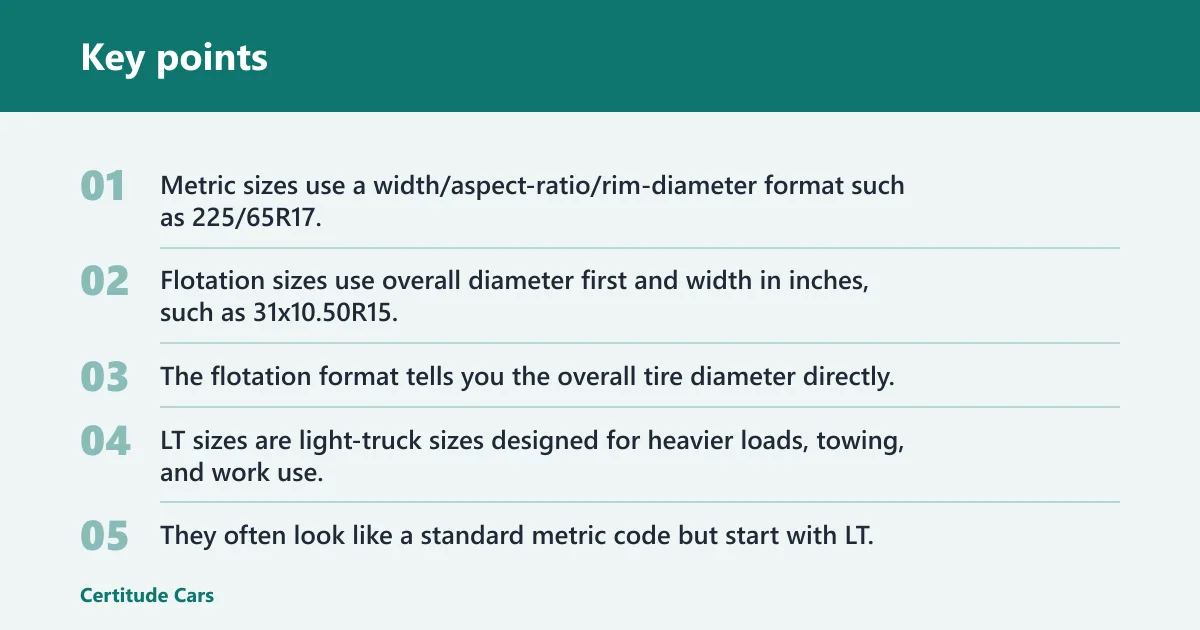
Metric sizes use a width/aspect-ratio/rim-diameter format such as 225/65R17. Flotation sizes use overall diameter first and width in inches, such as 31×10.50R15. The flotation format tells you the overall tire diameter directly, while the metric format requires a calculation to estimate that number.
What is an LT tire size, and how is it read?
LT sizes are light-truck sizes designed for heavier loads, towing, and work use. They often look like a standard metric code but start with LT, and they may show dual load indices for single and dual applications. The structure still follows width, aspect ratio, construction, and rim diameter, but the load rating context matters more for trucks and vans.
What are common misread tire size scenarios?
Here are common mistakes and what each one confuses: a 275 metric width is not the same unit as 10.50 flotation width; a 17 at the end is the wheel diameter, not the tire’s outer height; a 65 aspect ratio is not 65 inches, but a percentage of width; the R means radial construction, not rim size; and the load index is not the speed rating. Each misread blends a different measurement into the wrong category.
What does the worked measurement table show?
This table shows three real examples with the width, aspect ratio, sidewall height, and overall diameter worked out from the size string. The formulas assume a simple approximation: overall diameter = 2 × sidewall height + rim diameter. That gives a useful planning number, while actual dimensions can vary by manufacturer and design.
| Example size | Width | Aspect ratio | Sidewall height | Rim diameter | Overall diameter |
|---|---|---|---|---|---|
| P225/65R17 102T | 225 mm | 65% | 225 × 0.65 = 146.25 mm = 5.76 in | 17 in | (2 × 5.76) + 17 = 28.52 in |
| LT265/75R16 123/120S | 265 mm | 75% | 265 × 0.75 = 198.75 mm = 7.83 in | 16 in | (2 × 7.83) + 16 = 31.66 in |
| 31×10.50R15 | 10.50 in | N/A in flotation format | 31 – 15 = 16 in total sidewall height; each sidewall ≈ 8.00 in | 15 in | 31 in |
The passenger example uses the metric format most drivers see. The light-truck example keeps the same basic structure but includes an LT prefix and a dual load index. The flotation example uses inches for width and overall tire diameter, so you read it differently from a passenger metric size.
Say your truck wears a 31×10.50R15 tire and you compare it to a 265/75R16 tire on another vehicle. They may look similar in height, but they are not the same sizing system. One is flotation based and the other is metric, so the width and diameter labels are not read the same way.
That is why a size lookup or comparison tool can help, but only if you start with the full code and not one number by itself. Tire size can be searched by section width, aspect ratio, and rim diameter. If you are comparing alternatives, use the plus-size calculator to check diameter change, clearance, and speedometer impact before you buy.
How do you find your tire size on the vehicle?

Start with the sidewall. The tire size is molded into the tire itself, usually as a full code string. Then check the vehicle placard, often on the driver-side door jamb or door edge, because that placard lists the manufacturer’s recommended size and inflation information for the vehicle. If you are unsure where to look, use the guide for where to find door-jamb placard information.
Why does the OEM placard matter?
The placard matters because fit is not only about whether the tire fits the wheel. You also need enough clearance in the wheel well, enough room for suspension travel, and the correct load and speed ratings for the vehicle’s requirements. The OEM placard is the first-fit standard from the vehicle maker, so it is the baseline for size, pressure, and usage.
- Read the full sidewall code exactly as printed.
- Check the vehicle placard for the recommended size and pressure.
- Confirm the rim diameter matches the wheel.
- Check load index and speed rating against the vehicle spec.
- Verify wheel-clearance space before buying a different size.
Picture a driver who swaps from 225/65R17 to 245/65R17 because the wheel is still 17 inches. The wider tire may fit the rim, yet it can still rub the strut or liner if the vehicle was not built for that extra section width. The placard and clearance check are the gatekeepers.
Another common first-timer mistake is assuming two tires with the same width number will sit the same on the wheel. One may have a stiffer sidewall, a different shoulder shape, or a different aspect ratio, so the real-world fit and look can change even when the labeled width is unchanged.
Frequently asked questions
What does the width number on a tire size mean?
The width number is the section width. On most passenger and light-truck metric tires, it is the tire’s width in millimeters from sidewall to sidewall when inflated. On flotation sizes, width is measured in inches instead, so the unit system changes with the sizing format.
What is aspect ratio on a tire?
Aspect ratio is the sidewall height as a percentage of the tire’s width. A lower number means a shorter sidewall and usually a wider-looking tire profile. You use the ratio to calculate sidewall height, not the full diameter, so it is one part of the size, not the whole story.
How is rim size measured on a tire?
Rim size is measured in inches and appears as the final number in the tire size code. It refers to the wheel diameter the tire must fit, not the tire’s outside height. A tire marked 17 must go on a 17-inch wheel, regardless of the sidewall height.
How do I calculate tire sidewall height from tire size?
Multiply section width by aspect ratio, using the ratio as a decimal. For 225/65R17, the sidewall is 225 × 0.65 = 146.25 mm, which equals 5.76 inches after dividing by 25.4. That gives you one sidewall; overall diameter uses two sidewalls plus the rim diameter.
Where can I find my tire size on the tire or vehicle?
Look on the tire sidewall for the full code. Then check the vehicle placard on the driver-side door jamb or door edge for the manufacturer’s recommended size. The placard is the better reference when you are replacing tires, because it ties size to load, pressure, and fitment for that vehicle.
Sources
Tire and Rim Association yearbook sizing conventions; ETRTO standards for tire designation and dimensions; vehicle manufacturer owner’s manual and door-jamb placard guidance; Tire Rack and similar manufacturer-focused fitment explainers for load index and speed rating interpretation.