Does Engine Size Matter When Comparing Cars?
Engine size matters, but only as one input: compare displacement with horsepower, torque, vehicle weight, gearing, and transmission. By itself, it is a weak buying rule. Miss that, and you can pay more for fuel, tow less than you need, or buy a car that feels slow despite a larger engine. This guide shows when displacement matters, when it barely matters, and what to check first.
When displacement is a useful clue
Yes, but not on its own. Displacement is the total swept volume of the cylinders, usually shown in cc, liters, or cubic inches, and it can hint at how an engine may behave. It does not directly tell you power output, and it says little about how the car will feel once weight, gearing, and turbocharging are part of the picture.
Where size matters most
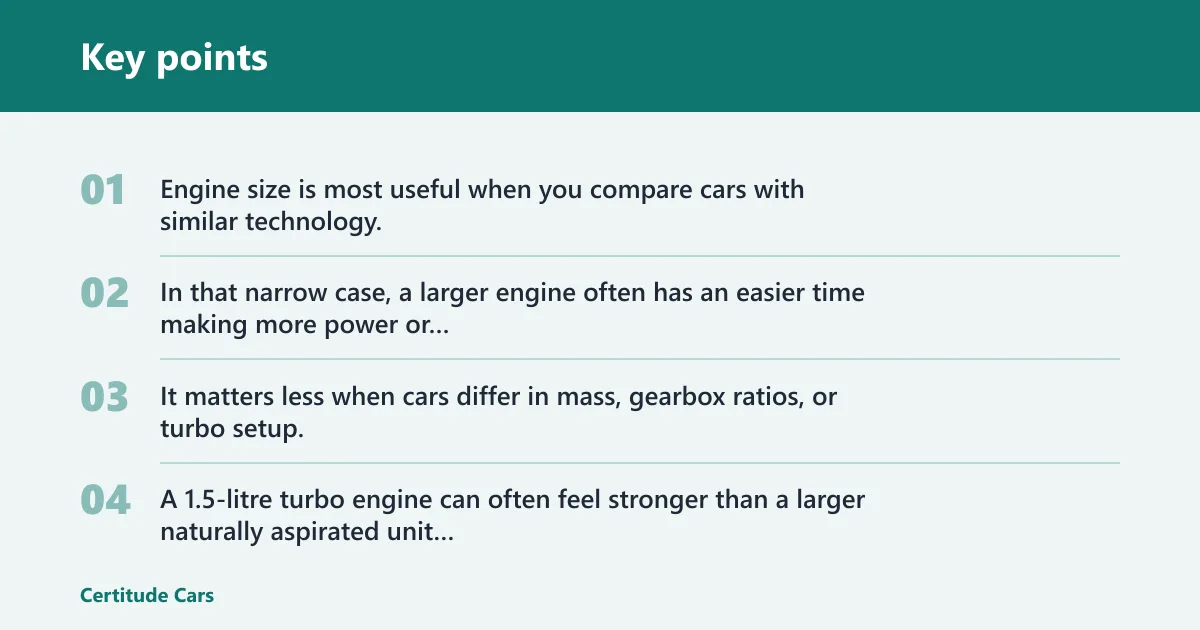
Engine size is most useful when you compare cars with similar technology, similar body size, and similar weight. In that narrow case, a larger engine often has an easier time making more power or torque, especially if both engines are naturally aspirated.
It matters less when cars differ in mass, gearbox ratios, or turbo setup. A 1.5-litre turbo engine can often feel stronger than a larger naturally aspirated unit because boost and calibration can change how displacement turns into output.
Engine size checklist
| Use case | Is displacement a useful signal? | Check this instead | Red flags that make size misleading |
|---|---|---|---|
| City driving | Sometimes | Low-rpm torque, curb weight, gearbox ratios | Small turbo engine tuned for lag; heavy hatchback with a modest engine |
| Motorway use | Only a rough guide | Top gear ratio, cruising rpm, torque at mid-range revs | Short gearing that keeps revs high; large engine with tall gearing that feels calm |
| Towing | Weak signal | Torque curve, towing limit, transmission cooling, axle ratio | High displacement but poor low-rpm pull; automatic gearbox with hunting ratios |
| Insurance or tax sensitivity | Sometimes | Local banding rules, official emissions, engine family | Assuming every smaller engine costs less; ignoring market-specific tax thresholds |
| Performance priority | Weak signal | Horsepower, torque, power-to-weight ratio | Big engine in a heavy car; small turbo engine with strong output and shorter gearing |
| Mixed driving | Useful only as one clue | Combined output, curb weight, fuel economy, gearbox spread | Choosing by litres alone; ignoring how the car is actually geared |
How is engine size determined?
Engine size is determined by the total swept volume of all cylinders. Manufacturers usually list it in cubic centimetres, liters, or cubic inches. A 2.0-litre engine is roughly 2,000 cc, and a larger number usually means a larger total cylinder volume rather than a direct promise of more power.
Cc, liters, and cubic inches
These are just different units for the same thing. In many markets, small engines appear in cc, while larger engines are listed in liters. Some older or American-spec references still use cubic inches. The unit changes; the swept volume does not.
Cylinders and swept volume
Displacement combines the volume of every cylinder. A four-cylinder 2.0-litre engine and a six-cylinder 2.0-litre engine have the same total swept volume, although their layouts and power delivery can feel different. That is one reason cylinder count and engine size are not the same thing.
Suppose two compact SUVs both list 1.5 litres. One is a turbocharged three-cylinder, the other a naturally aspirated four-cylinder with different gearing. Their road manners can differ sharply even before you look at horsepower or torque.
Where to find it on a spec sheet
- Check the engine specification line in the brochure or listing.
- Look for cc, liters, or cubic inches beside the engine code or fuel type.
- Open the registration document if the listing is incomplete.
- Use a VIN decode page if the paperwork is unclear.
- Confirm the exact trim, because the same model name can wear several engines.
If the listing gives only an engine family name, you still need the full spec sheet. Trim changes can bring a different turbo, different tune, or a different gearbox, and that changes the comparison more than the badge on the tailgate.
What engine size does not tell you
Displacement does not tell you how much power the engine makes, how quickly the car accelerates, or how relaxed it feels at motorway speed. For that, horsepower, torque, vehicle curb weight, and transmission gearing matter more. Engine size is one data point, not the verdict.
Horsepower versus torque
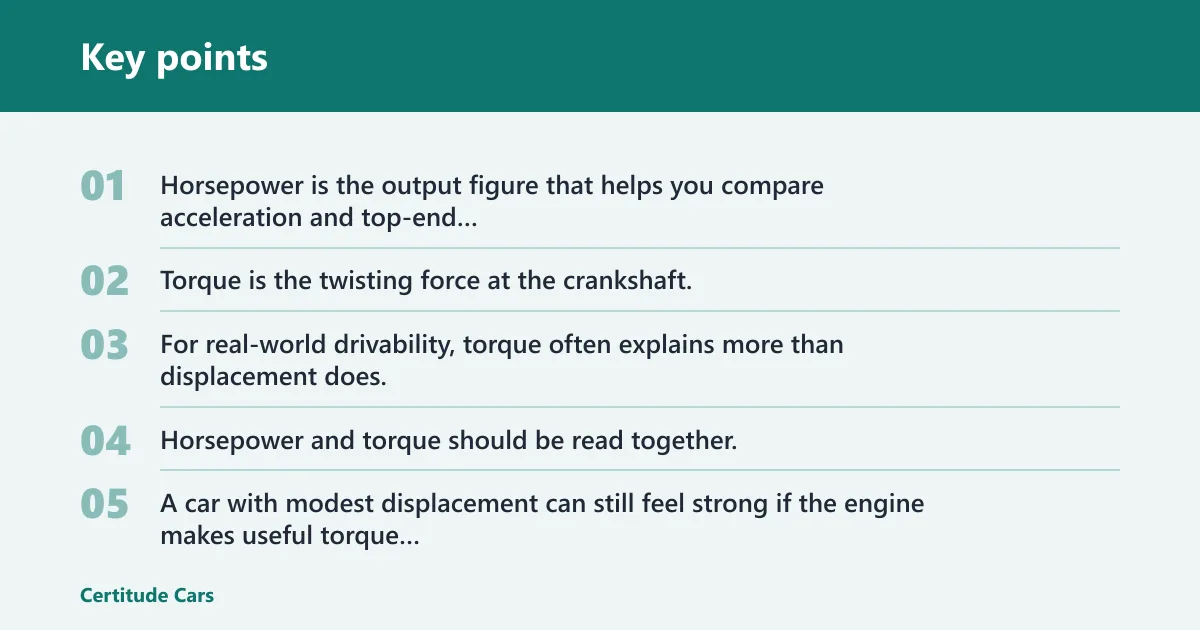
Horsepower is the output figure that helps you compare acceleration and top-end performance. Torque is the twisting force at the crankshaft, and it matters for pull from low rpm and for towing. For real-world drivability, torque often explains more than displacement does.
Horsepower and torque should be read together. A car with modest displacement can still feel strong if the engine makes useful torque early and the gearbox keeps the revs in the right band. A larger engine can feel lazy if the tune and gearing are poor.
Why curb weight changes the result
Vehicle curb weight is the mass of the car with standard equipment and fluids. It affects acceleration, braking, and efficiency. That is why power-to-weight ratio is often more predictive than engine size alone when two cars are different sizes or weights.
Picture a light hatchback with a 1.0-litre turbo engine and a heavy SUV with a 2.0-litre engine. The SUV may have the larger displacement, but the hatchback can still feel quicker if its power-to-weight ratio is better.
How gearing changes the feel
Transmission gearing changes how engine size turns into road speed. Short gearing helps a car feel lively at lower speeds but can raise motorway revs and noise. Tall gearing can make a smaller engine feel calmer on the highway, while also blunting acceleration.
That is why two cars with the same displacement can feel completely different. The gearbox is part of the performance equation. Ignore it, and you can misread the engine by a wide margin.
Does a small turbo engine count the same?
A turbocharged engine does not behave like a naturally aspirated engine of the same size. Boost can let a small displacement engine match or beat a larger one, so displacement alone becomes a weaker guide. The turbo, tune, and torque curve shape can matter more than the raw litres on the badge.
How turbocharging changes the comparison
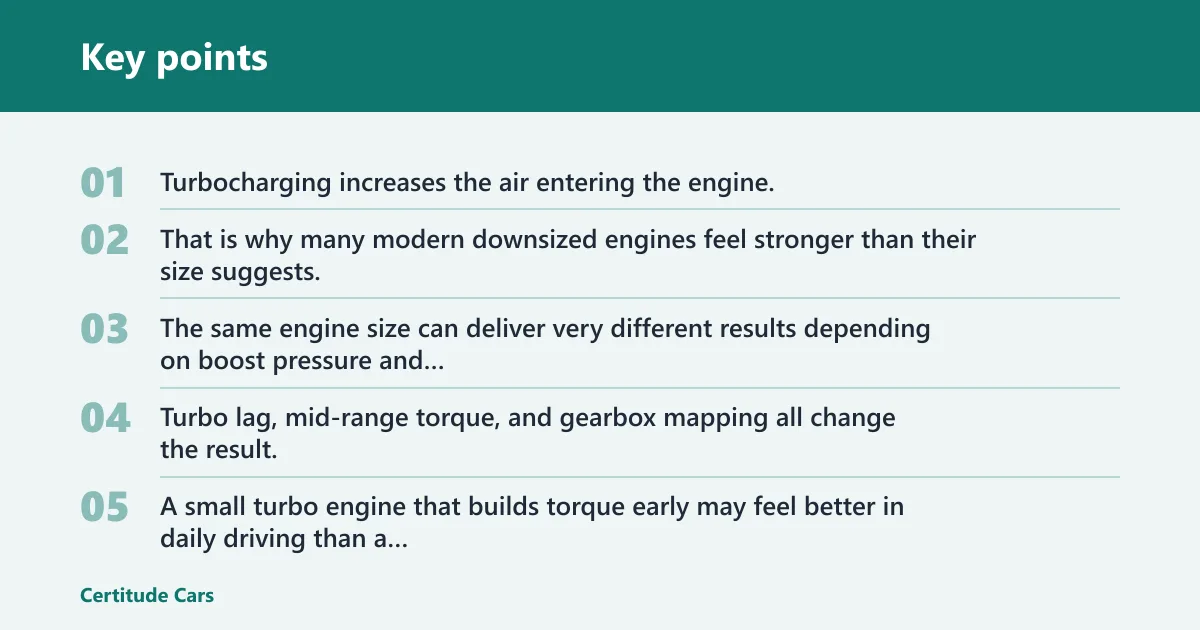
Turbocharging increases the air entering the engine, which can raise output without increasing displacement. That is why many modern downsized engines feel stronger than their size suggests. The same engine size can deliver very different results depending on boost pressure and calibration.
Turbo lag, mid-range torque, and gearbox mapping all change the result. A small turbo engine that builds torque early may feel better in daily driving than a larger engine that needs more revs to get moving.
When a smaller engine is enough
A smaller turbo engine is often enough for light cars, moderate commuting, and drivers who value fuel use and lower tax bands in markets where displacement still matters. But it is not automatically the better choice. Weight, gearing, and power delivery decide whether it feels right.
Fuel economy also needs context. Smaller engines often improve efficiency, but tuning and vehicle weight can outweigh displacement. Compare official test-cycle figures where available, then check real-world estimates if you drive in traffic, on hills, or with passengers.
What workshop diagnostics can tell you
Some diagnostic systems used for engine and ABS faults reference the ECU, use vehicle speed and engine speed signals, and can run a road test that produces quantitative data for comparison before and after repair. That analysis can include power, torque, acceleration, load response, and fuel consumption.
That kind of data is useful because it separates condition from displacement. A car with the “right” engine size can still underperform if the calibration, sensors, or drivetrain are off.
What should you compare instead?
Start with horsepower, torque, curb weight, gearing, and fuel economy. Those figures tell you more about how the car will actually feel and what it will cost to run. Engine size still matters, but it is usually the supporting number, not the headline number.
Horsepower and torque
Horsepower helps with acceleration and high-speed performance. Torque helps with low-speed pull and towing. If you are choosing between two cars, compare both figures rather than letting the larger displacement win by default.
Power-to-weight ratio
Power-to-weight ratio compares vehicle mass against engine output. It is especially helpful when body styles differ, because a larger engine in a heavier car may produce less usable performance than a smaller engine in a lighter one.
Fuel economy and running costs
Fuel economy often improves with smaller engines, but not always. Weight, gearing, turbo calibration, and driving cycle matter. Use official test figures for a baseline, then look for real-world estimates that match your driving pattern.
A common first-timer mistake is choosing the bigger engine because it sounds safer on paper. That can work for towing, but it can also mean higher fuel use and a car that still feels ordinary if the gearing is long and the body is heavy.
Frequently asked questions
Does engine size matter?
Yes, but it is only one part of the comparison. Engine size can hint at torque and power potential, yet horsepower, torque, curb weight, gearing, and turbocharging often explain the real driving feel better. For most shoppers, displacement is a starting point, not the final answer.
What size of engine is my car?
You can find it on the manufacturer spec sheet, the owner paperwork, or a VIN decode page. If the car has had an engine swap or market-specific trim change, confirm the code rather than relying on the badge alone. Badges can be vague; documents are better.
What’s my car engine size?
Look for the displacement figure in cc, liters, or cubic inches. If the listing says 1.2, 1.4, or 2.0, that is usually the engine size in liters. For a precise answer, use the VIN, registration card, or official spec sheet.
Car motor vs engine
In everyday car shopping, people often use “motor” and “engine” to mean the same thing. That casual use is fine, but spec sheets usually say engine. If you are comparing cars, focus on displacement, horsepower, torque, weight, and gearing rather than the label.