How Much Liability Insurance Do I Need for My Car?
Quick answer: Start with your state minimum, then compare that limit with your assets and income exposure. For many drivers, 100/300/100 is the practical floor. If your home equity, savings, business interests, or future income could be reached after an at-fault crash, higher auto limits and umbrella coverage are the safer next step. Too little liability can leave you paying out of pocket after a serious injury claim.
What liability insurance covers
Liability insurance pays others when you are at fault. It has two parts: bodily injury liability and property damage liability. It does not pay for repairs to your own car, and it can run out fast after a serious crash.
Bodily injury liability
Bodily injury liability pays for another person’s medical expenses and related injury claims after an at-fault crash. It uses per-person and per-accident limits, so one badly injured person can use up the first limit, while multiple injured people can push against the second.
Property damage liability
Property damage liability pays for damage to another person’s car or other property, such as a fence, mailbox, or storefront. It uses a per-accident limit. It does not cover your own vehicle, even if the crash was your fault.
Why liability does not pay for your own car
Liability is designed for damage you cause to others. If you want help repairing your own car after a crash, you usually look to collision coverage, and for theft, fire, or weather losses, comprehensive coverage. Those are separate decisions from liability.
How state minimum limits work
Every state sets minimum liability limits, and most states require car insurance of some kind. The minimums are the legal floor, not a claim that they are enough for every driver. One state may require lower limits than another, and a few states also require uninsured motorist coverage or PIP.
Per-person and per-accident limits
Liability limits are written as two or three numbers. The bodily injury limit per person caps what the policy pays for one injured person, and the per-accident limit caps the total for everyone hurt in one crash. Property damage uses a separate per-accident number. Iowa, for example, requires $20,000 bodily injury coverage for one person, $40,000 bodily injury coverage for two or more people in one accident, and $15,000 property damage liability coverage.
Why minimums vary by state
States set their own minimums, so your target should start with your state’s rule, then move up based on your assets and risk. Alabama’s minimum bodily injury liability is $25,000 per person, which shows how much requirements can differ across state lines. The best starting point is always the law where the car is garaged and registered.
Why legal minimums are not always enough after a serious crash
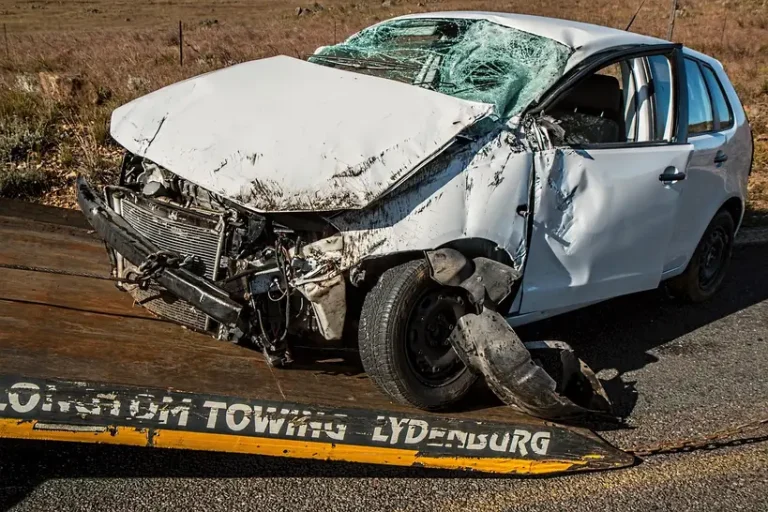
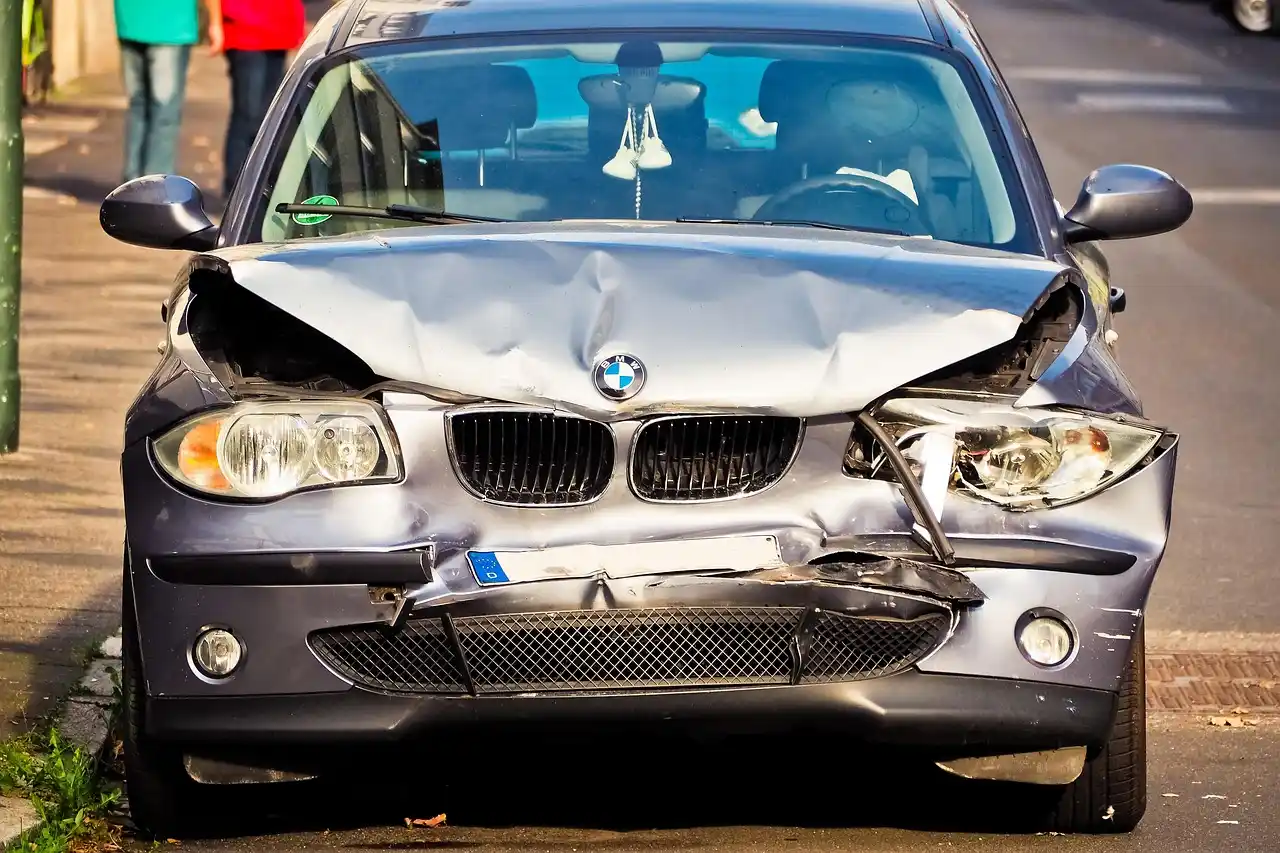
A serious crash can exhaust minimum limits quickly, especially if several people are injured or a newer vehicle is totaled. A legal minimum can satisfy the law and still leave a large unpaid balance if the injuries or property damage are severe.
How much liability coverage do I need?

Start with your state minimum, then compare that number with your assets, income exposure, and how much protection you want after an at-fault crash. For many drivers, 100/300/100 is the practical floor. If your home equity, savings, or business exposure is meaningful, umbrella coverage becomes the next step.
How much liability insurance checklist
- Start with your state minimum. Check your declarations page or your state insurance rule so you know the legal floor. You need at least that much liability insurance, and some states also require uninsured motorist coverage or PIP.
- Estimate what you could lose. Add home equity, savings, taxable investments, and any business ownership that could be exposed in a lawsuit after an at-fault crash. If the total is meaningful, minimum limits are usually too thin.
- Use 100/300/100 as the baseline for many households. That usually means about $100,000 per person in bodily injury coverage, about $300,000 per accident in bodily injury coverage, and about $100,000 in property damage coverage. It is a common middle ground for drivers who want stronger protection without jumping straight to an umbrella.
- Add umbrella coverage when your exposure is higher. If your assets or future income exposure exceed your auto liability limits, consider an umbrella policy. That step matters most when you have a home, higher savings, a business, or a household that wants broader lawsuit protection.
When minimum coverage may fit a low-asset profile
Minimum limits can make sense if you rent, have little savings, no business ownership, and limited wage or asset exposure. Even then, they are only a legal floor. A low-asset profile may justify the minimum, but it does not make the minimum generous.
When 100/300/100 should be the floor
For many drivers, 100/300/100 is the point where liability starts to match real-world claim sizes better. It is a practical baseline if you own a home, carry more than a small emergency fund, or want more room for injury claims than a state minimum usually provides.
When umbrella insurance becomes the smarter next step
Umbrella insurance adds extra liability protection above your auto limits. It is most relevant when your home equity, savings, business interests, or household income could be reached in a lawsuit after an at-fault crash. If those exposures exceed your auto limits, umbrella is worth serious attention.
Liability limit decision table
This table turns common driver profiles into a target limit choice. The right answer depends less on the car itself and more on what a lawsuit could reach if you cause a serious crash.
| Driver profile | Likely asset exposure | Suggested bodily injury / property damage limits | Umbrella insurance? | Rationale |
|---|---|---|---|---|
| Renter with little savings | Low | State minimum, or 50/100/50 if affordable | No, usually not first | Limited assets reduce lawsuit exposure, but a modest step above the minimum can still help after a serious crash. |
| Homeowner with moderate savings | Moderate | 100/300/100 | Consider it if equity is high | A home and savings raise the amount a claimant may try to reach, so 100/300/100 is a stronger floor than the legal minimum. |
| High-income driver with a mortgage and investments | High | 100/300/100 or higher auto limits | Yes | Auto limits alone may not match the amount exposed through assets and future income, so umbrella coverage becomes the next step. |
| Teen-driver household with multiple family cars | Moderate to high | 100/300/100 minimum target | Often worth considering | More drivers in the household can raise crash risk, and higher liability limits help if a young driver causes a severe injury claim. |
How do assets affect your limit choice?
Your liability limit should match what someone could try to collect after an at-fault crash. Home equity, savings, business ownership, and sometimes future wages can all matter. The more you have outside the car, the more useful higher liability limits and an umbrella policy become.
Home equity and savings
If you own a home or hold a meaningful cash balance, a lawsuit can reach beyond the auto policy. That is where minimum limits often fail as a planning tool. A homeowner with savings has more to protect than a renter with little reserve.
Business ownership and wage exposure
Business ownership can increase exposure because a claim may target business assets or disrupt income. High earnings also matter, since a judgment can pressure future wages in ways low-asset drivers do not face. That is why higher-income households often outgrow minimum limits first.
How much a lawsuit can reach beyond auto limits?
Suppose your auto policy has low bodily injury limits and you cause a crash that injures two people. The policy pays up to its cap first. Any amount above that may be sought from your assets, which is why liability sizing matters before a crash happens.
Say your state minimum is legal, but you own a home with $80,000 in equity and have $25,000 in savings. A claim that exceeds the auto limit can leave those assets exposed unless the policy limit is high enough or an umbrella fills the gap.
When should you go above 100/300/100?
Go above 100/300/100 when your assets, income, or household risk make that tier too thin. It is a useful baseline, but not a ceiling. Higher-income households, teen-driver families, and drivers who want more lawsuit protection often benefit from more than that amount.
Higher-income households
If your income and assets are well above average, the cost of being underinsured can outweigh the premium difference. Higher limits can buy more breathing room before an injured claimant reaches your personal finances. That matters even if your car itself is not expensive.
Teen drivers and family vehicles
Teen drivers and multiple-family-car households have more chances for a claim. A young driver who causes a serious crash can create the same liability exposure as any adult driver, so the household policy should be sized for the worst case, not the cheapest case.
Drivers who want more lawsuit protection
Some drivers simply want a larger buffer between a crash and their personal balance sheet. That is a legitimate choice. If your priority is lawsuit protection, higher auto limits and an umbrella policy are often better answers than trying to save a small amount by staying near the minimum.
What else can change your total coverage need?
Liability is only one part of the insurance choice. Loan or lease rules can add collision and comprehensive requirements, uninsured or underinsured motorist coverage may be worth adding, and PIP can be required in no-fault states. Vehicle value also affects whether higher liability or other coverages matter more.
Loan or lease requirements
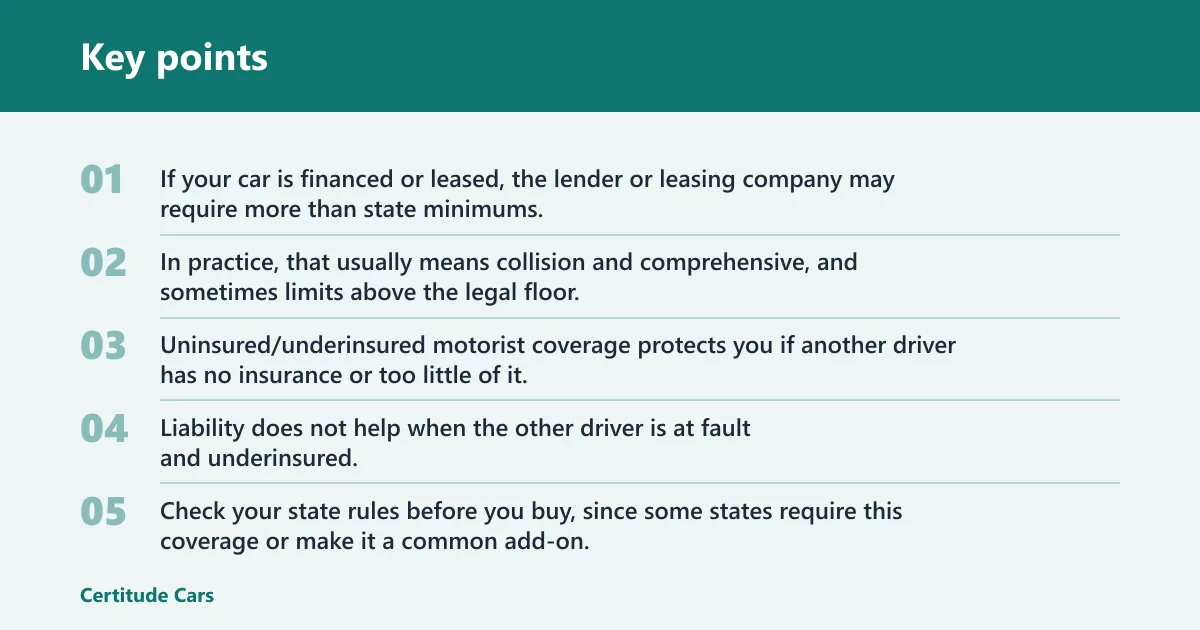
If your car is financed or leased, the lender or leasing company may require more than state minimums. In practice, that usually means collision and comprehensive, and sometimes limits above the legal floor.
Uninsured and underinsured motorist coverage
Uninsured/underinsured motorist coverage protects you if another driver has no insurance or too little of it. Liability does not help when the other driver is at fault and underinsured. Check your state rules before you buy, since some states require this coverage or make it a common add-on.
Personal injury protection in no-fault states
PIP pays medical expenses regardless of fault and is part of the minimum package in some no-fault states. It is separate from liability. If your state requires PIP, or if the option is available and useful, include it in the total coverage decision rather than treating liability as the whole picture.
Vehicle value and collision and comprehensive
Vehicle value matters because it changes what is worth protecting. If the car is older and its book value is low, it may make sense to carry stronger liability and skip expensive physical-damage coverage. If the car is newer or financed, collision and comprehensive may matter more than the car’s age alone suggests.
A common first-timer mistake is buying the cheapest legal minimum on a newer financed car and calling it enough. The car may need collision and comprehensive for the lender, and the household may still need stronger liability limits to protect savings and home equity.
Frequently asked questions
How much liability insurance do I need for my car?
For many drivers, 100/300/100 is the practical floor, not the end point. If you have little to lose, state minimums may fit your budget. If you own a home, have savings, or have higher income exposure, consider more and add umbrella coverage if needed.
How much liability insurance should I have for my car?
You should have at least your state minimum, then size upward based on what a lawsuit could reach. A good rule is to treat 100/300/100 as the baseline for many households, then move to an umbrella if your assets exceed what auto liability can cover.
How much liability insurance should I carry on my car?
Carry enough to cover a serious injury claim without putting your savings or home at obvious risk. For many drivers, that means 100/300/100. If your household assets or income are larger, add an umbrella policy rather than relying on a minimal auto limit.
How much liability insurance should I have on my auto policy?
Your auto policy should at least satisfy state law, but your target should reflect your financial exposure. Minimum limits may be legal and still be too low after a major crash. A strong next step is 100/300/100, with umbrella coverage above that for higher-asset households.
How much car insurance do I really need?
That depends on the car, the loan or lease, and the assets you want to protect. Liability covers damage to others, while collision, comprehensive, UM/UIM, and PIP address different risks. The right mix is the one that matches both legal rules and your financial exposure.