Title Transfer for a Car: Steps, Documents, and Fees
A car title transfer usually requires a signed title, an odometer disclosure for vehicles that are under 20 model years old, a bill of sale in some states, a lien release if needed, ID, and state fees. Missing a signature, payoff release, tax form, or filing deadline can lead the DMV to reject the transfer, delay registration, or add penalties. This guide breaks the process into seller, buyer, and DMV checklists, then covers common rejection points and the fees that change by state.
The key split is simple. The title changes legal ownership; registration puts the car on the road under the new owner, often with plates, insurance, and state taxes handled in the same visit. Problems usually start where those two tasks meet: a clean title transfer can stall because the lien is still open, the VIN does not match, the odometer entry was altered, or registration documents such as insurance or smog are missing.
What a car title transfer changes
Title transfer versus registration
A title transfer updates the state ownership record. Registration handles legal road use. It usually covers plates, tags, and often proof of insurance.
Many DMVs let the buyer do both at once. That saves a trip, but it also stacks the paperwork. One state may allow a title-only filing, while another expects insurance, tax payment, and plate forms in the same visit.
What the certificate of title proves
The certificate of title is the core ownership document. The title lists the owner, VIN, and any lienholder. It also includes vehicle details, signature blocks for transfer, and a lienholder section that shows whether a lender still has a security interest in the car.
The title does not replace registration paperwork, and a bill of sale usually does not replace the title in an ordinary transfer. If the title is missing, branded, altered, or still held by a lender, the transfer path changes quickly.
Why the DMV checks VIN, owner, and lien data
DMV review is mostly a consistency check. The VIN on the title, bill of sale, and transfer application must match. The seller name must match the title owner record. If a lien appears on the title, the DMV usually wants proof that the security interest has been released before ownership can move cleanly to the buyer.
One guide describes missing VIN, odometer, or lien release information as a common rejection cause. That is why private-sale transfers fail over small-looking entries: one wrong digit, one blank box, or one missing payoff release can stop the file.
Transfer checklist table
| Step owner | Required document or action | Common rejection risk |
|---|---|---|
| Seller | Confirm the vehicle has a title before listing or sale | No title available, duplicate title needed first |
| Seller | Sign the certificate of title in the correct transfer block | Missing signature, wrong line, erasures, crossed-out entries |
| Seller | Complete sale date, price or gift value, and mileage where required | Blank date, price mismatch, odometer error |
| Seller | Provide lien release if a loan was outstanding | Open lien, payoff not recorded, separate release missing |
| Seller | File release of liability where available | Tickets or toll issues continue to follow seller |
| Buyer | Check VIN, owner name, and signatures before handing over payment | VIN mismatch, unsigned title, name mismatch with ID |
| Buyer | Collect bill of sale with names, sale date, purchase price, and odometer reference | Missing purchase price or inconsistent date |
| Buyer | Complete the state transfer application | Wrong buyer name, omitted address, wrong title number |
| Buyer | Bring photo ID for identity verification | ID expired, name does not match purchase paperwork |
| Buyer | Bring proof of insurance if registering at the same time | No active policy for the new owner |
| Buyer | Bring smog or inspection documents where required | Transfer cannot be finished same day |
| Both | Keep copies of title, bill of sale, and submitted forms | No backup if the DMV requests correction |
| DMV | Review title, application, taxes, and fees, then issue updated record | Late filing, unpaid tax, unresolved lien, document inconsistency |
What documents do you need for a car title transfer?
Most transfers need the signed certificate of title, the buyer’s state title or transfer application, a current photo ID, and payment for title fees and any taxes due. Depending on the state and the vehicle, the DMV may also require a bill of sale, odometer disclosure, lien release, proof of insurance if registration is filed at the same time, and smog or inspection paperwork. Leave out any required item, even one signature line or lien release, and the clerk can stop the filing.
Core documents for most states
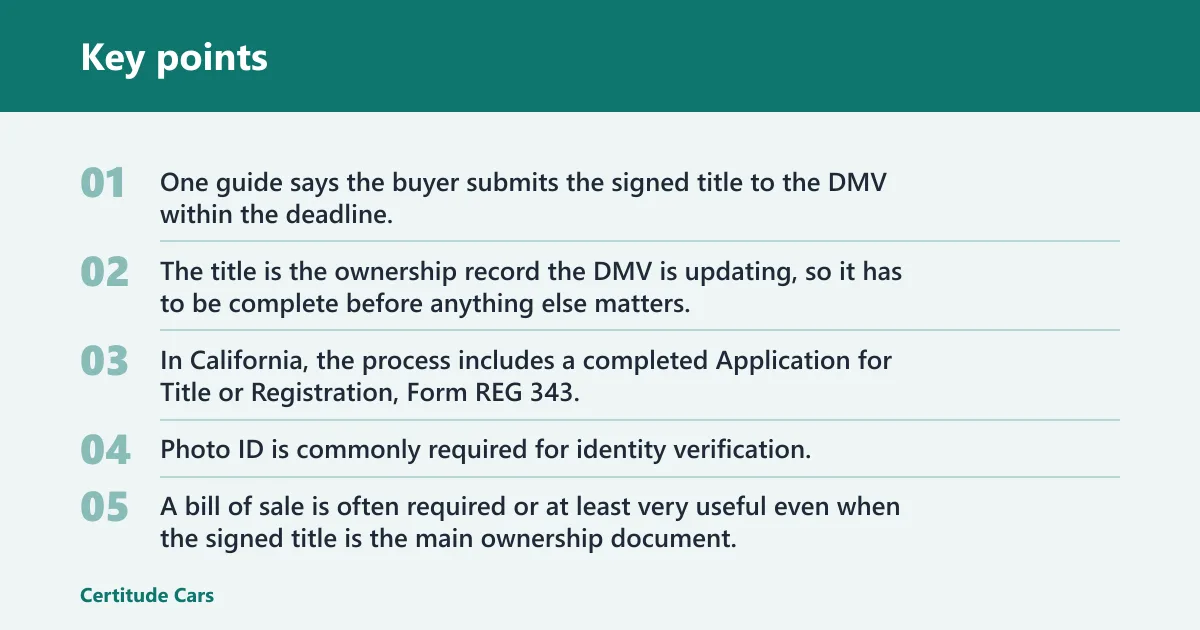
The signed title comes first. The buyer submits the signed title to the DMV within the deadline. The title is the ownership record the DMV is updating, so it has to be complete before anything else matters.
The transfer application is next. This is the state form that moves the car into the buyer’s name. In California, the process includes a completed Application for Title or Registration, Form REG 343.
Photo ID is commonly required for identity verification. Many DMVs accept a standard state-issued driver license or identification card, while some transactions or office policies may call for a REAL ID-compliant document. The practical issue is name matching: if the buyer’s ID shows a different legal name than the title application, expect a pause.
What belongs on the bill of sale
A bill of sale is often required or at least very useful even when the signed title is the main ownership document. It should show the buyer and seller names, sale date, purchase price, and an odometer reference. That gives the DMV supporting proof if the title is hard to read or the tax amount is questioned.
Sellers and buyers fill in the date, price or gift value, and mileage. Those fields need to align across the title, bill of sale, and transfer application.
Odometer, insurance, and smog records
The odometer disclosure is a common failure point because the mileage entry has to match everywhere the state asks for it. Altered numbers, a blank box, or conflicting mileage on the bill of sale and title can trigger rejection.
Insurance is usually a registration issue rather than a title-only issue, but many buyers handle both tasks together. Proof of insurance is part of the typical transfer document set.
Smog or emissions records are state-specific. The same California guide says some vehicles need a smog certification. In a private sale, that can affect whether the seller must supply the certificate and whether the buyer can complete registration that day.
How do you transfer a car title after a private sale?
After a private sale, the seller signs the title and completes any required sale and mileage fields, then the buyer checks the paperwork for errors and files it with the DMV. Many states let the buyer transfer title and register the car together, but only if taxes, insurance, and any lien or inspection issues are already cleared.
Private-sale process
- Match the title first. Compare the seller’s name, VIN, and vehicle details on the title to the car and the seller’s identification. If the title owner does not match the person selling the car, stop until that is explained with valid paperwork.
- Complete the title carefully. The seller should sign exactly where the state requires, and both parties should enter the sale date, purchase price or gift value, and mileage if the form asks for it. Avoid cross-outs and correction fluid because many DMVs reject altered ownership documents.
- Write the bill of sale. Include buyer and seller names, the sale date, purchase price, vehicle description, VIN, and odometer reference. Even where optional, it helps if the DMV questions tax, timing, or handwriting on the title.
- Check for lien status. If a lender is listed on the title, get the lien release before assuming the transfer can be filed. A signed title alone does not usually clear an active security interest.
- Prepare the DMV application. The buyer completes the state transfer form and gathers ID, payment, and any registration documents. If registration will happen in the same visit, add proof of insurance and any required inspection or smog certificate.
- File before the deadline. Submit the signed title, application, and fees within the state’s transfer window. Waiting can add late fees and may also complicate tax or registration timing.
- Keep copies. Retain copies or photos of the signed title, bill of sale, lien release, and receipt. Those records matter if the DMV later flags the VIN, mileage, or sale date.
Where private buyers get tripped up
A common first-timer mistake is paying, driving home, and only then noticing the seller signed the reassignment line meant for a dealer. The buyer now has a title with a real signature in the wrong block, which often means correction paperwork or a replacement title before transfer can continue.
Suppose the title shows 82,614 miles, but the bill of sale says 86,214 because one digit was copied wrong. That single mismatch can force the DMV clerk to stop the filing until the seller and buyer correct the odometer disclosure the way the state allows.
What can stop the transfer from going through?
Common blockers include missing signatures, an open lien, a VIN mismatch, odometer errors, and missed filing deadlines. DMVs also stop transfers when the buyer name does not match the ID, the title has visible alterations, or registration documents such as insurance or smog are required for the same visit and are not present.
Signature and title-entry errors
If the seller forgot to sign, signed in the wrong place, or left required fields blank, the transfer usually cannot be completed. Some states allow a corrected application or affidavit; others require the seller to sign again on the original title or apply for a replacement title first.
Buyer information matters too. If the buyer’s name on the title assignment does not match the DMV application or ID, the clerk may reject the filing until the discrepancy is fixed.
VIN, owner name, and odometer mismatches
One guide describes missing VIN, odometer, or lien release information as a common rejection cause. The same logic applies to mismatched information. The DMV is comparing multiple records to make sure the same vehicle and the same transfer appear on every document.
Picture a title with VIN ending in 4132, a bill of sale ending in 4312, and an insurance card matching the actual car. The buyer may know which number is right, but the DMV cannot guess. The file stops until the wrong document is corrected.
Rejection flow: what happens next
- Read the refusal reason. Ask the clerk which exact field failed review: signature block, lien release, VIN, odometer, tax amount, or deadline issue. A general “incomplete” answer is not enough if a return visit is involved.
- Fix the original source. Correct the document that caused the mismatch instead of trying to patch around it with extra notes. If the title is wrong, the title issue usually has to be fixed at the title level.
- Gather supporting proof. Bring the bill of sale, lien release, ID, registration documents, and any rejection slip to the next filing attempt. That shortens the second review because the clerk can see the correction trail.
- Refile before more fees stack. If a deadline or temporary permit is involved, handle the correction quickly. Delay can add penalties even after the paperwork problem is solved.
How much does a car title transfer cost?
A title transfer rarely costs only the title fee. The final total often includes the state title charge, registration fee, sales or use tax, plate fees, late penalties, and smog or inspection charges where required. The amount rises fast when the buyer combines ownership transfer with registration and has missed the filing deadline.
Title transfer table
| Fee type | Why it may be charged |
|---|---|
| Title fee | Processing the ownership change and issuing the new title record |
| Registration fee | Putting the vehicle in the buyer’s name for road use at the same time |
| Sales or use tax | Based on purchase price, declared value, or state tax rules for private sales |
| Plate or tag fee | New plates, transfer of plates, or updated registration credentials |
| Late fee | Buyer missed the state transfer deadline after purchase |
| Smog or inspection charge | Required emissions or safety check before registration can be finished |
| Administrative or transfer fee | State or local processing charge that may apply even when other fees are already due |
What drives the total
The title fee is only one line item. If the buyer also registers the car, the DMV may collect registration charges and plate-related fees in the same transaction. If the state taxes private-party purchases, the sale price on the title and bill of sale will matter.
Late filing raises the total further. Even a correct title can become expensive if it is submitted after the deadline. That is why sale date consistency matters: the date on the title, bill of sale, and DMV application may control whether a penalty applies.
Administrative fees also appear in some systems. The administrative fee is still required even when the procedure is completed in one visit.
What if the title has a lien, co-owner, or missing signature?
An active lien, the wording between co-owners, or a missing signature can stop a transfer even when the buyer has the title in hand. The fix depends on the problem: lien release for a loan, all required owner signatures for co-owned cars, and a corrected title or replacement paperwork when a signature is missing or entered in the wrong place.
Outstanding lien or recent loan payoff
If the title lists a lienholder, the lender’s interest usually must be released before the DMV will issue a clear new title. This often takes a separate lien release even if the seller has already paid off the loan or signed the title.
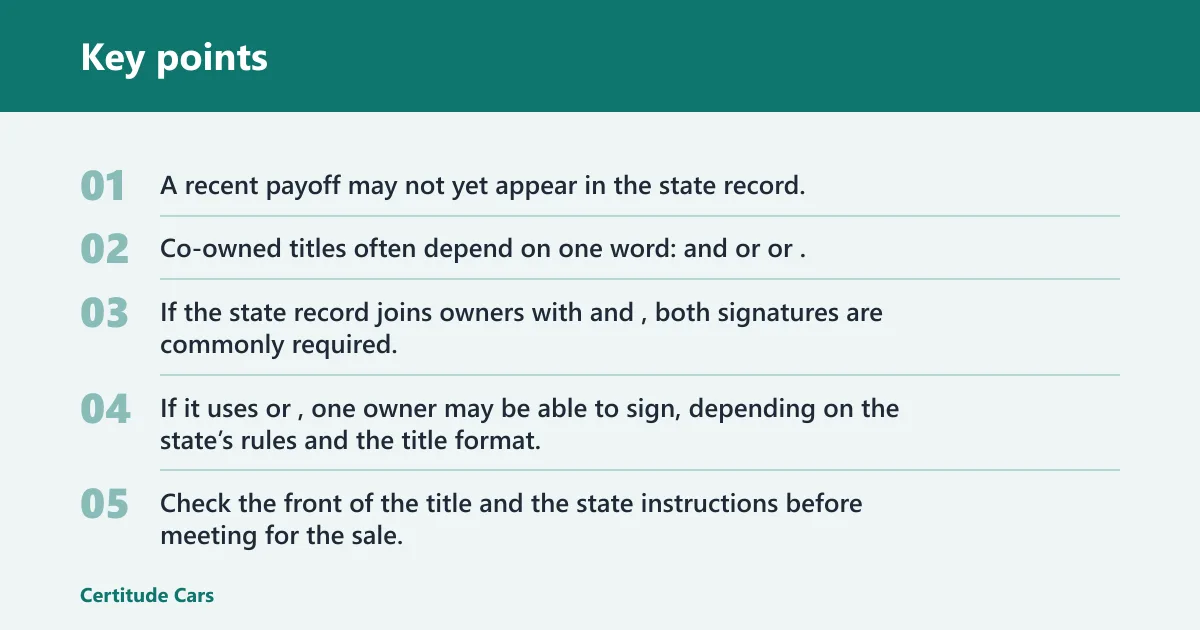
What happens next depends on timing. A recent payoff may not yet appear in the state record. In that case, the buyer may need the lender’s release letter or state-specific lien satisfaction form in addition to the signed title.
Co-owners and title wording
Co-owned titles often depend on one word: and or or. If the state record joins owners with and, both signatures are commonly required. If it uses or, one owner may be able to sign, depending on the state’s rules and the title format.
Do not rely on memory. Check the front of the title and the state instructions before meeting for the sale.
Missing seller signature or corrected title entries
If the seller forgot to sign, the cleanest fix is usually to have that seller sign the original title in the exact required place before the DMV review. If the seller signed the wrong line, wrote over a field, or entered the wrong buyer name, the state may require a replacement title or correction form rather than a handwritten fix.
Say your seller moved two states away and left one signature line blank. That can turn a same-day transfer into a mail-and-wait problem because the DMV may require that owner’s original signature or a newly issued title.
Inherited, gifted, and dealer-paperwork cases
Inherited vehicles can follow a different path than an ordinary private sale. In Minnesota, a vehicle can be transferred through a small estate affidavit when the estate is $75,000 or less. The same Minnesota page says formal probate is generally required when the estate exceeds $75,000, and it says the registrar issues a new title in the heir’s name for a non-probated transfer.
Gifted vehicles usually still require a title transfer, and the gift value must be shown where the state asks for it. Dealer-paperwork failures are different again: if a dealer did not file the title work correctly, the buyer may need the dealer to cure the missing reassignment, tax form, or lien payoff record.
Where, when, and how can you file the transfer?
You can sometimes complete title transfer and registration in one DMV visit, and a few cases may qualify for online or mail submission. Clean titles, complete signatures, no lien issues, and simple state rules are what make remote or same-day filing possible. Any mismatch, lien problem, or missing inspection usually pushes the transfer into an in-person process.
Decision path for filing method
- Start with title status. If the title is present, legible, and fully signed, the transfer may be ready for filing. If the title is missing, altered, or unsigned, expect correction steps before any filing method works.
- Check lien status. If a lienholder is listed and no release is attached, do not expect same-day completion. The ownership record usually cannot move cleanly until the lender’s interest is cleared.
- Decide if registration is included. If the buyer also wants registration, insurance and inspection or smog documents may be needed in the same transaction. That can turn an otherwise easy title filing into an in-person visit.
- Review state limits. One guide says every state is different on title-transfer rules. Some states allow mail or online handling for narrow cases, while others want original signatures and in-person identity checks.
- Choose the filing channel. Use online or mail only when the state accepts that exact transfer type, the title is clean, and no extra review is needed. Use in-person filing for liens, corrections, co-owner issues, inherited vehicles, or registration documents that must be checked on the spot.
Same-day transfer and registration
Same-day completion is most likely when the title is correctly signed, the lien is released, taxes can be calculated from clear sale paperwork, and registration documents are ready. Some systems are built for one-stop handling. One guide from outside the U.S. says the whole procedure is completed in one visit at any traffic police inspectorate, but that same guide notes the administrative fee is still required.
In U.S. practice, same-day is common only when the paperwork is clean and the state allows registration to ride with the title transfer. California-style transactions often bundle title application, insurance proof, and sometimes smog review in the same run.
Seller protection after the handoff
The seller’s job is not always finished at signature. A release of liability should be filed promptly where the state offers one. That notice helps stop later parking tickets, tolls, or accident reporting problems from following the prior owner after the buyer takes possession.
Frequently asked questions
How do you transfer a car title after buying privately?
The seller signs the title and completes required sale details, then the buyer checks the VIN, names, mileage, and lien status before filing with the DMV. The buyer submits the signed title, transfer application, and fees within the deadline, and may register the car during the same visit if state rules allow it.
How much does a title transfer for a car cost?
The title fee is only part of the total. Many buyers also pay registration charges, sales or use tax, plate fees, smog or inspection costs, and late penalties if they missed the filing deadline. The total goes up when title transfer and registration are combined in one DMV transaction.
What happens if the title has a lien on it?
If a lienholder is still listed, the DMV usually wants proof that the lender’s security interest has been released before issuing a clear new title. A seller’s signature alone often is not enough. The buyer may need a separate lien release, payoff confirmation, or updated state record before transfer can finish.
Do I need insurance to transfer the title and register the car?
Insurance is often tied to registration rather than the title change by itself. If the buyer is registering the vehicle at the same time, proof of insurance is commonly required. If the transaction is title-only, the answer depends on the state and the DMV’s filing rules for that specific transfer type.
Can title transfer and registration be done together?
Yes, in many states they can be done together if the title is complete and the buyer brings the extra registration items, such as insurance and inspection or smog records where required. If there is a lien issue, a missing signature, or a VIN or odometer mismatch, the DMV may delay registration until the title problem is fixed.