Tire Size Explained: How to Read and Choose It
A tire size like 225/45R17 is generally read as 225 mm width, a sidewall height of about 45% of that width, radial construction, and a tire intended for a 17-inch wheel; many fitment guides advise staying within about 3% overall diameter unless the vehicle maker approves otherwise. Get it wrong and you can throw off the speedometer, trigger ABS or AWD issues, reduce load capacity, or cause rubbing. Here you’ll decode the sidewall, check the door-jamb placard, and use a simple framework to judge factory, plus-size, and minus-size options safely.
What do the numbers on a tire mean?
A code such as 225/65R17 gives four fitment facts in order: width in millimeters, aspect ratio as a percentage, construction type, and wheel diameter in inches. The numbers after that, such as 102H, add load index and speed rating, which must still meet the vehicle’s requirement even if the size looks right.
Reading 225/65R17 from left to right
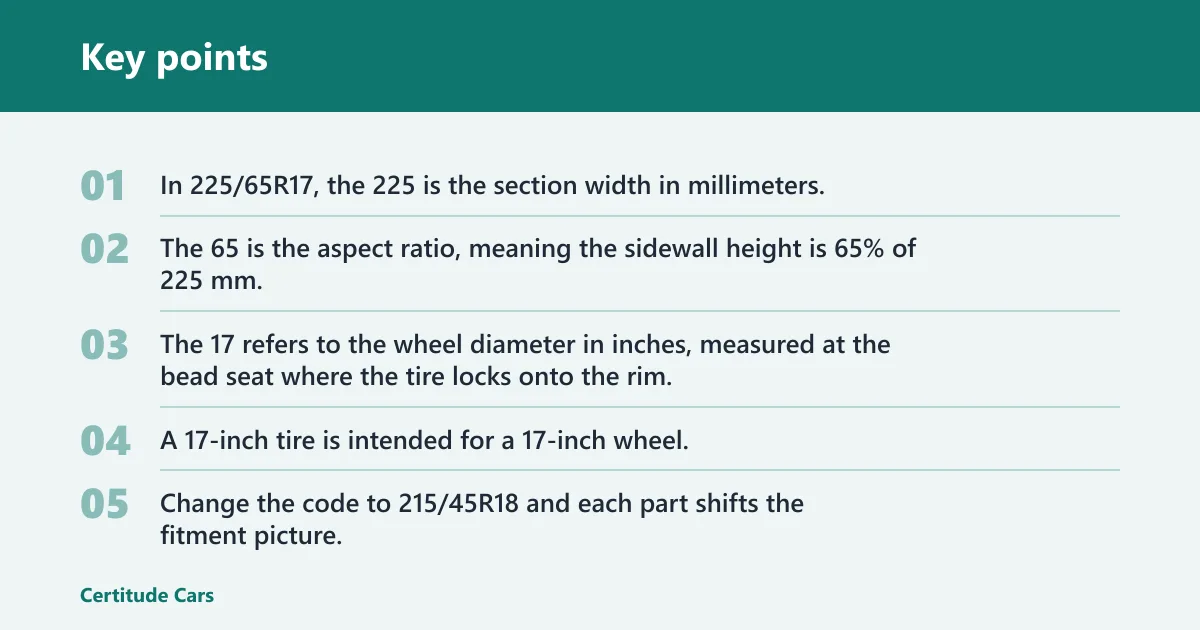
In 225/65R17, the 225 is the section width in millimeters. The 65 is the aspect ratio, meaning the sidewall height is 65% of 225 mm. The R identifies radial construction, the standard layout on modern passenger tires, where the internal cords run across the tire from bead to bead. The 17 refers to the wheel diameter in inches, measured at the bead seat where the tire locks onto the rim.
That last number is absolute. A 17-inch tire is intended for a 17-inch wheel. It will not stretch safely onto an 18-inch wheel, and it will not seat on a 16-inch wheel.
What changes when the size is 215/45R18
Change the code to 215/45R18 and each part shifts the fitment picture. The tire is narrower at 215 mm, the sidewall is shorter because 45% of 215 mm is less sidewall height than 65% of 225 mm, and the wheel must be 18 inches.
That shorter sidewall usually gives a firmer response to steering inputs because there is less sidewall flex. It can also change overall diameter, depending on how the new width and aspect ratio compare with the original size.
What the service description adds after the size
After the size, many tires show a service description such as 102H or 95V. The number is the load index. The letter is the speed rating. These are separate fitment checks, not decoration.
SimpleTire publishes a tire service description guide covering load index and speed rating. That matters because drivers often match only the size and miss that a lower load index can make a replacement unsuitable even when the tire mounts on the wheel.
How do you read tire size on the sidewall?
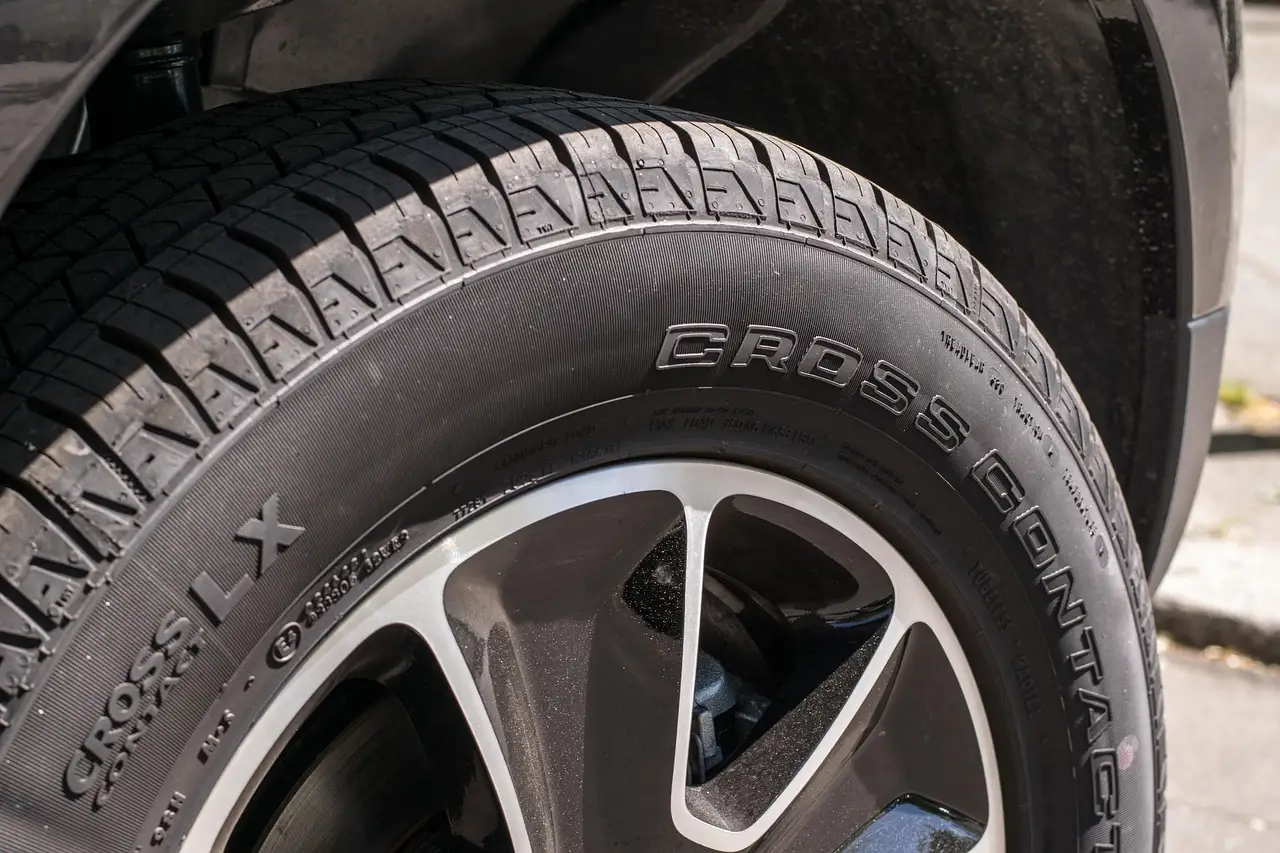
Read the sidewall from the prefix, if there is one, through the size code, then the service description. A P prefix usually marks a passenger tire, LT marks a light-truck tire, and inch-based flotation sizes put overall diameter first. The format changes, but the same fitment checks still apply.
Standard metric sizes: P-metric and no-prefix passenger sizes
A P-metric tire may read P225/65R17 102H. The P means passenger-vehicle designation.
In many replacement situations, a no-prefix passenger size and a P-metric size of the same dimensions are treated similarly. That does not mean every passenger-marked tire is interchangeable in every case. The load index, speed rating, and the vehicle placard still decide whether it is acceptable.
LT sizes for light trucks
An LT tire might read LT265/70R17. LT means light truck, and that category is built for different use cases than a passenger tire. Trucks, larger SUVs, vans, and towing setups often specify LT construction for load support and casing strength.
Do not assume an LT tire is a simple upgrade over a passenger tire. It may require different inflation pressures, ride differently, and have different load behavior. If the placard calls for passenger tires, switching to LT should be checked against the vehicle requirement, wheel rating, and intended use.
Inch-based flotation sizes such as 33×12.5R15
Flotation sizing puts overall diameter first. In 33×12.5R15, the 33 is the tire’s approximate overall diameter in inches, 12.5 is width in inches, R is radial construction, and 15 is wheel diameter in inches.
This format is common on trucks, Jeeps, and off-road builds. It still comes back to the same rules: wheel diameter must match exactly, load capacity must be enough, and real clearance must be checked at ride height, compression, and full steering lock.
Decoding the sidewall code
If you need to match a tire to your car, the sidewall code tells you the key facts in order: width, aspect ratio, construction, rim diameter, then load index and speed rating. This article breaks down each mark so you can compare a tire against the door placard or owner’s manual and avoid buying a size that rubs, carries the wrong load, or throws off speedometer readings.
For a clear walkthrough of the markings and how they fit together, see tire sidewall numbers. It also covers common prefixes and ratings, so you can tell whether a tire is an approved replacement or a mismatch before you order it.
What is the difference between width, aspect ratio, and rim diameter?
Width is the tire’s section width in millimeters, aspect ratio is the sidewall height as a percentage of that width, and rim diameter is the wheel size in inches. Width alone never tells the full fitment story because sidewall height and wheel width also change how the tire fits and how tall it ends up.
Width in millimeters
The first number, such as 225, is the width in millimeters. A wider tire can place the sidewall closer to the strut, spring perch, fender liner, or outer fender lip. It can also require a wider approved rim range than the current wheel provides.
That is why a tire with the same 17-inch wheel size can still be wrong. A 245-width tire may clear on one trim and rub on another with a different wheel offset or suspension package.
Aspect ratio as sidewall height percentage
The second number is a percentage, not a height in millimeters. A 45-series tire has a sidewall height equal to 45% of its width. Lower aspect ratios generally mean shorter sidewalls, quicker steering response, and less cushion over impacts.
Aspect ratio also changes overall diameter. A tire can be wider but end up close to stock diameter if the aspect ratio drops enough. That is the logic behind many plus-size packages.
Rim diameter in inches and why it must match exactly
The last number in the main code is the wheel diameter in inches: 15, 16, 17, 18, and so on. This must match the wheel exactly. A 17-inch tire only fits a 17-inch wheel.
It is also different from overall tire diameter. A 225/65R17 is not 17 inches tall. The 17 refers only to the wheel bead seat diameter.
How do you know what tire size fits your car?
The primary reference is the door-jamb tire placard, not the sidewall of whatever tires are currently installed. The placard lists the factory tire size and pressure recommendation for that vehicle and trim, so it is a common baseline for replacement, plus-size, or minus-size comparisons.
Using the door jamb tire placard as the baseline
The placard is usually on the driver’s door jamb or door edge. It may list one size or multiple approved sizes, sometimes with different front and rear specifications. Start there before looking at online listings, current tires, or wheel ads.
The placard matters because factory fitment accounts for wheel size, suspension travel, steering angle, and vehicle load requirements. It is the reference point that keeps a tire search from turning into guesswork.
When the current tire size on the car should not be trusted
The current tires may be leftovers from a previous owner, a winter setup, or an incorrect shop install. If the sidewall size conflicts with the placard, trust the placard first and then confirm whether the wheels themselves were changed.
A common first-timer mistake is reading 235/55R18 off the tire, ordering the same size, and only later noticing the door sticker calls for 225/65R17. That can leave the vehicle on non-factory wheels with a size choice made from the wrong baseline.
Matching the placard with wheel size and trim-specific fitment
Some trims use different wheel diameters or staggered setups. A base model may take 17-inch tires while a higher trim uses 19-inch tires with a lower aspect ratio to keep overall diameter close.
Match three things before buying: the placard size, the actual wheel diameter, and the trim-specific requirement. If any of those disagree, pause and verify before ordering.
How to choose the right tire size
A practical selection method
- Start with the placard. Write down the factory tire size, any alternate factory size, and whether the vehicle uses the same size on all four corners. This is the baseline that keeps diameter, load, and clearance checks anchored to the vehicle maker’s spec.
- Match wheel diameter exactly. Confirm the wheel size stamped on the wheel or printed on the tire if the current setup is known correct. A 17-inch tire fits only a 17-inch wheel, so this is a hard yes-or-no check.
- Compare overall diameter. Use a tire size calculator to compare the factory size with the proposed size and note diameter, circumference, and speed difference. A common rule of thumb is to screen out changes beyond about 3%, while remembering that smaller changes are usually easier to fit and calibrate.
- Check load index minimum. Find the load index on the original tire, placard documentation, or vehicle requirement and make sure the replacement meets or exceeds it. Do this even if the new size looks close because load capacity can drop when aspect ratio or construction changes.
- Verify speed rating. Read the letter after the load index and confirm the replacement meets the vehicle’s requirement. Speed rating may also appear elsewhere on the sidewall, and it should be checked separately from the size.
- Confirm rim-width range. Look up the tire manufacturer’s approved rim-width range for the exact tire size. Two tires with the same labeled size can still differ in approved wheel widths, and a mismatch can distort the tire shape and clearance.
- Inspect real clearance. Check inner clearance to the strut and suspension, outer clearance to the fender and liner, and turning clearance at full steering lock. If the tire is taller, also consider bump travel because rubbing may show up only when the suspension compresses.
Say your placard size is 225/65R17 and the goal is simply replacing worn tires. The clean answer is usually another 225/65R17 that meets the original load and speed requirements. It keeps speedometer error, gearing change, and clearance risk to a minimum.
Suppose the vehicle has 18-inch wheels already installed and the candidate size is 225/60R18. That might look close because the width stays near stock, but the decision still depends on diameter comparison, load index, speed rating, approved rim width, and real clearance around the liner and strut.
Load index and speed rating
How to find the minimum load requirement
Replacement tires should meet or exceed the vehicle requirement. If the door placard or owner information specifies a minimum service description, use that as the floor.
Do not treat a lower-profile tire as automatically equivalent to the original. Some upsized combinations lose load capacity if the chosen tire targets a lighter vehicle class.
Why speed rating is a separate fitment check
The speed rating is the letter after the load index, such as H or V. It reflects maximum speed capability under standard test conditions, and it is checked separately from the size because two tires with the same 225/45R17 dimensions can carry different service descriptions.
SimpleTire’s service description guide is a useful example of how retailers explain this pairing. The key point for fitment is simple: matching size alone is not enough.
What can go wrong after upsizing or downsizing?
Upsizing often pushes buyers toward lower-profile tires on larger wheels. Downsizing can do the opposite. In both cases, service description mistakes are common because shoppers focus on appearance or wheel diameter and miss that the replacement tire may have a lower load index or a speed rating below requirement.
That mistake is avoidable. Treat load index and speed rating as pass-fail checks before price, tread pattern, or brand preference.
Factory, plus-size, or minus-size?
When staying with the factory size makes the most sense
Factory size is usually the safest answer for daily driving, lease returns, warranty simplicity, and drivers who want the speedometer and clearance picture to stay closest to original. It also makes replacement shopping easier because the placard, wheel size, and vehicle calibration already line up.
When plus-sizing works and what usually changes
Plus-sizing means moving to a larger wheel diameter and a lower aspect ratio tire to keep overall diameter near stock. For example, a vehicle that came with 17-inch wheels may move to 18-inch wheels with a shorter sidewall.
If done correctly, plus-sizing can keep overall diameter close while changing steering feel and reducing sidewall height. If done poorly, it can create rim-width mismatch, lowered load capacity, harsh impact response, or rubbing at full lock.
When minus-sizing works and its tradeoffs
Minus-sizing means using a smaller wheel diameter with a taller sidewall while keeping overall diameter close to stock. This is common for winter setups where a smaller wheel and taller sidewall may offer better pothole tolerance and more sidewall compliance.
The tradeoffs are simple: you must still clear the brakes, match wheel diameter exactly to the tire, and keep the replacement within an acceptable diameter window. Brake caliper clearance is often the limiting factor on minus-size plans.
What happens if you change tire size?
Changing tire size can alter speedometer and odometer readings, effective gearing, acceleration feel, ground clearance, and physical clearance in the wheel well. The bigger the overall diameter change, the more likely the difference becomes noticeable, and the more likely a clearance or calibration issue appears.
Speedometer and odometer error
A taller tire travels farther per revolution, so the speedometer tends to read lower than actual road speed. A shorter tire does the opposite and tends to make the speedometer read higher.
That is why tire size calculators matter. Tiresizes.com offers a tire size calculator and comparison tools that show diameter, circumference, and speed difference between two sizes.
Gearing, acceleration feel, and ground clearance
Taller overall diameter effectively lengthens gearing. That can soften acceleration feel because the vehicle travels farther per wheel revolution. It can also raise ground clearance slightly. Shorter overall diameter does the reverse.
These changes are usually mild when diameter stays close to stock. Once the difference grows, the effects become easier to notice, especially on smaller engines, vehicles with tightly calibrated transmissions, or AWD systems sensitive to rolling circumference differences.
Clearance, rubbing, and steering-lock issues
Common failure points are the inner fender liner, strut body, spring perch, outer fender lip, mud flap, and the rear of the wheel arch during turns. Rubbing often appears first at full steering lock or when the suspension compresses over a dip.
Picture a move from a stock-width tire to one that is both wider and taller while keeping the same wheel offset. The tire may clear while parked straight ahead, then touch the liner only when backing out with the wheel turned hard. Static clearance alone does not catch that.
How to compare two tire sizes safely
Using a tire size calculator
- Enter the factory size. Start with the door-jamb placard size, not a guess from memory. This gives the calculator the right baseline for diameter and circumference comparison.
- Add the proposed size. Enter the candidate replacement exactly as marked, including width, aspect ratio, and wheel diameter. If you are comparing flotation sizes, make sure the tool supports that format.
- Read the diameter change. Note the overall diameter difference and whether it stays within about 3% as an initial screen. Smaller changes are usually easier to fit, but this is not a guarantee of clearance or calibration approval.
- Check speed difference. Look at the speedometer comparison the calculator provides. If the tire is taller, indicated speed will usually be lower than actual; if shorter, indicated speed will usually be higher.
- Review circumference too. Circumference helps show how much the rolling distance changes per revolution. That matters for odometer accuracy and for AWD systems that dislike mismatched rolling sizes across the axle set.
- Finish with physical checks. Use the calculator result as a screen, then verify load index, speed rating, rim-width range, and real vehicle clearance. A calculator cannot see your wheel offset, brake package, or fender liner shape.
Reading diameter, circumference, and speed difference
Diameter gives the top-level fitment clue. Circumference shows the rolling-distance change. Speed difference translates that into what the speedometer and odometer will do. Together, they tell you whether a size is merely different on paper or meaningfully different on the road.
Applying a practical diameter-change limit
A common screening rule is to stay within about plus or minus 3% overall diameter from factory. Use that as a first filter, not as automatic approval. A change smaller than that is usually easier to fit and less likely to create noticeable speedometer or gearing issues, but clearance, load, speed rating, and wheel width still decide the final answer.
Tire size checklist
| Driving goal | Factory size | Candidate size | Maximum diameter change | Load index requirement | Speed rating check | Yes/no decision |
|---|---|---|---|---|---|---|
| Direct replacement | 225/65R17 102H | 225/65R17 102H | 0% | Meet or exceed 102 | Meet or exceed H | Yes, if rim-width range and clearance are normal |
| Direct replacement | 225/65R17 102H | 225/65R17 98H | 0% | Below requirement | Matches H | No, load index fails |
| Plus-size to 18-inch wheel | 225/65R17 102H | 225/60R18 100H | About 3% screen | Fails if vehicle needs 102 | Matches H | No unless load requirement is met and clearance checks pass |
| Plus-size to 18-inch wheel | 215/45R18 89W | 225/40R18 92W | About 3% screen | Meet or exceed 89 | Meet or exceed W | Yes, if approved for wheel width and no rubbing at lock or compression |
| Minus-size winter setup | 215/45R18 89W | 205/55R16 91H | About 3% screen | Meet or exceed 89 | Check vehicle minimum before dropping from W to H | Maybe, only if brake clearance and minimum speed rating are satisfied |
| Truck flotation change | 33×12.5R15 | 35×12.5R15 | About 3% screen | Must meet axle load need | Check sidewall service description | No as a casual swap; diameter jump and clearance risk are high |
Frequently asked questions
Where can I find the factory tire size on my vehicle?
The best place is the tire placard on the driver’s door jamb or door edge. It lists the factory size and pressure recommendation for that vehicle and trim. Use it as the starting point because current tires may be incorrect, seasonal, or installed with aftermarket wheels.
Can I use a different tire size without problems?
Sometimes, yes, but only after several checks. The wheel diameter must match exactly, overall diameter should usually stay within about 3% as a screening rule, load index must meet or exceed requirement, speed rating must be acceptable, the tire must fit the wheel width, and clearance must be verified.
How does changing tire size affect the speedometer?
Changing overall diameter changes how far the vehicle travels per wheel revolution. A taller tire tends to make the speedometer read lower than actual speed, while a shorter tire tends to make it read higher. A tire size calculator helps compare the factory size and the proposed size before buying.
What happens if the tire is too big or too small?
If the tire is too big, it can rub the fender liner, strut, mud flap, or outer fender, especially at full lock or over bumps. If it is too small, the speedometer can read high and ground clearance drops. Either way, wrong size can also affect gearing feel and system calibration.
What do the numbers on a tire size mean?
The first number is width in millimeters, the second is aspect ratio as a percentage of that width, the letter is construction type, usually R for radial, and the last number is wheel diameter in inches. Numbers and letters after the size add load index and speed rating.
How do I know what tire size fits my car?
Start with the door-jamb placard, then confirm the actual wheel diameter on the car. After that, compare any alternate size with a tire size calculator and check overall diameter change, load index minimum, speed rating, approved rim-width range, and physical clearance at full steering lock and suspension compression.