Gas Mileage vs Speed: When Does Faster Driving Waste Fuel?
On most cars, fuel use climbs sharply once you pass about 55–65 mph. Saving 5 to 10 minutes usually is not worth the extra fuel unless the trip is long enough to make up the difference. This guide shows where the speed penalty starts, how much time you really save, and when driving faster makes sense.
| Decision factor | Gas mileage | speed | Winner |
|---|---|---|---|
| Fuel cost on the highway | Lower mph usually means fewer gallons burned per mile, especially around a vehicle’s sweet spot. | Higher mph usually burns more fuel because aerodynamic drag rises quickly. | Gas mileage |
| Trip time | Slower driving adds minutes, especially on long highway segments. | Faster driving saves time, though the gain shrinks if traffic or exits limit average speed. | speed |
| Best fit for typical highway use | Usually stronger for daily commuting, road trips with modest time pressure, and cost-conscious driving. | Usually stronger when the drive is long and the time saved is worth the fuel penalty. | Gas mileage |
| Short-trip value | Often better because the fuel penalty from extra speed rarely pays back in minutes saved. | Often weaker because small time savings do not offset a larger mpg drop. | Gas mileage |
| Fastest reasonable choice | Usually not the point of this choice. | Can make sense when traffic is light and the route is long enough for the time savings to matter. | speed |
When does speed start hurting mpg?
Speed starts hurting mpg once you move above a vehicle’s highway sweet spot, which is typically around 45 to 60 mph for many gasoline vehicles. At higher highway speeds, aerodynamic drag is commonly a major fuel loss, and air resistance tends to rise more steeply as speed increases from about 65 to 80 mph than from about 50 to 60 mph.
Why aerodynamic drag changes the math
Aerodynamic drag is the force of air pushing back on the car. It grows with speed, so each extra mph costs more fuel than the last one. That is why a small increase from 55 to 60 mph is usually less painful than the same jump from 70 to 75 mph.
Rolling resistance works differently. It comes from tire-road contact losses, and low tire pressure raises it. That means highway mpg can fall for two separate reasons at once: more air resistance at higher speed, and more tire loss if the tires are underinflated.
Why slower is not always better
Driving below the sweet spot can also waste fuel, because the engine may run less efficiently at very low road speed and the trip takes longer. Stop-and-go traffic can reduce fuel economy too, so a slower number on the speedometer does not automatically mean better mpg if the road is not steady.
Say your crossover gets stuck at 45 mph behind a slow truck on a highway with frequent merges. Fuel economy may still be decent, but if that pace forces repeated speed swings, the mpg gain can shrink fast.
How much fuel do 5 to 10 mph cost?
The cost depends on your starting mpg, trip length, and gas price per gallon. A calculator should use the EPA highway fuel economy rating as the reference mpg input, then compare the fuel burned at one speed against another speed so you can turn the mpg loss into dollars.
Why the same speed change costs more on longer trips
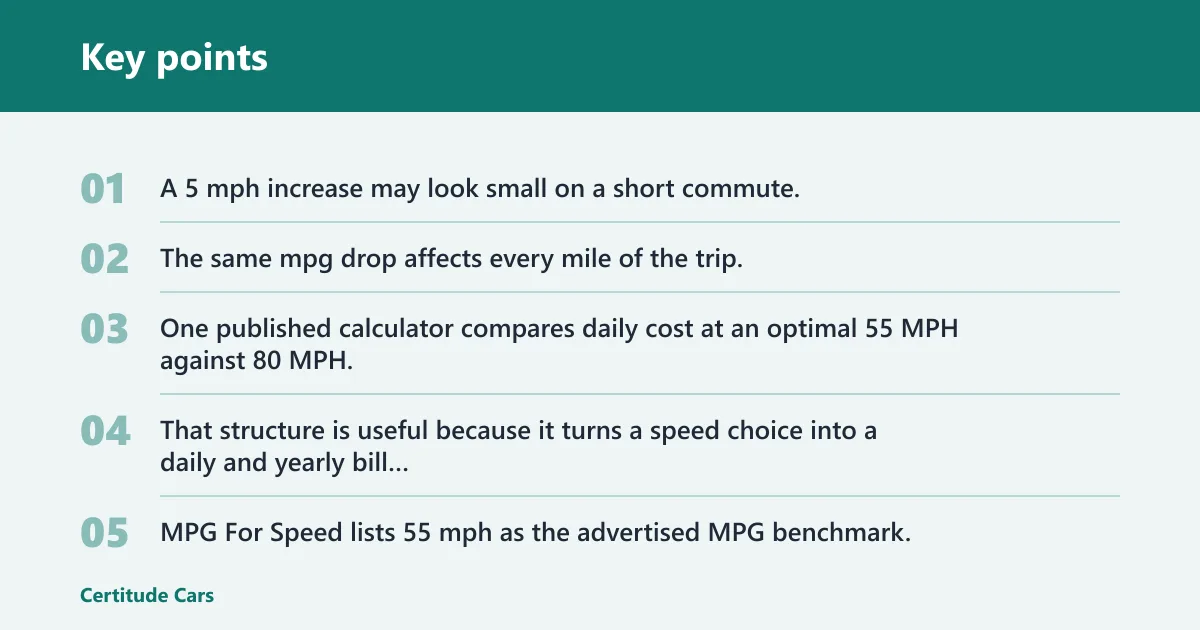
A 5 mph increase may look small on a short commute, but over highway miles the penalty adds up. The same mpg drop affects every mile of the trip, so the gallons lost grow with distance even when the time saved stays modest.
One published calculator compares daily cost at an optimal 55 MPH against 80 MPH, shows yearly savings between 55 and 80 MPH, and displays an efficiency loss percentage at higher speeds. That structure is useful because it turns a speed choice into a daily and yearly bill instead of leaving it as a vague mpg warning.
What a 10 mph increase usually means
MPG For Speed lists 55 mph as the advertised MPG benchmark, and says the average car is 3% less efficient at 60 mph. NYSDOT says highway driving above 60 mph uses more fuel. That puts 65, 70, and 75 mph in the range where the penalty usually becomes easier to see in both fuel use and cost. (NY)
Suppose you are choosing between 55 mph and 65 mph on a 200-mile trip. If the faster pace saves about 30 minutes but raises fuel use enough to matter at your gas price per gallon, the faster choice may cost more than it saves in time, especially on a route you drive often.
Speed fuel table
| Speed | Likely fuel penalty direction | Typical use case | Short trips | Medium trips | Long trips |
|---|---|---|---|---|---|
| 55 mph | Usually lowest or near lowest on many gasoline vehicles | Baseline reference speed; often close to a highway sweet spot | Usually worth it | Usually worth it | Usually worth it |
| 60 mph | Small penalty or near-neutral versus the sweet spot | Balanced choice when traffic flows a little faster | Usually worth it | Usually worth it | Usually worth it |
| 65 mph | Moderate penalty begins for many vehicles | Common freeway pace where drag starts to matter more | Usually not worth it | Usually depends on trip length | Usually not worth it |
| 70 mph | Clear penalty; drag rises faster here | Fast traffic lane, time-saving choice | Usually not worth it | Usually not worth it | Usually depends on trip length |
| 75 mph | Strong penalty for many cars, SUVs, and pickups | High-speed interstate travel | Usually not worth it | Usually not worth it | Usually not worth it |
| 80 mph | Largest penalty in this table | Fastest common highway pace in the comparison range | Usually not worth it | Usually not worth it | Usually not worth it |
What speed gets the best gas mileage?
For many gasoline vehicles, the best highway mpg is often around 45 to 60 mph, but there is no single best speed for every car. That peak shifts with vehicle type, load, terrain, traffic, and gearing, so a sedan, SUV, pickup, and hybrid may each land in a different mpg band.
Why the peak shifts by vehicle type and load
Extra weight changes the answer. A common rule of thumb is that an extra 100 pounds can reduce mpg by about 1%, so a loaded vehicle may have a lower sweet spot than the same vehicle running light. A roof cargo carrier can also add drag, which lowers highway efficiency further.
Hybrids often behave differently from pickups and larger SUVs because their powertrains can hold efficient operating ranges under different conditions. But even for hybrids, speed still matters: once airflow resistance climbs, the mpg drop becomes harder to ignore.
The practical rule is simple. Start with the vehicle’s EPA highway fuel economy rating as the baseline, then compare your normal highway speed against the 45 to 60 mph sweet spot. If the route is flat and steady, that band is often the most efficient place to sit.
What else changes highway mpg?

Several factors can move the answer away from the speedometer alone. Cruise control, air conditioning, roof cargo, and tire pressure can all change highway mpg, sometimes enough to blur the difference between two nearby speeds.
Cruise control on flat roads and hills
Cruise control usually helps on flat highways because it reduces speed fluctuations. That steadier pace can trim waste from repeated speeding up and slowing down. On hilly terrain, though, it can be less efficient because it may hold speed too aggressively uphill and use extra fuel.
Air conditioning vs open windows
Air conditioning can lower fuel economy, and in hot climates the drop can be as much as 25%. At highway speed, though, open windows can add enough drag to be the worse tradeoff. So the better choice often depends on speed: AC may cost fuel, but open windows can cost even more once airflow gets fast.
Roof cargo, tire pressure, and rolling resistance
A roof cargo carrier adds aerodynamic drag, so remove it when you do not need it. Low tire pressure raises rolling resistance, which is separate from aerodynamic drag and can quietly hurt mpg even when your speed is unchanged. Those two losses stack with speed, which is why a loaded, underinflated vehicle can feel especially thirsty on the highway.
When is slowing down worth it?
Slowing down is usually worth it when the trip is short, the fuel penalty is clear, and the time saved is only a few minutes. It is usually less worth it on long highway drives, where a sustained speed gap can save more time, but only if that time matters more than the added fuel bill.
Short trips
On short highway trips, a speed increase of about 5 to 10 mph can save too little time to justify the extra fuel. If the drive is only 15 to 25 minutes, a small reduction in travel time rarely offsets a meaningful mpg penalty.
Medium trips
On medium trips, the answer depends on the route. If traffic is steady and the road is long enough, the faster choice can save a useful amount of time. If the drive includes exits, congestion, or hills, the fuel penalty can rise while the time savings shrink.
Long trips
On long trips, speed choice becomes a more direct cost-benefit decision. A higher pace may save enough time to matter, but the 70 to 80 mph range is where wind resistance rises more steeply and the fuel penalty becomes harder to ignore. That is the point where the faster option needs a clear purpose.
Choose Gas mileage if…
Choose Gas mileage if you want the lower fuel bill, your route is mostly steady highway, and the time saved by driving faster is only 5 to 10 minutes. It is also the better pick when your vehicle is loaded, the tires are low on air, or the road already keeps you near the 45 to 60 mph sweet spot.
Choose speed if…
Choose speed if the trip is long enough that minutes matter more than fuel cost, traffic is light, and the route lets you hold a higher average pace without constant braking. That choice makes the most sense when you can accept the mpg penalty in exchange for a real time gain.
Verdict
For most drivers, Gas mileage wins the default comparison. Speed wins only when the trip is long, the time savings are meaningful, and the extra fuel cost is acceptable at your gas price per gallon.
Frequently asked questions
At what speed does gas mileage start getting worse?
For many vehicles, mpg starts falling once you move above about 55 to 65 mph. That is where aerodynamic drag begins to dominate highway fuel use. The exact point shifts by vehicle, load, and terrain, so the best answer is a range, not a single speed.
Is 65 mph worse for fuel economy than 55 mph?
Usually yes. 65 mph is often outside the sweet spot for many gasoline vehicles, while 55 mph is commonly near a highway mpg benchmark. The difference may be modest in some cars, but the fuel penalty grows as speed rises, especially toward 70 mph and above.
How much gas do I waste driving 10 mph faster on the highway?
It depends on the car and the route, but a 10 mph jump often creates a noticeable mpg drop once you are above the sweet spot. The easiest way to estimate it is to use your EPA highway fuel economy rating, your gas price per gallon, and the trip length.
Does driving too slowly also hurt gas mileage?
Yes. Driving below the sweet spot can be inefficient too, especially if the engine is operating outside its best range or the trip takes longer. Slow traffic can also hurt mpg when it causes stop-and-go movement, so the best pace is usually the steady one near the vehicle’s efficient band.
Does cruise control save gas at higher speeds?
Often yes on flat highways, because cruise control reduces speed swings and helps keep the car steady. It is less reliable on hills, where holding speed can demand extra fuel uphill. On rolling terrain, a careful driver may sometimes beat cruise control by allowing small speed changes.
Is it better to use AC or open windows at highway speed?
At highway speed, AC is often the better tradeoff even though it can lower fuel economy. Open windows increase aerodynamic drag, and that drag gets worse as speed rises. In hot climates, AC can cut mpg by up to 25%, but windows can be even more costly when the car is moving fast.