Car Depreciation Explained
Car depreciation is the gap between what you paid and what the market would pay now. In practice, many new cars lose value fastest at the start, then more gradually as they age, which is why 2- to 3-year-old cars are often treated as a value sweet spot. Use depreciation to judge when to buy, how long to keep, and when to trade in or sell.
- Biggest levers: age, mileage, condition, service history, trim, and buyer demand.
- Fastest drop: the move from new to used after first registration or drive-off.
- Best-buy rule: 2- to 3-year-old cars often avoid the steepest early loss.
- Best-sell rule: sell before high mileage, overdue maintenance, or visible cosmetic decline narrows the buyer pool.
This guide explains how depreciation works and how to use it when buying, financing, keeping, trading in, or selling a car.
How depreciation is measured
Car depreciation is the difference between your purchase price and the vehicle’s current market value. The biggest drop usually comes when a car moves from new to used after first registration or drive-off, then value tends to fall more gradually year by year. That affects you if you plan to sell soon, trade in, or keep the car for a long time.
Purchase price, market value, and the gap that matters
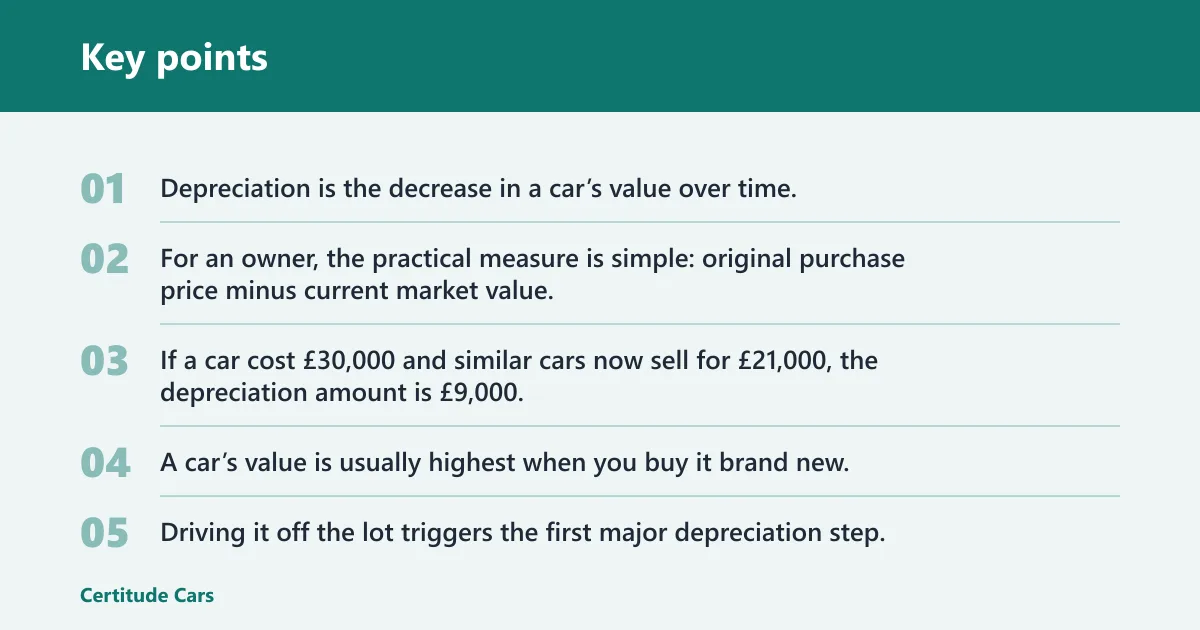
Depreciation is the decrease in a car’s value over time. For an owner, the practical measure is simple: original purchase price minus current market value. If a car cost £30,000 and similar cars now sell for £21,000, the depreciation amount is £9,000.
That is different from a dealer trade-in offer, different again from a private-sale asking price, and different from the balance left on a finance agreement. Mix those up and timing decisions go wrong.
Drive-off loss is not the same as later annual loss
A car’s value is usually highest when you buy it brand new. Driving it off the lot triggers the first major depreciation step. After that reset from “new” to “used,” value usually falls at a slower yearly rate, though age, mileage, condition, and demand still change the pace.
Common market estimates often place first-year loss in the 15% to 35% range, with many cars approaching about 50% by the three-year mark. Those points help explain why buying nearly new can change the numbers more than negotiating a small discount on a factory-fresh car.
Why depreciation matters even if you never sell privately
Depreciation affects more than a future sale advert. It shapes finance risk, insurance settlement expectations, lease-end choices, and whether a trade-in offer will cover the remaining loan. It also affects the real cost of ownership, because fuel, tax, maintenance, and depreciation together show what the car actually costs.
Suppose a buyer chooses between a discounted new hatchback and the same model at two years old. The used car may need tyres sooner, but if the first owner already absorbed the steep early value drop, the second owner can still come out ahead despite slightly higher upkeep.
How does a car depreciate over time?
Most cars lose value fastest in the first few years, then the decline usually slows through years 3 to 5 and often levels out more by years 8 to 10. That pattern is not fixed. Make, model, trim, mileage pace, service record, and buyer demand all affect where the sharpest drops happen.
The typical curve from year 1 to year 10
Year 1 is usually the steepest part because the car loses its “brand-new” premium as soon as it enters the used market. Years 2 and 3 often still bring heavy losses, though usually less abrupt than the first drop. By years 4 and 5, many mainstream vehicles are losing value more slowly in cash terms.
From about years 8 to 10, the curve often flattens further. At that point, buyers focus less on age alone and more on mileage, maintenance, condition, and whether the model still has an active buyer base.
Why the curve changes by make, model, and trim
Make, model, and trim all affect how long a vehicle retains value. Popular trims with desirable engines, sensible wheel sizes, and common options usually hold value better than oddball specifications, underpowered versions, or expensive packages that few second owners want to fund.
Residual value is the share of the original price that can still be recovered later. Buyers use it to judge ownership cost. Sellers use it to set expectations. Lenders and leasing companies use it because a vehicle expected to hold value better creates less value risk over the term.
Where timing starts to matter
The curve matters because the best time to buy is not always the best time to sell. Buying at two to three years old often avoids the hardest early depreciation. Selling before major mileage jumps, cosmetic neglect, or warranty expiry can protect value if the market for that model weakens after those points.
Picture a family SUV with 29,500 miles and a full dealer service history. If similar buyers in that market start filtering out cars above 30,000 miles, waiting another six months can push the vehicle into a less attractive search band and lower offers by more than you might expect.
Why do some cars lose value faster than others?
Cars lose value at different rates because used-car buyers price age, mileage, condition, desirability, and running-cost expectations differently. Above-average mileage, poor repairs, missing history, weak demand, and unpopular specs push values down faster. Strong demand, clean history, sensible trims, and careful upkeep usually support better retained value.
Age, mileage, and annual-use patterns
Age matters, but mileage is where many owners misread the market. Roughly 7,500 to 12,000 miles per year is a useful UK benchmark. Cars far above that range usually face stronger downward pressure because buyers expect more wear, earlier major maintenance, and shorter remaining life.
Extra mileage often hurts premium vehicles more than mainstream ones because buyer expectations are tighter. A high-mileage executive saloon may lose more than a high-mileage supermini, even if both are mechanically sound, because the premium buyer is paying for condition as much as transport.
Condition, service history, and original parts
High mileage, wear and tear, dents, and dings usually accelerate depreciation because they raise doubt about future costs. Used-car buyers discount uncertainty. Dents, kerbed alloys, stained interiors, overdue servicing, poor paintwork, and warning lights all point to future expense or past neglect.
Service history matters because it cuts doubt. Original parts often matter too, especially on premium or enthusiast models, where non-standard repairs can suggest corner-cutting. Missing records do not always destroy value, but they shrink the buyer pool and weaken negotiating power.
Demand, supply, and model desirability
Desirability is supply and demand made visible in used prices. A common, reliable model with broad buyer appeal and strong parts support often holds value better than a niche car with expensive repairs or limited interest. Popular trims also tend to resell faster and with fewer price cuts.
Unpopular colours, unusual wheel sizes, or heavy modifications can hurt even when the base model is strong. The issue is reduced buyer count.
Fuel type and vehicle segment
Vehicle type changes the pattern. SUVs and many trucks often hold value better than sedans because family demand stays broad. Luxury sedans often depreciate faster because used buyers worry about expensive repairs, lower fuel economy, and weaker demand once the new-car prestige premium disappears.
EV depreciation can behave differently from petrol or diesel. Battery warranty length, charging speed, range expectations, software support, and the pace of new-model improvement can move used values quickly. That does not mean every EV depreciates badly; it means segment comparison matters more than broad slogans.
How do you calculate car depreciation?
Calculate car depreciation in two parts: first find the car’s current market value, then compare it with what you paid. The amount lost is the purchase price minus current value. The percentage lost is that amount divided by the purchase price, multiplied by 100.
The pound-value formula
Use this basic formula:
Depreciation amount = original purchase price – current market value
If you bought a car for £24,000 and its current market value is £16,500, the depreciation amount is £7,500.
The percentage formula
Use this formula for model-to-model comparison:
Percentage depreciation = loss ÷ original purchase price × 100
Using the same example: £7,500 ÷ £24,000 × 100 = 31.25%. That percentage lets you compare value loss across different price bands.
A quick calculator example
Start with the transaction price, then use a realistic current value from comparable cars. Divide £7,500 by £24,000 and multiply by 100 to get 31.25% depreciation.
Market value, private-sale value, retail, and trade-in
Current value is not one number. Market value is the broad estimate for what similar vehicles actually command. Private-sale value is what a retail buyer may pay directly to an owner. Trade-in value is usually lower because the dealer needs room for preparation, warranty risk, and profit.
Retail dealer pricing is higher still, because it includes that preparation and margin. For depreciation decisions, compare like with like. If you plan to part-exchange, use trade-in estimates. If you plan to sell privately, use private-sale comparables.
Where a depreciation calculator fits
A car depreciation calculator is useful for comparing models and ownership periods, not for predicting an exact future cheque. It works best when you can adjust age, mileage, trim, and term length instead of applying one flat rate to every car.
- Set your starting price. Use the true transaction price, not the list price. Include discounts and exclude optional products that do not add resale value, because depreciation works off what you actually paid.
- Estimate current market value. Compare the same model, engine, trim, age, mileage, and condition. Use private-sale examples if selling privately and trade-in examples if handing it to a dealer.
- Check annual mileage. Compare your odometer with the rough UK benchmark of 7,500 to 12,000 miles per year. If your car is well above that pace, adjust expectations down before calculating.
- Factor in condition and history. Deduct for dents, wheel damage, patchy maintenance, poor repairs, warning lights, or missing records. Add support for a complete service file and clean, original specification.
- Run timing scenarios. Compare selling now with selling in 6 or 12 months. This shows whether another year of use is likely to cost less in depreciation than replacing the car today.
Depreciation decision table
| Ownership scenario | Time horizon | Estimated depreciation pressure | Likely resale risk factors | Best exit strategy |
|---|---|---|---|---|
| Brand-new mainstream car | 3 years | High | Drive-off reset to used, first-year loss, supply-heavy fleet models, ordinary trim | Sell only if incentives, warranty value, or low-rate finance made the total cost acceptable; otherwise keep longer to spread the early loss |
| Brand-new mainstream car | 5 years | High early, then medium | Mileage crossing average bands, cosmetic wear, major service items due | Often stronger than a 3-year exit because the steepest early loss has already been absorbed; sell before condition slips or mileage spikes |
| 2-year-old used car | 3 years | Medium | Weak history, outdated trim, unpopular engine, local oversupply | Good value-retention play for many buyers; buy clean and standard, then exit around year 5 of vehicle age while demand is still broad |
| High-mileage commuter | 3 to 5 years | Medium to high | Above-average annual miles, stone chips, seat wear, looming maintenance, lower buyer confidence | Usually keep longer rather than chase resale; maintain it well and sell before a visible threshold that pushes it far beyond class averages |
| Accident-history car | Any | High | Recorded damage, poor repairs, insurer history, reduced buyer pool, lower trade-in offers | Buy only at a clear discount; if already owned, keep longer and document repair quality because immediate resale often locks in the penalty |
| Premium SUV | 3 to 5 years | Medium, but mileage-sensitive | Above-average miles, expensive tyres and brakes, option-heavy spec, facelift effect | Buy used rather than new in many cases; exit before high mileage undermines premium-buyer expectations and before deferred maintenance shows |
How should you use depreciation when buying, financing, or selling?
Use depreciation to guide timing, not to chase a perfect number. Buying used often improves value retention because someone else has already taken the steep early drop. Buying new can still make sense when incentives, long ownership, or a specific warranty need outweigh the extra value loss.
When buying new can make sense
New can work if the discount is strong, the finance rate is genuinely low, the model has strong residual value, or the plan is to keep the vehicle well past the heaviest depreciation years. The key is to compare total cost, not just the monthly payment.
If the loan term is long and the deposit is small, fast early depreciation can create negative equity, where the finance balance is higher than the car’s market value. That risk is highest when buying new with minimal cash down on a model that does not hold value well.
When used usually gives better value retention
A two- to three-year-old car often offers the best balance of price, remaining life, and slower future depreciation. The first owner took the drive-off hit. The second owner still gets a modern vehicle, often with decent history and safety equipment, but without paying the full new-car premium.
Say your choice is the same crossover at new price or at 28 months old with 18,000 miles. If the used one has full service history and clean panels, it may offer a much calmer depreciation path with little real sacrifice in daily use.
How depreciation affects selling timing and loan equity
Selling at the wrong point can hurt more than keeping the car for another year. If the car is clean, average-mileage, and still in a broad-demand age band, waiting may be sensible. If it is nearing expensive maintenance, a mileage threshold, or visible cosmetic decline, an earlier sale may protect value.
Loan equity matters here. Depreciation reduces market value; loan equity compares that value with the remaining balance. A car can be depreciating normally and still be fine to keep. Trouble starts when the owner needs to sell or trade while the loan balance is still above what the market will pay.
Trade-in versus private sale
Trade-in is usually easier but often returns less than a private sale because the dealer prices in preparation, warranty exposure, and resale margin. For timing decisions, use the value route you actually expect to take. A strong private-sale number does not fix a weak trade-in position.
What hurts resale value the most?
Above-average mileage, accident history, poor repairs, neglect, and weak documentation do the most damage because they either shrink the buyer pool or raise doubt about future costs. Cosmetic issues matter too, but hidden-risk signals usually hurt more than ordinary wear on an otherwise well-kept car.
Above-average mileage and key thresholds
Mileage matters most when it changes buyer perception. A car slightly above average may be fine. A car far beyond the rough UK range of 7,500 to 12,000 miles per year often draws lower offers because buyers expect accelerated wear and less future resale flexibility.
Thresholds are often local and model-specific rather than universal. Crossing from average to clearly above average can matter more than the exact number itself.
Accident history, rebuilt titles, and poor repairs
Vehicles damaged in an accident generally lose value, but the market usually penalizes severity more than the mere existence of a claim. Minor cosmetic repair with full documentation is one thing. Structural damage, airbags deployed, poor panel alignment, or a rebuilt title is another.
Prioritize the risk factors in this order: structural or title issues first, poor repair quality second, then cosmetic history. The first two can sharply cut both private-sale interest and dealer appetite.
Neglect, patchy records, colours, and modifications
Neglect stacks up. Missed services, budget tyres on a premium car, warning lights, cheap paintwork, and mismatched body panels all suggest hidden cost. Missing records do similar damage because they turn ordinary maintenance into unanswered questions.
Colour and modifications matter less than accident history or neglect, but they still affect liquidity. Loud colours, lowered suspension, aftermarket exhausts, oversized wheels, and deleted emissions parts all narrow the audience. On a mainstream family car, boring often resells better.
How does car depreciation work for tax?
Consumer depreciation is market value loss. Tax depreciation is a separate legal and accounting issue that depends on jurisdiction, ownership structure, and business use. Private owners should not assume the market loss on a personal car can be claimed for tax in the same way.
Market depreciation versus tax depreciation
In everyday car shopping, depreciation means what the vehicle lost in market value. For tax, the relevant rules may use capital allowances, business-use percentages, leasing treatment, or other local methods. Those rules do not automatically match what the car is worth on the open market.
Business-use vehicles and jurisdiction differences
A sole trader, company-car user, and private owner may all face different treatment. Business mileage records, emissions bands, ownership versus leasing, and mixed personal use can all change what is deductible. The same car can have one market depreciation profile and a very different tax outcome.
What private owners should not assume
Private owners should not assume that a drop in market value creates a personal tax deduction. It usually does not work that way. The safe move is to separate resale planning from tax planning, then check local rules before relying on any deduction.
Frequently asked questions
How much does a car depreciate in the first year?
Many new cars lose value fastest in the first year, though the exact result depends on demand, trim, mileage, and segment. The main reason is the immediate shift from new to used after first registration or drive-off, which resets what buyers are willing to pay.
How do cars depreciate over time?
Most cars depreciate steeply in year 1, continue falling through years 2 and 3, then usually slow through years 4 and 5. Around years 8 to 10, the curve often becomes flatter. Mileage, condition, service history, and demand can still move values sharply at any age.
How do I determine car depreciation?
Start with the actual purchase price, then estimate the current market value using comparable cars with the same age, mileage, trim, and condition. Subtract current value from purchase price for the cash loss. Divide that loss by the purchase price and multiply by 100 for the percentage loss.
Why do cars depreciate in value?
Cars lose value because they age, accumulate miles, wear mechanically and cosmetically, and face changing buyer demand. New cars also carry a premium that disappears once they become used. Weak service history, dents, poor repairs, accident records, and unpopular specifications usually speed up the decline.
How does vehicle depreciation work?
Vehicle depreciation works as a market adjustment over time. The car starts at its highest value when new, takes an early drop into the used market, then loses value more gradually as age, mileage, condition, and desirability change. Trade-in value, resale value, and loan equity sit on top of that base movement.