Can a Loose Gas Cap Turn on the Check Engine Light?
Yes, a loose gas cap can turn on the check engine light, and code P0457 is commonly associated with a cap leak. Ignore it, and you may waste time, fail an emissions test, or miss a larger EVAP leak. This guide shows how to tell a loose cap from a broader EVAP fault using code patterns, symptom clues, and a simple decision path.
How an EVAP leak triggers the warning light
Yes. A loose, cracked, missing, or poorly seated gas cap can let fuel vapor escape near the filler opening, and the EVAP system can detect that pressure loss. The check engine light may be labeled service engine soon or check powertrain, and the stored code can point to an EVAP leak rather than a specific failed part.
What the light means when the EVAP system finds a leak
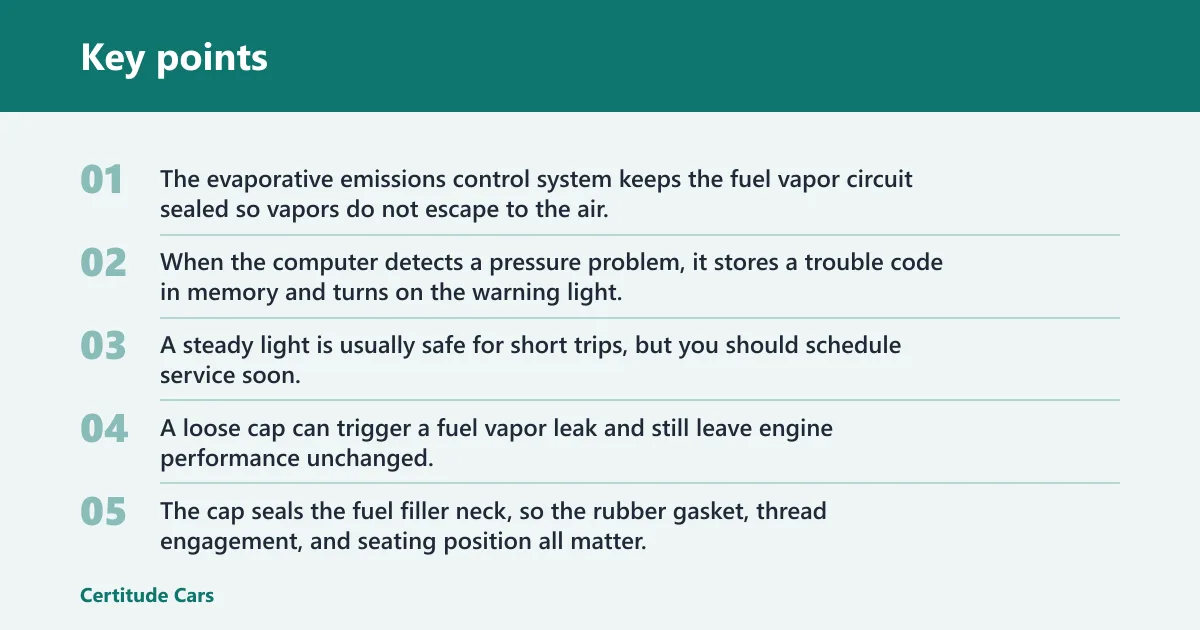
The evaporative emissions control system keeps the fuel vapor circuit sealed so vapors do not escape to the air. When the computer detects a pressure problem, it stores a trouble code in memory and turns on the warning light. That fault can be emissions-related without changing how the engine feels on the road.
A steady light is usually safe for short trips, but you should schedule service soon. A blinking light is different and usually points to a problem needing immediate attention, which is not the normal pattern for a simple gas cap issue. (Consumerreports)
Why a gas cap problem can set emissions codes without changing drivability
A loose cap can trigger a fuel vapor leak and still leave engine performance unchanged. That is why many drivers notice the warning light before they notice any roughness. The cap seals the fuel filler neck, so the rubber gasket, thread engagement, and seating position all matter.
Say your tank was topped off, the cap was left one click short, and the car still drives normally. The light can come on anyway, because the EVAP monitor is looking for vapor containment, not just engine smoothness.
Which codes point to a gas cap problem?
Common gas-cap-related EVAP codes include P0440, P0442, P0455, and P0457. Those codes tell you the computer saw a leak or pressure fault in the EVAP system, but the code points to the problem area, not always the exact part that failed.
Common code families and what they suggest
P0457 is the most direct gas-cap-related code because it often points to a large leak near the filler opening. P0455 usually suggests a large EVAP leak, while P0442 points to a small leak. P0440 is broader and can fit several EVAP faults, not just the cap.
| Code | Leak pattern | Likely cap connection | What it does not prove |
|---|---|---|---|
| P0457 | Large leak at or near the filler neck | Strong | Does not prove the cap is the only fault |
| P0455 | Large EVAP leak | Possible | Could be hose, canister, purge valve, or neck leak |
| P0442 | Small EVAP leak | Possible | Often needs more inspection than a cap swap |
| P0440 | General EVAP fault | Weak to moderate | Does not isolate one part |
Code strength matters. A code can make a loose cap more likely, but it cannot confirm that the cap is the only problem. If the cap checks out, other EVAP parts can be responsible.
How to check the cap and filler neck
Start with the cap itself, then inspect the filler neck. Look for a cap with cracks, a missing cap, dirt on the sealing surface, damaged threads, or a rubber gasket that is hard, split, or flattened. A replacement often costs $10–$30, but it must match the year, make, and model.
Remove and inspect the cap. Look for cracks in the body, broken lugs, or a gasket that feels hard, cut, or flattened. If the seal is not supple and continuous, it may not hold vapor pressure.
Check the filler neck. Wipe the neck clean and inspect the sealing edge and threads for rust, dents, debris, or fuel residue. A damaged neck can mimic a bad cap because the cap cannot seal against a bad surface.
Refit the cap fully. Tighten a loose cap until it clicks. If the cap never reaches a solid click or feels stripped, the threads or cap body may be worn.
Match the replacement correctly. Use the correct part for your year, make, and model. A cap that looks close enough can still fit poorly and keep the EVAP system from sealing.
Picture a sedan with P0457 and a cap whose gasket has a visible split. That points much more strongly to the cap than to a deep EVAP fault. If the same car has a cap that seals well but the warning returns, the next suspect is somewhere else in the vapor circuit.
EVAP decision checklist
This checklist ranks the most common outcomes after you check the gas cap. Use it to separate a likely loose cap from a probable cap replacement, a broader EVAP leak, or a problem that needs urgent inspection.
| Symptom | Likely code family | Confidence level | Next step |
|---|---|---|---|
| Cap was loose, missing, or not clicked shut; no other symptoms | P0457 or related EVAP code | High for a loose cap | Tighten or replace the cap, then retest after several trips |
| Cap seals poorly, gasket is cracked, or threads feel worn | P0457, P0455, or P0442 | High for cap replacement | Replace the cap with the correct part for the vehicle |
| Cap looks fine, but the light returns after reset | P0440, P0442, or P0455 | Moderate for a non-cap EVAP leak | Inspect filler neck, hoses, charcoal canister, and purge valve |
| Rough running, stalling, or strong fuel smell away from the fuel door | Not a simple cap pattern | Low for a loose cap only | Get an urgent fuel-system inspection |
This table separates common outcomes instead of treating every EVAP light the same. A cap problem usually fits a clean symptom pattern: loose or damaged cap, EVAP leak code, and no drivability complaint. Rough running or stalling shifts the diagnosis away from the cap alone.
Why the light may stay on after tightening the cap
The EVAP readiness monitor does not always rerun right away. Many vehicles need several normal drive cycles before the computer retests the system and clears the light if the fix worked. A common estimate is 3–5 drive cycles, but some vehicles need more than that.
Why retesting can take more than a few trips
The monitor usually runs only under specific conditions, such as fuel level, temperature, speed, and engine load. If those conditions do not show up in regular driving, the system may wait. That is why a tightened cap can still leave the warning on for a while.
Suppose the cap is tightened after a fill-up, but the car only makes short neighborhood trips. The EVAP monitor may not run enough to confirm the repair, so the light stays on even though the cap is now seated correctly.
What to do while waiting for a retest
Keep the cap fully seated. Recheck that it clicks and sits flush after each fill-up. If it loosens again, the sealing problem is not solved.
Watch for repeat codes. If the same EVAP code returns after a few normal trips, the fault likely extends beyond the cap.
Note any new symptoms. Fuel odor, rough idle, or stalling changes the diagnosis and should push you toward a deeper inspection.
Should you replace the cap or look deeper?
Replace the cap when the seal is damaged, the cap is missing, the click is weak or absent, or the part does not fit the vehicle correctly. If the cap looks sound and the code returns, the problem is more likely another EVAP leak such as a cracked charcoal canister, a hose leak, or an EVAP purge valve fault.
When a cap replacement makes sense
A new cap makes sense when the old one has a damaged gasket, obvious cracks, stripped threads, or poor seating. It also makes sense when the code pattern and filler-neck inspection point near the fuel door. In those cases, a properly matched replacement is the simplest first repair.
When to suspect another EVAP component
If the cap passes inspection and the light stays on, check the hose connections, charcoal canister, and EVAP purge valve. A charcoal canister can crack or become saturated. A purge valve can fail stuck open or closed and create pressure issues that mimic a cap leak.
The gas cap is usually the first thing to inspect, but it is not the only thing that can fail. If the vehicle runs rough, stalls, or smells strongly of fuel away from the fuel door, a loose cap is less likely to be the whole story and the system needs a closer look.
Is it safe to drive with a check engine light from a loose gas cap?
Usually, yes for short-term driving, because a gas-cap-related CEL is generally an emissions issue rather than a drivability emergency. That said, a blinking light needs immediate attention, and a steady light still means service should be scheduled soon. If the car also runs rough or stalls, treat it as a different problem.
Can a gas cap issue fail emissions inspection?
Yes. An EVAP leak can fail an emissions inspection, and the vehicle may also fail if the readiness monitor has not completed after repair. A loose cap can keep the monitor from setting to ready, so even a simple fix can leave the car inspection-ineligible until the system retests.
Frequently asked questions
Can a loose gas cap turn on the check engine light?
Yes. A loose cap can let fuel vapor escape, which can trigger an EVAP fault and turn on the check engine light. The warning may appear without any drivability change, and the computer stores a code in memory to show the fault area.
How tight should a gas cap be before the light goes off?
It should be tightened until it clicks. That click tells you the cap is seated, but the light may not go off immediately. The EVAP monitor may need several drive cycles before it confirms the repair and clears the warning.
What check engine light codes are caused by a gas cap?
P0457 points most directly to a cap leak, while the others can also involve hoses, the filler neck, the charcoal canister, or the purge valve.
How long does it take for the check engine light to reset after tightening the gas cap?
Some vehicles clear the light after 3–5 drive cycles if the fix worked, but many need more than that. The monitor only runs during certain conditions, so short trips may delay the reset even when the cap is now sealed correctly.
Can a loose gas cap make the car run rough or stall?
Usually not. A gas cap issue does not affect engine performance, according to one guide, and the more common result is an emissions warning. Rough running or stalling suggests a separate fault and should move the diagnosis beyond the cap.
Why did my check engine light stay on after I tightened the gas cap?
The monitor may not have rerun yet, or the cap may not be the only problem. Check the gasket, threads, filler neck, hose connections, charcoal canister, and EVAP purge valve. If the same code returns, look for a broader EVAP leak.