What Is MPG Used for When Comparing Cars?
MPG estimates how far a car travels on one gallon of fuel, and it works best as a cost filter: compare it with your annual miles, fuel price, and driving mix. Ignore that context and you can buy something that looks efficient on paper but costs more to run. This guide shows how MPG compares across vehicle classes, how to estimate annual fuel spend, and when city, highway, or combined MPG matters most.
What MPG means in car shopping

MPG is the standard fuel-economy figure shoppers use to compare vehicles on the same basis. It tells you miles traveled per gallon of fuel, so a larger number means the car goes farther on the same gallon. The useful part is not the number alone, but the way it fits your commute, road type, and budget.
City, highway, and combined MPG
City MPG reflects stop-and-go driving with frequent braking. Highway MPG measures fuel economy on open roads at steady speed. Combined MPG blends city and highway results, so it is often the best headline figure for side-by-side shopping because it gives a broad starting point.
The EPA fuel-economy label is the standard comparison tool on a window sticker. It includes city, highway, and combined MPG, and may also include MPGe for electric and plug-in models. That standardization matters because it lets you compare listings without guessing how each brand reports fuel use.
How do you use MPG to compare cars?
Use MPG as a filter, not a scorecard by itself. Start with vehicle class, then compare combined MPG for the closest matches, then check city or highway MPG only if your driving pattern leans heavily one way. A compact sedan, SUV, hybrid, and truck should not be judged only by the same headline number.
Compare vehicle class first
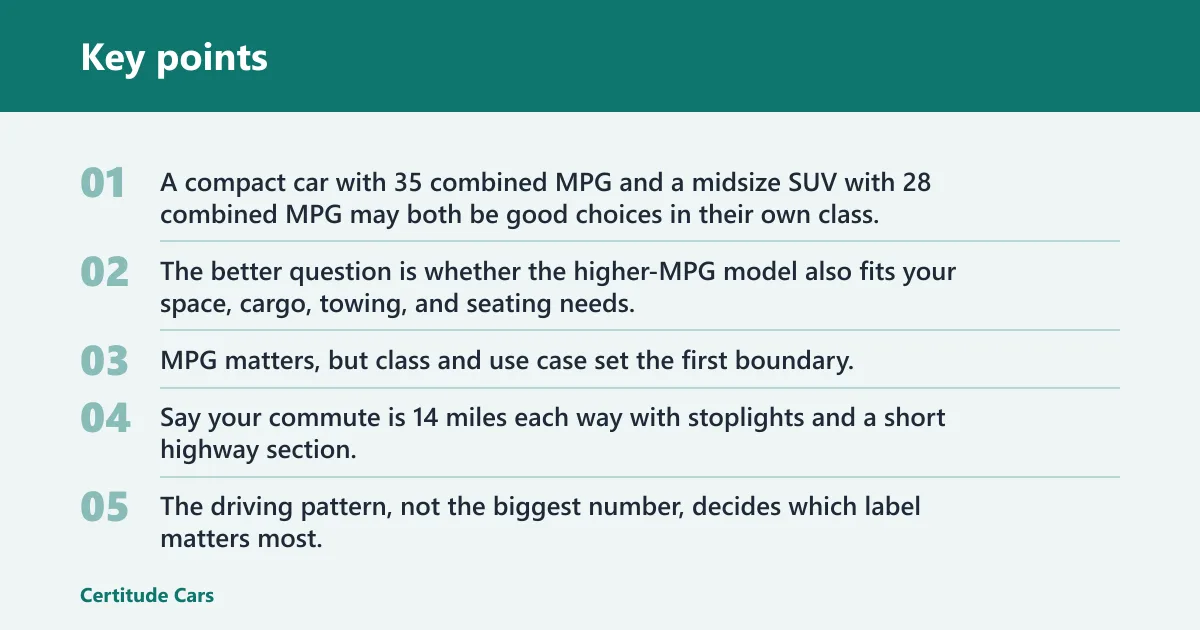
A compact car with 35 combined MPG and a midsize SUV with 28 combined MPG may both be good choices in their own class. The better question is whether the higher-MPG model also fits your space, cargo, towing, and seating needs. MPG matters, but class and use case set the first boundary.
Say your commute is 14 miles each way with stoplights and a short highway section. A car with stronger city MPG may fit better than one with a slightly better highway rating, even if both look similar on paper. The driving pattern, not the biggest number, decides which label matters most.
Use combined MPG for broad comparison
Combined MPG is the cleanest first pass when you compare two versions of the same body style, such as one compact sedan against another compact sedan, or one hybrid trim against another. It helps you avoid overreacting to a single city or highway figure that may not match your driving.
If two cars are close on combined MPG, look at the one that better matches your route. If one will spend most of its time in town and the other will mostly see highway miles, the city and highway figures can change the result even when the combined numbers look similar.
Why city, highway, and combined MPG differ
They differ because driving conditions differ. Stop-and-go traffic uses more fuel than steady cruising, so city MPG is typically lower. Open-road driving is steadier, so highway MPG is usually higher. Combined MPG sits between the two and gives a mixed-use view.
City MPG for stop-and-go driving
City MPG is the better figure for urban commuters, drivers with short trips, and routes full of lights and congestion. Frequent braking and acceleration use fuel that steady cruising would save. If your daily drive is mostly local, city MPG deserves more attention than a highway number.
Highway MPG for steady-speed driving
Highway MPG is the better figure for long-distance drivers who spend most miles on interstates or rural roads at steady speed. It can tell you more than city MPG when your route has long, uninterrupted stretches. If your commute is mostly open-road miles, highway MPG should matter more than city MPG.
Combined MPG for mixed use
Combined MPG works best for shoppers who split time between local roads and highways. It is the safest single number when you do not know the exact mix yet. Because it blends the two conditions, it reduces the risk of overrating a car that excels only in one setting.
Match the rating to your route. Use city MPG if most miles are low-speed and interrupted, highway MPG if most miles are steady, and combined MPG if your driving is mixed. This keeps you from choosing a car that looks efficient under the wrong test.
Compare within the same class. Start with compact cars against compact cars, SUVs against SUVs, and trucks against trucks. Different vehicle classes carry different weight, shape, and purpose, so raw MPG is only useful when the comparison is fair.
Check the EPA label. Use the official window-sticker ratings so every car is compared against the same standard. That label also makes it easier to spot whether a model lists MPG or MPGe, which are not the same number.
How to turn MPG into fuel cost
MPG becomes more useful when you convert it into annual fuel cost. To do that, divide annual miles by MPG to estimate gallons used, then multiply by fuel price per gallon. This makes the tradeoff between two cars concrete instead of abstract.
Annual miles and fuel price
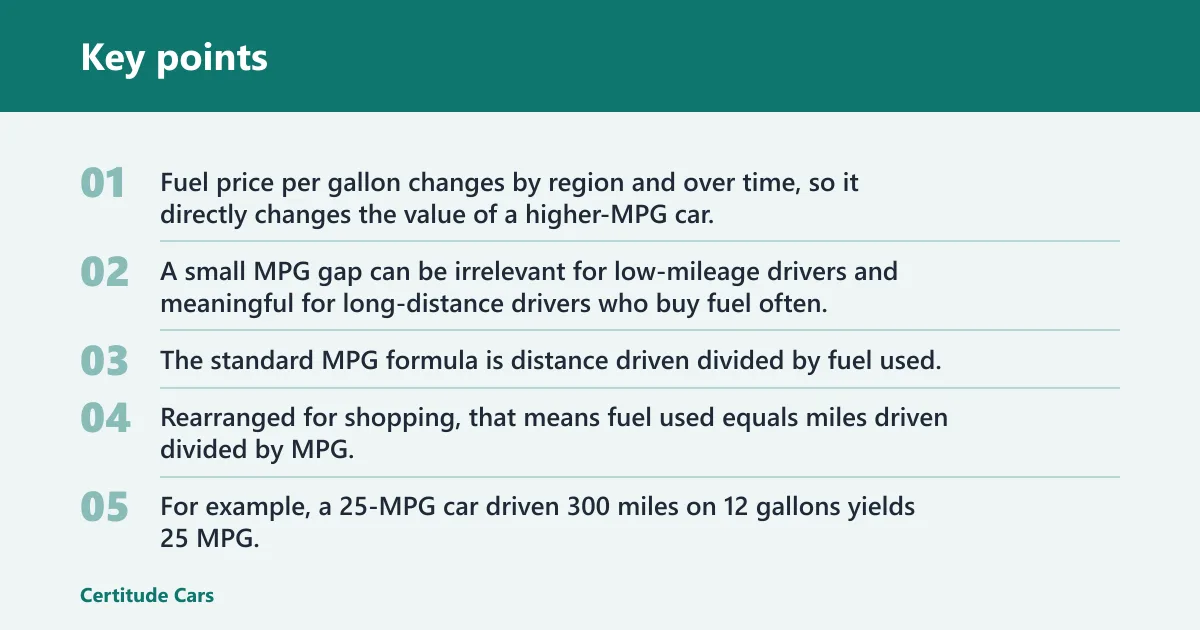
Fuel price per gallon changes by region and over time, so it directly changes the value of a higher-MPG car. Annual miles matter just as much. A small MPG gap can be irrelevant for low-mileage drivers and meaningful for long-distance drivers who buy fuel often.
Estimated gallons used per year
The standard MPG formula is distance driven divided by fuel used. Rearranged for shopping, that means fuel used equals miles driven divided by MPG. For example, a 25-MPG car driven 300 miles on 12 gallons yields 25 MPG. A 40-MPG hybrid using 12,000 miles per year would consume about 300 gallons.
A 50-MPG hybrid using 12,000 miles per year would consume about 240 gallons. In that example, the annual fuel difference between 40 MPG and 50 MPG is 60 gallons. That difference is the number that matters when you are comparing ownership cost.
Break-even notes for a higher price premium
A higher-MPG car is not automatically the better deal if it costs much more to buy. To judge the premium, compare the extra purchase price with the annual fuel savings. If the savings do not recover the price gap during your ownership period, the more efficient car may not be the better financial choice.
For example, if two similar cars differ by 60 gallons per year in your use case, multiply that by your fuel price to estimate annual savings. Then compare that savings with the price premium. If you plan to keep the car only a few years, the break-even point matters more than the headline MPG.
MPG comparison worksheet
Use this worksheet with dealer listings or spec sheets. Keep annual miles and fuel price the same for every vehicle so the comparison stays fair. That way, you compare ownership cost instead of guessing from a single MPG number.
| Vehicle name | Combined MPG | Annual miles | Fuel price per gallon | Estimated annual gallons | Estimated annual fuel cost | Break-even notes for price premium versus fuel savings |
|---|---|---|---|---|---|---|
| Compact car A | 35 | 12,000 | $3.50 | 343 | $1,200 | Baseline choice; compare any higher price against annual savings from the 35-MPG figure. |
| Hybrid B | 40 | 12,000 | $3.50 | 300 | $1,050 | Saves about 43 gallons versus 35 MPG, or about $150 per year at this fuel price. |
| Hybrid C | 50 | 12,000 | $3.50 | 240 | $840 | Saves about 103 gallons versus 35 MPG, or about $360 per year; a higher purchase price needs a long enough ownership period to pay back. |
| SUV D | 28 | 12,000 | $3.50 | 429 | $1,501.50 | Higher fuel cost may still be acceptable if cargo, seating, or towing needs make the SUV the right class. |
The calculator’s reference table lists compact cars at 30-35 combined MPG. That is a useful shopping range, not a promise. A compact in that band may still cost more or less to run depending on your mileage and fuel price.
When real-world MPG changes
Official MPG is a standard estimate, not a guarantee for every trip. Real-world MPG can drop because of cold weather, short trips, higher speeds, hills, cargo, low tire pressure, towing, or roof racks. Those conditions change how much fuel the vehicle uses.
Cold weather and short trips
Cold starts and short trips tend to hurt MPG because the engine or hybrid system spends more of the trip warming up. If the car rarely reaches full operating temperature, fuel economy can fall below the window-sticker number. That matters most for drivers whose routine is many short errands.
Speed, hills, cargo, and tire pressure
Higher speed increases air resistance, and hills add load. Extra cargo also increases the work the vehicle must do. Tire pressure matters too, because underinflated tires can reduce efficiency. These are everyday variables, which is why the real number often differs from the label.
Suppose two cars have the same combined MPG on paper. One is driven mostly on level suburban roads with properly inflated tires. The other carries a full cargo area, climbs hills, and runs below recommended tire pressure. The second car will usually return the worse real-world result, even though the label is identical.
Towing and roof racks
Towing and roof racks create extra drag and load, so they can lower MPG sharply. That is one reason an SUV or truck may return very different fuel economy once it is used for work or travel gear. If towing is part of ownership, compare the tow-use fuel cost, not only the empty-vehicle label.
What is MPGe and how is it different?
MPGe is the EPA’s comparison metric for electric vehicles and plug-in hybrids. It lets shoppers compare alternative-fuel vehicles with gasoline cars, but it is not the same as MPG. Do not treat the numbers as interchangeable, because one measures fuel gallons and the other uses an energy-equivalent standard.
33.7 kWh per gallon equivalent
The EPA uses 33.7 kWh as the gasoline-energy equivalent for MPGe. MPGe was introduced by the EPA in 2010 and became mandatory on redesigned fuel-economy labels in 2013. That label change made it easier to compare EVs and plug-in hybrids with gasoline models on the same sticker. (Caranddriver)
Why you should not mix the two metrics
MPG tells you how far a gasoline-powered vehicle goes on one gallon of fuel. MPGe uses an energy-equivalent basis that is useful for EVs and plug-in hybrids, but not for a direct one-to-one cost comparison with gasoline MPG. If you are cross-shopping, keep the metrics separate and convert both to cost if needed.
Frequently asked questions
What is mpg for cars?
MPG for cars is the miles a vehicle can travel on one gallon of fuel. It is the standard fuel-economy number on many car listings and window stickers. A larger MPG number means the car uses less fuel for the same distance, which usually lowers running cost.
What is a car mpg used for when comparing vehicles?
Car MPG is used to compare fuel economy across vehicles on a common scale. It works best when you match the number to your annual miles, fuel price, and driving pattern. That way, you compare likely ownership cost instead of chasing the largest figure alone.
How does mpg help compare cars on fuel economy?
MPG helps compare cars by showing how far each one can travel on the same amount of fuel. Combined MPG is usually the best first number for cross-shopping, while city and highway MPG help if your driving is mostly one type. It is a filter, not the full decision.
What does vehicle mpg mean in real life?
In real life, vehicle MPG shows how much fuel a car will likely use in your own driving. Cold weather, short trips, speed, hills, cargo, tire pressure, towing, and roof racks can all lower it. The sticker number is a standard estimate, not an exact promise.
What is good mpg on a car?
Good MPG depends on vehicle class. A compact car at 30-35 combined MPG is often competitive, while an SUV or truck will usually post lower numbers because of size and use. The better question is whether the MPG is strong for that type of vehicle and your route.
How do mpg and MPGe compare?
MPG and MPGe are not the same unit. MPG measures fuel distance per gallon for gasoline vehicles, while MPGe compares EVs and plug-in hybrids using an energy-equivalent measure based on 33.7 kWh per gallon equivalent. Use them carefully, and convert to cost if you need a fair cross-shopping comparison.