What Is Car Depreciation and Why Does It Matter?
Car depreciation is the drop in a vehicle’s value over time. It can reduce a resale or trade-in value by thousands, and many new cars are reported to lose about 20% to 30% in the first year. Miss it, and you can overpay, hold the car past its strongest sale window, or accept a weaker trade-in. This guide explains how depreciation works, what speeds it up, and when timing a sale matters most.
What car depreciation means
Car depreciation is the gap between what you paid for a car and what it is worth later on the used market. Put simply, it is market value loss, not accounting language. The original purchase price is the starting point, and the resale value is the amount a buyer or dealer will actually pay later.
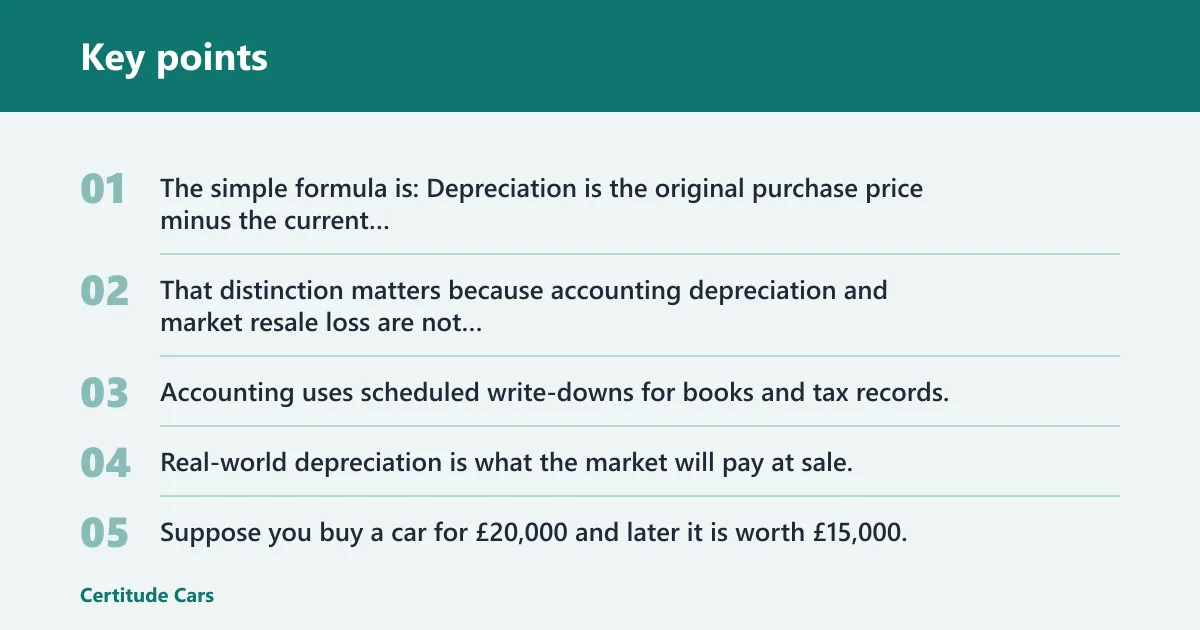
The simple formula is:
Depreciation is the original purchase price minus the current resale value.
That distinction matters because accounting depreciation and market resale loss are not the same thing. Accounting uses scheduled write-downs for books and tax records. Real-world depreciation is what the market will pay at sale, and that can move faster or slower depending on demand, age, mileage, condition, and the model itself.
Suppose you buy a car for £20,000 and later it is worth £15,000. The depreciation is £5,000. That is 25% of the original price, which is enough to change whether selling now or waiting makes financial sense.
Why depreciation matters
Depreciation matters because it shapes total ownership cost, even when the monthly payment looks manageable. For many cars, value loss is one of the largest costs of ownership, and it is the cost most buyers overlook until it appears in a part-exchange offer or private-sale price.
It also affects timing. If a car loses value fastest early on, waiting for another year may cost more than it saves. If demand is strong for your model, selling or trading in before mileage climbs too far can protect more of the car’s value.
It matters on the buying side too. A used car that has already taken the steep first-year hit can be better value than a new one, provided the mileage, service history, and condition stack up. That is why depreciation changes the question from “Which car do you want?” to “When is the cheapest point in that car’s life to own it?”
How car depreciation works
Depreciation usually hits hardest early, then becomes more uneven. The biggest drop happens as soon as a new car is driven off the forecourt. Year 1 depreciation is often the sharpest period, with many cars losing 15–35% in that first year.
After year one, the curve usually does not flatten neatly. Some models keep falling at a steady pace, while others hold up better for a while and then drop again when they get older, pass mileage milestones, or fall out of favour with buyers. Cars may lose about 60% of their value by Year 3, 60–70% by Year 5, and about 80% by years 8–10.
That does not mean every car follows the same path. A body-on-frame SUV or pickup truck often holds value better than a luxury saloon, and early EVs can drop faster where buyer confidence, battery concerns, or charging access affect demand. Depreciation is not a fixed annual tax; it is a market response.
Picture a five-year-old car with complete records, average mileage, and tidy paintwork. It may still depreciate, but a neglected example of the same model can lose value faster because buyers price in risk, repair work, and uncertainty. The market rewards confidence.
What speeds up value loss
Several factors work together rather than in isolation. Mileage is one of the clearest: higher mileage lowers value and speeds depreciation. In the UK, average annual mileage is often reported at around 8,000–12,000 miles, and 10,000 miles per year is a useful benchmark when judging whether a car is above or below normal use.
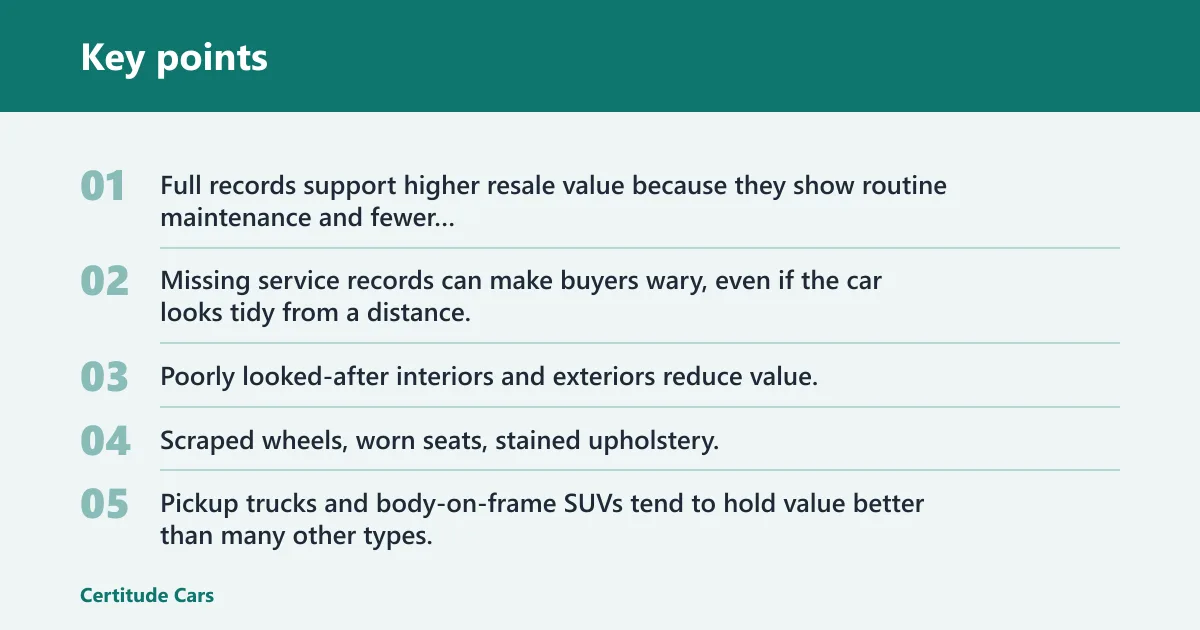
Service history matters for the same reason. Full records support higher resale value because they show routine maintenance and fewer unknowns. Missing service records can make buyers wary, even if the car looks tidy from a distance.
Condition also counts. Poorly looked-after interiors and exteriors reduce value. Scraped wheels, worn seats, stained upholstery, and paint damage all make a car feel more expensive to put right, so buyers lower their offers.
Vehicle segment changes the picture too. Pickup trucks and body-on-frame SUVs tend to hold value better than many other types, while luxury sedans and early EVs often drop faster. Demand drives that gap. So does perception.
Emissions compliance matters in the UK as well. Cars that do not meet emissions rules can lose value faster, and cars that cannot enter low-emission zones are less attractive to buyers. A model that is mechanically sound can still weaken in resale terms if buyers expect access issues or higher running restrictions.
Depreciation decision checklist
| Ownership stage | What depreciation means at that stage | Best action to reduce loss |
|---|---|---|
| New-car purchase | The car starts losing value immediately, and the first-year drop is usually the steepest. | Buy with resale in mind, compare similar used examples, and avoid paying for trim or options you may not recover. |
| Year-one ownership | The car is in the sharpest part of the depreciation curve, often with a 15–35% loss in the first year. | Keep mileage near normal usage, keep service records complete, and avoid cosmetic wear that weakens resale. |
| Mid-life ownership | Value loss may slow, but age, mileage, and condition still shape the market price. | Service it on schedule, fix visible faults, and check whether your segment still has strong buyer demand. |
| Pre-sale timing | The car’s value can dip again when mileage rises, emissions concerns grow, or the model ages out of demand. | Compare private-sale, part-exchange, and waiting; choose the exit that leaves the smallest likely gap between value now and value later. |
How to judge finance and trade-in timing
Depreciation affects finance because equity can change faster than the loan balance. If the car loses value quickly, you may owe more than it is worth for a while. That does not mean every finance deal is bad, but it does mean the timing of sale or part-exchange should be checked carefully.
Keeping the car can make sense if the monthly cost is already low, the vehicle is holding value better than average, and you plan to keep it well past the early drop. Selling sooner can make sense if the car is in the steepest part of depreciation and the market is still strong for that model. A trade-in is worth comparing when convenience matters, but you should still compare it with a private-sale figure if time allows.
A common first-timer mistake is waiting for a “better” resale price while mileage keeps climbing. If the next six months add about 5,000 to 8,000 miles and move the car into a new mileage bracket, the extra waiting can cost more than any small rise in asking price.
How much value does a car lose in year one?
Many cars lose about 15–35% in the first year, and that is the range to use carefully rather than as a promise. The exact loss depends on make, model, mileage, condition, service history, and segment demand. The biggest drop happens early, often before the car reaches even modest age.
Here is a simple worked example. If a £20,000 car loses 25% in year one, it falls to £15,000. That means the first-year depreciation is £5,000. The same vehicle may still lose value after that, but the first step down is usually the steepest.
What does that mean in practice? If your car has already taken a large first-year hit and is still in good condition, keeping it longer can make sense because the next year may not be as severe. If you are buying, the same pattern makes one- to three-year-old used cars worth a close look, provided mileage and records are sensible for the age.
That said, there are failure cases. Some cars still depreciate quickly after year three, especially if they are high-mileage, have patchy history, face weak demand, or are affected by emissions restrictions. Age alone does not guarantee value retention.
Frequently asked questions
What does car depreciation mean?
Car depreciation is the drop in a vehicle’s value over time. It is the difference between the original purchase price and the amount the car will sell for later. In practical terms, it is a hidden ownership cost that affects resale, part-exchange, and how long you should keep the car.
How does car depreciation work?
Depreciation starts as soon as the car becomes used, and the biggest drop usually happens when it leaves the forecourt. After that, age, mileage, condition, service history, demand, and emissions compliance all shape the next sale price. The rate is uneven, not a fixed yearly percentage for every model.
Why does car depreciation matter when buying or selling?
It matters because it changes what the car really costs to own. When buying, it helps you judge whether a new car is worth the early value loss or whether a used one makes more sense. When selling, it affects whether now is a better time than after another year of mileage and age.
How much value does a car lose in the first year?
Many cars lose 15–35% in year one, though the exact figure varies by model and market. A car that looks cheap on finance can still be expensive to own if the first-year value loss is large. That is why the first year matters more than most later periods.
What causes a car to depreciate faster?
Higher mileage, missing service records, poor condition, weak segment demand, and emissions issues can all speed up depreciation. Cars that cannot enter low-emission zones are less attractive to many buyers. Luxury sedans and early EVs often fall faster than pickup trucks or body-on-frame SUVs, though exceptions exist.
How do mileage and service history affect depreciation?
Mileage directly lowers value and speeds depreciation, especially when annual use goes well beyond the 8,000–12,000 mile benchmark. Full service records usually support a stronger resale price because they reduce uncertainty for buyers. Missing records can make people cautious, even if the car appears clean and drives well.
Does depreciation affect trade-in and finance decisions?
Yes. Depreciation can shape equity, so a fast-falling car may be worth less than the finance balance for a period. That does not mean every owner should avoid finance, but it does mean trade-in timing should be compared carefully with the car’s likely value in six or twelve months.
How do you calculate car depreciation?
Use a simple subtraction: original purchase price minus current resale value. If you bought the car for £20,000 and it is worth £15,000 now, depreciation is £5,000. For percentage loss, divide the loss by the original price and multiply by 100.
How does car depreciation work for tax?
For tax, depreciation can mean an accounting write-down rather than the market value loss a buyer sees. That is why a car can lose resale value faster or slower than the book value used in records. The tax treatment depends on the vehicle and the business context, so it is worth checking the relevant rules for your situation.