Can You Drive with the Check Engine Light on?
If the check engine light stays on and the car feels normal, you can usually drive a short distance to a repair shop; if it flashes, stop as soon as you can do so safely. Ignoring the wrong warning can turn a small repair into engine or catalytic converter damage. This guide helps you judge the light by color, flashing pattern, and symptoms, then choose whether to keep driving, limit the trip, or pull over immediately.
When it’s safe to keep driving
Yes, sometimes. A steady check engine light often means you can drive a short distance if the car feels normal, but a flashing light is urgent and means you should stop as soon as it is safe. The right choice depends on symptoms, road type, and whether the fault is intermittent or active.
Quick answer for a steady light
A solid check engine light is usually less urgent than a blinking one, and the car may still be usable for a short trip. That does not mean you should treat it as normal. Scan the code soon, keep the trip short, and avoid hard driving until you know what the fault points to.
Why a blinking light changes everything
A blinking or flashing check engine light means something is seriously wrong with the engine. It is often linked to an active misfire, and continued driving can damage the catalytic converter. Treat it as a stop-driving warning, not a “get home first” warning.
When to stop driving right away
Pull over if the car shakes, loses power, smells strongly of fuel, overheats, or flashes the check engine light. In those cases, the safest next step is to shut it down and arrange a tow. A blinking light should not be used as a signal to finish a commute, climb a hill, or continue onto the highway.
What the check engine light means
The check engine light, also called the malfunction indicator lamp, or MIL, is a warning from the onboard diagnostics system rather than a single-fault message. In U.S. vehicles since 1996, that system uses OBD2 to store diagnostic trouble codes, which technicians and scanners read through the OBD port.
Pending, stored, and permanent codes
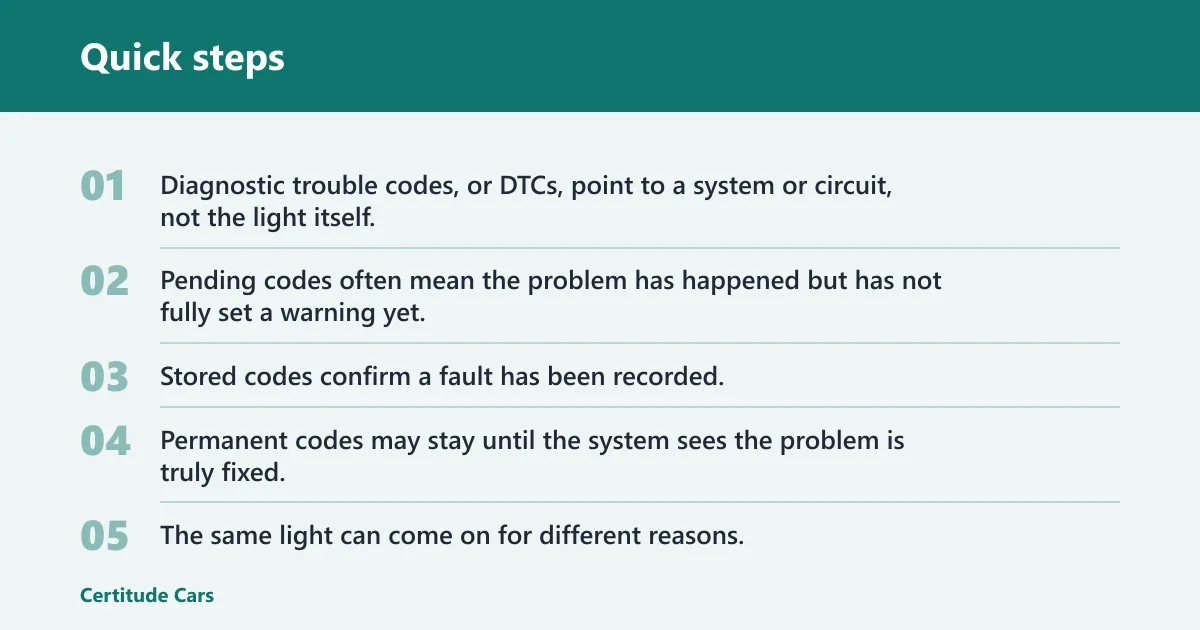
Diagnostic trouble codes, or DTCs, point to a system or circuit, not the light itself. A code can be pending, stored, or permanent. Pending codes often mean the problem has happened but has not fully set a warning yet. Stored codes confirm a fault has been recorded. Permanent codes may stay until the system sees the problem is truly fixed.
Why the light is a warning, not a diagnosis
The same light can come on for different reasons. A loose gas cap, an oxygen sensor fault, a misfire, a lean condition, or an evaporative emissions leak can all turn it on. The lamp tells you to investigate. The code tells you where to look.
Check engine decision table
Use this table to match the symptom and code status to a practical next step. If the car feels normal, the risk is usually lower. If it shakes, smells odd, or flashes, the situation is more urgent.
| Scenario | Likely severity | Keep driving? | Avoid highway driving? | Next best action |
|---|---|---|---|---|
| Steady light, no symptoms | Low to moderate | Yes, for a short trip | Prefer to avoid long highway runs | Check the gas cap, then scan codes soon |
| Steady light with rough idle | Moderate | Only if needed for a short distance | Yes | Reduce driving and get the codes read promptly |
| Steady light with weak acceleration | Moderate to high | Limit to the nearest shop if it still moves normally | Yes | Inspect for limp behavior and scan before further driving |
| Steady light with fuel smell | High | No, unless you must move to a safer spot | Yes | Stop, check for leaks, and arrange service |
| Flashing light | Urgent | No | Yes | Pull over safely and tow the vehicle |
| Light that comes and goes | Moderate | Short trips only until scanned | Usually yes | Read pending and stored codes before the next long drive |
| Light after gas fill-up | Low to moderate | Usually yes for a short trip | Prefer short local driving first | Check the gas cap and look for EVAP codes |
| Light plus overheating | Urgent | No | Yes | Stop immediately and address the overheating first |
What symptoms make driving unsafe?
Shaking, power loss, fuel smell, and overheating matter more than the light by itself. A steady warning with no other symptoms is often less urgent than a flashing light or a car that is clearly running badly. When the symptom changes the way the car behaves, treat the trip as risky.
Rough idle or shaking
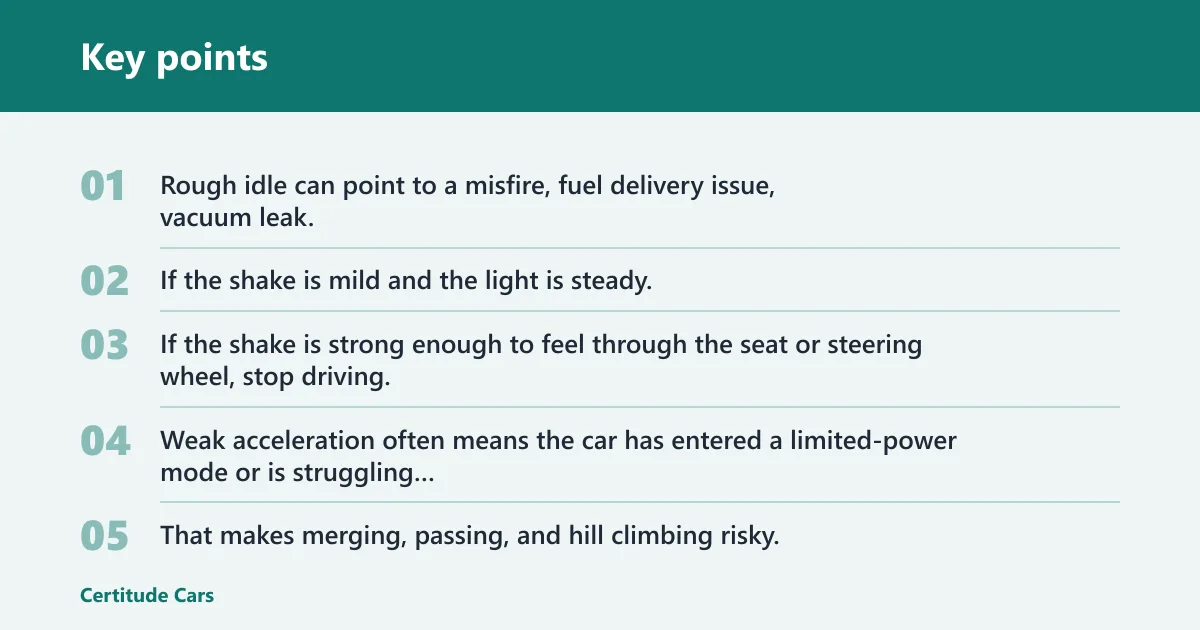
Rough idle can point to a misfire, fuel delivery issue, vacuum leak, or another engine fault. If the shake is mild and the light is steady, a short drive to a shop may still be reasonable. If the shake is strong enough to feel through the seat or steering wheel, stop driving.
Weak acceleration or loss of power
Weak acceleration often means the car has entered a limited-power mode or is struggling with an engine fault. That makes merging, passing, and hill climbing risky. Keep the trip short and local, and do not plan highway driving until the code is read.
Fuel smell or overheating
A fuel smell can signal an EVAP problem, a leak, or an issue that should not be ignored. Overheating is more urgent still. If the temperature gauge climbs, steam appears, or the car smells hot, stop immediately. Do not wait to see whether the warning clears on its own.
Say your sedan starts idling unevenly at a stoplight, but it still moves normally and the light stays solid. That is the kind of case where a short trip to a nearby shop is usually safer than continuing to drive for the whole day.
Suppose the light flashes during a highway merge and the car begins to stumble under throttle. That is not a “see how it goes” situation. Pull over safely and arrange a tow.
Can you keep driving on the highway?
Highway driving can raise the risk because speed, load, and heat can make a problem worse quickly. If the car is running perfectly and the light is steady, a short highway trip may still be acceptable, but local roads are the safer choice. If the car shakes, loses power, or flashes, skip the highway entirely.
Why highway speed can raise risk
At higher speed, an engine fault can worsen faster, and a misfire can put more stress on the catalytic converter. If you are far from a repair shop, that matters. A car that feels only slightly off at low speed may become much worse under cruise and acceleration.
When a short local trip is the safer choice
If you must move the car, a short trip to a nearby shop is safer than a long commute or a highway run. Keep the speed moderate, avoid heavy throttle, and do not stack extra errands onto the trip. The goal is to reduce load until the fault is confirmed.
When you should pull over instead
Pull over if the light flashes, the engine stumbles hard, the temperature rises, or the car smells like fuel or burning components. In those cases, driving farther can increase repair cost and risk. If you are already on the road, get to a safe shoulder or parking area first.
What to do first when it comes
Start with the gas cap, then read the code, then decide how far to drive. That sequence gives you the fastest answer with the least risk. If you do not have a scanner, a free scan at some auto parts stores or a borrowed OBD2 scanner can still give you useful code information quickly.
Check the gas cap
A loose gas cap is one of the common causes of a solid light. Tighten it until it clicks, then give the car a normal drive cycle and see whether the warning returns. EVAP codes such as P0440, P0442, P0445, P0455, and P0456 are common examples tied to this system.
Read the code with an OBD2 scanner
An OBD2 scanner can be wired or Bluetooth-based, and it helps you confirm whether the fault is minor or urgent. If you do not own one, borrowing one or using a free scan can still tell you whether the issue is a misfire, an EVAP leak, a lean condition, a sensor fault, or something more serious.
Decide whether to drive, limit use, or tow
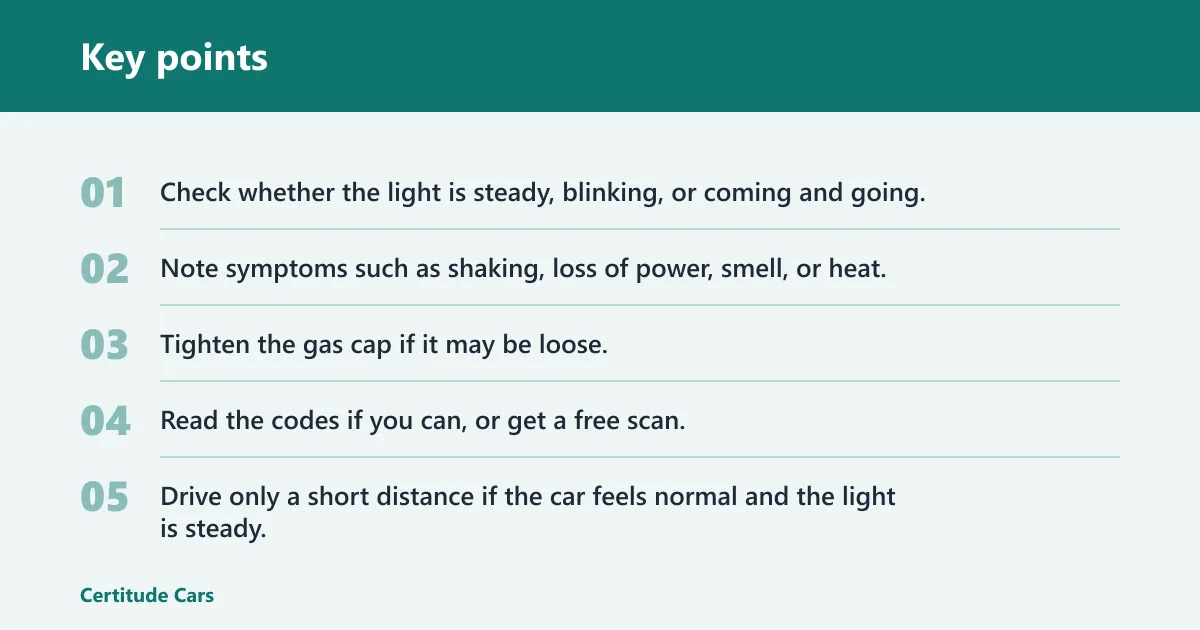
- Check whether the light is steady, blinking, or coming and going.
- Note symptoms such as shaking, loss of power, smell, or heat.
- Tighten the gas cap if it may be loose.
- Read the codes if you can, or get a free scan.
- Drive only a short distance if the car feels normal and the light is steady.
- Stop or tow if the light flashes, the engine misfires, or the car overheats.
Why it comes and goes
A light that comes and goes often points to an intermittent fault. The problem may appear under certain temperatures, loads, or road conditions, then disappear before the next trip. That still matters, because a light that turns off can leave a stored code behind.
Intermittent faults and pending codes
Some check engine lights go on and off because the fault is intermittent. Pending codes may be present before the problem becomes repeatable enough to set a steady warning. If the light disappeared but the code remains stored, you still have useful evidence to guide diagnosis.
After a gas fill-up
If the light appears after refueling, the gas cap is the first thing to inspect. A cap that is not sealed can trigger EVAP codes and a solid light. If the cap is fine and the warning stays on, the leak may be in the EVAP system rather than at the filler neck.
Light off does not always mean fixed
Do not assume the problem is gone just because the light went dark. The vehicle may have completed a monitor and hidden the warning for the moment. Read the code history if possible, especially if the light has returned more than once.
Picture a commuter car that shows a steady light on Monday, then seems normal by Wednesday. If the code was still stored, the intermittent fault has not vanished; it has only become harder to catch. That is one reason prompt scanning matters.
Common codes and what they usually point
Codes narrow the fault to a system or circuit. They do not tell you to keep driving, but they help judge urgency. P0300 points to a misfire. P0171 and P0174 often point to a lean condition. P0420 is commonly linked to catalytic converter efficiency. P0101, P0131, P0134, and P0401 are also common examples that can point to airflow, oxygen sensor, or exhaust gas recirculation issues.
How those codes change urgency
P0300 deserves prompt attention because misfires can lead to flashing-light severity and catalytic converter damage. P0171 and P0174 may still allow short, gentle driving, but they can cause rough running and poor fuel control. P0420 often means the system has already noticed a catalyst efficiency problem, which should be checked soon rather than ignored.
What a free scan can tell you
A free scan at an auto parts store can separate a simple EVAP fault from a more urgent engine problem. That matters when you are deciding whether to drive home, take the back roads, or stop for a tow. Even a basic code read is better than guessing from the lamp alone.
Frequently asked questions
Can you drive with the check engine light on?
Sometimes, yes. If the light is steady and the car feels normal, short-distance driving is often reasonable until you can scan the codes. If it flashes, or if the car shakes, loses power, smells odd, or overheats, do not keep driving.
Is it safe to drive with a solid check engine light?
A solid light is often driveable short term, but it still needs prompt diagnosis. Keep the trip short, avoid hard acceleration, and do not plan a long highway drive until you know what code is stored. A steady light can still mean a fault that gets worse.
What does a blinking check engine light mean?
A blinking check engine light means the problem is urgent. It often points to an active misfire and can damage the catalytic converter if you keep driving. The safest move is to pull over, stop the engine if needed, and arrange towing instead of continuing.
How long can I drive with the check engine light on?
There is no universally safe distance for driving with the check engine light on. A steady light with no symptoms may be okay for a short trip to a shop, while a flashing light means stop now. If the car shakes, smells like fuel, or overheats, the answer becomes immediate shutdown, not more miles.
Do I need an OBD2 scanner to check the light?
You do not need to own one, but you do need some way to read the code. An OBD2 scanner is the fastest tool, and it may be wired or Bluetooth-based. If you do not have one, borrow one or use a free scan at some auto parts stores.
Can a loose gas cap turn on the check engine light?
Yes. Tighten the cap first, then see whether the light clears after the car has been driven normally.