What Is the Difference Between Fuel Grades?
Fuel grades are octane levels: regular is often around 87, mid-grade around 89, and premium commonly around 91–93. Use the octane grade listed in your owner’s manual; if the engine pings on the allowed lower grade, move to the recommended higher one. Using the wrong grade can waste money or, in an engine that needs more octane, trigger knock and reduce performance. This guide explains what octane means, why mid-grade often exists, and how to choose the right fuel for your car.
Fuel grades at the pump
At the pump, fuel grades are the different gasoline labels a station sells, sorted by octane number. They are not the same thing as fuel type, so gasoline grades are separate from diesel or other fuels. The label tells you which pump-side option you are buying, not whether the fuel is “better” in every engine.
What the grade labels mean
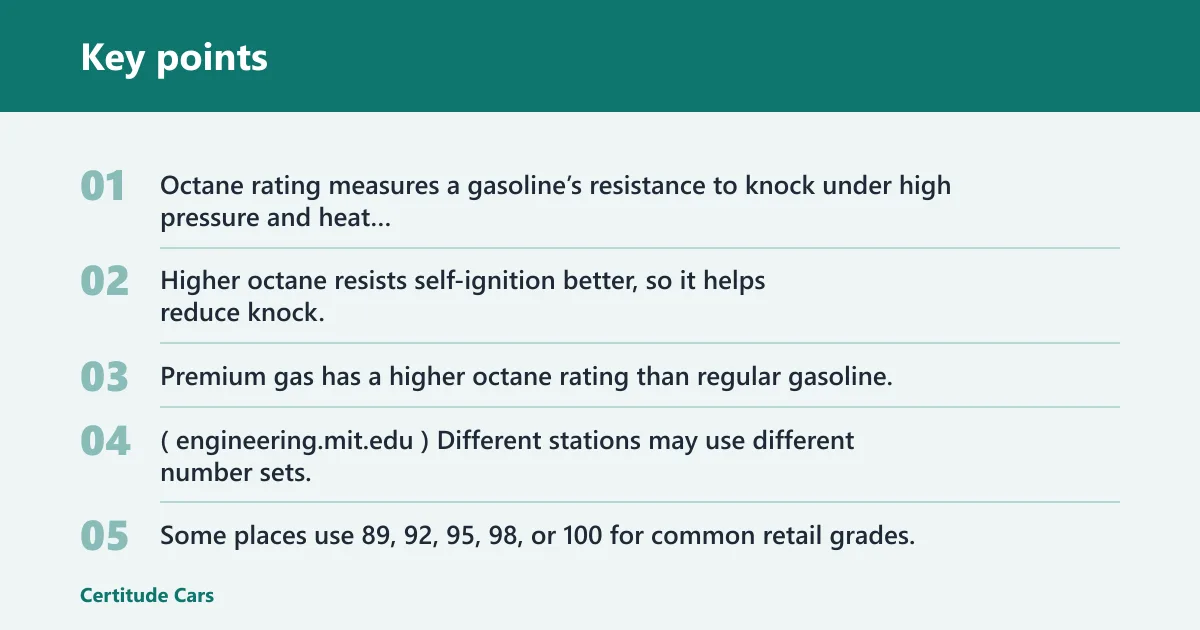
Octane rating measures a gasoline’s resistance to knock under high pressure and heat inside the cylinder. Higher octane resists self-ignition better, so it helps reduce knock. Premium gas has a higher octane rating than regular gasoline, while mid-grade sits between them in many markets. (MIT)
Different stations may use different number sets, but the logic stays the same: the higher the gasoline label, the higher the octane number. Some places use 89, 92, 95, 98, or 100 for common retail grades, while others use the familiar 87, 89, and 91–93 pattern.
Why stations use regular, mid-grade, and premium
Stations offer more than one grade because engines do not all have the same knock tolerance. Regular is the lowest common retail grade, mid-grade fills the middle price and octane step, and premium gives the highest common retail octane. Mid-grade is often a blended or branded step between regular and premium, not a universal requirement for most engines.
A common first-timer mistake is to think “mid-grade” means “the right choice for any car that wants something better.” It does not. It simply gives another octane option for vehicles that may call for it, or for drivers who are following a label between regular and premium.
What octane rating means
Octane rating is a knock-resistance measure, not a measure of energy or power by itself. Higher-octane fuel resists detonation and knocking better, which matters when an engine squeezes the air-fuel charge hard or runs under higher heat. All gasoline grades contain the same amount of chemical energy.
Knocking and self-ignition
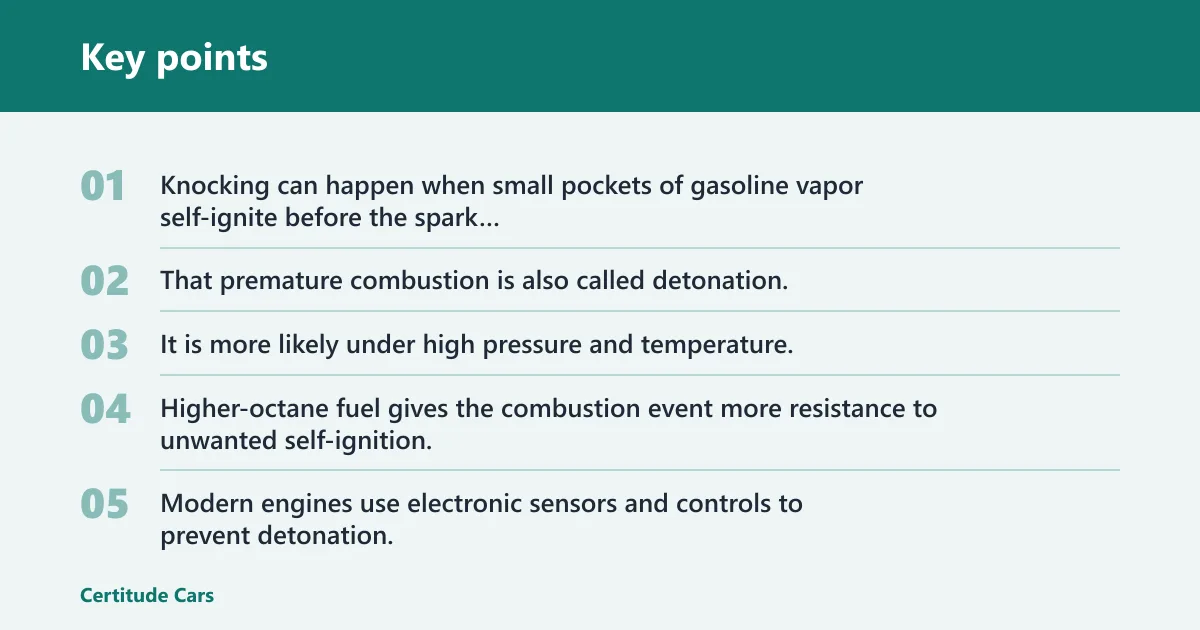
Knocking can happen when small pockets of gasoline vapor self-ignite before the spark plug fires or after it should be finished. That premature combustion is also called detonation. It is more likely under high pressure and temperature, which is why octane matters most in engines that create those conditions.
Higher-octane fuel gives the combustion event more resistance to unwanted self-ignition. Modern engines use electronic sensors and controls to prevent detonation, but that does not mean every engine needs the same grade. It means the engine management system can react within the limits the fuel allows.
What octane does not measure
Octane does not mean “more energy,” “cleaner burn,” or “more power” on its own. Since all gasoline grades contain the same amount of chemical energy, a higher number does not automatically add output in a non-tuned engine. It only changes how much knock resistance the fuel provides.
Regular vs mid-grade vs premium
The three common gasoline grades differ mainly in octane and knock resistance. Regular is the lowest retail grade, mid-grade is the middle step, and premium is the highest common retail octane. The practical question is not which label sounds best. It is which label matches the engine’s needs.
Regular gasoline
Regular gasoline is the lowest common retail grade and is typically adequate unless the owner’s manual specifies otherwise. For many cars, it is the correct and least expensive choice. If the manual says regular is acceptable, premium usually does not add anything useful in day-to-day driving.
Mid-grade gasoline
Mid-grade gasoline is an intermediate octane fuel, often blended or sold between regular and premium. It exists because some engines are tuned to prefer more knock resistance than regular provides, but not always as much as premium. It is not a universal requirement for most engines.
Suppose your owner’s manual lists 87 octane, and the car runs normally on that fuel. Mid-grade may cost more without changing how the engine behaves. If the manual specifically allows a range, then mid-grade can be the middle choice, but it is still a label you follow, not a performance upgrade by default.
Premium gasoline
Premium gasoline has the highest common retail octane. It may help only in engines designed for it, especially when the engine’s compression ratio is higher and knock risk rises. Higher-octane fuel can help performance-oriented engines with higher compression ratios, and it is still specified for better acceleration and power output in some engines.
Does higher octane add power?
Higher octane does not add power in most non-tuned engines. If the engine is designed for regular fuel, the control system already expects that grade and usually will not make extra power simply because you paid for premium. In those engines, higher octane mainly changes knock resistance, not output.
When premium can help
Premium can help when the engine is designed to take advantage of it. That includes some performance engines, some turbocharged engines, and engines with higher compression ratios. In those cases, the fuel choice may support better acceleration and power output because the calibration is built around that knock resistance.
Picture a turbocharged sedan whose manual says premium is required. The engine can make higher cylinder pressure, so the octane rating matters more. If the driver fills with a lower grade, the car may protect itself by pulling timing or reducing output rather than delivering full performance.
Why more octane is not the same as more energy
All gasoline grades contain the same amount of chemical energy, so the extra cost of premium is not paying for more fuel content. It is paying for a higher octane number and more resistance to knock. That distinction is why premium can be valuable in one engine and pointless in another.
Why some engines need premium
Higher engine compression ratio is one common reason an engine needs higher octane. Compression increases the pressure and heat inside the cylinder, which raises the chance of knock. Higher-octane fuel gives that engine more room to operate without unwanted detonation.
High load and high temperature conditions
Knock risk also rises under heavy load, high ambient temperature, towing, or sustained climbing. In those conditions, the engine works harder and the air-fuel mixture sees more stress. A fuel that resists detonation better can help the engine stay within its intended operating window.
Modern engines use electronic sensors and controls to reduce detonation, but they cannot turn regular fuel into premium. If a vehicle is calibrated for higher octane, the fuel choice still matters. The owner’s manual is the deciding source, not a guess based on price or label color.
What to remember about compression ratio
Compression ratio is often mentioned in performance-engine guidance because it is linked to the need for higher gasoline grade. That does not mean every high-compression engine must use premium in every market, but it does mean octane choice is tied to the way the engine was designed and calibrated.
How to choose the right grade
Start with the owner’s manual. It is the primary source for required fuel grade and should override assumptions that premium is always better. If the manual specifies a single grade, use that grade. If it lists a range, choose within that range based on cost and the engine’s guidance.
What to do if the manual allows regular or premium
If the manual allows more than one grade, regular is often acceptable unless the manufacturer says premium may improve performance under certain conditions. In that case, premium may be useful for towing, hot weather, or heavy acceleration, but it is not a default power upgrade for every trip.
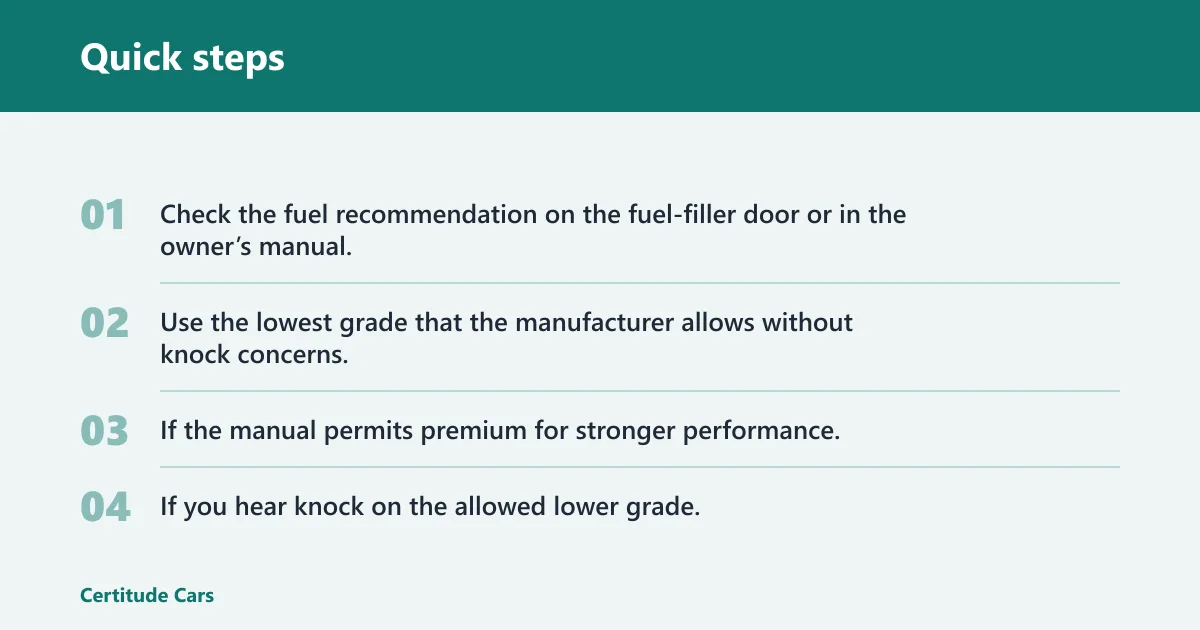
- Check the fuel recommendation on the fuel-filler door or in the owner’s manual.
- Use the lowest grade that the manufacturer allows without knock concerns.
- If the manual permits premium for stronger performance, decide whether that benefit matters for your driving.
- If you hear knock on the allowed lower grade, return to the recommended fuel and have the engine checked if needed.
What to do if the manual requires premium
If the manual requires premium, use premium. That instruction is tied to the engine’s calibration and knock tolerance. Using a lower grade may cause the engine to reduce power, run less smoothly, or protect itself from detonation rather than operate as intended.
Fuel cost matters, but the manual matters more. A vehicle that requires premium is not asking for a luxury option; it is asking for a specific octane level that matches the engine’s compression and control strategy.
Fuel grades comparison table
| Grade | Octane range | Knock resistance | When it is useful | Adds power in a non-tuned engine? | Decision rule for the driver |
|---|---|---|---|---|---|
| Regular | Usually 87 | Lowest of the three common grades | Most everyday engines that are designed for regular fuel | No, not by itself | Use it if the owner’s manual says regular is acceptable or required |
| Mid-grade | Usually 89 | Between regular and premium | Engines that specify an intermediate octane or allow a range | Usually no | Use it only if the manual calls for it or gives it as an allowed option you want to follow |
| Premium | Usually 91–93 | Highest common retail knock resistance | Engines designed for higher compression or tuned for premium | No, unless the engine was designed for it | Use it when the owner’s manual requires premium or recommends it for your engine |
Can you mix fuel grades?
Yes. Mixing regular, mid-grade, and premium in the same tank just blends the octane level of the fuel in the tank. That can matter if you are trying to meet a specific octane target, but it does not create a new fuel type or a special performance boost.
When mixing matters and when it does not
If your car allows either regular or premium, mixing grades may land you somewhere between them, which is fine only if that still fits the manufacturer’s guidance. If your manual requires premium, a partial tank of lower octane is not the same as filling with the required grade. The result is still a lower overall octane than the engine was designed around.
A common first-timer mistake is to think a few gallons of premium can “fix” a tank of regular in a required-premium engine. It may raise the blend somewhat, but it does not turn the whole tank into the specified fuel grade. When the manual calls for premium, fill with premium.
Frequently asked questions
What is the difference between fuel grades?
Fuel grades are the common gasoline labels at the pump, separated mainly by octane rating. Regular has the lowest common octane, mid-grade sits in the middle, and premium has the highest common retail octane. The difference is knock resistance, not a different fuel type.
What is the difference between gasoline grades?
Gasoline grades differ by octane number and the amount of knock resistance they provide. Higher-octane gasoline resists detonation better under pressure and heat. That matters most in engines that need it, while many everyday engines run normally on regular fuel.
What is the difference between gasoline octane ratings?
Octane ratings measure how a gasoline resists self-ignition under difficult conditions. A higher octane number means more resistance to knock. It does not mean more energy in the fuel or automatic extra power in every engine.
What is the difference between the 3 grades of gasoline?
The three grades are regular, mid-grade, and premium. Regular is the lowest common retail grade, mid-grade is the middle step, and premium is the highest common retail octane. The right one depends on the owner’s manual, engine design, and knock risk.
What fuel grade should I use in my car?
Use the grade listed in the owner’s manual or on the fuel-filler door. If the manual says regular, use regular. If it requires premium, use premium. If it allows a range, choose within that range based on the manufacturer’s guidance and your driving needs.
Does higher grade fuel do anything in an engine?
Higher grade fuel raises octane and improves knock resistance, which can matter in some engines. It does not add energy to the fuel, and it usually does not add power in a non-tuned engine. Its benefit depends on whether the engine was designed to use that octane.
What does higher octane fuel mean?
Higher octane fuel means the gasoline resists knocking better under pressure and temperature. That can help engines with higher compression ratios or other designs that are more prone to detonation. It is a measure of knock resistance, not fuel quality in the general sense.
Can you mix fuel grades in the same tank?
Yes, you can mix grades, and the result is an octane blend somewhere between the fuels you added. That can be acceptable only if the final octane still matches the vehicle’s requirement or allowed range. It does not replace the grade the manual calls for.