Battery Light Before the Car Dies: How Long Do You Have?
Many drivers may have about 5 to 30 minutes after the battery light comes on, but if the alternator is failing hard or electrical loads are high, the car can die much sooner. Keep driving and you can lose power steering, the engine, and the ability to restart. This guide explains the range, the warning signs, and when to pull over now.
What the battery light really means
The battery warning light is a charging-system alert, not a battery-only warning. It usually means the battery is not being charged correctly while the engine runs, often because the alternator, belt, wiring, or voltage regulator has a fault.
Why the light can stay on or turn off again
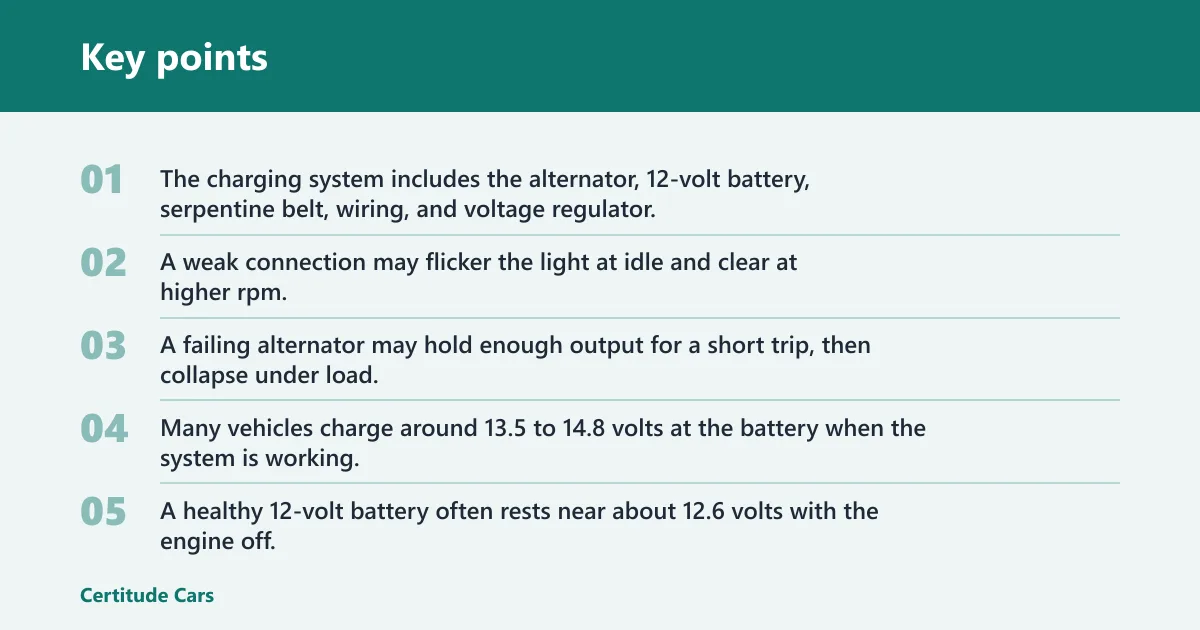
The charging system includes the alternator, 12-volt battery, serpentine belt, wiring, and voltage regulator. A partial or intermittent fault can keep the engine running for a while after the light appears, then let voltage sag later when demand rises or engine speed drops.
That is why the same light can mean different levels of risk. A weak connection may flicker the light at idle and clear at higher rpm. A failing alternator may hold enough output for a short trip, then collapse under load.
Many vehicles charge around 13.5 to 14.8 volts at the battery when the system is working. A healthy 12-volt battery often rests near about 12.6 volts with the engine off. A warning light with engine voltage below that charging range deserves attention right away.
How long can you really drive?
How long you can drive depends on battery reserve, charging loss, and electrical load. A healthy battery with a partial charging fault may buy limited time. A weak battery, night driving, and several accessories can cut that window sharply.
What changes the time window most
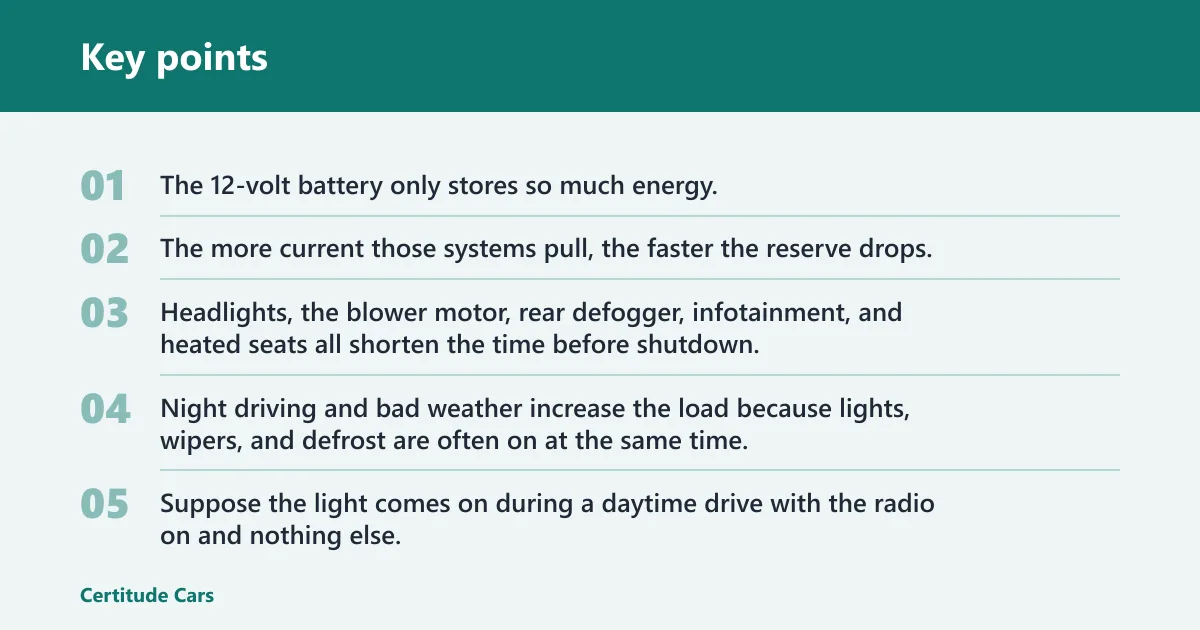
The 12-volt battery only stores so much energy. Once the alternator stops keeping up, the car starts using that reserve to run ignition, fuel control, lights, fans, and electronics. The more current those systems pull, the faster the reserve drops.
High load matters a lot. Headlights, the blower motor, rear defogger, infotainment, and heated seats all shorten the time before shutdown. Night driving and bad weather increase the load because lights, wipers, and defrost are often on at the same time.
Suppose the light comes on during a daytime drive with the radio on and nothing else. That is a lower-load case, so the engine may keep running long enough to reach a nearby repair stop. Suppose the same light appears at night with headlights, cabin blower, rear defogger, and heated seats on. The available time can drop fast.
Battery-light urgency matrix
| Scenario | Likely driving time range | Warning signs | Immediate actions |
|---|---|---|---|
| Healthy battery, minimal load | About 15 to 30 minutes | Light stays on, but headlights remain steady and the engine runs normally | Turn off non-essential accessories, head to the nearest safe stop, and arrange testing soon |
| Weak battery, minimal load | About 5 to 15 minutes | Slow cranking before this trip, dimming at idle, dashboard lights may flicker | Cut electrical demand right away and drive only to the closest safe place or repair shop |
| Healthy battery, high load | About 5 to 20 minutes | Lights dim at idle, blower speed drops, electrical accessories act unstable | Shut off rear defogger, seat heaters, and other extras; leave now for a short, direct route |
| Weak battery, high load | Minutes, sometimes less than 5 | Engine stumbles, warning lights multiply, steering or braking feel heavier, electronics fade | Pull over safely and stop driving; call for roadside help or a tow |
This table is a guide, not a promise. A failing alternator, slipping belt, or weak battery can shift the outcome quickly. If the car starts losing electrical power, treat it as an immediate stop-driving problem.
What should you do right now?
Cut electrical demand first, then watch for stall warnings. If the engine starts stumbling, the lights dim hard, or electronics begin dying, pull over safely and stop driving. The point is to protect remaining battery reserve long enough to reach a safe stop, not to stretch the trip by pushing the system harder.
Immediate actions to take
Turn off extra loads. Switch off the rear defogger, seat heaters, phone chargers, and any unnecessary infotainment features. Leave headlights on if conditions require them, but do not add more demand than needed for safety.
Watch for fading power. Check for dim headlights, a slower blower, flickering dash lights, or power windows that move sluggishly. Those signs mean the charging reserve is dropping and the car may be close to stalling.
Head to a safe stop. If the engine stumbles, the steering gets heavy, or warning lights multiply, pull over as soon as it is safe. Do not try to “see what happens” on the highway or in heavy traffic.
A common mistake is assuming the battery is fine because the engine still cranks after a few short stops. That does not mean the alternator is charging. Starting uses the battery briefly; running the car depends on the charging system keeping up.
Can you make it home safely?
Sometimes, yes, but only as a short, low-load, low-risk trip. A daytime city route on local streets is much easier on the charging system than a night drive with lights, heat, wipers, and traffic. If the car is already showing weak-power symptoms, do not count on making it home.
Daytime city driving
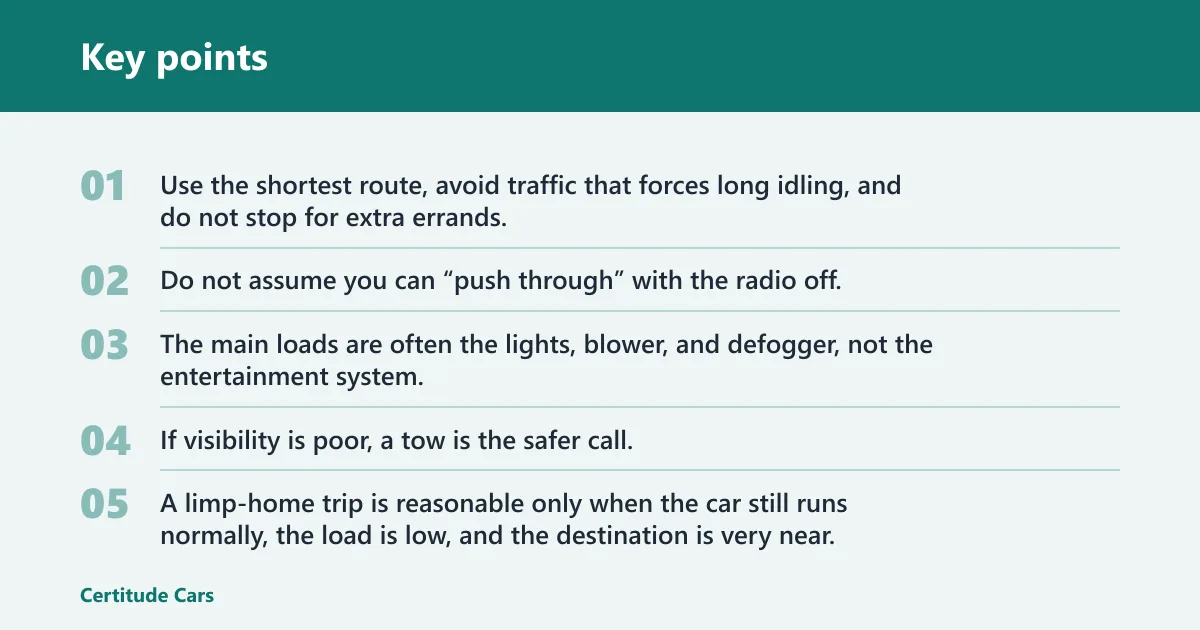
A short drive home in daylight can be reasonable if the engine runs smoothly, the battery light is the only warning, and electrical load stays low. Use the shortest route, avoid traffic that forces long idling, and do not stop for extra errands.
Night driving and bad weather
Night driving is a poor choice because headlights, dashboard illumination, and often the blower or defogger are already in use. Rain or fog adds wipers and defrost demand. Those loads can turn a limited window into a much shorter one.
Do not assume you can “push through” with the radio off. The main loads are often the lights, blower, and defogger, not the entertainment system. If visibility is poor, a tow is the safer call.
Short limp-home trips versus towing
A limp-home trip is reasonable only when the car still runs normally, the load is low, and the destination is very near. Towing is the better choice when the light stays on and the car shows any sign of electrical decline, belt trouble, or engine stumble.
Picture a sedan with a steady battery light at noon, no dimming, and a 3-mile route home. That is a candidate for a cautious, direct trip. Now picture an SUV at dusk with headlights, rear defogger, and a blower on high. That same warning becomes much more urgent.
What is usually failing?
The alternator is commonly reported as a frequent failure point when the battery light stays on. But the battery, serpentine belt, wiring, and voltage regulator can also be involved. The key is to separate the cause from the symptom before you decide whether to keep driving.
Alternator output problems
The alternator charges the battery while the engine runs. If its output drops, the battery light may come on even though the battery itself was fine before the trip. A failing alternator may work at higher rpm and fail at idle, which is why the light can appear at a stoplight first.
Serpentine belt slip or break
On many vehicles, the serpentine belt drives the alternator. If the belt slips or breaks, charging can stop immediately. Depending on the vehicle, the same belt can also affect power steering or cooling, so a belt fault can create more than one problem at once.
Battery, wiring, or regulator faults
A weak or dead battery can make the symptoms worse, but it does not automatically mean the battery is the root cause. Corroded wiring, a loose connection, or a bad voltage regulator can also trigger the light or cause intermittent charging.
How to check the charging system
A voltage meter or multimeter can confirm whether the charging system is doing its job. An OBD-II scan tool can read charging-related trouble codes and point toward voltage regulator or system faults. These checks help separate a weak battery from a charging failure.
Using a voltage meter or multimeter
Check resting battery voltage. With the engine off and the car settled, measure the battery in DC volts. A healthy 12-volt battery often reads near 12.6 volts, while a much lower reading suggests the battery is already weak.
Check running voltage. Start the engine and measure at the battery again. Many vehicles should show about 13.5 to 14.8 volts if the charging system is working. A reading that stays near battery-resting voltage suggests poor charging.
Repeat under load. Turn on headlights and the blower, then check again. If voltage drops sharply with normal loads, the alternator or belt may be struggling even if the engine still runs.
If the reading jumps around, inspect the belt and terminals before drawing a final conclusion. A loose connection can mimic a failing alternator. A slipping belt can do the same thing.
Using an OBD-II scan tool
Read stored codes. Plug in the scan tool and check for charging-related trouble codes. Codes tied to system voltage, regulator control, or battery management can point toward the fault area.
Check live data. Look at charging voltage and related electrical data while the engine is running. The numbers help confirm whether the problem is constant, intermittent, or load-related.
Compare symptoms and data. Use the scan results with the voltage readings and belt inspection. That combination is more useful than guessing from the warning light alone.
Frequently asked questions
How long can I drive with the battery light on before the car dies?
Most drivers have 5 to 30 minutes, but that window can shrink to minutes if the alternator is failing hard or the electrical load is high. A weak battery, night driving, or a slipping belt can shorten it further. Treat any drop in power as a stop-driving sign.
Will my car keep running if the battery light is on?
It may keep running briefly because the battery can carry the electrical system for a while. That does not mean charging has recovered. If the alternator is not supplying enough voltage, the car is running on reserve and can stall once that reserve is used up.
Can I make it home with the battery light on?
Sometimes, if the trip is short, it is daylight, and the car shows no dimming, stumbling, or other electrical loss. Do not count on it for a long route or a night drive. If the warning appears with low voltage or multiple symptoms, a tow is the safer choice.
Does the battery light mean the battery is bad or the alternator is failing?
It usually means the charging system is not charging properly. The alternator is the most common failure point, but the battery, belt, wiring, and voltage regulator can also be involved. A voltage check and code scan are the quickest ways to sort that out.
What happens first when the charging system fails?
The first signs are often dimming lights, a slower blower, or a dash warning that comes on at idle or in traffic. As voltage falls, electronics may act strange, then the engine may start stumbling. Once that happens, the remaining driving time can disappear fast.
What should I do immediately when the battery light appears?
Turn off non-essential electrical accessories, note whether the lights or engine behavior change, and choose the shortest safe route to a stop or repair point. If the engine stumbles, the dash dims, or power drops, pull over and stop driving. That is the point where risk rises sharply.