Oil Light on Dashboard: What It Means and What to Do
A red oil can warning means low oil pressure: pull over and shut the engine off as soon as it is safe; an amber oil light usually means check oil level or schedule service soon, not immediate shutdown. Keep driving with a red oil-pressure light and you can damage bearings, camshafts, a turbocharger, or the whole engine within minutes. This guide separates red from amber warnings, explains the fastest checks, and shows when you can add oil, when you need a tow, and when it is only a service reminder.
What does the oil light actually mean?
The oil light can mean two very different things. A red oil-can warning is a low-oil-pressure warning that may indicate pressure below a safe threshold right now, while an amber oil, wrench, or service reminder usually points to maintenance status or a level check, not immediate engine shutdown.
Red oil-can warning: pressure problem first
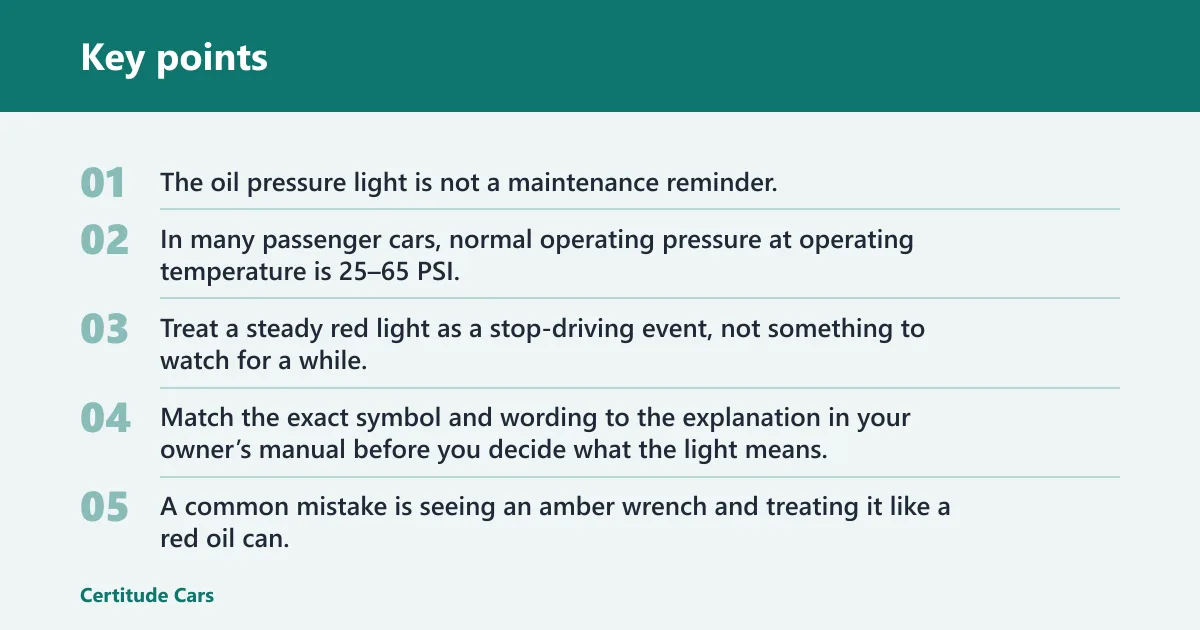
The oil pressure light is not a maintenance reminder. A red oil pressure warning can indicate critically low oil pressure right now, and these warnings often trigger below about 7–10 PSI. In many passenger cars, normal operating pressure at operating temperature is 25–65 PSI.
That gap matters. If engine pressure is low enough to switch on the red warning, the oil film may no longer protect bearings and other moving parts. Treat a steady red light as a stop-driving event, not something to watch for a while.
Amber oil or service reminder: usually maintenance, not emergency
An amber light takes a closer read. Some vehicles use an amber oil icon for a level check or an oil-life reminder, and some use a wrench or service message instead. Les Schwab describes amber oil lights as possibly low oil or low pressure, so the exact symbol and wording on the cluster matter.
If the message says service due, oil change required, or shows a wrench without a red oil-pressure warning, that is usually safe for a short trip to service. It still needs attention, but it is a different problem from a red pressure warning.
Why icon shape, color, and wording vary by vehicle
Clusters differ by make and model. One car may show a red oil can, another may say low oil pressure, and another may separate an amber level warning from a red pressure warning. Match the exact symbol and wording to the explanation in your owner’s manual before you decide what the light means.
A common mistake is seeing an amber wrench and treating it like a red oil can. Those are often separate messages with very different urgency.
Can you keep driving with the oil light on?
You should not keep driving with a steady red oil-pressure warning. Pull over, shut the engine off, and plan on towing if the warning stays on, if the engine knocks, or if it runs rough. An amber service reminder is usually safe for a short trip, but it still needs the right follow-up.
When a red warning means stop now
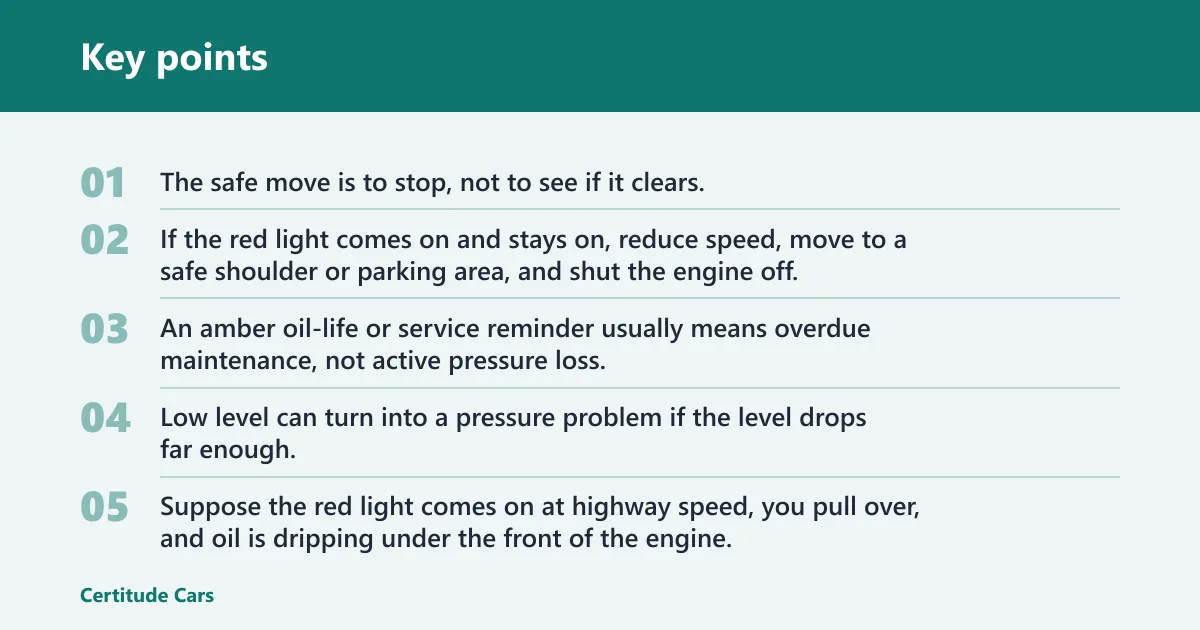
Red means immediate action is required. The same source says red oil lights may mean immediate attention is required, and OBDadvisor warns the engine may be ruined within minutes if pressure is lost. The safe move is to stop, not to see if it clears.
If the red light comes on and stays on, reduce speed, move to a safe shoulder or parking area, and shut the engine off. If you also hear knocking, ticking that suddenly got louder, or feel rough running, do not restart it unless you must move it a few feet for safety.
When an amber reminder is usually safe for a short trip
An amber oil-life or service reminder usually means overdue maintenance, not active pressure loss. If the engine sounds normal and there is no red pressure warning, a short trip to home, a shop, or a safe place to check the oil is usually reasonable.
That said, if the amber light is paired with a low oil level message, check the dipstick soon. Low level can turn into a pressure problem if the level drops far enough.
When to shut the engine off and call for a tow
Towing is generally recommended if the red warning stays on after a restart check, if there is unusual engine noise, or if oil is visibly leaking. Continuing to drive under those conditions can turn a sensor problem into an engine-replacement problem if low pressure is real.
Suppose the red light comes on at highway speed, you pull over, and oil is dripping under the front of the engine. That is no longer a monitor-it situation. Shut it off and tow it.
What should you do right after the oil light comes on?
Act in order: get to a safe place, shut the engine off if the red warning remains on, wait briefly for oil to drain back, and check the dipstick on level ground. The first few minutes tell you whether you are dealing with an urgent pressure loss or a simple low-level fix.
Immediate checks
- Move to safety. If the red oil-can warning appears, signal, reduce speed, and pull over somewhere flat and safe. Avoid hard acceleration because rising load can increase engine damage if pressure is truly low.
- Shut the engine off. If the red pressure warning stays on, turn the engine off as soon as you are safely stopped. Do not let it idle while you decide, because the warning means pressure may already be below a safe threshold.
- Wait for drain-back. Give the oil a short wait after shutdown so it can return to the pan before checking the dipstick. That improves the reading and helps you avoid adding oil because of a false low reading.
- Check the dipstick. Park on level ground, pull the dipstick, wipe it clean, reinsert it fully, then pull it again and read the level against the minimum and maximum marks. If the level is below the minimum mark, add the manufacturer-specified oil grade before restarting.
- Look for obvious leaks. Check under the vehicle and around the filter area for fresh oil. A loose drain plug, a damaged filter seal, or a major leak after service can explain a sudden warning.
- Restart only if appropriate. If the oil was low and you corrected it, a brief restart to see whether the warning clears may be reasonable. If the red light stays on, shut it off again and arrange a tow rather than driving farther.
Oil warning decision table
| Dash light behavior | Likely meaning | Immediate action | Next diagnostic step |
|---|---|---|---|
| Steady red oil can | Critically low oil pressure right now, or a severe sensor fault | Pull over, shut engine off, check oil level, tow if light stays on | Verify actual pressure with a mechanical gauge at the sender port before replacing parts |
| Flashing or intermittent oil warning | Marginal pressure, wiring or sending-unit fault, or pressure dropping in certain conditions | Reduce load, get to a safe place quickly, check level and leaks | Check service history, oil grade, and confirm pressure with a mechanical gauge |
| On at idle, off with RPM | Hot idle pressure may be too low; possible low level, thin oil, pump wear, or increased bearing clearance | Avoid extended idling, shut off if red warning remains steady | Measure hot pressure with a mechanical gauge and compare behavior at idle versus raised RPM |
| Amber oil/service reminder | Oil change due, maintenance reminder, or in some vehicles a level check request | Check level soon and schedule service; usually no immediate shutdown needed | Confirm the exact symbol in the owner’s manual, perform service, and reset the reminder |
Does the oil light mean low oil or low oil pressure?
Sometimes it means low oil level, but a red oil-can warning is mainly about low oil pressure. Low level is one common cause, yet full oil does not rule pressure loss out. The dipstick check comes first because it is quick, safe, and can change your next move right away.
How low oil level can trigger a pressure warning
Low oil level is a common cause of oil light warnings. If the oil level falls far enough, the pickup can draw aerated oil or lose a steady supply, especially during braking, cornering, or on a grade. That can make the pressure light flicker or turn on solid.
The same source lists low oil level as a cause of oil light warnings. Dirty oil can also contribute, especially if it restricts flow or has been neglected long enough to affect pressure behavior.
Why full oil can still mean low pressure
A full crankcase does not prove healthy pressure. The engine can still have a bad oil pressure sending unit, wiring fault, worn oil pump, pickup restriction, incorrect oil viscosity, filter problem, or worn engine bearings that increase internal clearances and reduce pressure.
That is why “the oil is full” should change the diagnosis, not end it.
How the dipstick check fits into diagnosis
The dipstick check answers one question fast: is the engine obviously low on oil? It does not answer whether the actual pressure is correct. If the level is normal and the red warning remains, the next meaningful test is pressure verification, not guessing at parts.
Picture a crossover parked level after a five-minute wait, with the dipstick right at the full mark and a steady red warning still returning on restart. In that case, adding oil is not the fix path. Pressure testing is.
Why is the oil light on but the oil is full?
If the dipstick reads between the minimum and maximum marks, the warning can still be real. Full oil with an oil light points toward a bad sending unit, wiring issue, wrong viscosity, recent service problem, pump wear, pickup restriction, or bearing wear that lowers pressure when the engine is hot.
Bad oil pressure sending unit or wiring fault
The oil pressure sending unit is an electrical sensor that reports pressure to the cluster or engine computer. A failed sender or damaged wiring can trigger a false warning even when pressure is normal. The same source lists a bad oil-pressure sensor as a possible cause.
This part is a common replacement candidate, but only after pressure is verified. Replacing the sender first can fix some cars, but it can also waste money and miss a real pressure problem.
Wrong oil viscosity, recent oil change, or filter problem
Oil viscosity has a direct effect on hot-engine pressure. If the engine was filled with the wrong grade, especially a thinner-than-specified oil, hot idle pressure may drop enough to trigger the light. Use the grade specified by the manufacturer, exactly as listed in the manual or service information.
After an oil change, also consider underfill, overfill, the wrong filter, a defective filter, a failed anti-drainback valve, bypass-valve issues, or a sealing problem at the filter or drain plug. Those mistakes can create either a real pressure issue or a delayed pressure build on startup.
Say your car takes a low-viscosity synthetic grade and it was mistakenly filled with a different grade during a quick service. The light may stay off when cold, then show up after a long drive once the oil is fully hot. That pattern points the diagnosis toward viscosity and pressure behavior, not just oil quantity.
Oil pump wear, pickup restriction, or engine bearing wear
The same source lists a bad oil pump as a possible cause, and worn engine bearings as another. Both can reduce pressure, especially once the oil is hot. A restricted pickup screen can do the same by starving the pump.
Bearing wear matters because increased clearances let oil escape more easily inside the engine, which lowers system pressure. That often shows up first at hot idle, when pump speed is lowest and the oil is thinnest.
Why does the oil light come on at idle, flash, or turn on and off?
Those patterns usually point to marginal pressure rather than a simple reminder. A warning that appears at hot idle but goes out with RPM often suggests pressure near the trigger point, while flashing or intermittent warnings can come from low level, sensor faults, wiring faults, or pressure that drops only in certain conditions.
On at idle, off with RPM
A light that comes on at idle but goes off at higher RPM can point to oil pump wear. It can also come from low oil level, thin or wrong-grade oil, or bearing wear that lowers hot idle pressure.
This pattern helps because it shows you when pressure is weakest. The pump turns slowly at idle, and hot oil slips through worn clearances more easily. If the warning appears only there, measure pressure hot at idle and again at raised RPM before deciding the pump is bad.
Flashing or intermittent while driving
A flashing warning is not harmless. It can mean oil slosh from low level, an intermittent sender or wiring fault, or pressure that falls during turns, braking, or after the engine fully warms up. Treat it as a warning that still needs diagnosis, not as a nuisance light.
If it happens only during a long corner, check the dipstick first. If it happens randomly on smooth roads with a full oil level, the sending unit and wiring move higher on the list, but pressure still needs confirmation.
Warnings that appear only when the engine is hot
Heat changes the picture. Hot oil thins out, and that can expose a marginal pump, worn bearings, or the wrong viscosity much more clearly than a cold start does. A car that never shows the light cold but does after twenty minutes of driving may still have a real pressure problem.
What the flicker pattern can tell you
If the oil warning appears and disappears while you are driving, the pattern itself can help narrow the cause. A brief flicker during hard cornering, braking, or low-speed idle can point to oil sloshing, a low oil level, or pressure dipping under certain conditions. A light that keeps returning may also indicate a failing sensor or wiring issue, but it can still signal a real pressure problem that needs immediate attention.
The supporting guide on oil light flickering explains how to separate a harmless-looking warning from a serious loss of oil pressure, what to check first, and when to stop driving before engine damage gets worse.
How do you confirm the real cause before replacing parts?
The fastest evidence-based path is simple: verify oil level and leaks, confirm the correct oil and filter were used, then measure actual pressure with a mechanical gauge. That gauge test is the ground truth because it separates a real lubrication problem from a bad sender or false electrical warning.
Check level, leaks, viscosity, and service history
- Verify the oil level. Read the dipstick correctly on level ground after a short wait. If the level is below minimum, correct that first with the specified oil grade and note how much was needed.
- Inspect for fresh leaks. Look at the filter, drain plug, and the ground under the engine. A leak after recent service can explain a sudden warning more quickly than any sensor theory.
- Confirm the oil grade. Compare the invoice or service record with the manufacturer’s specified viscosity. Wrong-grade oil can reduce pressure when hot, especially at idle.
- Review recent work. If the warning started right after an oil change, suspect underfill, overfill, the wrong filter, a defective filter, or a sealing issue before jumping straight to the oil pump.
Test actual pressure with a mechanical oil pressure gauge
A mechanical gauge can distinguish real low pressure from a bad sensor. The gauge is installed at the sender port so it reads actual engine oil pressure directly, without relying on the vehicle’s warning circuit. That makes it the evidence standard before replacing parts.
If the gauge shows normal pressure for the engine and operating condition, the sending unit, wiring, or cluster logic becomes the likely fault path. If the gauge confirms low pressure, the repair path moves toward oil supply, pump condition, filter issues, pickup restriction, or internal engine wear.
When the sending unit is the likely repair
The sending unit becomes the likely repair when the mechanical gauge says pressure is normal but the dash warning remains. In that situation, replacing the electrical sensor is reasonable because the engine has already been cleared of true low-pressure failure by measurement.
That order matters. The sensor is cheaper than engine work, but it should still be a confirmed repair, not the first guess every time.
What can oil pressure repairs cost?
Costs vary by engine layout, labor rates, and how long the warning was ignored. A sending unit is usually the least expensive fix, towing is moderate, oil pump work is much higher because of labor access, and engine damage from continued driving can range from major repair to complete engine replacement.
Cost snapshot
| Repair item | Typical range | Why the range varies | Notes |
|---|---|---|---|
| Oil pressure sensor or sending unit | $80–$350 | Part price, sensor location, and diagnostic time | Replace after pressure is verified, not before |
| Oil pump repair or replacement | $500–$1,800 | Engine design, pan or front-cover access, and related seals or timing components | Often suspected when the light is on at idle, but confirm with a gauge first |
| Tow | $75–$250 | Distance, time of day, and roadside membership | Usually cheaper than risking engine damage from a steady red warning |
| Possible engine damage from continued driving | $2,000 to engine replacement | Whether bearings, camshafts, turbo parts, or the short block were damaged | Driving with real low pressure can escalate costs very quickly |
What to do after adding oil or after the light goes out
If the level was low and the warning cleared after adding the correct oil, the problem is not fully solved yet. The engine used or lost oil for a reason, and that cause still needs attention. Recheck the level, inspect for leaks around the filter, drain plug, and underbody, and watch for the warning returning under the same conditions.
If the light goes out on its own but comes back at idle, while hot, or during turns, treat that as a pattern to diagnose, not proof that the engine is fine.
Frequently asked questions
What does the oil light on a car dashboard mean?
A red oil-can light usually means low oil pressure, which is an immediate lubrication warning rather than an oil-change reminder. An amber oil, wrench, or service light usually points to maintenance or a level check. The exact meaning depends on the symbol, color, and wording your vehicle uses.
Can I keep driving if the oil light comes on?
If the warning is a steady red oil-pressure light, no: pull over and shut the engine off as soon as it is safe. If it is an amber oil-life or service reminder and the engine sounds normal, a short trip is usually acceptable while you arrange service or check the oil level.
How do I know if it is the oil change light or the oil pressure light?
The oil pressure warning is usually a red oil can or a message about low oil pressure, and it calls for stopping the engine if it stays on. An oil-change reminder is often amber and may use a wrench, service text, or oil-life message. Match the symbol and wording to the guide in your owner’s manual.
Could a bad oil pressure sensor turn the light on?
Yes. The oil pressure sending unit is an electrical sensor, and it can fail or send a false warning through a wiring fault. The correct way to prove that is to install a mechanical gauge at the sender port and verify whether actual oil pressure is normal first.