Can You Find Engine Specs by Registration?
Yes, if a UK registration lookup returns the VIN or exact type approval data, you can confirm engine capacity and fuel type; if it only gives make, model, and trim, it is not reliable enough for exact engine specs. Wrong engine details can mean the wrong parts, incorrect insurance details, and a poor used-car purchase. This guide shows when registration searches are accurate, when they are not, and how to verify the engine with a second source.
Can you find engine specs by registration?

A valid UK vehicle registration number can often return some vehicle details, which may include engine size, power, torque, fuel economy, and dimensions. That is enough for many checks. It is not always enough for exact identification, though, because one model name can cover more than one engine across years, trims, or markets.
A reg lookup is strongest when the database is current and tied to the correct vehicle record. If the result looks broad, treat it as a starting point, not the final answer. That matters most when you need the engine code, the factory-fitted unit, or a precise parts match.
What a registration lookup shows
Many good registration lookups show the vehicle’s engine size in litres or cubic capacity, along with performance data such as horsepower or bhp and torque. They may also show fuel economy figures and basic dimensions like length, width, and boot space in litres. Parkers says a valid UK registration can return exact spec details, and its specs pages show horsepower as bhp.
That is enough to compare cars on paper. It is also enough to spot obvious mismatches, such as a listing that claims a 2.0-litre diesel while the lookup shows a petrol engine. Vehiclelookup also shows that a plate search can return full vehicle specs, including engine type, and gives an engine example of 2.0L I4 Turbo.
Engine size and displacement
Engine displacement is usually shown in litres or cubic capacity. It is a useful shorthand, but it is not the whole story. The same model name can be offered with different capacities, and trim or market changes can alter what sits under the bonnet.
Use displacement as a filter, not a final ID. A lookup that says 3.0 litres narrows the field, but it does not always tell you whether the car has a different tune, a different fuel system, or a different engine family.
Power, torque, and fuel economy
Horsepower is a performance figure, and it may appear as bhp or hp. The same source says hp is increasingly common and slightly higher than bhp, so the label itself matters when you compare numbers. Torque may be shown in lb/ft or Nm depending on the source, and it can vary by year and configuration.
Fuel economy is also part of the wider picture. The same source says post-2017 fuel economy figures are from WLTP testing. That helps when you compare running costs, but it does not confirm the engine code on its own.
Dimensions and boot space
Dimensions are useful context, especially when a used-car advert looks vague. Length, width, and boot space in litres help you compare trims and body styles. They do not identify an engine by themselves, but they can expose a mismatch when the listed car is supposedly a different body variant.
Say your reg lookup shows a saloon with a 480-litre boot and the advert claims an estate body. That mismatch is a warning sign. Check the VIN or documents before you rely on the engine result.
When reg data can be wrong
A registration lookup can be wrong when the database is stale, when a private plate has been transferred recently, or when the model name covers several engine options. The wider the spec gap between trims and years, the more careful you need to be. A reg check is often accurate enough for browsing, but not always for verification.
Private plates and recent transfers
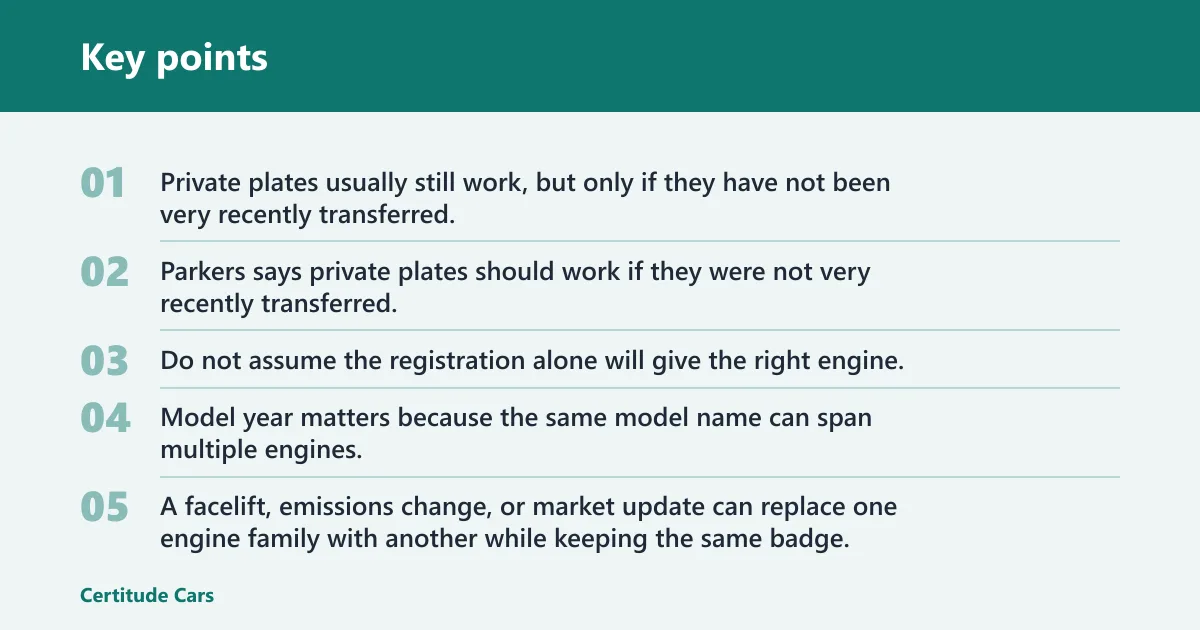
Private plates usually still work, but only if they have not been very recently transferred. The same source says private plates should work if they were not very recently transferred. A recent change can create a temporary mismatch between the plate and the vehicle record, which can point your lookup at the wrong car.
If the car has a cherished plate or a plate swap is recent, cross-check the VIN on the windscreen, the V5C logbook, or the under-bonnet label. Do not assume the registration alone will give the right engine.
Model year and trim changes
Model year matters because the same model name can span multiple engines. A facelift, emissions change, or market update can replace one engine family with another while keeping the same badge. That is why a reg lookup can be close, yet still miss the exact unit.
Engine family or code is the clearest separator. Codes such as N63, N62, and M73 identify variants that a simple make-model search can blur together. Autofiles records BMW 750 engines across 1999–2022 and shows engine families M73, N62 and N63, which is a good example of why the code matters.
When the result is only an approximate match
A result is only approximate when it gives the right model family but no engine code, or when the spec set looks generic rather than factory-locked. That is common with older cars, imported vehicles, and recently transferred plates. It can also happen when the site is relying on trim averages instead of build data.
Picture a 5 Series listed by registration as a 3.0-litre diesel, but the advert and logbook suggest a later high-output variant. The displacement may look right, while the power and engine code do not. In that case, the reg lookup is not enough for exact confirmation.
Can you use a VIN instead?

A 17-character VIN is often the better source when you need factory specifications rather than a plate-based lookup. Check-your-spec says a BMW VIN decoder can confirm the model year, production plant, and engine, and it also notes that the VIN is 17 characters long. That makes it a stronger check when the registration is missing, changed, or unclear.
What a 17-character VIN reveals
A VIN decoder can reveal the factory engine, model year, and other build details that a registration search may not show. It is especially useful when you need the engine code or when the car name covers several options. If the reg lookup is broad, the VIN is usually the route to the exact spec.
Use the VIN when you want the build record, not just the market-facing description. That is the cleanest way to confirm whether the car left the factory with the engine you expect.
When VIN is the better source
VIN is the better source when the plate has changed, the car is imported, the listing seems inconsistent, or the exact engine family matters for parts or insurance. It is also the safer choice when you are checking whether a claimed trim really matches the vehicle’s original specification.
Find the VIN. Look on the windscreen base, the V5C logbook, or the door shut label. The VIN should be 17 characters long, and that length helps you spot incomplete or mistyped records.
Decode the factory data. Use the VIN to confirm engine code, model year, and production details. That gives you a factory-level check rather than a plate-based summary.
Compare against the reg result. Match displacement, power, and fuel economy with the registration lookup. If the figures diverge, trust the document trail and the VIN before you trust the plate search.
What to do if results conflict
If the reg lookup conflicts with the logbook or VIN, stop treating the plate result as final. The safest order is VIN first, then V5C logbook, then the under-bonnet label. If two of those agree and the registration does not, the plate lookup is probably stale or attached to the wrong record.
Check the VIN first. Confirm the 17-character VIN from the car and decode it. That identifies the factory engine and model year.
Match the V5C. Compare the make, model, fuel type, and engine capacity on the logbook. If the logbook and VIN agree, give them priority over the reg search.
Inspect the under-bonnet label. Look for the engine code or emissions label on the car. This is useful when the visible spec data is vague or contradictory.
Pause on major mismatches. If power, displacement, or fuel type differ, do not buy parts or finalise the purchase until the discrepancy is explained. A small mismatch can be a database issue; a large one can signal a different engine.
Engine spec verification matrix
| Lookup method | Engine size | Engine code | Power | Torque | Best use case |
|---|---|---|---|---|---|
| Registration lookup | Usually shown; good for a first check | Sometimes missing or too broad | Usually shown as bhp or hp | Often shown, but may vary by year or trim | Quick comparison from a valid UK reg |
| VIN decoder | Factory spec, usually more exact | Best source for the fitted engine | Factory build data, if available | Factory build data, if available | Confirming exact spec before buying or ordering parts |
| Logbook | Usually listed on the V5C | Often not shown in full | May be absent or simplified | Usually absent | Document cross-check and ownership records |
| Under-bonnet label | May be shown or inferable | Often visible on a sticker or plate | Not always listed | Not always listed | Physical confirmation when records disagree |
What to do if results conflict checklist
- Check the 17-character VIN on the car and decode it.
- Compare the VIN result with the V5C logbook.
- Inspect the under-bonnet label for the engine code.
- Treat reg-only results as provisional if the plate was transferred recently.
- Use the factory engine code, not the model name, when the sources disagree.
Frequently asked questions
Can I check a car’s engine specs from the registration number?
Yes, a valid UK registration can often return engine specs, including size, power, torque, fuel economy, and dimensions. That said, it is not always exact enough for every case. Use the reg lookup as a first check, then confirm with the VIN or logbook if you need the factory engine code.
What engine size is on a number plate lookup?
A number plate lookup usually shows engine displacement in litres or cubic capacity. That is useful for comparing cars, but it can vary by trim, model year, and market. If the exact engine matters, confirm the code as well, because displacement alone does not always identify the variant.
Will a private plate still show the right car specs?
Usually, yes, if the private plate has not been very recently transferred. The same source says private plates should work if they were not very recently transferred. If the transfer is fresh, the lookup can point at stale data or the wrong vehicle record, so check the VIN before you rely on the result.
Can I check car specs by registration before buying?
Yes, and you should. A reg lookup is a good way to compare the advert with the likely factory spec, especially for power, fuel economy, and dimensions. For a purchase decision, though, confirm the engine through the VIN and the V5C if the car name could cover more than one engine.
What engine data can I get from a reg lookup?
You can usually get engine size, power, torque, fuel economy, and some dimensions. The same source says specs include engine data and performance figures, and that horsepower is shown as bhp on its specs pages. That still leaves room for error when the plate has changed recently or the database is outdated.
Can I use a VIN instead of a registration to find engine size?
Yes. A 17-character VIN can be decoded to confirm the factory engine and model year. That is the better route when the registration is missing, uncertain, or recently transferred. If your question is “can i look up engine size by vin number,” the answer is yes, and it is often the cleaner check.