Do You Pay a Deductible If the Accident Was Not Your Fault?
Usually, the at-fault driver’s insurer pays for the damage, but if you open the repair claim under your own collision coverage first, your deductible usually comes out before your insurer pays the balance. If the claim path is wrong, repairs can pause and you may be short hundreds or thousands until the claim is sorted out. This guide explains fault, deductibles, reimbursement, and the main claim scenarios.
Quick answer on deductibles
Usually, the driver who caused the crash or that driver’s insurer is responsible for the damage. But if you file the repair claim under your own collision coverage first, your policy’s deductible usually applies before your insurer pays the rest. The final cost can shift later if subrogation succeeds.
The short version is simple: fault and payment timing are different. The at-fault driver may end up owing the bill, yet you can still have to pay first if your own carrier handles the repairs before liability is settled. That is the point many claimants miss.
When you may still pay first
You may still owe a deductible up front when the other driver’s fault is disputed, when the other insurer has not accepted liability yet, when the other driver is uninsured, or when you choose to use your own collision coverage to get repairs moving. Reimbursement, if it happens, usually comes later.
Who pays first after a crash?
The insurer that pays first depends on which claim path you use. If the other driver’s insurer accepts fault, it can pay the repair shop directly or reimburse you. If you use your own insurer first, collision coverage usually pays after your deductible, and your insurer may later seek repayment from the at-fault side.
Filing with the other driver’s insurer
When the other driver is clearly at fault and insured, you can often file a third-party claim against that insurer. In that path, you usually do not pay a deductible for vehicle damage because their liability coverage is paying for your loss, not yours. The catch is timing, because fault acceptance is not always immediate.
Filing with your own insurer
If you open the claim under your own collision coverage, your insurer pays covered repair costs after subtracting the deductible in your policy. A common deductible range is about $250 to $2,000. This option often gets repairs started faster, but it can leave you out of pocket until recovery from the other driver is complete.
How collision, liability, and UMPD work
Collision coverage generally pays for crash damage to your vehicle regardless of fault, and it usually carries a deductible. Liability insurance generally pays for damage you cause to others, not for your own car. Uninsured motorist property damage, or UMPD, may help when the at-fault driver has no insurance, but state rules differ.
Collision coverage
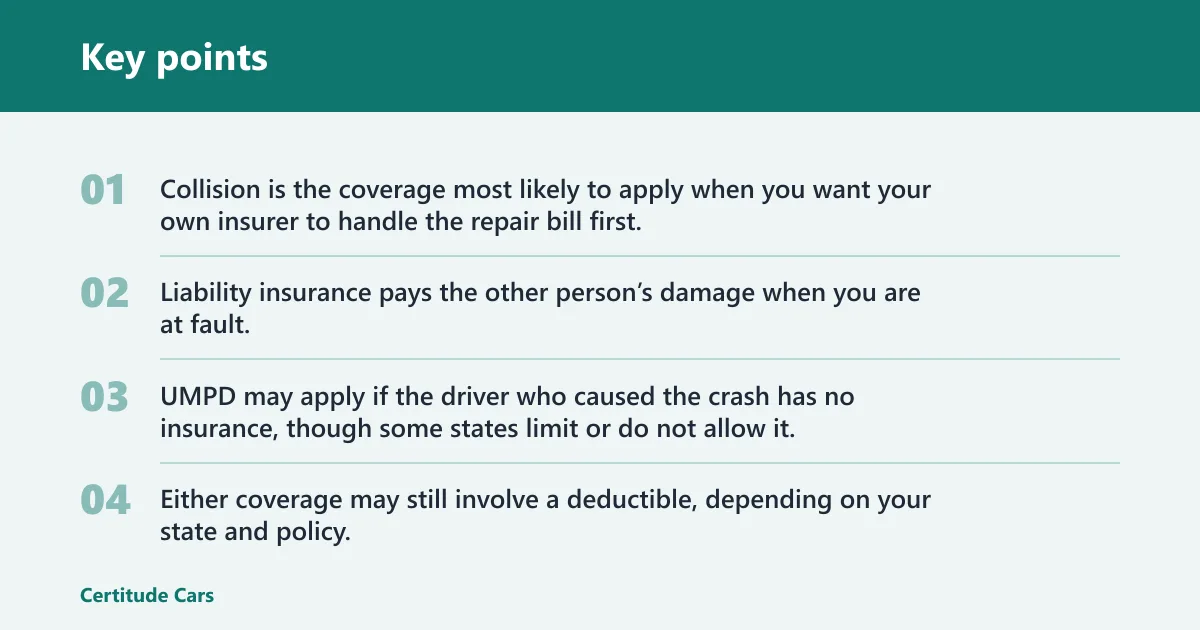
Collision is the coverage most likely to apply when you want your own insurer to handle the repair bill first. It is tied to your policy terms and usually includes a deductible. That deductible is the part you pay before the insurer covers the remaining approved repair cost.
Liability insurance
Liability insurance pays the other person’s damage when you are at fault. It does not pay to fix your own vehicle. If the other driver’s insurer is accepting fault, their liability coverage is usually the source of payment for your repairs.
Uninsured and underinsured motorist coverage
UMPD may apply if the driver who caused the crash has no insurance, though some states limit or do not allow it. Underinsured motorist coverage can matter when the other driver has insurance, but the limits are too low to cover the full loss. Either coverage may still involve a deductible, depending on your state and policy.
Pay deductible decision table

This table shows who usually pays first, whether a deductible is usually owed, and what documents help most. State law and policy language can change the outcome, so treat this as a claim-path guide, not a promise.
| Scenario | Who pays first | Deductible usually owed? | Reimbursement possible? | Main documents needed |
|---|---|---|---|---|
| Not-at-fault with known insurer | Other driver’s insurer, if it accepts liability | Usually no, if they pay directly | Not usually needed if they pay in full first | Photos, police report, other driver’s insurance info, repair estimate |
| Not-at-fault with uninsured driver | Your UMPD or collision coverage, depending on state and policy | Often yes, if collision is used; UMPD may also have one | Sometimes, if your insurer later recovers from another source | Photos, police report, plate or witness details, repair estimate |
| Disputed fault | Usually your own insurer first, or delayed until fault is decided | Often yes, if you use collision first | Possible after fault is resolved and recovery is made | Photos, statements, police report, dashcam or witness details |
| Shared fault | Each insurer may pay a share based on fault split | Often yes on your side if you use collision | Possible, but often partial if fault is shared | Photos, police report, statements, repair estimate, insurer notes |
| Hit-and-run | Your collision, UMPD, or uninsured motorist coverage, depending on policy and state | Often yes with collision; UMPD may also apply | Sometimes, if the driver is found later or another recovery source exists | Photos, police report, witness statements, location details, estimate |
| Using your own collision coverage first | Your insurer pays after the deductible | Yes, usually immediately | Yes, through subrogation if recovery succeeds | Photos, police report, insurer info, repair estimate, statements |
Can you get your deductible back?
Yes, sometimes. If your insurer recovers money from the at-fault driver or that driver’s insurer through subrogation, your deductible may be reimbursed. It is not automatic on every claim, and the amount can be partial if recovery is incomplete or fault is only partly assigned to the other driver.
Subrogation and recovery
Subrogation is the process where your insurer seeks repayment from the party that caused the loss. If that effort works, your insurer may refund your deductible after the recovery is finished. The timing varies, and the claim can stay open for weeks or months while liability is negotiated.
Partial recovery and shared fault
If fault is shared, deductible recovery may be reduced or denied in part. Suppose a repair bill is $4,200 and your collision deductible is $1,000. If fault is split roughly 70/30 and recovery is only partial, you may get back only part of that deductible, not the full amount.
Typical timing
Deductible reimbursement usually comes after the claim settles or after subrogation money arrives. That can take a few weeks on a clean claim, or much longer if fault is disputed, the other insurer delays, or the driver lacks coverage. There is no fixed deadline that applies to every policy.
What if fault is disputed or shared?
Disputed fault can delay payment and keep your deductible tied up. Shared fault can also change how much, if anything, gets reimbursed. In those claims, insurers may split responsibility after they review the police report, photos, driver statements, scene evidence, and any witness accounts.
Evidence that affects fault
Adjusters usually look for the best available proof of how the crash happened. A police report can help, but it is not always the final word. Photos of vehicle positions, damage patterns, traffic signals, skid marks, and nearby witnesses can matter when the insurer is deciding who pays.
How shared fault changes payment
If both drivers carry some blame, one insurer may pay only a percentage of the repair cost. That can leave you with part of the repair bill and sometimes part of the deductible too. A common first-timer mistake is assuming any not-at-fault finding guarantees full reimbursement. It does not.
How to file and protect your claim
Start with the insurer that matches the fastest and most realistic payment path. If the other driver is clearly insured and fault is accepted, their insurer may be enough. If fault is unclear, the other driver is uninsured, or you need repairs started now, your own collision coverage may be the practical first move.
-
Gather the crash record.
Take photos of all damage, the scene, license plates, and road markings. Get the police report number, the other driver’s insurer information, and any witness names before details are lost. -
Ask which coverage applies.
Tell each insurer whether the claim is going through liability, collision, UMPD, or underinsured motorist coverage. This matters because the deductible, if any, can change with the coverage used. -
Request a written estimate.
Get a repair estimate and keep it with the claim file. If the shop finds hidden damage later, that supplement can change the total and the final deductible math. -
Confirm reimbursement rules.
Ask whether subrogation is possible, whether deductible recovery can be partial, and whether the insurer needs anything from you to pursue recovery. Get the claim number and note the adjuster’s name. -
Check rental and tow coverage.
Rental reimbursement and towing are separate from repair coverage on many policies. Some policies cover those costs, some cap them, and some require a different deductible or no deductible at all. Read that part before you book a rental or authorize a tow.
Say your parked sedan is hit in a grocery lot and the other driver leaves a note with insurance details. If their insurer accepts fault, their liability coverage should pay for the bumper repair, and you may avoid a deductible entirely. If they deny fault, your own collision claim can get the repair moving, but your deductible may come first.
Suppose a minivan is sideswiped by an uninsured driver at an intersection, and the owner carries collision with a $500 deductible plus UMPD. The insurer may use UMPD if state law allows it, or collision if that path is cleaner. Either way, the deductible question depends on the policy terms, not only on who caused the crash.
Frequently asked questions
Do you pay a deductible if the accident was not your fault?
Often no, if the other driver’s insurer accepts fault and pays for the damage directly. But if you use your own collision coverage first, you usually pay your deductible up front and wait for possible reimbursement later through subrogation. The insurer path matters as much as fault.
Who pays the deductible if the other driver caused the crash?
Usually, the at-fault driver’s insurer should end up paying the repair bill. In practice, your own deductible can still appear first if your insurer handles the claim under collision coverage. If recovery succeeds, your insurer may return some or all of that deductible later.
Can I get my deductible back after a not-at-fault accident?
Yes, sometimes. Deductible reimbursement usually depends on subrogation, the strength of the fault evidence, and whether the at-fault driver or insurer actually pays. Recovery can be full, partial, or denied, so it is best to ask the adjuster how your claim is being handled.
Do I have to pay my collision deductible if the other driver is uninsured?
Often yes, if you use collision coverage to repair your vehicle. UMPD may help in some states, but it can still carry a deductible or other limits. The answer depends on your policy language and whether your state allows uninsured motorist property damage coverage for this loss.
What if the insurance companies are still deciding who was at fault?
Your claim may stall until fault is assigned, or you may choose to use your own collision coverage first to start repairs. In that case, your deductible usually applies right away. If the other side is later found at fault, recovery may be possible through subrogation.
Do I pay a deductible for rental car or tow coverage after an accident?
Sometimes, but not always. Rental reimbursement and towing are separate coverages from collision repair, and each policy sets its own rules. Some policies have no deductible for those benefits, while others cap the amount or require you to satisfy the same deductible as the repair claim.