Repair Costs: What Car Fixes Really Cost
Most car repair quotes split into parts, labour, shop supplies, and tax; for non-safety repairs, think hard before approving work that exceeds 50% of the car’s private-sale value. Approve blindly and you can overpay by hundreds, or leave a fault long enough for it to damage related parts and push the bill higher. This guide breaks down what you’re paying for, normal price bands for common jobs, and how to judge the quote against vehicle value and urgency.
What are you really paying for in a repair quote?
A repair quote is a scope document, not a parts list. The final bill usually combines parts, booked labour time, diagnostic time, VAT, and some form of margin or shop-supplies charge, with the total shaped by part grade, access difficulty, and the warranty attached to the work.
Parts, labour, diagnostics, VAT and markup
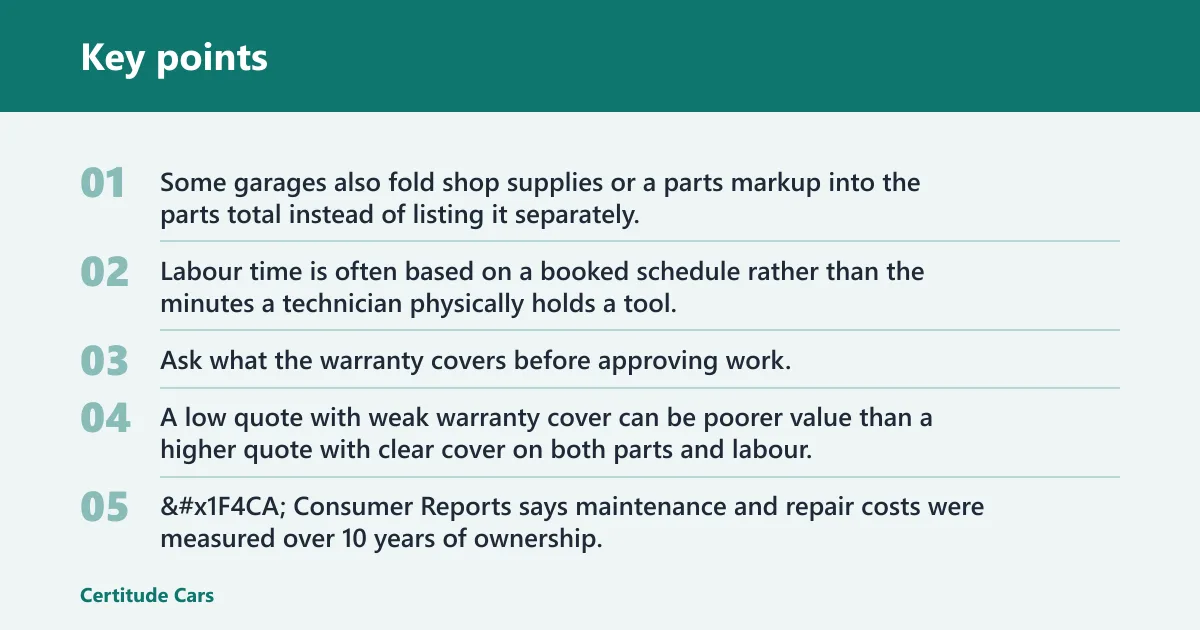
Start with the line items. A proper estimate should show the part or parts being fitted, the labour hours charged, any diagnostic fee already spent tracing the fault, and VAT. Some garages also fold shop supplies or a parts markup into the parts total instead of listing it separately.
That markup is not automatically padding. It can cover sourcing, handling, warranty administration, and the risk tied to supplying a part that later fails. The problem is poor detail: if the invoice only says “repair carried out”, you cannot compare it properly with another quote.
Booked hours are not the same as clock time
Labour time is often based on a booked schedule rather than the minutes a technician physically holds a tool. That matters because access drives cost. A battery on top of the engine bay is quick; the same battery buried under trim, with coding required after fitting, is a different job.
Vehicle packaging changes the bill. Tight engine bays, undertrays, corroded fasteners, and subframe removal can all turn a straightforward repair into a longer booked job.
Warranty on parts and labour
Ask what the warranty covers before approving work. Some quotes cover the supplied part only, so if that part fails the garage may replace the part but still charge labour to strip the car again. Better quotes also cover labour to replace a failed supplied part within the warranty period, which matters most on jobs where access is expensive.
A low quote with weak warranty cover can be poorer value than a higher quote with clear cover on both parts and labour.
Why dealer, specialist and independent prices differ
Dealer quotes often use genuine parts, manufacturer labour schedules, and brand-specific diagnostic systems, which can lift both parts and hourly rates. Specialists may know the usual failure pattern on a given engine or gearbox and quote a narrower, more accurate scope, while independents can charge less per hour and offer more flexibility on parts source, but the quote still needs the same detail on labour, parts grade, diagnosis, and warranty.
📊 Consumer Reports says maintenance and repair costs were measured over 10 years of ownership. Source: Consumerreports.
Why can the same symptom produce very different repair bills?

The same symptom can come from several faults, and each one has its own repair path, labour time, and parts bill. A brake squeal might mean worn pads, corroded pad slides, a sticking caliper, scored rotors, or suspension movement transmitting noise, so one garage may quote diagnosis first while another quotes the most likely part replacement, which is why totals can split quickly.
Fault tracing versus part swapping
A rattle at the front does not automatically mean brakes. It could be worn pads, scored rotors, a sticking caliper, suspension play, or even a loose undertray. A quote that includes diagnosis first may look expensive next to a parts-swap estimate, yet still be the safer choice.
Gearbox symptoms are a classic example. Harsh shifting can come from low fluid, a solenoid issue, internal wear, software adaptation, or a clutch-related fault on some transmissions. That is why diagnosis should come before a repair-or-replace decision.
Hidden damage, seized fixings and access time
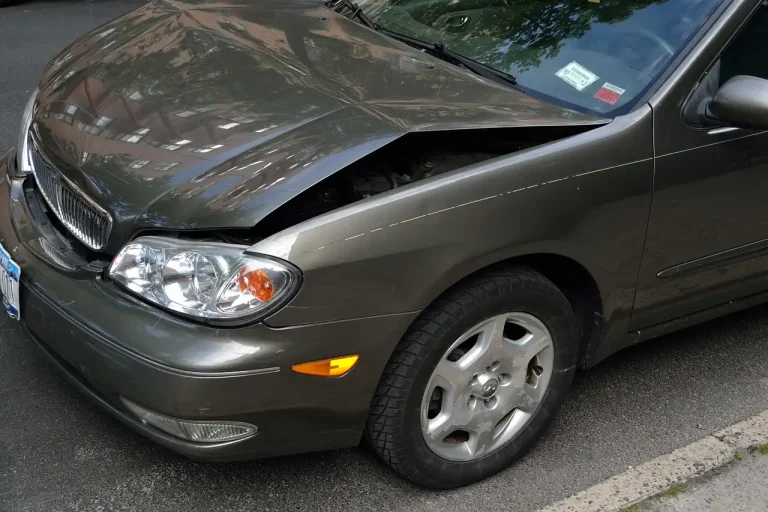
Initial estimates are built on visible information. Once dismantling starts, hidden damage can appear. Body repair is especially sensitive to this. A bumper scuff may stay cosmetic, or it may reveal cracked mounts, distorted brackets, and paint blending into the next panel.
Seized fixings matter too. On older cars, rusted exhaust bolts, suspension hardware, or brake carrier bolts can add time and extra parts.
Repair path versus replacement path
One component can offer more than one valid path. A brake caliper may be serviceable with sliders and seals, or it may need full replacement. A body panel may be repairable with paintless dent removal, or it may need filler, paint, and blending. The quote needs to say which path it prices.
Picture a rear door with a shallow crease about the width of a hand, no paint break, and no edge damage. One body shop may quote dent removal only; another may quote panel repair and respray. Both can be reasonable, but they are not pricing the same outcome.
Repair quote decision table
| Brake repair option | Parts | Labour | Diagnostics | VAT | Total | Compare to £4,000 private-sale value | Decision flag |
|---|---|---|---|---|---|---|---|
| Front pads only after confirmed wear | £95 | £90 | £0 | £37 | £222 | 5.6% | Repair |
| Front pads and rotors with inspection report | £210 | £135 | £45 | £78 | £468 | 11.7% | Repair |
| Front pads, rotors and one caliper | £355 | £180 | £45 | £116 | £696 | 17.4% | Inspect |
| Front and rear brakes plus one seized caliper | £540 | £270 | £45 | £171 | £1,026 | 25.7% | Inspect |
How to read the table
The symptom is the same broad category: braking work. The repair scope is not. Parts rise because the fault severity rises. Labour rises because more components are replaced. Diagnostics appears only where confirmation is billed separately. VAT applies to the subtotal, so the visible part price never tells the full story.
The compare-to-value column is a decision aid, not an automatic yes-or-no rule. A £696 brake bill on a £4,000 car may still be sensible because brakes are a wear-and-safety item. A £1,026 estimate should trigger a closer look at the rest of the car, recent major work, and what maintenance is likely next.
How much should your car repair cost?
Your repair should cost what the correctly scoped job usually costs for that vehicle class, fault severity, and parts grade in your area. Use price bands and included items, not a single average, because labour rates, booked hours, and missing scope can move a quote far more than the headline part price.
Use averages as benchmarks, not verdicts
Benchmarks help when they are specific. FixMyCar lists brake repairs at an average price of £440.93. It lists car battery replacement at an average price of £137. It lists car body repair at an average price of £453.41, dent removal at an average cost of £436.59, gearbox repair at an average cost of £381.75, and timing chain repair at an average price of £702.16.
Those figures help place a quote on the map. They do not prove your quote is right or wrong. A brake estimate below the benchmark may cover pads only, while a higher one may include rotors, diagnosis, and a caliper.
Regional labour rates and vehicle class
Labour rates differ by region and by workshop type. City dealer labour will usually sit above rural independent labour. Vehicle class matters too. Larger wheels, electronic parking brakes, underbody covers, and denser packaging all add time even when the job name stays the same.
Part grade changes the number
Quotes should state whether parts are genuine, OEM-equivalent, or budget aftermarket. That choice affects price, warranty, and sometimes noise, fit, or service life. A low quote can be fair. It can also hide a lower-grade part or a thinner scope.
When the cheap quote is missing scope
Say your front brakes squeal at low speed and pulse under light braking. Quote A lists pads only. Quote B lists pads, rotors, fitting kit, and a brake inspection. The second quote may look inflated against the first, but the symptom points to more than pad wear alone.
How do you judge a repair against your car’s value?
Judge a repair by comparing the fully taxed total with the car’s current private-sale and trade-in value, then add future maintenance risk. A common rule of thumb is to pause on non-safety work around 50% of private-sale value, but recent major work and low annual mileage can justify exceptions.
Find current market value first
Use two anchors: what similar cars actually advertise for in private-sale condition, and what trade-in offers look like for your mileage and trim. Private-sale value is usually the better comparison for a keep-or-repair decision, because replacing the car normally costs more than trade-in value alone suggests.
Calculate the repair-to-value percentage
Use a simple calculation: repair total divided by realistic private-sale value, then multiply by 100. If the job is about £1,200 and the car would likely sell privately for about £3,000, the repair-to-value percentage is about 40%.
FreeHome Service Center cites a commonly used 50% rule for repair decisions. It also says a car may not be worth repairing when repair costs approach or exceed market value.
Use the 50% rule with exceptions
The rule is a filter, not a law. It is stronger for cosmetic or convenience repairs than for safety items you must fix to keep driving legally. It is also weaker if the car has had recent tyres, brakes, or suspension work, or if annual mileage is low enough that the repair could buy several cheap years of use.
Add future maintenance risk
Big repairs on older or high-mileage cars deserve a second question: what is likely next? A timing chain estimate on an engine with known oil consumption, weak turbo hardware, or cooling-system age risk is different from the same estimate on a car that is otherwise sound.
Suppose a car worth about £2,500 needs a £900 gearbox job and also has ageing tyres and an MOT advisories list for rear suspension corrosion. The gearbox figure alone may look survivable. The total ownership risk does not.
What do common car fixes usually cost?
Common fixes are easiest to judge when the quote states the repair path clearly. Wear items like brakes and batteries often sit in lower or mid-range bands, while gearbox and timing chain work can climb fast because diagnosis, access, and downstream damage risk all land in the same bill.
Brake repair
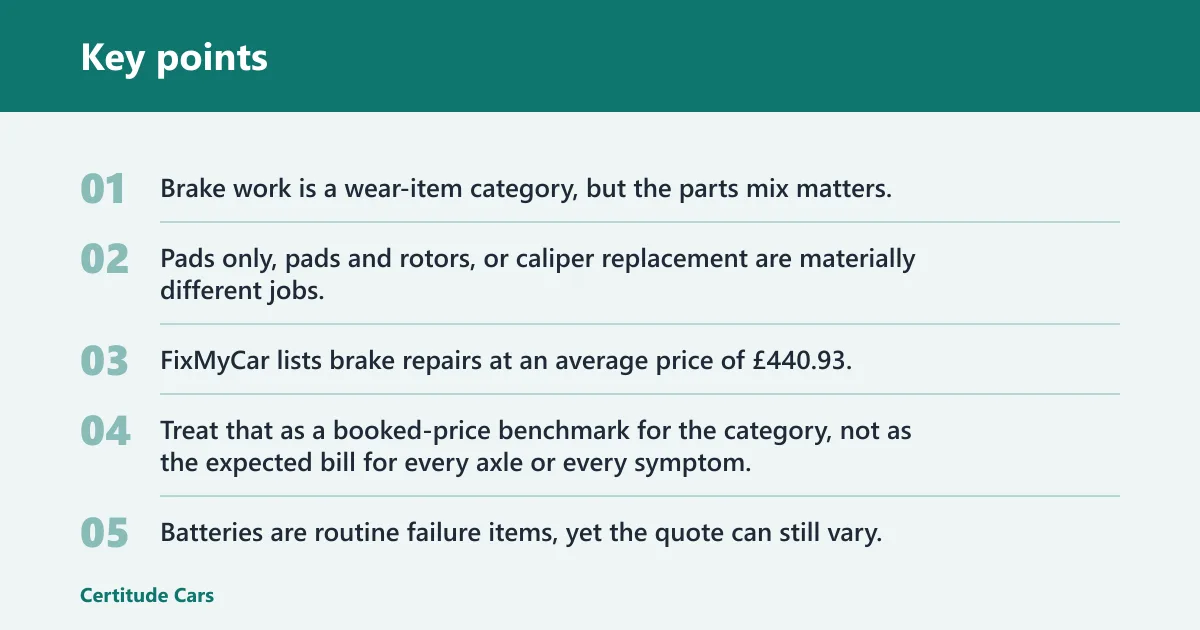
Brake work is a wear-item category, but the parts mix matters. Pads only, pads and rotors, or caliper replacement are materially different jobs. A quote may also include diagnosis if the symptom was noise, pulling, pulsation, or a warning light rather than a simple service recommendation.
The same source lists brake repairs at an average price of £440.93. Treat that as a booked-price benchmark for the category, not as the expected bill for every axle or every symptom.
Battery replacement
Batteries are routine failure items, yet the quote can still vary. A proper battery job may include a health test, charging-system check, disposal charge for the old battery, and coding or registration on vehicles that monitor battery state.
The same source lists car battery replacement at an average price of £137. If the quote is much higher, check whether it includes a larger battery type, battery management coding, or awkward installation access.
Body repair
Body quotes split sharply by repair path: dent removal, scratch or scuff correction, panel repair, panel replacement, and paint respraying. Paint blending into adjacent panels can lift the total because colour match and finish quality matter more than the dent size alone.
The same source lists car body repair at an average price of £453.41 and dent removal at an average cost of £436.59. It also lists car windscreen repair at an average price of £272.60, which is a useful reminder that “body” damage is not one job family.
Gearbox and timing chain jobs
These are diagnosis-first categories. The same source lists gearbox repair at an average cost of £381.75, but that category can range from a targeted external repair to a far larger internal job. The exact fault matters more here than the label on the estimate.
Timing chain work is engine-critical. The same source lists timing chain repair at an average price of £702.16. Before approving it, make sure the quote states whether it covers chain-only work, guides, tensioners, seals, and any extra parts found once the engine is opened.
For comparison with another major driveline job, FixMyCar lists clutch replacement at an average price of £454 and cambelt change at an average price of £426.76. Those figures help frame where a chain job sits: usually above regular belt service because access and risk are often worse.
When is repair better than replacement?
Repair is usually the better decision when the fault is isolated, the car’s remaining value and condition are sound, and the job reduces risk rather than postponing it. Replacement becomes stronger when the fault signals wider failure, pushes costs near market value, or lands on a car with several expensive needs queued up.
Wear items usually favour repair
Brakes, batteries, and some suspension items are predictable ownership costs. They do not usually justify replacing the car by themselves unless the total condition picture is already poor.
Engine and gearbox faults need wider context
Timing chain and gearbox quotes deserve caution because the fault can be a symptom of broader wear. Ask whether the estimate is for a contained repair, a rebuild path, or a replacement path. Those are different bets.
Cosmetic versus structural body damage
Cosmetic damage can often be deferred if rust risk is low and visibility or safety is unaffected. Structural damage, poor panel fit after an impact, or damage near safety systems is a different category and needs proper assessment.
When partial repair makes sense
Partial repair works when the garage can define the boundary honestly. A single caliper on one corner may be reasonable if the opposite side is healthy and the quote states the condition found. It is weaker when the untreated side is near end-of-life and likely to trigger another labour bill soon.
How do brand, age and ownership stage change repair costs?
Brand, age, and ownership stage affect repair cost because they shape parts pricing, labour time, and the chance that one fault uncovers others. Mainstream models with broad parts supply usually cost less to keep going than premium models with tighter packaging, pricier parts, and more age-sensitive systems.
Long-term brand maintenance cost
Consumer Reports says maintenance and repair costs were measured over 10 years of ownership. It ranks Buick and Lincoln as the lowest-cost brands to maintain and repair, and says European brands are among the most expensive to maintain and repair.
The useful lesson is not brand tribalism. It is cost structure. Premium and European models often bring higher parts prices, longer labour access times, and more model-specific electronics.
Parts availability and age-related cost increase
Older cars can cost more in two opposite ways. Some mainstream parts get very cheap. Others become harder to source, pushing buyers toward dealer stock, used parts, or specialist rebuilds. Once availability tightens, downtime and diagnostic uncertainty rise with the price.
Ownership stage matters
During warranty years, many major failures shift away from the owner, though wear items still do not. In early post-warranty years, cars often need their first meaningful brake, battery, tyre, and suspension spending. In high-mileage age bands, one repair can expose the next because seals, bushes, sensors, and fixings all age together.
How should you compare repair quotes from different garages?
You should compare quotes line by line for scope, part grade, labour hours, diagnostics, VAT, and warranty terms. A lower total only means savings if the garages are pricing the same repair path; otherwise, you are comparing different jobs and the cheaper estimate may simply omit work you still need.
Use a like-for-like comparison method
- Match the fault description. Make sure every garage is quoting from the same symptom or confirmed diagnosis. “Front brake noise” and “replace front pads and rotors” are not the same scope, and neither is a gearbox “inspection” versus a gearbox “repair.”
- Check included parts. Compare the exact components listed: pads only, pads and rotors, one caliper, fitting kit, fluid, seals, coding, paint materials, or blending. If one quote names brands or part grade and another does not, ask before deciding.
- Compare labour hours. Ask how many booked hours the quote allows and whether dismantling discoveries could add time. This is where access difficulty, corrosion, or hidden body damage often changes the final figure.
- Confirm diagnostics status. Find out whether diagnosis is included, already paid, or still to be added. On timing chain, gearbox, electrical, and intermittent-fault work, this line can be the difference between a sound estimate and blind parts replacement.
- Verify VAT and extras. Check whether VAT is included and whether shop supplies, disposal charges, programming, wheel alignment, or paint blending sit outside the headline price. This is where online parts-price comparisons usually break down.
- Read the warranty terms. Compare parts warranty, labour warranty, and any conditions attached. If one garage warrants both supplied parts and installation while another warrants only the part, the totals are not equal in value.
Questions worth asking before approval
- Is the quote for repair, replacement, or diagnosis only?
- Which parts are genuine, OEM-equivalent, or aftermarket?
- What work is included if dismantling reveals related damage?
- Is the car safe to drive if the job is delayed?
- Will this repair likely prevent larger damage, or only postpone a wider issue?
Frequently asked questions
How much does a car repair cost?
There is no single useful number. The real cost is the total of parts, labour, diagnostics, VAT, and any included markup or shop supplies, judged against the exact fault and your car’s value. Use category benchmarks to sense-check the quote, then compare scope and warranty before approving.
How much to repair a car
Start with the repair path, not the symptom alone. A battery replacement can sit near FixMyCar’s average price of £137, while timing chain work averages £702.16 on the same source. The gap exists because access, diagnosis, parts count, and failure risk are completely different.
How much to fix my car
To judge your own quote, calculate the repair-to-value percentage using a realistic private-sale figure for the car today. Then ask whether the work is safety-related, whether the diagnosis is confirmed, and what future maintenance risk sits behind it. That method is stronger than chasing the cheapest headline price.
How much is the average car repair?
Average figures can help, but only by category. Those are category benchmarks, not promises, because each total moves with labour rate, fault severity, and what the quote actually includes.
Why are car repairs so expensive?
Repairs feel expensive because the invoice includes far more than the visible part. You are also paying for diagnosis, booked labour time, workshop overhead, VAT, and the warranty risk carried by the garage. Costs rise again when access is poor, parts are model-specific, or one symptom can come from several different faults.
How much should my car repair cost?
Your car repair should cost a fair market rate for the confirmed fault, part grade, and labour time on that model in your area. If a non-safety repair approaches 50% of private-sale value, stop and reassess. If the quote is very low, check whether it is missing diagnosis, VAT, or related parts.