What Is a Title Transfer for a Car?
A title transfer for a car is the legal process that moves ownership from seller to buyer by updating the vehicle title and required records, and it only works if the current owner can legally sign. If any link is missing, you can face registration delays, rejected paperwork, fines, or a car you cannot prove you own. This guide explains who can sign, what blocks a transfer, and the documents that complete the chain.
How ownership and registration differ
A title transfer is the official passing of vehicle ownership from one legal entity to another. The certificate of title is the core proof document, because it identifies the vehicle and names the owner; possession of the car alone does not move legal ownership. The DMV or vehicle registry then updates the state record so the new owner can register the car.
Ownership, possession, and registration
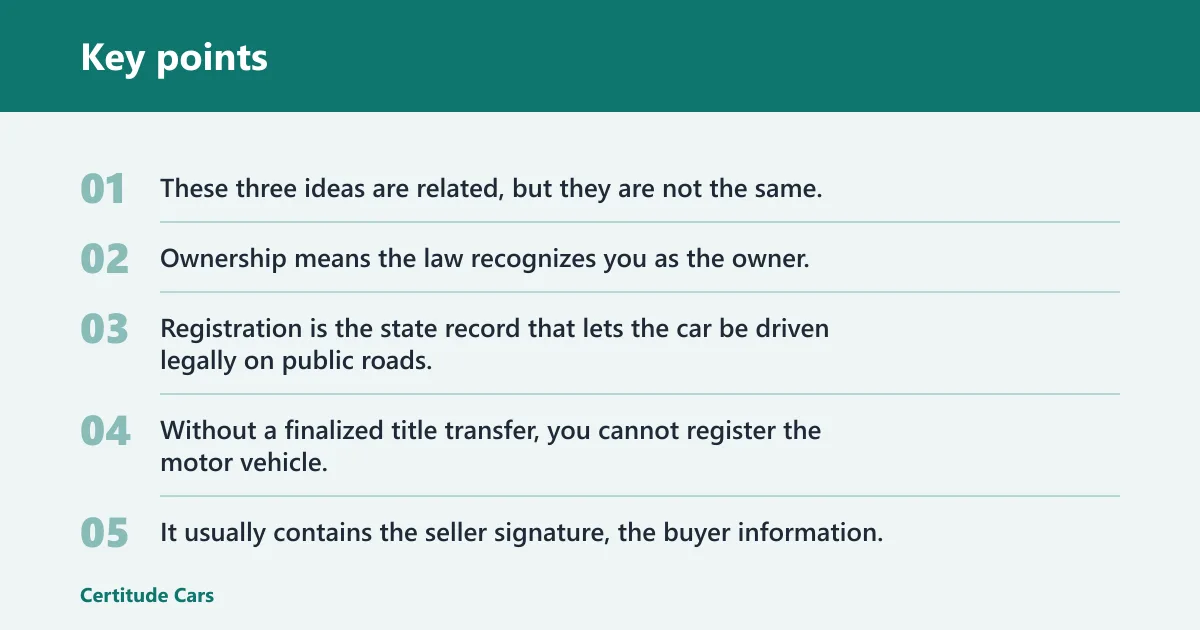
These three ideas are related, but they are not the same. Possession means you have the car. Ownership means the law recognizes you as the owner. Registration is the state record that lets the car be driven legally on public roads. Without a finalized title transfer, you cannot register the motor vehicle.
Why the certificate of title matters
The title is the legal chain of proof. It usually contains the seller signature, the buyer information, and vehicle details such as the VIN. If the title is missing, unsigned, altered, or does not match the car, the chain breaks and the DMV may refuse the transfer.
When a transfer is required
Title transfer is required after a sale, and some states also require it after a gift, donation, or inheritance. Utah title transfers can be required after a private sale, inheritance, or donation. In many states, the buyer also needs the transfer completed before registration can move forward.
📊 Connecticut’s transfer page includes a $24 fee for the Passports to the Parks program. Source: CT.
How a car title transfer works
Title transfer starts by checking the title against the vehicle, then collecting the signatures and supporting documents, then submitting everything to the DMV or vehicle registry. Some agencies may require in-person submission. After review, the state issues an updated title, and often a registration record as well.
Check the title and VIN
Start with the title itself. Confirm the VIN on the title matches the vehicle’s 17-character VIN, since that number links the paperwork to the specific car. A mismatch can stop the transfer even if every signature is present, since the agency cannot prove the documents describe the same vehicle. (Wikipedia)
Collect signatures and supporting documents
The seller signs where the title instructs, and the buyer may need to sign transfer forms. Typical transfer paperwork can include a completed title application. A bill of sale may need the buyer and seller names, vehicle description, and purchase price. An odometer statement may be required in some transfer cases.
Submit paperwork to the DMV or vehicle registry
The DMV or vehicle registry checks the chain of proof. That means it looks for a valid title, the right signatures, and any supporting forms. Some states require proof of car insurance and an identification document for transfer. Other states also want the transaction completed in person, especially if the title has an issue.
Wait for the updated title and registration
Once the agency approves the file, it issues the updated title and, if eligible, the registration record. If anything is missing, the DMV may reject the packet, ask for extra forms, or hold the file until the defect is fixed. That is why a clean first submission matters.
What documents do you need for a car title transfer?
You usually need the title, identification, and supporting proof that ties the sale to the correct vehicle. The exact list varies by state, but the core job of each document is the same: prove who owned the car, who bought it, what vehicle changed hands, and whether any lender still has a claim.
Certificate of title
The title proves legal ownership and shows the seller’s authority to pass it on. It also carries the vehicle information the DMV uses to verify the car. If the title is signed by the wrong person or the name does not match the record, the transfer can stall.
Bill of sale and ID
A bill of sale records the buyer and seller names, the vehicle description, and the purchase price. It supports the title by showing the transaction that caused the ownership change. An identification document helps the DMV confirm that the person signing is the person named on the paperwork.
Lien release, odometer statement, and proof of insurance
A lien release is needed if the vehicle was financed, because it confirms the lender’s interest is cleared. An odometer statement records mileage at transfer and helps prevent disclosure errors. Proof of insurance may be required in some states before transfer or registration, and a DMV counter may check it at the counter.
Inspection and state-specific forms
Some states require emissions or safety inspection before registration, which can delay completion of the transfer. Others require a state title application or a separate transfer form. Utah’s DMV guidance says car title transfer cannot be completed online, so the final step may still require an office visit.
Title transfer checklist
The right path depends on how the vehicle changed hands. This checklist shows the most common transfer types, what each one needs, who must sign, and what usually blocks approval. Use it as a problem-solver, not as a universal rule, because state rules differ by state office and transaction type.
| Which title transfer path applies? | Required core documents | Who must sign | Can registration happen the same day? | Most common failure point | Likely DMV follow-up |
|---|---|---|---|---|---|
| Private sale | Certificate of title, bill of sale, ID, odometer statement if required, proof of insurance if required | Seller and buyer; co-owner rules may apply | Sometimes, if the title is clean and state rules allow it | Missing signature, lien not released, VIN mismatch | Reject packet or ask for corrected title and extra forms |
| Dealer sale | Dealer paperwork, title application, proof of insurance in some states, ID | Dealer representative and buyer, as required by state process | Sometimes, but not guaranteed | Missing dealer submission or insurance proof | Issue temporary paperwork and process title later |
| Gift | Certificate of title, gift statement or transfer form, ID, odometer statement if required | Donor and recipient, plus any co-owner who must sign | Sometimes | Gift form not completed or title not signed correctly | Request state gift paperwork or tax-related forms |
| Inheritance | Certificate of title, death certificate, probate or executor paperwork if required, estate transfer form | Executor, personal representative, or heir as state law allows | Usually no | Estate authority not proven | Schedule an appointment or require probate documents |
| Donation | Certificate of title, donation receipt or transfer form, ID, odometer statement if required | Owner and donee, plus any co-owner who must sign | Sometimes | Missing transfer form or lien release | Ask for supporting charity or transfer paperwork |
| Lost title | Duplicate title application, ID, bill of sale if available, lien release if applicable | Current legal owner | Usually no until the duplicate title is issued | No proof of ownership at the counter | Require a duplicate title before transfer |
| Absent seller | Title, power of attorney if allowed, court or DMV alternative ownership documents, ID | Depends on state rules and available authority documents | Rarely | No valid seller signature or authority document | Reject the transfer or direct the buyer to a special process |
Private sale
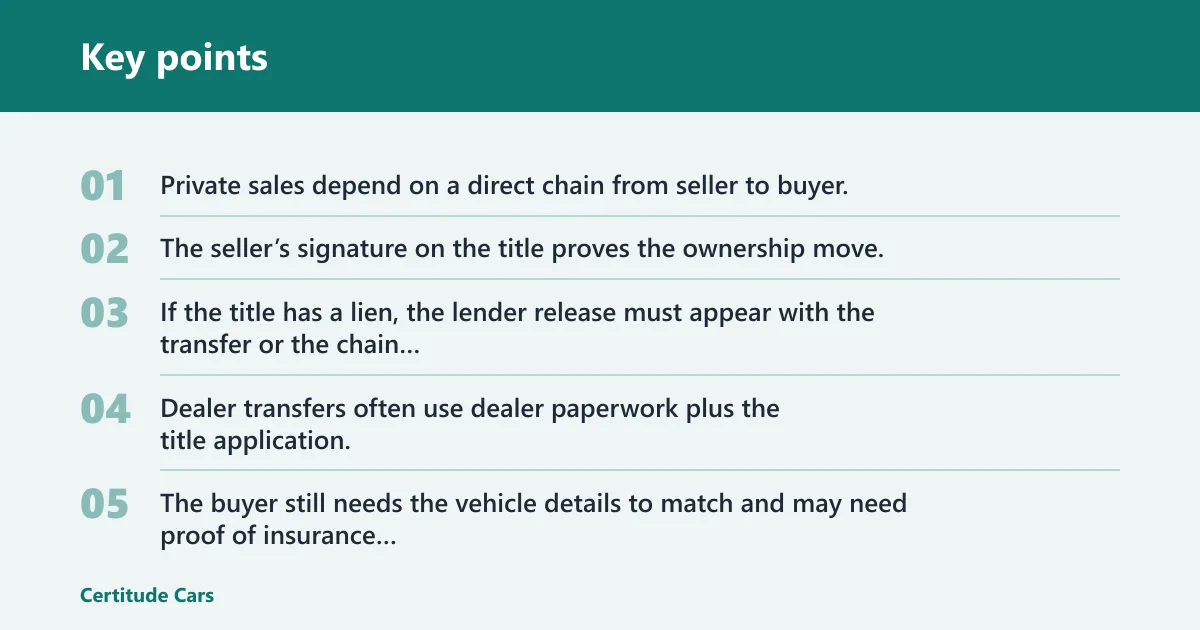
Private sales depend on a direct chain from seller to buyer. The seller’s signature on the title proves the ownership move, and the bill of sale supports the transaction details. If the title has a lien, the lender release must appear with the transfer or the chain is incomplete.
Dealer sale
Dealer transfers often use dealer paperwork plus the title application. The buyer still needs the vehicle details to match and may need proof of insurance before registration. Some dealers file documents for you, but that does not mean every state treats the title and registration as one same-day step.
Gift or donation
A gift still changes ownership, so the DMV needs a record of that change. A donor may need to sign transfer papers and state gift forms, and the recipient may still need tax or title application forms. The absence of a sale price does not remove the need for proof.
Inheritance
Inheritance transfer uses estate paperwork rather than a normal sale chain. It may require a death certificate, and in some cases probate or executor paperwork. Connecticut’s transfer guidance includes immediate family member transfers from a deceased owner, and Connecticut requires an appointment at a DMV hub or branch office for some estate transfers.
Say your father’s name is the only name on the title, but the estate has not issued executor papers yet. The car may still sit in the driveway, but the DMV may not accept the transfer until the estate documents show who can sign for the vehicle.
Lost title
If the title is lost, the chain is broken until a duplicate title is issued. The state needs a current ownership record before it can change the record. A buyer should not rely on a handwritten promise alone, because the DMV needs a document it can verify.
Absent seller
You usually cannot assume a transfer can happen without the seller present. If the title still needs a signature, the buyer may need a power of attorney or another state-approved substitute. If no valid authority document exists, the DMV may reject the file.
Why signatures and title wording matter
The wording on the title tells you who has authority to sign. A co-owner line with “and” may mean both owners need to sign. A line with “or” may allow one owner to sign, if the state accepts that format. A missing or wrong signature breaks the legal chain of proof.
How “and” changes the signing rule
When a title says two owners hold the car as “and” owners, both may need to sign the transfer. That wording shows shared control over the vehicle. If only one person signs when both are required, the DMV may stop the transfer until the missing signature is added.
How “or” changes the signing rule
When a title says “or,” one owner may be able to sign for the transfer. That is a major difference, because the second signature may not be required. Still, the DMV will follow state rules, so you should check the exact title wording before you rely on one signature alone.
What happens if a signature is missing
A missing signature is not a small clerical issue. It means the agency cannot prove the right person authorized the ownership change. The likely result is a rejected packet, a request for a corrected title, or a requirement to return with the missing signer or substitute paperwork.
Can title transfer and registration happen together?
Sometimes they can, but they are not the same process and they are not always approved on the same day. Registration depends on a completed transfer first. In some states, proof of insurance, inspections, or office rules can force the two steps apart even when the title is clean.
When same-day registration is possible
Same-day registration is most likely when the title is complete, the VIN matches, the signatures are valid, and the state allows counter processing. Some offices can issue temporary paperwork while they review the transfer. That does not guarantee a permanent registration on the spot.
Why insurance or inspection can block it
Some states require proof of insurance before registration, and some require emissions or safety inspection as a condition for registration. If either item is missing, the title may transfer but the registration may wait. That split matters because the buyer may own the car without being able to plate it yet.
Why some states split the steps
States split title transfer and registration because they solve different legal problems. The title answers who owns the car. Registration answers whether the car may be used on public roads. Utah’s DMV guidance says car title transfer cannot be completed online, which shows how state process rules can affect timing.
What can block the transfer?
Most transfer failures come from a break in the chain of proof. The DMV needs the right owner, the right vehicle, the right signatures, and the right supporting documents. If one link is missing, the agency may refuse the update, hold the file, or send you back for more paperwork.
Missing lien release
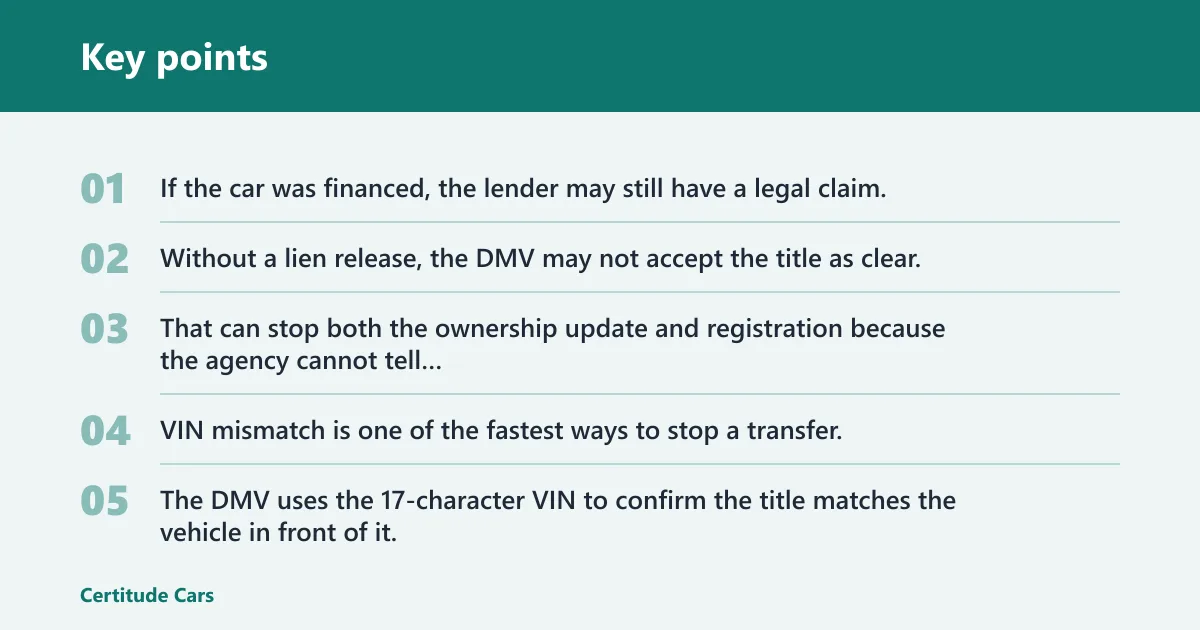
If the car was financed, the lender may still have a legal claim. Without a lien release, the DMV may not accept the title as clear. That can stop both the ownership update and registration because the agency cannot tell whether the lender’s interest has been cleared.
Title or VIN mismatch
VIN mismatch is one of the fastest ways to stop a transfer. The DMV uses the 17-character VIN to confirm the title matches the vehicle in front of it. If the VIN on the car, the title, and the application do not agree, the record is unreliable.
Picture a compact sedan with a title that lists one digit differently from the dashboard VIN plate. Even if the buyer and seller both signed, the office may pause the file until the mismatch is explained and corrected.
Lost title or absent seller
A lost title means the state cannot see the current proof of ownership. An absent seller means the chain may be missing the signature that authorizes the transfer. Both cases often need extra steps before the DMV can approve anything.
Odometer or inspection problems
An odometer statement must be accurate when required, because mileage errors can create disclosure problems. Inspection issues can also hold the file if the state needs emissions or safety approval before registration. These are common reasons a transfer stalls after the sale is already complete.
What happens if the transfer is delayed?
Delay hurts both sides. The buyer may be stuck without registration, plates, or proof of ownership. The seller may still face liability exposure if the DMV record has not been updated and the vehicle is later ticketed, towed, or involved in an incident.
Buyer registration delays
If the transfer is not finalized, registration cannot move forward. That can mean no plates, no renewal, or no ability to complete the next DMV step. The buyer may also need temporary paperwork while the state reviews the file.
Seller liability exposure
For the seller, delay is more than inconvenience. If the transfer is not recorded, the state may still connect the car to the prior owner. That can create notices, fines, or other follow-up tied to a vehicle that has already been sold.
Next steps after a DMV rejection
If the DMV rejects the packet, read the rejection reason first. Then fix the specific defect: missing signature, missing lien release, wrong VIN, incomplete insurance proof, or estate documents. Do not resubmit the same packet unchanged, because the same defect will usually trigger the same result.
Frequently asked questions
How do I properly transfer a car title?
Start with the signed certificate of title, then add the bill of sale, ID, and any required state forms. Check the VIN, confirm whether a lien release is needed, and verify co-owner wording before anyone signs. Then submit the packet to the DMV or vehicle registry.
When is a title transfer required after buying a car?
It is required as soon as your state expects the ownership record to change, and often before you can register the car. Do not wait for a later date if the title needs your signature. A delay can block registration and can leave the seller exposed on the old record.
Can I transfer a title if the title is lost?
Usually not until you first get a duplicate title. The DMV needs a current ownership document before it can change ownership records. If the car has a lien or there is no clear seller record, expect extra steps before the transfer can be approved.
Can you transfer title without the seller present?
Sometimes, but only if state rules allow a substitute such as a power of attorney or another approved document. If the seller’s signature is still required and no substitute exists, the DMV may reject the file. A buyer should not assume the office will accept an unsigned title.
Can title transfer and registration be done together?
Sometimes they can, but not always. Same-day registration is more likely when the title is complete, the VIN matches, insurance is in place if required, and the state allows counter processing. Inspection rules, missing signatures, or estate paperwork can split the two steps.