What Does MPG Stand for in Cars?
MPG stands for miles per gallon, the fuel-economy figure that shows how far a car should travel on one gallon of fuel. If you treat the official MPG as a fixed number, your fuel bills can be higher than expected and the wrong car can look like the right one. This guide explains the official test figure, why your driving changes it, and how to compare cars properly.
What does MPG mean?
MPG means miles per gallon. It measures how many miles a car can travel on one gallon of fuel, so a car with 50 MPG can go 50 miles on one gallon. Higher MPG means better fuel economy, which usually means lower fuel spend over the same distance.
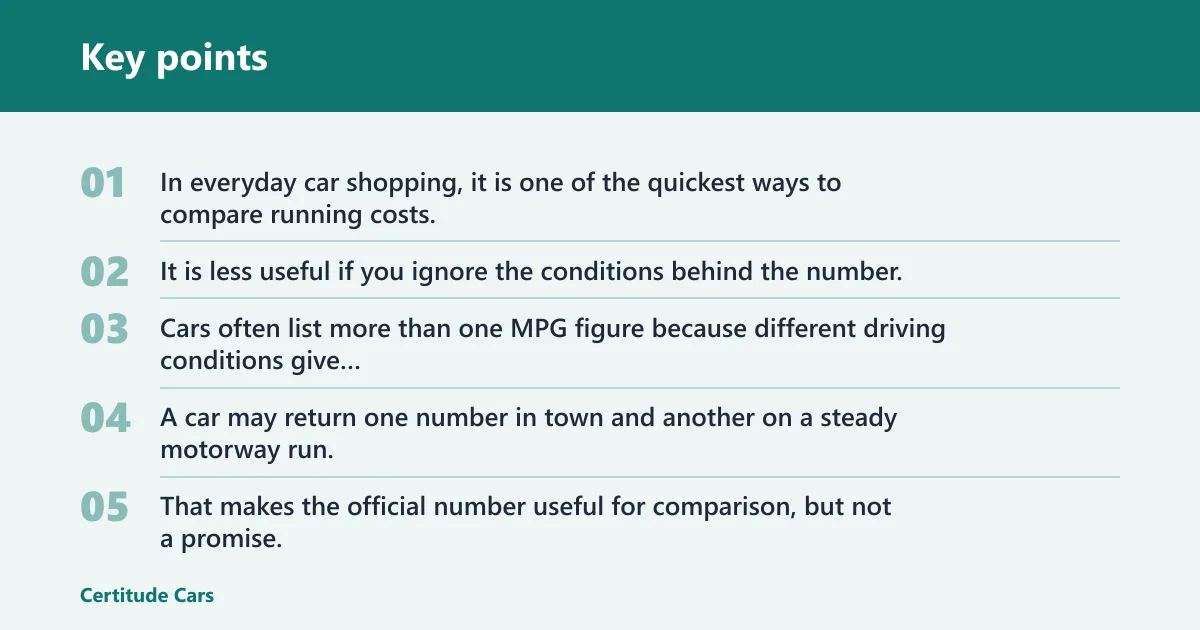
MPG is used for petrol and diesel cars. In everyday car shopping, it is one of the quickest ways to compare running costs, especially when two cars have similar size and performance. It is less useful if you ignore the conditions behind the number.
Why cars show more than one MPG figure
Cars often list more than one MPG figure because different driving conditions give different results. A car may return one number in town and another on a steady motorway run, while the headline figure is usually a combined average across test phases. That makes the official number useful for comparison, but not a promise.
Fuel economy, fuel consumption, and MPG are often used loosely in car ads and owner discussions, but they do not always mean exactly the same thing. MPG is a distance-per-fuel unit; fuel consumption can also be shown as litres per 100 km in some markets. The meaning changes with the unit, even when the subject is the same.
What is WLTP MPG?
WLTP is the current official UK fuel economy test, and it is the figure most new cars are measured against. The UK government adopted WLTP for new-car consumption figures, and the official UK guidance on WLTP explains that the test is designed to reflect a wider range of modern driving than older lab cycles. It includes Low, Medium, High, Extra-high, and Combined phases, so the published number is based on a broader test cycle.
Why WLTP replaced NEDC
NEDC was the older laboratory test cycle. It is outdated for new-car figures because it did not match modern driving as well as WLTP. The UK’s switch to WLTP is part of a broader move toward more representative lab testing, but it is still a laboratory test rather than a guarantee of your own result.
The Combined MPG is the most useful comparison number in listings and advertising. It blends the different WLTP phases into one headline figure. That makes it easier to compare cars, but it still sits above or below what you may see in daily driving depending on route, traffic, load, and speed.
Official MPG vs Real-World MPG: what changes the number
| Factor | Direction of impact | Plain-English reason |
|---|---|---|
| City driving | Usually lowers MPG | Stops, starts, and short trips waste more fuel than steady cruising. |
| Motorway driving | Can raise or lower MPG | Steady speed helps, but higher cruising speeds push drag up quickly. |
| Cold starts | Usually lowers MPG | A cold engine uses extra fuel before it reaches normal running temperature. |
| Tyre pressure | Low pressure lowers MPG | Underinflated tyres create more rolling resistance, so the engine works harder. |
| Load | More load lowers MPG | Extra weight needs extra energy to move and slow down. |
| Driving style | Gentle driving can raise MPG | Harsh acceleration and heavy braking waste fuel between steady-speed sections. |
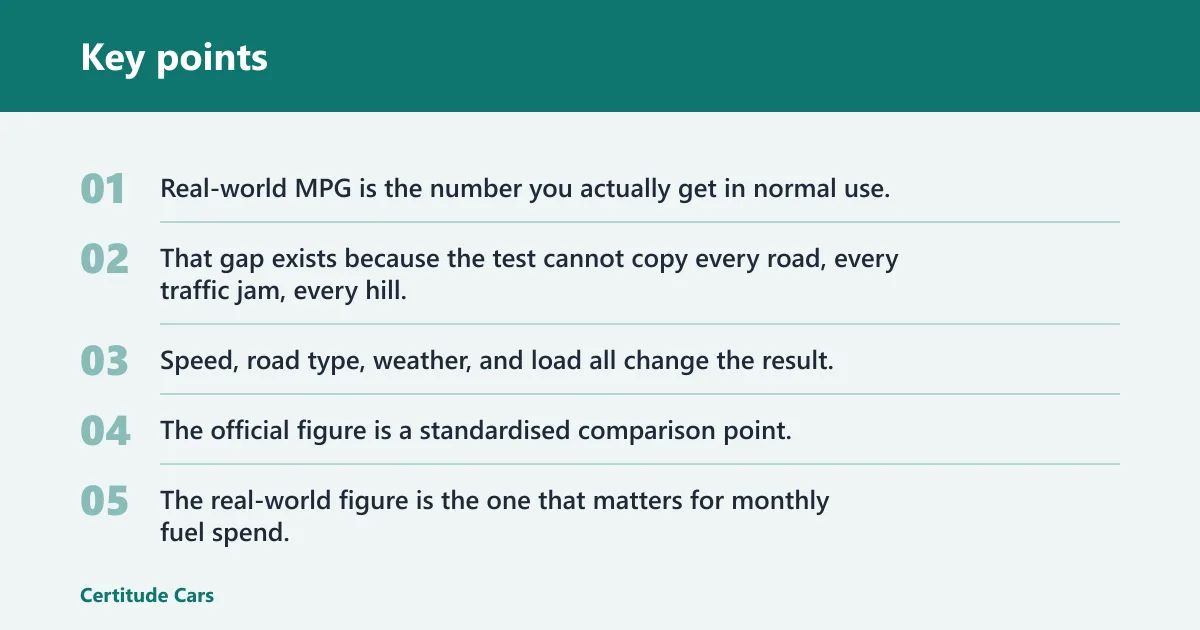
Real-world MPG is the number you actually get in normal use, and it is usually lower than the official figure. That gap exists because the test cannot copy every road, every traffic jam, every hill, and every driver. Speed, road type, weather, and load all change the result.
The official figure is a standardised comparison point. The real-world figure is the one that matters for monthly fuel spend, because it reflects your route, your speed, and your driving pattern rather than a controlled test cycle.
Say your hatchback is rated at 55 MPG combined, but your weekly school run is full of short trips and cold starts. The number you measure at the pump can land well below the brochure figure, even if nothing is wrong with the car. The route, not the badge, is doing the work.
| Vehicle type | Poor MPG | Average MPG | Good MPG | Notes |
|---|---|---|---|---|
| Small petrol hatchback | Below 35 MPG | 35-50 MPG | 50+ MPG | City use usually pulls the figure down; steady motorway use can improve it. |
| Family SUV | Below 30 MPG | 30-40 MPG | 40+ MPG | Heavier bodies and wider tyres often reduce MPG, especially in stop-start traffic. |
| Diesel estate | Below 40 MPG | 40-55 MPG | 55+ MPG | Long-distance driving suits diesel best; short urban trips can blunt the advantage. |
| Hybrid | Below 45 MPG | 45-60 MPG | 60+ MPG | Best results often come from slower traffic and routes that let the battery assist more often. |
How do you calculate MPG?
You calculate MPG by dividing the miles driven by the fuel used in gallons. In the UK, that means you need to convert litres into imperial gallons first, because cars are usually filled in litres. The RAC’s MPG calculator guidance uses the imperial-gallon method and the standard UK conversion of about 4.546 litres per gallon.
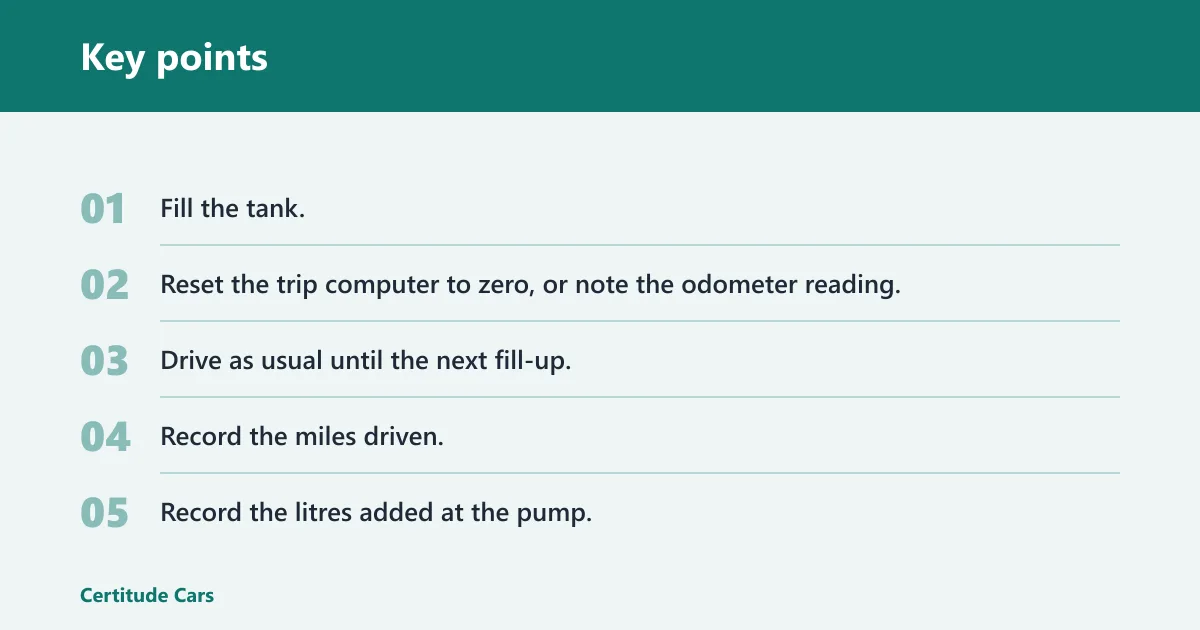
- Fill the tank.
- Reset the trip computer to zero, or note the odometer reading.
- Drive as usual until the next fill-up.
- Record the miles driven.
- Record the litres added at the pump.
- Convert litres to imperial gallons using about 4.55 litres per gallon.
- Divide miles by gallons used.
The trip computer and the odometer help you measure the miles driven, and resetting the trip at fill-up keeps the calculation clean. The hand calculation uses fuel actually put into the tank, which is why it can differ from the dashboard display. A trip computer is useful, but it is not the final word.
Suppose you drive about 275 miles and refill with about 45.5 litres. Divide 45.5 by 4.55 to get about 10 imperial gallons, then divide 275 by 10. The result is about 27.5 MPG. If you had treated those 45.5 litres as gallons, the result would be wrong by a large margin.
A common first-timer mistake is using a US-gallon conversion by accident. This is a UK calculation, so use imperial gallons and the about 4.55 litres-per-gallon conversion. That matters every time you fill up at a UK pump.
Why the trip computer can differ from a hand calculation
Trip computers estimate fuel use from sensor data, while a fill-up calculation uses actual fuel added and actual distance covered. Small differences in rounding, refuelling method, and the slope of the fill can change the number. That is why owners often see a small gap between dashboard MPG and pump-based MPG.
What does MPG mean for electric cars and MPGe?
Electric cars do not use MPG in the same way because they do not burn petrol or diesel. For EVs, the usual comparison is energy use, range, or a miles-per-kilowatt-hour style figure rather than miles per gallon. When an electric car is compared with a petrol or diesel car, MPGe may appear instead.
MPGe is the EPA’s comparison unit for electric vehicles, so consumers can compare EV efficiency with fuel cars on a common scale. It is a conversion-based measure, not the same as pump-fuel MPG, and the underlying electricity use still depends on charging losses, driving speed, temperature, and vehicle size.
Fuel type matters. Petrol, diesel, hybrid, and electric cars all use different measuring ideas, so one label does not fit every drivetrain neatly. Hybrids can show strong official MPG because the test cycle may suit their electric assist, yet their real-world result still depends on how much of your route allows battery help.
What is a good mpg for a car?
A good MPG depends on the car type and how you drive it. For many mainstream used cars, 40-60 MPG is a practical reference band. Smaller, lighter cars often do better; larger cars, faster motorway use, and heavy loads tend to pull the number down.
What matters most depends on how you use the car. If you spend most of your time in town, city MPG matters most. If you do long motorway journeys, the steady-speed figure matters more. If you tow, carry heavy loads, or compare against an EV, the headline combined number is only part of the picture.
Frequently asked questions
What does mpg mean in cars?
MPG means miles per gallon in cars. It tells you how far the car can travel using one gallon of fuel. A higher number means better fuel economy, which usually means lower fuel costs for the same distance. It is most useful when you compare similar cars under the same test standard.
What does mpg stand?
MPG stands for miles per gallon. In simple terms, it measures distance travelled on one gallon of fuel. That makes it a quick way to compare petrol and diesel cars, but not a direct promise of the number you will get on your own roads.
How is mpg measured?
Official MPG in the UK is measured using WLTP, the standard modern fuel economy test. WLTP includes Low, Medium, High, Extra-high, and Combined phases. Real-world MPG is measured by you, usually by comparing miles driven with fuel added at a fill-up and converting litres into imperial gallons.
What does mpg mean for electric cars?
MPG does not work in the same way for electric cars because they do not use fuel in gallons. EVs are usually compared by range, energy use, or MPGe in mixed comparisons. If you are comparing across fuel types, do not treat EV MPGe as the same thing as petrol MPG.
What is a good mpg for a car: a good MPG depends?
A good MPG depends on the class of car and your driving pattern. For many used cars, 40-60 MPG is a practical reference band. Smaller, lighter cars may do better, while larger cars, faster motorway use, and heavy loads tend to pull the number down.