What Size Wheels Fit My Car?
There is no single wheel size that fits every car. The fit decision comes down to five mandatory checks: the OEM placard/manual spec, the tire sidewall size, the wheel’s bolt pattern and center bore, the wheel width and offset, and the tire’s load index and speed rating. If any one fails, the wheel or tire package is not a safe match.
Fast yes/no checklist: 1) check the door jamb placard or owner’s manual, 2) verify the tire sidewall size, 3) match the bolt pattern exactly, 4) confirm the center bore/hub fit, 5) confirm wheel width matches the tire’s approved range, 6) confirm offset keeps the wheel within safe inner/outer clearance, 7) verify brake clearance, 8) keep overall tire diameter close to stock, and 9) meet or exceed load index and speed rating.
How to find your factory wheel size
Start with the driver-side door jamb placard, then confirm the tire size on the sidewall and check the owner’s manual if the placard is missing. If your car came with more than one factory wheel package, trim and option details matter, because the same model can leave the factory with different wheel and tire combinations.
Check the door jamb placard first
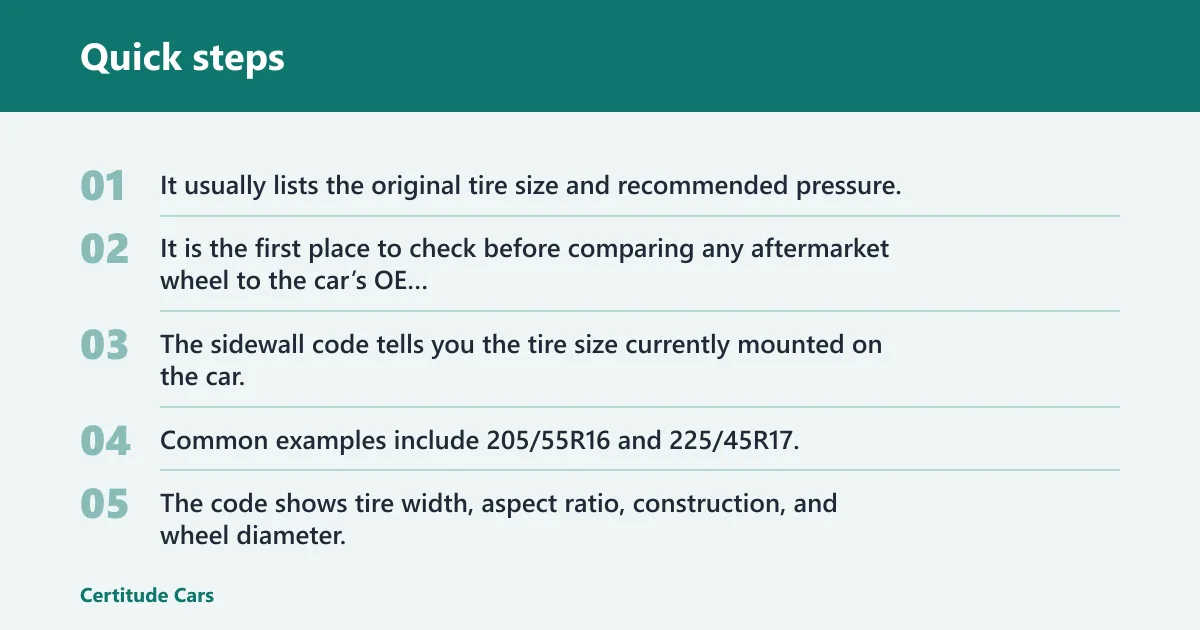
The placard is the fastest factory source. It usually lists the original tire size and recommended pressure, and that gives you the baseline for replacement wheels and tires. It is the first place to check before comparing any aftermarket wheel to the car’s OE spec.
Read the tire sidewall
The sidewall code tells you the tire size currently mounted on the car. Common examples include 205/55R16 and 225/45R17. The code shows tire width, aspect ratio, construction, and wheel diameter. The last number is the rim diameter in inches, which must match the wheel bead seat size.
Use the owner’s manual when the placard is missing
The owner’s manual often lists OE tire specifications and may include approved alternate sizes. That is useful when the placard is damaged, missing, or unreadable. If the manual and placard disagree, use the vehicle-specific OEM information and verify the exact trim or package before buying.
Note trim-specific factory wheel options
A base trim and a higher trim can use different wheel widths, offsets, or diameters. That is why “what size rims are on my car?” can have more than one correct answer. Check the exact trim, package, and model year before you buy a replacement wheel.
Wheel size vs tire size
Wheel size and tire size are related, but they are not the same thing. Wheel diameter and width describe the rim itself, while the tire code describes the tire that mounts on it. The fit decision only works when you check both parts separately and then compare the full package to factory specs.
Wheel diameter and width in inches
Wheel diameter is measured in inches and must match the tire bead seat size. Wheel width also matters because it determines what tire widths are approved for that rim. A tire can physically mount on more than one width, but it still has to stay within the manufacturer’s approved wheel-width range.
How tire codes map to wheel fitment
A tire code like 205/55R16 breaks down into section width, aspect ratio, construction, and wheel diameter. The last number must match the rim diameter. If the wheel diameter changes, the tire size has to change with it. The fit question is not only “does it bolt on?” but “does the tire still suit the wheel and the car?”
Why overall tire diameter matters
Overall tire diameter affects speedometer and odometer accuracy. A replacement tire should stay close to the original diameter so the vehicle’s gearing, ABS behavior, and speed display remain predictable. Keep the comparison tight when you change wheel diameter, especially during plus-sizing.
What size wheels fit my car?
What fits your car depends on a chain of checks, not one number. Bolt pattern is the first pass or fail filter, then center bore, width, offset, and brake clearance. A wheel that matches one spec but fails another is still a no-go.
Bolt pattern: first pass or fail check
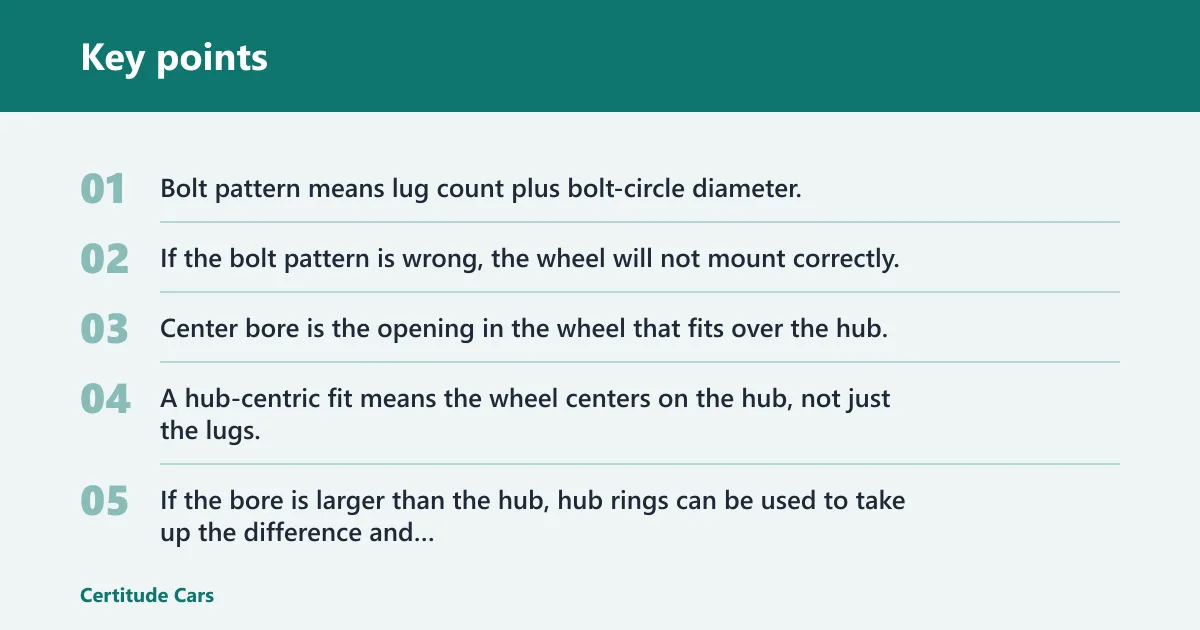
Bolt pattern means lug count plus bolt-circle diameter. Common patterns include 5×112 and 5×114.3. It must match the hub exactly. If the bolt pattern is wrong, the wheel will not mount correctly, even if the diameter looks right.
Center bore: hub fit and ring use
Center bore is the opening in the wheel that fits over the hub. A hub-centric fit means the wheel centers on the hub, not just the lugs. If the bore is larger than the hub, hub rings can be used to take up the difference and center the wheel. If the bore is smaller than the hub, the wheel will not fit at all.
Offset: inner and outer clearance
Offset is the position of the hub mounting surface relative to the wheel centerline. Positive offset moves the wheel inward; zero sits near the center; negative moves it outward. A small offset change may be manageable if brake and suspension clearance stay safe, but a large change can cause rubbing, steering interference, or a wheel that sits too far in or out.
Brake clearance and suspension space
Brake calipers can block a wheel even when bolt pattern, diameter, and offset look correct. Larger wheels often give more room, but spoke shape and barrel design still matter. Check caliper clearance and suspension space as a separate step, especially if you are moving to a different wheel design or larger diameter.
Text wheel fitment decision table
This checklist turns the buying question into a simple pass/fail path. If any row fails, the wheel is not an automatic fit. The next step tells you whether you can correct the issue with a different size, a hub ring, or a new wheel choice.
| Check | Pass | Fail | Next step |
|---|---|---|---|
| Bolt pattern | Lug count and bolt-circle diameter match exactly | Pattern differs, such as 5×112 vs 5×114.3 | Do not buy it for this car; find the exact pattern |
| Center bore | Bore is equal to or larger than the hub and can be centered hub-centrically | Bore is smaller than the hub, or is larger but you have no hub-ring plan | Use a correct hub ring if the bore is larger; reject the wheel if the bore is too small |
| Width range | Wheel width falls within the tire maker’s approved wheel-width range | Wheel is outside the tire’s approved range or forces an unsafe sidewall shape | Choose a tire size approved for that wheel width, or choose another wheel width |
| Offset range | Wheel stays close enough to OE offset that inner and outer clearance remain safe | Offset change pushes the wheel inward toward suspension/brakes or outward toward the fender | Compare against OE offset and choose a closer spec; reject large changes that create rubbing risk |
| Brake clearance | Caliper and suspension parts clear through full rotation and lock | Wheel contacts caliper, strut, or liner | Reject the wheel or change design, diameter, or offset |
| Overall outcome | All five checks pass | One or more checks fail | Fit, fit only with changes, or no fit |
Can I put bigger wheels on my car?
Yes, sometimes, but “bigger” only works when the full package still fits the car. Plus-sizing usually means increasing wheel diameter while keeping overall tire diameter close to stock. If the tire gets too short or too tall, you can pick up speedometer error, ride harshness, or rubbing.
Plus-sizing basics
Plus-sizing changes the wheel diameter and usually reduces sidewall height so the overall tire diameter stays near stock. That is why a larger wheel does not automatically mean a larger tire circumference. The tire still has to clear the body, suspension, and brakes.
Keeping overall diameter close to stock
Stay close to the original tire diameter when you change wheel size. Small changes are easier to accommodate than large ones, because the speedometer, odometer, and electronic stability systems are all calibrated around the OE package. Use the vehicle’s factory size as the reference point.
Speedometer and odometer error
When overall diameter changes, the car may report speed and distance differently. A larger-than-stock tire can make the speedometer read low; a smaller one can make it read high. That is why a fitment decision should include tire diameter, not only wheel diameter.
Ride comfort and sidewall tradeoffs
Larger wheels often mean shorter sidewalls, and shorter sidewalls usually transmit more road harshness. That tradeoff is real, but it depends on the full wheel-and-tire package, not wheel size alone. The goal is a setup that clears safely and stays close enough to OE diameter for predictable driving behavior.
How do I know my wheel size?
You can identify wheel size from the wheel itself, the tire code, or the vehicle documents. The wheel marking tells you the rim diameter and width; the tire sidewall tells you the tire size mounted on it. For a replacement, match both to the factory source and confirm load and speed ratings.
Decode wheel markings
Wheel markings usually show diameter and width, often with offset and other details. The diameter must match the tire bead seat size, and the width must suit the tire section width range. If the wheel stamp is hard to read, use the placard, manual, or a trusted make-specific fitment listing to verify the OE spec.
Match the wheel to the tire code
Do not confuse “same wheel size” with “same tire size.” Two wheels can share the same diameter and still need different tires because width and offset changed. The wheel and tire package changed together, so the fit check has to start from the exact OE setup.
Confirm load index and speed rating
Load index and speed rating are part of the tire code and are not optional extras. The replacement tire must meet or exceed the original equipment requirement. Use the vehicle placard or manual for the OE target, then confirm the replacement tire’s service description before buying.
Common fitment mistakes to avoid
Most bad buys happen because one spec gets checked and the others get ignored. Bolt pattern alone does not guarantee fit. A wheel can bolt on and still rub, hit the caliper, or sit too far in or out. Trim differences matter too, especially on models with several factory wheel options.
Assuming bolt pattern is enough
A matching bolt pattern is only the first hurdle. The wheel can still fail on center bore, offset, width, or brake clearance. That is why a yes/no checklist works better than a quick visual guess.
Skipping caliper and suspension clearance
Brake clearance is a separate check because spokes and barrel shape can interfere even when the diameter looks correct. A wheel that clears one brake package may not clear another on the same car. This is common on vehicles with multiple trims or brake options.
Choosing a tire size that changes diameter too much
Do not let the tire size drift far from OE. Even a wheel that fits physically can create speedometer error if the tire diameter moves too far. Keep the tire code close to the factory value, then confirm that the load index and speed rating still meet spec.
A common first-timer mistake is buying a wheel because the bolt pattern matches, then discovering the caliper touches the barrel by a few millimeters. The wheel looks right on paper. It fails in the one place that matters most: clearance under load and steering movement.
Frequently asked questions
What size rims fit my car?
“Rims” and wheels are often used the same way in shopping language, but the fit check is the same either way. You need the exact diameter, width, bolt pattern, center bore, offset, and brake clearance for your vehicle. A match on one spec does not guarantee a full match.
How do I size car wheels?
Use the factory wheel as your reference point. Check diameter and width first, then confirm bolt pattern, center bore, offset, and brake clearance. After that, compare the tire code and keep overall diameter close to stock so speedometer and odometer error stay within a practical range.
What wheels fit my car?
The wheels that fit are the ones that pass every fitment check for your exact trim or package. That means matching bolt pattern, correct center bore, acceptable width, safe offset, and enough room for the brakes and suspension. If you are unsure, compare the OE data with the wheel maker’s specs before buying.
What size rims are on my car?
Check the driver-side door jamb placard first, then read the tire sidewall and confirm the owner’s manual if needed. Trim-specific factory packages can change the answer, so verify the exact vehicle build.