What Are the Grades of Fuel in the USA?
In the U.S., gasoline is commonly sold as regular, midgrade, and premium, typically differentiated by octane. Diesel may be labeled by cetane, winter blend, or biodiesel content. The grade your owner’s manual or fuel cap specifies is the right one for your car. Using the wrong fuel grade can waste money, trigger drivability problems, or in rare cases damage the engine or fuel system. This guide explains each pump label, what the numbers mean, and which one matters for your vehicle.
How fuel grade labels work
U.S. fuel grades are a label system, not a universal quality scale. For gasoline, the number on the pump is the octane rating, usually shown as AKI. For diesel, the labels point to a different fuel family with different use cases, especially cold-weather flow and engine compatibility.
The split is straightforward: gasoline grades are one decision, diesel grades are another. If you mix those up, the number on the pump will not help you pick the correct fuel.
What a fuel grade label tells you
A fuel grade label tells you how the fuel is grouped for sale and how it behaves in a specific engine. It does not tell you that one fuel is always better. The owner’s manual decides first, then the fuel cap if it lists a minimum octane or diesel requirement.
Why gasoline and diesel are separate categories
Gasoline and diesel are built for different combustion systems. Gasoline engines use spark ignition and rely on octane resistance to knock. Diesel engines use compression ignition and follow different fuel specifications, including sulfur and aromatics limits for on-road fuel.
For on-road diesel in the U.S., sulfur is limited to 15 ppm. The diesel specification for highway fuel included a minimum cetane index of 40 or maximum 35% aromatics. Ultra low sulfur diesel was required to be available beginning in mid-2006, and retail diesel compliance started on October 15, 2006.
What are the grades of gasoline?
U.S. gasoline commonly comes as regular, mid-grade, and premium. Regular is the lowest common octane grade at retail pumps and the baseline option most vehicles are designed to use. Mid-grade sits between regular and premium. Premium is the highest common retail gasoline grade, but it is not automatically more powerful. (EIA)
Regular gasoline
Regular gasoline is the default choice for many cars, crossovers, and light trucks. At U.S. pumps, it is often the lowest octane gasoline on the island, and the octane number is usually the one you should watch first. If your manual says regular, that is usually the correct buy.
Mid-grade gasoline
Mid-grade gasoline is the in-between option. Some stations blend it from the regular and premium tanks, while others sell it as a separate grade with its own pump label. It can make sense when a manufacturer recommends higher than regular but does not require premium.
Premium gasoline
Premium gasoline is the highest common retail gasoline grade. It is often recommended for some turbocharged or high-compression engines because those engines may need greater resistance to knock. That does not mean premium adds power in every car. In an engine designed for regular, premium usually just costs more.
Say your compact sedan calls for regular fuel and runs smoothly on it. Buying premium will not turn it into a different car. It may reduce knock in some engines, but unless the manual asks for a higher octane, the extra cost usually brings no practical return.
What does octane mean at the pump?
Octane is the number on the gasoline pump that tells you how well the fuel resists knock. In the U.S., the pump label shows AKI, not RON. Higher octane means greater resistance to knock, but it is not a general measure of fuel quality for every engine.
AKI on U.S. pump labels
AKI stands for Anti-Knock Index. It is the U.S. pump rating standard for gasoline, and it is the number most drivers see on regular, mid-grade, and premium labels. The number helps you match the fuel to the engine’s needs. (Wikipedia)
Why higher octane resists knock
Knock happens when the air-fuel mixture burns in an uncontrolled way. Engines with higher compression or boost can be more sensitive to it. Higher octane fuel resists that kind of knock better, which is why some engines ask for premium. It does not make every engine stronger.
AKI versus RON
RON is used in some other countries, which is why a traveler may see a different number on a fuel sticker abroad. U.S. pumps use AKI, so the printed number will not line up directly with a RON label. Do not compare them as if they were the same scale.
When should you buy premium?
Buy premium only when the owner’s manual says to, or when the manual allows it and the engine asks for it under load or in hot weather. The words matter. “Required” means the engine needs that minimum octane. “Recommended” means the maker prefers it, but the car may still run on regular.
Check the owner’s manual first
The owner’s manual is the deciding source for fuel choice. It may list a minimum octane or specify premium. If the manual says regular, that is the grade to use. If it says premium required, regular can cause knock, poor operation, or long-term problems.
Recommended versus required fuel
“Recommended” and “required” are not the same instruction. Recommended premium may give a quieter run or a small margin against knock, but many vehicles can still use regular. Required premium means the engine calibration expects that octane. Treat required as a hard rule.
Why premium is not always worth it
Premium does not automatically mean better mileage, more power, or cleaner running in every vehicle. If the engine is tuned for regular gasoline, higher octane usually gives no benefit beyond a higher bill. The useful test is simple: follow the manual, not the idea that a bigger number is better.
Suppose a turbo sedan is labeled “premium recommended.” If the manual allows regular with a performance trade-off, a careful driver can decide whether the extra cost is worth it. If the manual says “premium required,” that same choice is no longer optional.
Fuel grades decision table
This table turns the pump label into a buying decision. Read the fuel type first, then the label, then the manual language. That order matters more than brand, station color, or local marketing terms.
| Fuel type | Pump label | Octane or grade number | Typical use case | Buy this only if… |
|---|---|---|---|---|
| Gasoline | Regular | Lowest common AKI at the pump | Baseline fuel for most vehicles | Your owner’s manual says regular, or it lists a minimum AKI that matches this grade. |
| Gasoline | Mid-grade | Between regular and premium | Step-up option when the maker suggests more than regular | Your manual recommends a higher octane but does not require premium. |
| Gasoline | Premium | Highest common retail AKI | Some turbocharged, high-compression, or performance engines | Your manual requires premium, or the engine is calibrated for it. |
| Diesel | #1-D | Diesel grade, not octane | Cold-weather flow and extreme cold climates | You need better low-temperature flow than standard diesel provides. |
| Diesel | #2-D | Diesel grade, not octane | Standard diesel for moderate-to-warm climates | Your diesel vehicle calls for normal on-road diesel in typical conditions. |
How to read the table
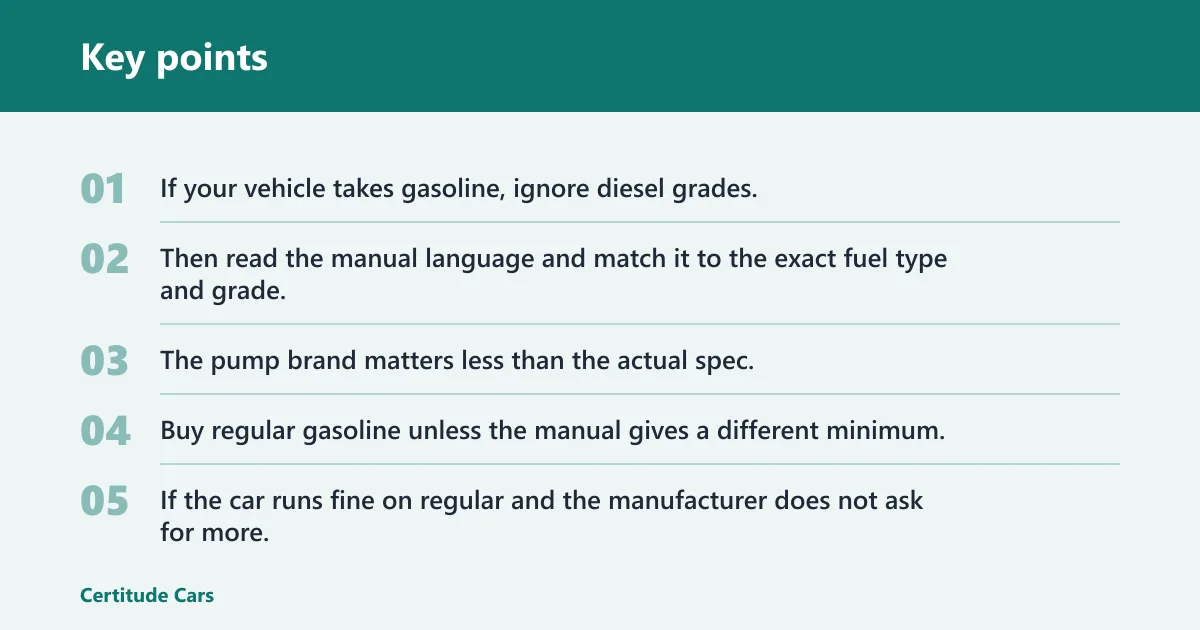
Start with the fuel family. If your vehicle takes gasoline, ignore diesel grades. If it takes diesel, ignore octane labels. Then read the manual language and match it to the exact fuel type and grade. The pump brand matters less than the actual spec.
What to buy if your manual says regular
Buy regular gasoline unless the manual gives a different minimum. If the car runs fine on regular and the manufacturer does not ask for more, premium is usually extra cost without a clear benefit. That is the simplest answer for many drivers.
What to buy if your manual requires premium
Buy premium gasoline. If the manual says premium is required, do not substitute regular because the price is lower. The engine calibration expects a higher anti-knock margin, and the wrong fuel can bring knock or reduced drivability.
How to handle diesel labels
Diesel labels do not use octane. They identify a different fuel family and, in winter, may point to flow behavior rather than spark-ignition knock resistance. For many drivers, #2-D is the standard choice. #1-D matters more when temperatures drop hard enough to thicken fuel.
What are the grades of diesel fuel?
U.S. diesel grades are separate from gasoline grades. In the U.S., diesel is commonly labeled #1-D and #2-D. #1-D is better for cold weather flow, while #2-D is the standard diesel grade for efficiency and higher energy density in moderate-to-warm climates.
#1-D diesel
#1-D diesel has lower viscosity and flows more freely at freezing temperatures. That makes it useful in extreme cold climates, where fuel can thicken and become harder to move through the system. It is not a gasoline substitute and does not use octane labels.
#2-D diesel
#2-D diesel is the standard diesel grade for many road vehicles. It has higher energy density than #1-D and is commonly used in moderate-to-warm climates. When winter arrives, some fuel suppliers use winterized blends that mix #1-D and #2-D.
Picture a pickup that is approved for diesel only. A driver who sees “premium” on a gasoline pump should keep walking; that label belongs to a different fuel family. The correct choice is between the right diesel grade and, in some regions, a winterized blend.
How diesel differs from gasoline grades
Gasoline grades are about octane and knock resistance. Diesel grades are about cold-weather behavior, energy content, and engine requirements. That is why the same station can sell both fuel families, yet the labels mean different things.
For mobile diesel applications in the U.S., the fuel has sulfur and aromatics limits. The aromatics rule allows either cetane index 40 or aromatics 35% volume. Nonroad diesel sulfur was set to 500 ppm effective June 1, 2007, and ULSD for nonroad fuel became effective June 1, 2010.
Frequently asked questions
What are the grades of fuel in the USA?
For gasoline, the common U.S. grades are regular, mid-grade, and premium. Diesel is a separate category and is usually discussed by #1-D and #2-D rather than octane. The correct fuel is the one your owner’s manual or fuel cap specifies, not the one that sounds highest.
What is the difference between fuel grades?
The difference depends on the fuel family. Gasoline grades differ mainly by octane and knock resistance. Diesel grades differ by cold-weather flow, energy density, and usage conditions. That is why the first step is to separate gasoline from diesel before comparing labels.
What fuel is the best?
The best fuel is the one your specific vehicle is built to use. For many gasoline cars, that means regular. For some engines, it means premium. For diesel vehicles, it means the correct diesel grade for the season and climate. The manual settles the question.
What is fuel grade?
Fuel grade is the label used to group fuels by a property that matters to the engine, such as octane for gasoline or cold-flow behavior for diesel. It is not a universal score of quality. It is a buying guide tied to a specific engine design.
What is the difference in gasoline grades?
Gasoline grades differ mainly in octane rating, shown in the U.S. as AKI at the pump. Higher octane resists knock better, which helps some engines. It does not make every engine faster or more efficient. The owner’s manual decides which grade belongs in the tank.