Why Is My Check Engine Light Flashing and My Car Shaking?
A flashing check engine light with shaking usually means an active engine misfire. Do not keep driving far, because the engine is likely burning fuel unevenly and can overheat the catalytic converter. Treat the flash as urgent, slow down, and stop driving if the shake is strong or the light keeps flashing.
What the flashing light means
A flashing check engine light is more urgent than a solid one. A steady light usually means a fault that needs attention, while a flashing light often indicates a severe misfire that can damage the engine or emissions system right now. NHTSA OBD-II guidance and OEM service procedures treat a flashing MIL as a high-priority warning, especially when it appears with rough running.
Flashing versus solid
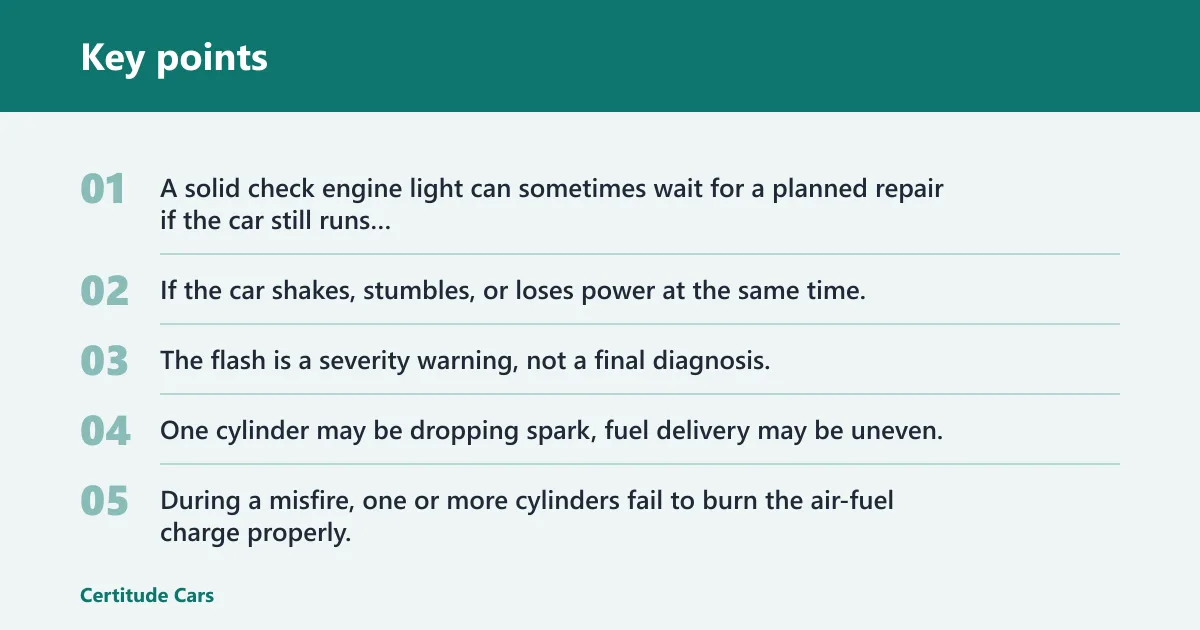
A solid check engine light can sometimes wait for a planned repair if the car still runs normally. A flashing light changes the threshold. If the car shakes, stumbles, or loses power at the same time, the engine is not burning fuel cleanly and the risk rises fast.
The flash is a severity warning, not a final diagnosis. One cylinder may be dropping spark, fuel delivery may be uneven, or an air leak may be leaning out the mixture enough to set off misfire detection.
Why a misfire triggers the flash
During a misfire, one or more cylinders fail to burn the air-fuel charge properly. That leaves raw fuel in the exhaust stream. OEM and repair-data references consistently note that severe misfire can overheat the catalytic converter because the converter is forced to burn that extra fuel in the exhaust.
That is why a flashing light is more than a nuisance. It is a warning that continued driving can turn one ignition, fuel, or air fault into a larger exhaust-system repair.
Why the car shakes
Shaking means the engine is running unevenly. A misfire creates rough combustion, so one cylinder is doing less work than the others. The result can be a rough idle, a stumble during acceleration, or a harsh vibration that gets worse under load.
Idle-only shaking and load-related shaking point in different directions. A problem that shows up mainly at idle often suggests a vacuum leak, weak ignition, or one cylinder that is just on the edge of failing. A problem that gets worse on hills or during passing often points to ignition or fuel delivery under demand.
Idle-only shaking
If the engine shakes most at a stoplight or in park, pay attention to a steady rough idle, small rpm swings, and a light that may flash only briefly. That pattern can fit a single weak plug, a coil that misfires at low speed, or a vacuum leak that leans out the mixture at idle.
Acceleration misfire
If the shake appears when the accelerator is pressed, look at the parts that matter most under load. A weak ignition coil, worn spark plug, or restricted fuel injector may act up when cylinder pressure rises. The engine can feel fine at idle and fall apart as soon as demand increases.
Intermittent shake
An intermittent shake is still serious. It can mean the misfire comes and goes as temperature, load, or engine speed changes. That pattern often confuses drivers because the car may seem normal for a few minutes and then stumble again without warning.
Picture a compact sedan that idles smoothly in the driveway, then starts shaking and flashing the moment it climbs a steep on-ramp. That pattern is more useful than the code by itself, because it points toward a load-related misfire rather than a simple no-start or a constant idle fault.
Can you keep driving?
Do not plan on long-distance driving with a flashing light. If the shake is strong, the engine power drops, or the flashing is steady, pull over and stop driving. OEM service guidance and OBD-II references both treat this as a do-not-ignore condition because the misfire can quickly damage the catalytic converter.
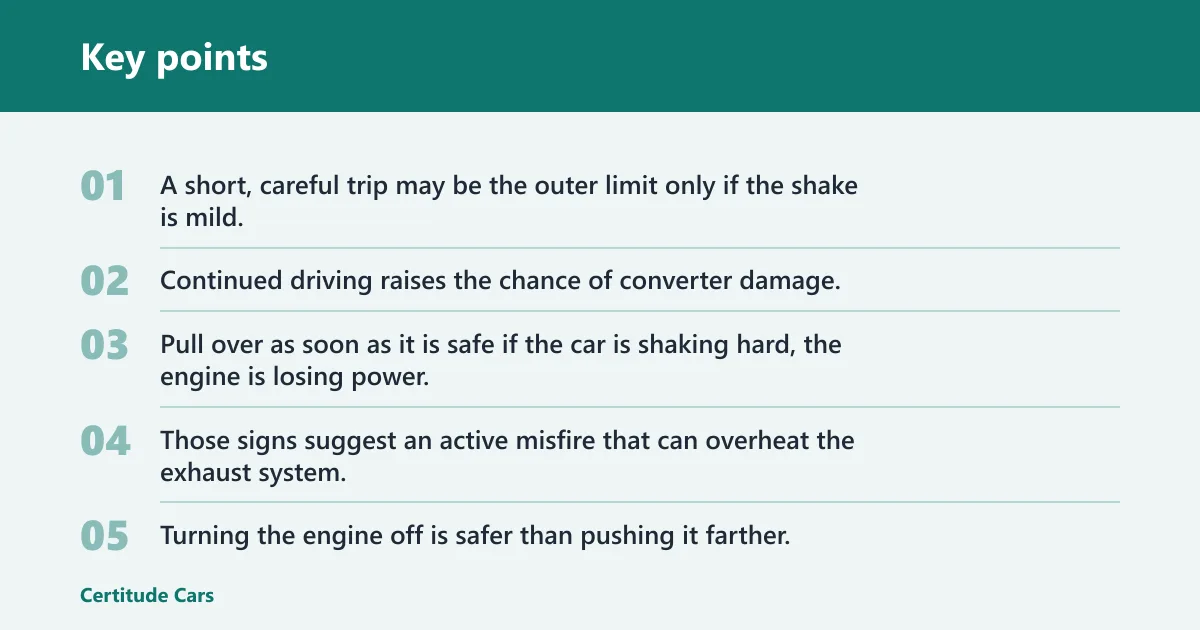
A short, careful trip may be the outer limit only if the shake is mild, the car still responds normally, and the light is flashing intermittently rather than continuously. Even then, keep the route short and direct. Continued driving raises the chance of converter damage.
When to stop right away
Pull over as soon as it is safe if the car is shaking hard, the engine is losing power, or the flash stays steady at cruising speed. Those signs suggest an active misfire that can overheat the exhaust system. Turning the engine off is safer than pushing it farther.
When a short trip may be the limit
If the engine only stumbles lightly and the flashing comes and goes, the car may make it to a nearby shop, but that is not a green light to keep driving normally. Keep the speed low, avoid hills if possible, and skip hard throttle. Treat it as a get-there-and-stop situation.
Why continued driving risks the converter
Unburned fuel entering the exhaust can superheat the catalytic converter. That is the cause-and-effect chain behind the warning: the misfire sends raw fuel downstream, and the converter is forced to burn that fuel off. The longer the misfire continues, the greater the damage risk.
Misfire triage table
Use the symptom pattern first. Then choose the safest next action. This table is for roadside sorting, not for replacing parts on guesswork.
| Symptom pattern | Likely system branch | Likely DTC pattern | Is driving unsafe? | What it often points to | First checks | Safest next action |
|---|---|---|---|---|---|---|
| Idle-only shaking | Ignition, air, or one-cylinder fuel issue | P0300 or a cylinder-specific P0301-P0308 code | Usually yes if the flash is active; avoid long driving | Worn spark plug, weak ignition coil, vacuum leak | Check for rough idle, inspect plugs and coils, scan for fuel trim clues | Stop hard driving, inspect basics, scan codes soon |
| Acceleration misfire | Ignition or fuel delivery under load | Often cylinder-specific P0301-P0308; sometimes P0300 if the miss moves around | Yes if power drops or the flash is steady | Weak coil, worn plug, fuel injector problem | Note whether the miss appears only under throttle, check service history | Reduce speed, avoid hard throttle, head to a shop carefully |
| Load-dependent flashing | Misfire that appears under demand | P0300 is common when the misfire shifts; cylinder-specific codes if one cylinder is dominant | Yes | Ignition breakdown, restricted fuel flow, leaning air leak | Watch for hill-climb symptoms, listen for stumble under load, scan codes | Stop aggressive driving and do not continue long distances |
| Intermittent flash-stop behavior | Intermittent misfire | P0300 is common; a single-cylinder code may appear and disappear | Still yes, because the fault can return suddenly | Coil, plug, injector, or wiring fault that comes and goes | Check whether heat, rain, or load changes the symptom | Do not assume it is fixed; scan and diagnose soon |
A common first-timer mistake is to see the light stop flashing and assume the problem is gone. The fault may have gone intermittent instead. That still deserves diagnosis, because the next drive cycle can bring the misfire back.
What are the most common causes of a flashing check engine light?
The common causes split into four branches: ignition, fuel, air, and mechanical. Spark plugs and ignition coils are often near the top of the list, but fuel injectors, vacuum leaks, and internal engine faults can also cause a misfire. The code pattern helps separate a single-cylinder problem from a random misfire, but it does not identify the failed part by itself.
OBD-II codes such as P0300 and cylinder-specific P0301-P0308 are example misfire codes used across many makes. Major repair-data publishers and OEM service information use those codes as the starting point for diagnosis, not the final answer.
Spark plugs
Spark plugs are a common first cause because they wear over time. Each cylinder uses one plug, and a weak or worn plug can fail to ignite the mixture cleanly. Replacement is often done as a set, because one tired plug usually means the others are not far behind.
If one plug is fouled or worn, the engine may shake most at idle or under load. That can mimic more expensive failures. A plug problem is common, but the code alone should not push you straight to replacement without checking the rest of the cylinder.
Ignition coils
Ignition coils deliver high voltage to the spark plugs. A weak or intermittent coil can act like a bad plug because both problems break the spark at the cylinder. If the misfire changes with engine heat or load, the coil branch deserves close attention.
Coil problems can be tricky because they may fail only under certain conditions. That is one reason the light can flash, stop, and flash again. The fault is still there even when the symptom fades for a moment.
Fuel injectors
A fuel injector can contribute to a misfire when it does not deliver fuel correctly. That may be from clogging, electrical failure, or poor spray pattern. A cylinder that is starved for fuel can shake the engine and trigger a misfire code just like an ignition fault can.
Do not skip injector checks just because the plug and coil look suspicious. A code pointing to a cylinder tells you where the misfire shows up, not whether the root cause is spark, fuel, or wiring.
Vacuum leaks
A vacuum leak can create lean running and a misfire, especially at idle or low speed. Extra unmetered air changes the mixture and can make one bank or one cylinder stumble. That is why idle-only shaking often points beyond ignition parts.
Vacuum leaks are easy to miss if the focus stays only on plugs and coils. Hoses, intake gaskets, and connected fittings all matter. This is a diagnosis job, not a guess-and-replace job.
Mechanical faults
Mechanical problems can also sit behind a misfire. Low compression, a leaking valve, timing issues, or internal damage can all create rough running. If a cylinder keeps misfiring after the basic ignition and fuel checks, mechanical testing becomes more likely.
That is the branch many quick articles skip. Yet it matters because a car can still shake with fresh plugs and a new coil if the cylinder cannot seal or compress properly.
How to diagnose it with codes
An OBD-II scan tool is the standard diagnostic approach. It connects to the vehicle’s standard port and reads diagnostic trouble codes, which help identify where the system noticed the fault.
That code is a starting point, not the answer. A diagnostic trouble code can point to a cylinder misfire or a system fault, but it does not tell you whether the root cause is a plug, coil, injector, vacuum leak, or mechanical issue. The next step is testing.
Simple roadside check sequence
- Slow down and keep the engine load light.
- Lift off hard acceleration and avoid hills if possible.
- Watch whether the flash is steady or intermittent.
- Listen for rough idle, sputtering, or loss of power.
- If the shake is strong, pull over and stop driving.
- Read codes with an OBD-II scan tool as soon as it is safe.
If the light is flashing but the car is still moving, do not clear the code first. Clearing it too early can erase the trail before the fault is found. Read the code, note whether the misfire is cylinder-specific or random, and then test the likely branch.
Suppose a crossover flashes the light only while climbing a long grade, then runs normally again on level road. That points you toward a load-related misfire branch, not an automatic parts swap. The code matters, but the driving condition that triggers it matters just as much.
Frequently asked questions
Why is my check engine light flashing and my car shaking?
That combination usually means an active engine misfire. One or more cylinders are not burning fuel correctly, so the engine runs rough and the exhaust may carry unburned fuel. The shake shows rough combustion; the flashing light warns that the fault is severe enough to risk damage.
Can I keep driving if the check engine light is flashing?
Only for the shortest practical distance, and only if the shake is mild. If the engine shakes hard, loses power, or the flash is steady, pull over and stop driving. Long-distance travel is the wrong move because the catalytic converter can overheat quickly.
Is a flashing check engine light always a misfire?
Most of the time, yes, the flash points to a misfire or a severe fault that acts like one. But the root cause can still vary. Spark plugs, ignition coils, fuel injectors, vacuum leaks, and mechanical problems can all lead to the same flashing warning.
Can a flashing check engine light damage the catalytic converter?
Yes. A severe misfire sends unburned fuel into the exhaust, and that fuel can overheat the catalytic converter as it burns inside the converter housing. The longer the misfire continues, the greater the chance of converter damage.
What should I do first if the car starts shaking and the light flashes?
Ease off the throttle, keep the load light, and see whether the flash and shake get worse. If they do, pull over and stop driving. Then use an OBD-II scan tool if available. The first goal is safety, not code replacement.
Will the light stop flashing if the problem goes away temporarily?
Yes, it can stop flashing if the misfire becomes intermittent. That does not mean the fault is fixed. Intermittent coil, plug, injector, wiring, or air-leak problems often come and go with heat, speed, or engine load, then return on the next trip.
Do I need a scan tool to diagnose a flashing check engine light?
You need one of some kind if you want to get beyond guesswork. An OBD-II scan tool is the standard approach and reads diagnostic trouble codes such as P0300 or a cylinder-specific misfire code. The code is only the start, though. It tells you where to test, not which part to buy.
Related guides
For next-step diagnosis, see our guides on engine misfire, bad spark plugs, ignition coil symptoms, catalytic converter failure, and OBD-II code guides.