What Is Needed to Transfer a Title?
You usually need the signed title, the buyer and seller details the title form asks for, a lien release if there was a loan, and any state-required transfer forms; registration is separate and may also require proof of insurance, a government-issued photo ID in the situations your state specifies, and state tax payment records. Missing one item can delay ownership, trigger penalties, or force a return trip to the DMV. This guide breaks title-transfer requirements into a DMV-ready checklist and shows which documents belong to transfer, registration, or both.
What title transfer actually changes
Title transfer changes legal ownership on the vehicle record. Registration is a different step that can require proof of insurance, fees, and sometimes inspection. State rules vary on whether the seller must appear, whether notarization is required, and whether a county tax office or DMV handles the filing. The DMV may reject ownership paperwork when the title is unsigned, the wrong section is filled out, names do not match, or a lien is still open.
Title transfer vs. registration
Think of the signed title as the ownership document and registration as the permission to operate the vehicle on public roads. A valid transfer can be complete even when registration is still pending, but a state may block registration until insurance, tax, inspection, or ID requirements are satisfied. For the next step after the transfer packet, see registration follow-up.
Why the signed title matters
Most title transfers require an original title signed by the current owner. That signed assignment is the core of the transfer packet. If the title lists more than one owner, the signature rule depends on the wording printed on the title. When owners are connected by AND, both signatures may be required. When owners are connected by OR, either owner’s signature may be enough.
When the DMV may reject ownership paperwork
Rejection usually comes from a paperwork mismatch, not from the sale itself. Common problems include missing signatures, a blank or wrong assignment section, a mismatch between the name on the title and the ID, an unreadable or altered title, or an odometer field that was skipped or filled in wrong. In some states, notarization or an in-person signature is also required for the transfer to count.
Title transfer checklist
This checklist covers the documents that most often belong in the signed title packet. Some items are always part of transfer. Others become relevant only in certain states or deal types. Keep the transfer packet separate from the registration packet so you do not mix ownership proof with road-use paperwork.
Original vehicle title
The original vehicle title is the anchor document. It must be signed by the current owner, and it may require a co-owner signature depending on the exact wording on the face of the title. The assignment section also needs the buyer’s name and any other fields your state requires.
Bill of sale
A bill of sale documents the purchase price and date. It is typically part of the transfer paperwork, especially for private sales and gifts. It can help prove the transaction if the DMV asks for a backup record or if the title itself leaves some sale details incomplete.
Government-issued photo ID
A government-issued photo ID may be needed to file the transfer or register the vehicle, but not every state requires both parties to appear in person. The name on the ID should match the person signing or filing when the state requires identification at the counter. If the ID does not match the title name, bring the paperwork that explains the difference.
Lien release
If the vehicle was financed, lien release documentation may be required. That release shows the lender’s interest is cleared. Without it, the DMV may treat the title as still encumbered, which can block transfer or delay the record change until the lender’s paperwork is updated. For a deeper look at lien payoff timing and record changes, see title transfer and registration.
Odometer disclosure
Odometer disclosure belongs in the correct title field, not in a margin note or separate guess. A missing reading, the wrong box, or a skipped field can void paperwork. That risk is highest when a seller writes the mileage in the wrong place or signs before the odometer line is complete. Federal disclosure rules also apply in many transfers; states and DMV offices typically enforce the form location and signature sequence on the title or reassignment form.
Items that often belong to registration instead
Proof of insurance often matters after transfer when you register the vehicle. A valid emissions or safety inspection may also be required depending on the state. VIN verification can be needed when the vehicle is titled in a new state. These items often do not replace the signed title packet, and in many states they are used only for registration or out-of-state conversion.
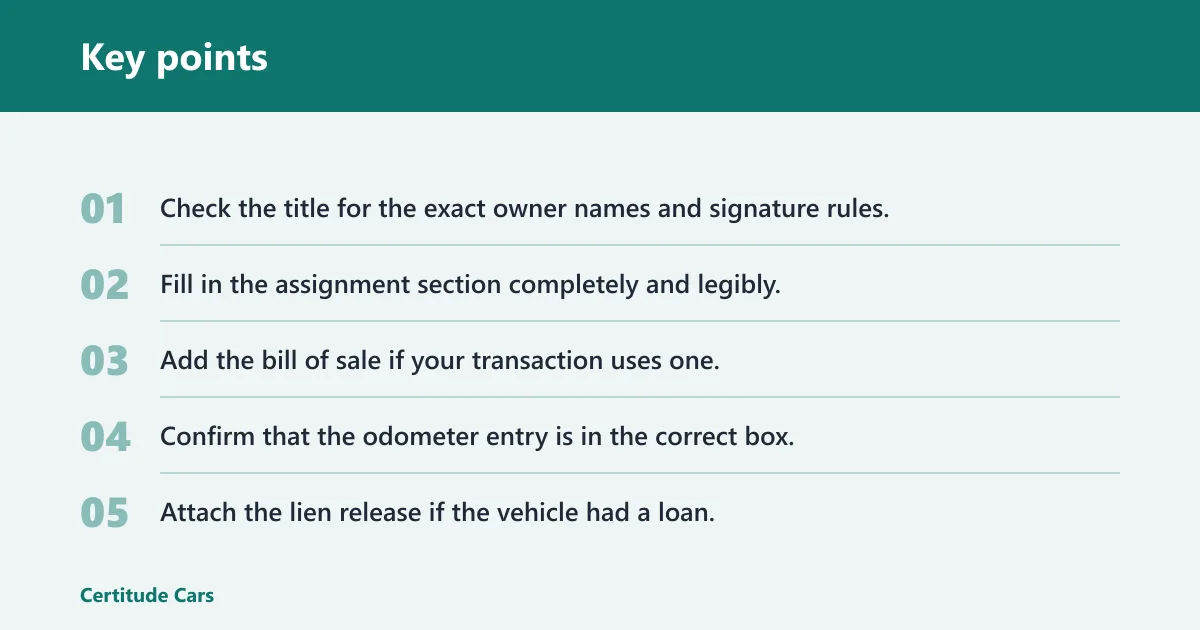
- Check the title for the exact owner names and signature rules.
- Fill in the assignment section completely and legibly.
- Add the bill of sale if your transaction uses one.
- Confirm that the odometer entry is in the correct box.
- Attach the lien release if the vehicle had a loan.
- Separate registration items, such as insurance and inspection, from the title packet.
What a title transfer checklist should include by scenario
The required packet changes by transaction type. Private sale, dealership sale, gift, inheritance, and electronic transfer do not follow the same path. The safest approach is to sort each document into one of three buckets: transfer, registration, or state-specific follow-up.
Private sale
Private sales usually need the signed title, a bill of sale, ID if the filing state requires it, and a completed odometer disclosure. If there is a lien history, add the release. Private sales are the place where missing signatures and skipped title fields cause the most avoidable delays.
Dealership sale
Dealerships often handle more of the filing, but that does not eliminate your responsibility to check the title packet. Confirm the title assignment, temporary paperwork, and any tax or fee handling before leaving. The buyer still needs to prepare for registration requirements that can follow later.
Gift transfer
A gift still needs paperwork that proves the ownership change. A bill of sale marked as a gift or a gift affidavit may be required by the state. The title still needs the correct assignment section, and the DMV may still ask for ID and other transfer forms.
Inheritance transfer
Inheritance is different because the seller may be deceased. The transfer packet may need death certificate documentation, probate or court papers, and the existing title. The person filing should expect the DMV to check authority to transfer, not just the vehicle’s name history.
Electronic title transfer
Some states use online ownership-change portals. Florida is one example: Florida Highway Safety and Motor Vehicles explains that electronic title transactions still require the buyer to complete the transfer steps, and registration generally requires proof of insurance, title fees, and registration fees before plates can be issued. In Florida, the process may run through the FLHSMV system, but the title change and registration are still separate requirements that must both be satisfied for road use.
Say your sedan is sold privately on a Saturday, and the seller forgets to complete the odometer line before handing over the title. That one blank field can turn a clean transaction into a rejected packet, even if both sides already signed everything else.
Suppose a title lists two owners joined by AND, but only one signature appears in the assignment area. The DMV can treat that as an incomplete transfer because the record still shows both owners as part of the chain of title.
What if the title is missing or signed wrong?
If the title is missing or signed wrong, the DMV may not accept the ownership change at all. A missing title usually means there is no original ownership document available to transfer. A wrong signature, crossed-out field, or altered assignment area can be just as damaging as no title.
Missing title
A lost title usually means you need a replacement or duplicate before transfer can move forward. Do not try to improvise with a photo, copy, or handwritten substitute unless your state specifically allows it. The original title is the document the DMV wants to cancel and replace.
Wrong assignment section
Using the wrong section is a common rejection trigger. The assignment area is where the seller transfers ownership, and the odometer disclosure may sit nearby or inside the same form. If the seller writes in the wrong box, the clerk may send the packet back rather than correct it at the counter.
Co-owner signature problems
Co-owner errors are frequent when the title names two owners. If the title says AND, both signatures may be required. If it says OR, one signature may be enough. The problem is not the number of signatures alone; it is whether the signatures match the wording printed on the title.
Damaged or altered title
A damaged title can still be a problem if the critical text is unreadable. Alterations, erasures, or overwritten names can trigger rejection because they raise questions about whether the document was changed after signing. If the title is torn or illegible, ask the state agency how to replace it before filing.
Can you transfer a title without insurance or registration?
Often, yes. Title transfer and registration are separate steps. Insurance is commonly needed for registration, not for the ownership change itself, and many states treat inspection the same way. You can sometimes complete the title transfer first and handle insurance, plates, and registration afterward. Texas DMV guidance treats these as separate filing issues as well, with transfer paperwork first and registration requirements following if the vehicle will be plated in Texas.
Insurance after transfer
Current insurance coverage is often listed as a transfer-related need, but that usually points to the registration step that follows. A title may move without active coverage in some states, while registration may be blocked until proof of insurance is shown. Florida buyers, for example, need proof of insurance to complete registration, while Texas also requires insurance before a vehicle can be registered for road use. For the broader requirement list, see proof of insurance.
Registration after transfer
Registration is the road-use side of the transaction. It can bring in fees, taxes, proof of insurance, and sometimes a VIN check or inspection. Do not assume a signed title means the car is ready to drive on the street with legal plates. For what happens after the ownership change, see registration fees.
State-specific inspection rules
A valid emissions or safety inspection may be required depending on the state. In some places it is part of registration, in others it is tied to title processing for an out-of-state vehicle. VIN verification can also be needed when the vehicle is titled in a new state, especially after relocation. Texas, for example, has inspection and registration rules that can depend on county and vehicle type; Florida and other states also use their own verification standards for out-of-state vehicles and rebuilt or branded titles.
Title transfer pre-flight matrix
Use this matrix before you go to the DMV. It separates the signed title packet from registration follow-up and shows the most common rejection triggers by scenario. If a line item is not needed in your state, the Texas Department of Motor Vehicles, Florida Highway Safety and Motor Vehicles, or the relevant state agency controls the final list.
| Scenario | Must-have documents | Optional documents | Notarization / duplicate title / out-of-state transfer | Insurance treatment | Common rejection triggers |
|---|---|---|---|---|---|
| Private sale | Original title signed by the current owner, bill of sale, government-issued photo ID if required by the state, odometer disclosure, lien release if financed | Inspection certificate, VIN verification for out-of-state transfer, insurance proof for later registration | Notarization only if the state or title form requires it; duplicate title needed if the original is lost; VIN verification often required when bringing the vehicle from another state | Usually transfer-only does not need insurance, but registration usually does | Missing seller signature, wrong assignment section, unreadable odometer entry, mismatched name on title or ID, no notarization where required |
| Dealership sale | Assigned title or dealer paperwork, buyer ID if the state requires it, odometer disclosure if required, lien release if applicable | Temporary registration papers, tax receipt, insurance proof for registration | Notarization usually depends on the state form, not the dealership; duplicate title may be needed if dealer assignment starts from a replacement title | Insurance usually tied to registration, not the title assignment | Incomplete dealer assignment, missing buyer details, open lien, missing supporting forms, tax paperwork not matched to the filing state |
| Gift | Signed title, bill of sale or gift affidavit, ID if required, odometer disclosure, lien release if needed | Relationship affidavit, tax-exemption form if your state uses one | Notarization may be required by the state for a gift affidavit; duplicate title needed if the original was lost; out-of-state gift transfers often still need VIN verification | Insurance usually matters at registration, not at the gift transfer step | No proof of transaction, wrong title assignment, missing ID where required, inconsistent names, gift affidavit not signed or notarized when required |
| Inheritance | Title, death certificate, court or probate papers if required, ID of filer, lien release if applicable | Affidavit of heirship, small-estate paperwork, insurance proof for later registration | Notarization can apply to heirship affidavits; duplicate title may be needed if the decedent’s title is missing; out-of-state inheritance often requires additional verification | Insurance usually needed later for registration, not for the inheritance transfer itself | No authority to transfer, missing death record, unresolved lien, incomplete probate documents, mismatch between filer and estate paperwork |
| Electronic transfer | Seller and buyer action in the portal, title details, fee payment, insurance proof for registration in states that require it | Receipt from the portal, tax confirmation, registration paperwork | Notarization depends on the underlying state rule, not the portal; duplicate-title processing may still be needed if the original record is missing; out-of-state conversion may still require VIN verification | Insurance is often registration-only, not transfer-only | One party did not complete the online step, fee not paid, insurance missing for registration, portal mismatch, online transfer not finalized in the DMV system |
What happens if a lien release is missing?
If a lien release is missing, the DMV may treat the title as still tied to the lender. That can block the transfer, delay the new title, or send you back to the lender for proof that the loan is paid off. A missing release matters even when the car was otherwise sold correctly. Texas DMV and other state agencies typically require clear lien satisfaction before the title can be fully reassigned.
Open lien status
An open lien means the lender’s interest still appears active in the record. The DMV may refuse to process a transfer until the release is provided. That is true even if the seller says the loan was paid years ago.
Paid-off loan with no release
A paid-off loan with no release is a paper problem, not a payment problem. The seller may need to contact the lender for a lien satisfaction letter or equivalent release form. Without that proof, the title packet may stop at the counter.
How the lender affects filing
The lender’s paperwork can determine whether the transfer can move forward at all. If the state wants the lien cleared before assignment, you need the release in the packet. If the state allows filing first, the lender’s release may still be needed before the new title prints.
Frequently asked questions
What is needed to transfer a title?
You usually need the original title signed by the current owner, the buyer and seller details the form asks for, and a bill of sale. A government-issued photo ID may be needed depending on the state and filing method, and a lien release may be required if the vehicle was financed. Odometer disclosure must be completed in the correct field, and some states also require notarization or a transfer form.
What do I need to transfer title?
Start with the signed title and make sure the assignment area is complete. Add the bill of sale, ID if required, and any lien release or transfer form your state requires. Then separate registration items, such as insurance or inspection, so you do not bring the wrong packet to the DMV. If the vehicle is coming from another state, expect VIN verification or inspection rules to appear in the registration step.
Can you transfer a title without insurance?
Sometimes yes, because insurance is often tied to registration rather than the title transfer itself. The state may still require proof of insurance before it issues plates or final registration. Florida is a clear example: buyers need proof of insurance to complete registration.
Can you transfer a title without registration?
Often yes. Title transfer and registration are separate steps, and the ownership change can be recorded before plates or active registration are finished. That said, the vehicle may not be legal for road use until registration, insurance, and any required inspection are complete.
Can you transfer a title without the seller present?
Sometimes yes, if the seller already signed the title correctly and all required information is in place. The key issue is whether the signed title and supporting paperwork match the state’s rules. If the title needs a live signature or notarization, the seller may need to appear. State rules differ on whether a notarized signature is enough without in-person filing.
What is needed to transfer a title in texas?
Texas title transfer is a state-specific filing path, so the exact packet should follow Texas DMV guidance. In most Texas private-party transfers, the core items are the signed Texas title, a completed title application, proof of insurance for registration, and payment of title and registration taxes or fees if the vehicle will be plated in Texas. Texas can also require an inspection before registration, and out-of-state vehicles may need VIN verification or other identity checks depending on the vehicle and county. Common Texas rejection triggers include missing signatures on the title, using the wrong form, an incomplete odometer disclosure, missing lien release, a mismatch between the title and the application, or skipping the separate registration step after the title work is filed. Texas mini checklist: signed title; application for Texas title/registration; proof of insurance if registering; lien release if applicable; inspection or VIN verification if required; payment for title, tax, and registration fees; and any county-specific documents the clerk requests.