Gas Mileage Reimbursement: How Do Mileage Rates Work?
Mileage reimbursement usually pays a per-mile rate for qualified business driving. Commuting and personal errands do not qualify. In the U.S., tax-free treatment turns on business purpose and clean records. Bad rules can create taxable wages, denied deductions, and payroll mistakes. This guide explains the 2026 mileage rate, what counts as reimbursable miles, and when a trip is taxable or excluded.
What mileage reimbursement actually pays
Mileage reimbursement is payment for using a personal vehicle for work. The standard rate is a benchmark for business travel, not a promise to cover every car expense, and it is built around operating costs rather than gasoline alone. That matters because a claim can be valid, partly taxable, or denied depending on the trip.
Fuel, wear, and fixed car costs
The 2026 benchmark business mileage rate is 72.5 cents per mile. It is based on a national study of vehicle ownership and operating costs, and it covers items such as fuel, depreciation, insurance, registration, and routine maintenance. The rate bundles variable and fixed driving costs into one figure.
The rate applies equally to gasoline, diesel, hybrid, and electric vehicles. That is useful for policy writing because the mileage rate does not change just because the car does. The claim still has to be for qualified business miles. (IRS)
Why tolls and parking are separate
Parking fees and highway tolls are reimbursable separately. They are not included in the per-mile rate, so you should list them as their own line items. Parking at the regular workplace is a commuting expense, though, so it is usually not reimbursable as business mileage.
That split matters for pay processing. A mileage claim can be approved for the miles, while tolls and parking are handled on a separate expense line if the trip itself qualifies.
What is the IRS mileage rate for 2026?
The 2026 business mileage rate is 72.5 cents per mile. Employers often use it as a reference point for reimbursement, but it is not a legal minimum pay rate. A company can set a different amount, as long as its policy and tax treatment are handled correctly.
Why employers can pay a different amount
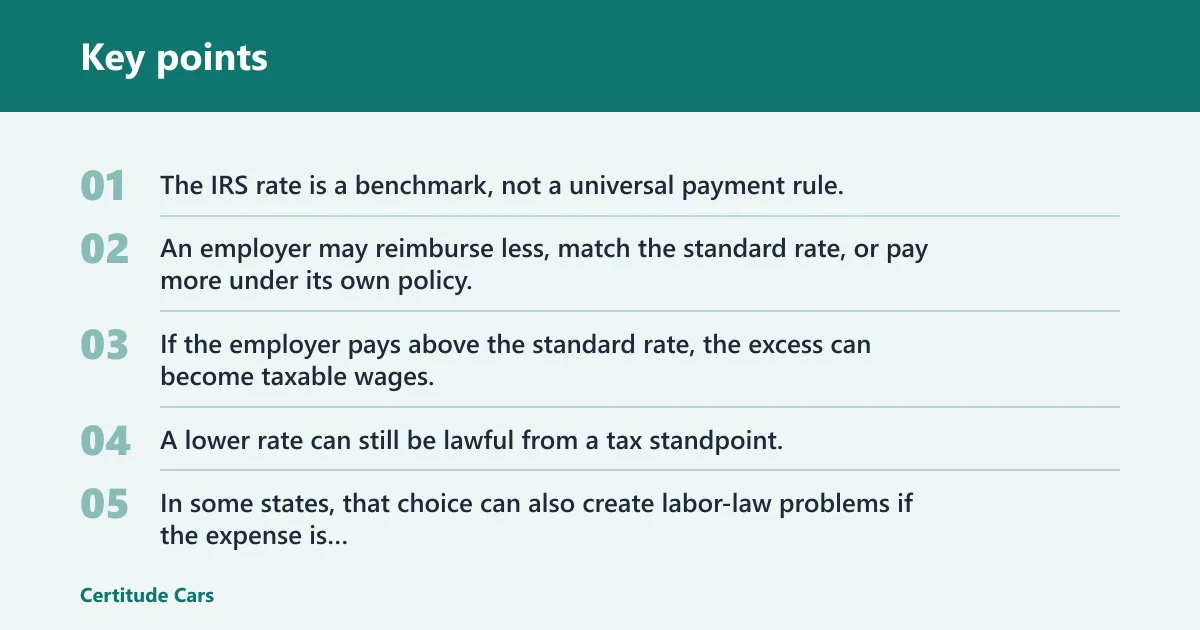
The IRS rate is a benchmark, not a universal payment rule. An employer may reimburse less, match the standard rate, or pay more under its own policy. If the employer pays above the standard rate, the excess can become taxable wages.
A lower rate can still be lawful from a tax standpoint, but it may create a policy issue for employees who absorb part of the cost of work travel. In some states, that choice can also create labor-law problems if the expense is necessary for the job.
When paying less creates a policy issue
If a company reimburses less than the benchmark, the difference is not automatically a tax issue. It can, however, become a wage complaint, an expense-policy dispute, or a state-law issue where reimbursement of necessary business expenses is required. That is why the written policy needs to spell out the rate, the trip types, and the approval rules.
Which miles count for reimbursement?
Only qualified business miles count. That means work-related travel, not ordinary commuting or personal errands. Trips to client sites and temporary work locations commonly qualify, while driving from home to a regular workplace usually does not.
Client visits and temporary work sites
Travel to meet a client, visit a job site, or reach a temporary work location is commonly reimbursable if the trip is for business. The key point is the business purpose. If the driving is part of getting work done away from the employee’s normal commuting pattern, it is more likely to qualify.
Picture an employee who drives 18 miles to a client meeting across town, then returns to the office. Those business miles can qualify if the trip is documented. The same employee’s normal home-to-office drive would not qualify.
Regular commuting and mixed-purpose trips
Regular commuting is generally excluded. Driving from home to the usual office, or from the office back home, is not reimbursable business mileage. Mixed-purpose trips need closer review because only the business portion may count, and some trips may not qualify at all if the personal reason dominates.
Suppose someone leaves home, stops at the office to pick up a file, then drives to a client. The home-to-office segment is commuting. The office-to-client segment can qualify if it is properly logged. The record should separate the two parts instead of lumping the whole trip together.
Substantiation rules for mileage logs
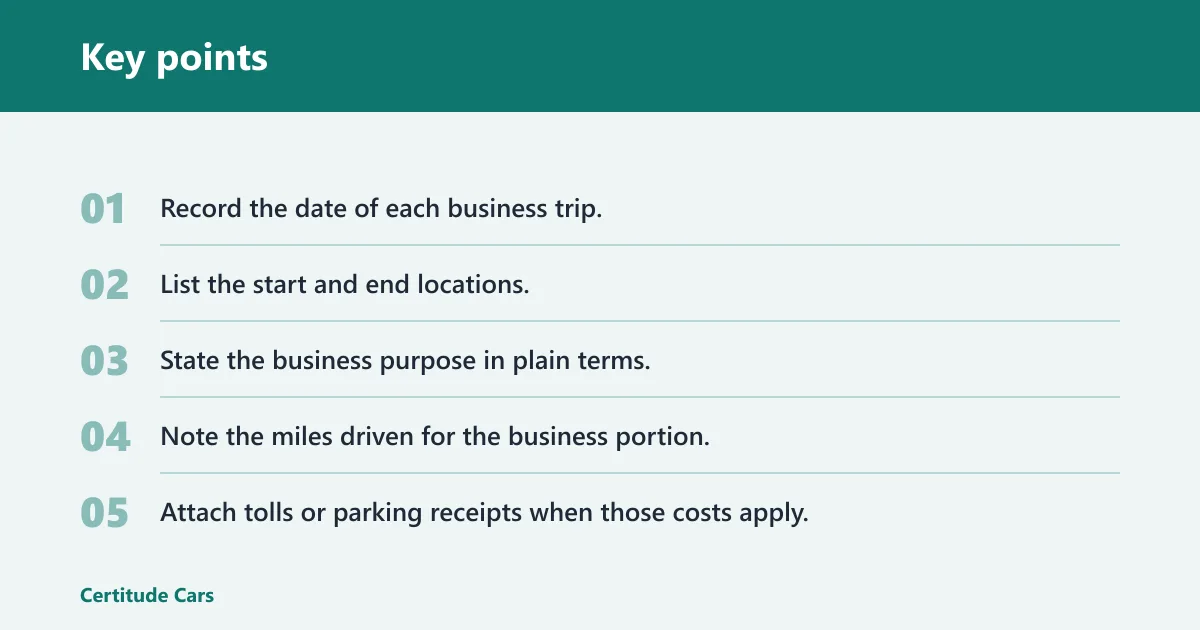
A mileage claim needs substantiation. A good log shows date, destination, business purpose, and miles driven. Without that support, the claim can be denied even if the trip was work-related. Missing or vague records are a common reason reimbursement gets reduced or reclassified.
- Record the date of each business trip.
- List the start and end locations.
- State the business purpose in plain terms.
- Note the miles driven for the business portion.
- Attach tolls or parking receipts when those costs apply.
Mileage reimbursement decision table
This table shows the usual result for common trip types. It is the fastest way to decide whether a claim should be paid, partly paid, or denied.
| Trip type | Qualifies? | Tax-free? | Documentation needed |
|---|---|---|---|
| Client visit from one work site to another | Yes, if the trip is for business | Yes, under an accountable plan | Date, destinations, business purpose, miles, and any toll or parking receipts |
| Temporary work site | Usually yes | Yes, under an accountable plan | Temporary assignment details, destination, miles, and mileage log entry |
| Regular commuting | No, in most cases | No | Generally not reimbursable; if a company allows an exception, keep the written policy and supporting records |
| Tolls on a business trip | Yes, if tied to a qualified trip | Yes, when the trip itself is reimbursable | Toll receipt or toll statement plus mileage log |
| Parking at a client site | Yes, if tied to a qualified trip | Yes, when the trip itself is reimbursable | Parking receipt plus mileage log |
| Parking at the regular workplace | No, usually a commuting expense | No | Usually not reimbursable unless a specific policy or state rule says otherwise |
How do you calculate a mileage claim?
The basic calculation is miles times rate. If the trip qualifies and the employer uses the standard rate, multiply the business miles by 72.5 cents. If the employer uses a custom rate, use that rate for the claim, then separate any taxable excess if the policy pays above the IRS benchmark.
Miles times rate
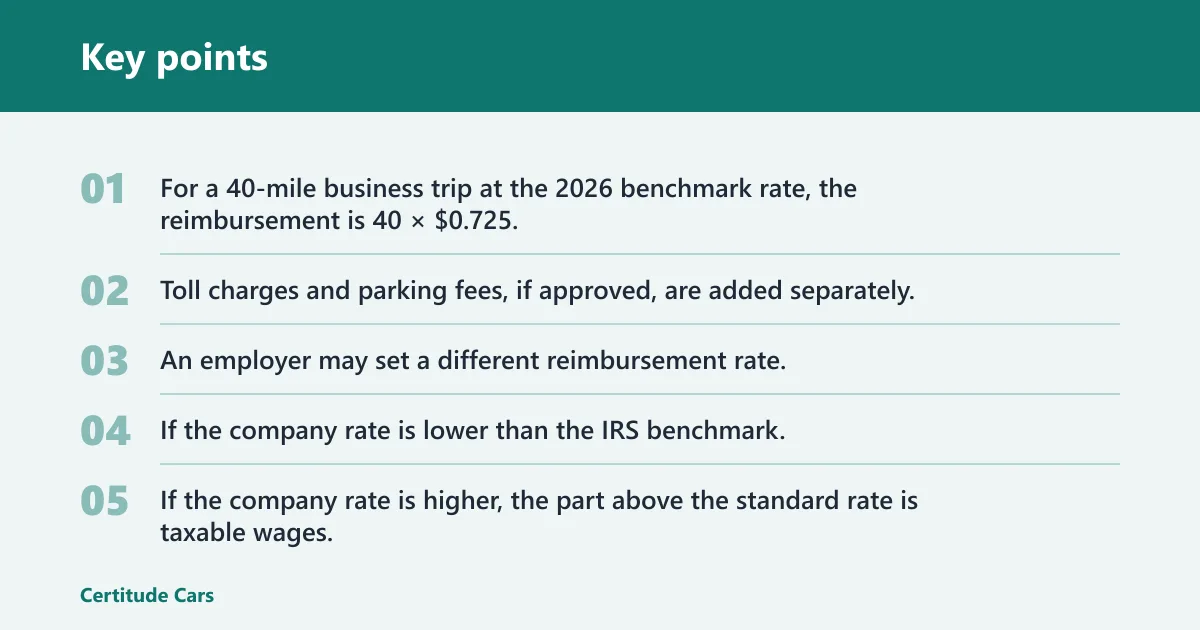
For a 40-mile business trip at the 2026 benchmark rate, the reimbursement is 40 × $0.725, or $29.00. That figure covers the mileage only. Toll charges and parking fees, if approved, are added separately.
Using an employer-specific rate
An employer may set a different reimbursement rate. If the company rate is lower than the IRS benchmark, the amount paid is still the amount paid. If the company rate is higher, the part above the standard rate is taxable wages.
A common first-timer mistake is to mix mileage and expenses into one number. Keep them separate. The mileage calculation should stand on its own, then tolls and parking are added as separate reimbursable items.
Splitting tax-free mileage from taxable excess
When the employer pays above the standard rate, split the payment into two parts. The portion equal to the standard mileage rate can be tax-free under an accountable plan if the rules are met. The excess is taxable wages and needs payroll treatment.
For example, if an employer pays 80 cents per mile and the benchmark is 72.5 cents, the excess is 7.5 cents per mile. That excess is the taxable piece, while the first 72.5 cents per mile can remain tax-free if the claim is properly supported.
Is mileage reimbursement tax free?
Mileage reimbursement is tax-free only under an accountable plan. That means the trip must have a business connection, the employee must substantiate the mileage, and any excess advance must be returned. If one of those rules fails, the payment is treated differently for tax purposes.
Accountable plan rules
An accountable plan needs three things: business connection, substantiation, and return of excess advances. If all three are met, the reimbursement can be paid tax-free. The plan should also be applied consistently so the employer treats similar claims the same way.
Nonaccountable plan treatment
If a plan is nonaccountable, it fails one or more of those rules. The payment is then reported on the W-2 as wages and is subject to income tax and payroll tax withholding. That is true even if the payment is labeled “mileage reimbursement” on the pay stub.
What happens when reimbursement exceeds the IRS rate
A custom employer rate above the IRS rate makes the excess taxable wages. The employer can still reimburse the full amount, but the payroll system has to split the payment correctly. The standard-rate portion may be tax-free under an accountable plan; the overage is not.
What state mileage rules can change the answer?
Roughly a dozen states require reimbursement of necessary business expenses, and those rules can apply regardless of salary level. That means a low-wage worker and a salaried employee may both have a claim if the expense was required for the job. Some state laws also allow interest, attorney’s fees, or enhanced damages.
States that require necessary expense reimbursement
These laws matter when a job requires driving, yet the company tries to push the cost onto the worker. The practical question is whether the expense was necessary for the employer’s business. If it was, the company may need to reimburse it even when the federal tax rule would not force a payment.
Why salary level does not always matter
Salary does not automatically remove the reimbursement duty. A state expense rule can still apply to a higher-paid worker if the expense was necessary and the policy does not properly cover it. The policy should be written to match the states where the company has employees.
Possible remedies and penalties
Depending on the state, unpaid necessary expenses can lead to more than a reimbursement bill. Interest, attorney’s fees, and enhanced damages may be available. Employers should treat mileage claims as a wage-and-expense issue, not just an accounting task.
Practical employer checklist for mileage claims
Use a single policy for approval, denial, and documentation. That keeps claims consistent and reduces payroll errors. It also makes it easier to separate tax-free mileage from taxable amounts when the payment does not fit the standard rule.
- Confirm that the trip had a business purpose.
- Reject ordinary commuting unless a written exception applies.
- Check that the mileage log includes date, route, purpose, and miles.
- Pay mileage at the company rate or the approved benchmark.
- Reimburse tolls and parking separately from mileage.
- Split any payment above the standard rate into tax-free mileage and taxable wages.
- Return excess advances when the plan requires it.
- Keep records that support W-2 reporting and state-law review.
Frequently asked questions
How do mileage reimbursement rates work?
They work as a per-mile payment for qualified business driving. First, decide whether the trip is reimbursable. Then multiply the business miles by the applicable rate. If the employer pays above the standard benchmark, the extra amount can become taxable wages and needs payroll treatment.
Does mileage reimbursement cover gas only or other car costs too?
It covers more than gas. The standard mileage rate is meant to reflect fuel, depreciation, insurance, registration, and routine maintenance. It does not replace separate reimbursement for tolls or parking, which should be handled on their own lines when the trip qualifies.
Can an employer pay less than the IRS mileage rate?
Yes. The IRS rate is a benchmark, not a floor. An employer may pay less, match it, or pay more under its own policy. Paying less can still create a state-law or policy issue if the driving was a necessary business expense.
What miles count for mileage reimbursement?
Qualified business miles count. Common examples include client visits and temporary work sites. Regular commuting usually does not count, and mixed-purpose trips need the business segment separated from the personal or commuting segment. A mileage log is the main proof for the claim.
Are tolls and parking included in mileage reimbursement?
No. Highway tolls and parking fees are reimbursable separately from the per-mile rate. Parking at the regular workplace is usually a commuting expense, so it often is not reimbursable. Keep receipts and connect each charge to a qualified business trip.
How do I calculate mileage reimbursement for a trip?
Multiply the qualified miles by the applicable rate. For the 2026 benchmark, 40 business miles equals 40 × $0.725, or $29.00. Add tolls and parking separately if the policy allows them. If the employer rate is higher, split out the taxable excess.
What happens if my employer pays above the standard mileage rate?
The amount above the standard rate is taxable wages. The employer can still reimburse the full amount, but payroll must separate the tax-free mileage portion from the excess. The excess generally belongs on the W-2 and is subject to income and payroll tax withholding.
Does mileage reimbursement apply to electric vehicles too?
Yes. The standard mileage rate applies equally to gasoline, diesel, hybrid, and electric vehicles. The vehicle type does not change the basic reimbursement rule. The key question is still whether the trip was qualified business travel and whether the log supports the claim.