What Does Vehicle MPG Mean for Real-World Fuel Costs?
Vehicle mpg means how many miles a car travels on one gallon of fuel; to estimate cost, divide your local fuel price by mpg for cost per mile. Miss it, and a “good” mpg figure can still hide a costly commute or road trip. This guide shows the arithmetic for trip, commute, and annual fuel costs.
What does vehicle mpg mean?
MPG stands for miles per gallon. A higher number means the car goes farther on the same gallon, so it uses less fuel for the same distance. A car with 50 MPG can travel 50 miles using one gallon of fuel, which makes MPG useful for comparing running costs.
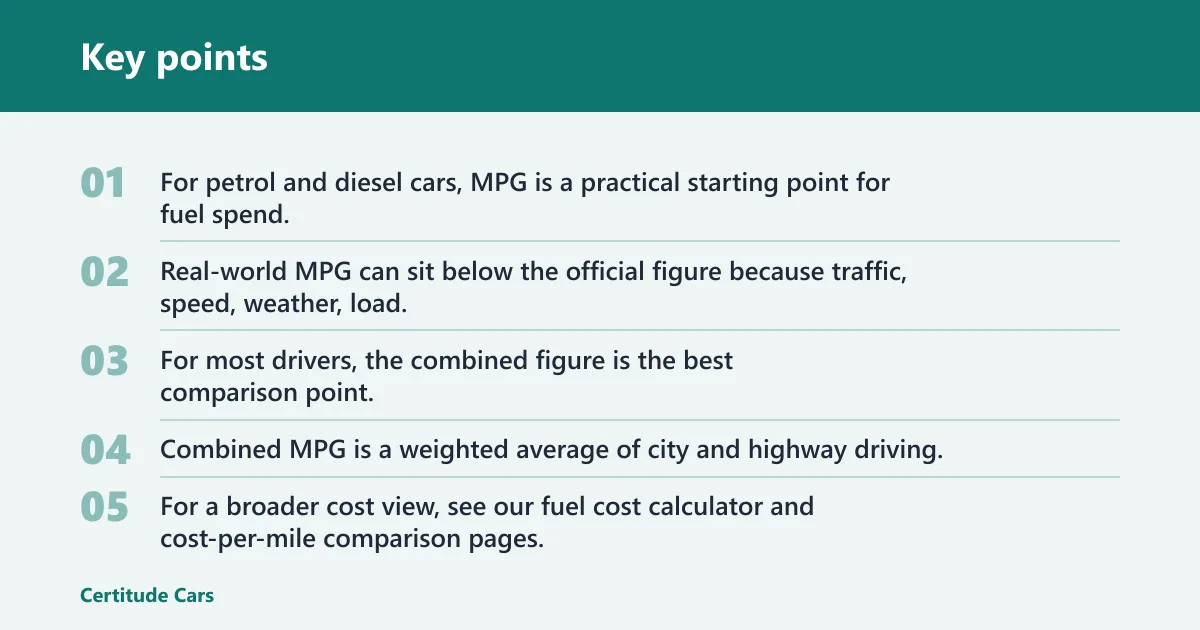
For petrol and diesel cars, MPG is a practical starting point for fuel spend. It does not tell you everything. Real-world MPG can sit below the official figure because traffic, speed, weather, load, and maintenance all change how much fuel the car burns.
For most drivers, the combined figure is the best comparison point. Combined MPG is a weighted average of city and highway driving, so it usually gives a better budgeting figure than a single city or motorway number. For a broader cost view, see our fuel cost calculator and cost-per-mile comparison pages.
What MPG means for petrol and diesel cars
Petrol cars often sit around 35-40 MPG, while over 50 is excellent, according to Direct Cars. Diesel models often return better MPG than similar petrol cars, especially on longer journeys, because they tend to use less fuel at steady cruising speeds. That is why a diesel with a higher MPG figure can cost less per mile even if the purchase price is higher.
Hybrids and plug-in hybrids can sometimes go over 60 or even 70 MPG, but only in the right driving pattern. Short trips, cold starts, and depleted batteries can drag real-world results down fast. For more on that gap, see hybrid real-world MPG.
How do you turn MPG into fuel cost?
Use this fuel cost formula: distance divided by mpg, then multiplied by fuel price. It works for a trip, a weekly commute, or a full year. If you know the miles and the price of fuel where you buy it, you can estimate spend without guessing.
Cost per mile comes from the same formula. Fuel price divided by MPG gives you the cost of one mile. Multiply that by 100 for a cost per 100 miles, which makes comparisons easier when you are looking at cars with different efficiency figures.
How to estimate a trip or annual commute
- Write down the distance in miles.
- Divide that distance by the car’s MPG figure.
- Multiply the fuel used by your local fuel price per gallon.
- Repeat the same calculation for another car if you want to compare totals.
Say your commute is 30 miles each day, five days a week, and your car returns 40 MPG. That is 150 miles a week, or about 7.5 gallons of fuel at 40 MPG. If fuel costs £6.00 per gallon, the commute uses about £45 in fuel each week.
Which gallon should you use: UK or US?
Do not compare quoted MPG figures across markets without checking the test standard and gallon type. A UK gallon is larger than a US gallon, so the same car will show different MPG numbers depending on which gallon is used. UK figures are usually quoted per imperial gallon; US figures are usually per US gallon.
MPG to money table
The table below uses a fuel price of £6.00 per gallon so the money conversion is easy to check. The fuel used column shows how much fuel 100 miles needs at each MPG figure.
| MPG | Fuel used per 100 miles | Estimated cost per 100 miles at £6.00 per gallon |
|---|---|---|
| 20 MPG | 5.0 gallons | £30.00 |
| 30 MPG | 3.33 gallons | £20.00 |
| 40 MPG | 2.5 gallons | £15.00 |
| 50 MPG | 2.0 gallons | £12.00 |
| 60 MPG | 1.67 gallons | £10.00 |
The pattern is simple. A move from 30 MPG to 40 MPG cuts fuel use from 3.33 gallons to 2.5 gallons per 100 miles. That saves £5.00 per 100 miles at the same fuel price. Over a year, that difference becomes real money.
Why is real-world MPG lower than the label?
Official MPG figures are estimates, not guarantees. Real-world MPG often drops because the test cycle does not match your exact route, traffic, weather, or driving style. A car can meet its label in one setting and miss it in another without anything being mechanically wrong. For test details, see WLTP explained and EPA label explained.
Traffic, speed, and stop-start driving
GreenCars states city MPG measures stop-and-go driving, while highway MPG measures efficiency at steady speeds. Stop-start traffic usually lowers MPG because the engine spends more time accelerating the car back up to speed. Hard acceleration and heavy braking make that worse.
Highway driving usually changes MPG too. At steady speed, many cars use fuel more efficiently than they do in traffic, but very high cruising speed can push consumption back up because aerodynamic drag rises quickly.
Cold weather and tyre pressure
Cold weather reduces efficiency in several ways. Engines take longer to warm up, oils thicken slightly, and tyre pressure can drop. Under-inflated tyres increase rolling resistance, which can reduce MPG even when everything else is normal. The U.S. Department of Energy notes that winter conditions and short trips can reduce fuel economy, while proper tyre pressure helps protect efficiency. See our tyre pressure guide for the maintenance side.
Picture a compact hatchback that usually returns 45 MPG on mixed roads. In winter, a short daily trip, low tyre pressure, and repeated cold starts can pull that figure down enough that the driver notices the difference at the fuel pump.
Load, roof racks, and maintenance
Vehicle load and aerodynamics matter. Extra weight lowers MPG, and roof racks or cargo boxes can add drag that makes the car work harder. Poor maintenance can do the same, especially if tyre pressures are low or the engine is not running as it should.
A common first-timer mistake is to blame the fuel label when the problem is really a loaded car. A full boot, four passengers, and a roof box on a motorway run can change the money-per-mile picture more than many shoppers expect.
Which MPG figure should you compare?
Combined MPG is usually the best comparison figure because it blends city and highway driving. It gives a more balanced view than using only one driving condition. For most car shoppers, it is the most useful number for side-by-side comparisons. For the formula behind it, the U.S. EPA explains that the combined label is a weighted blend of city and highway values.
WLTP and EPA figures are not the same
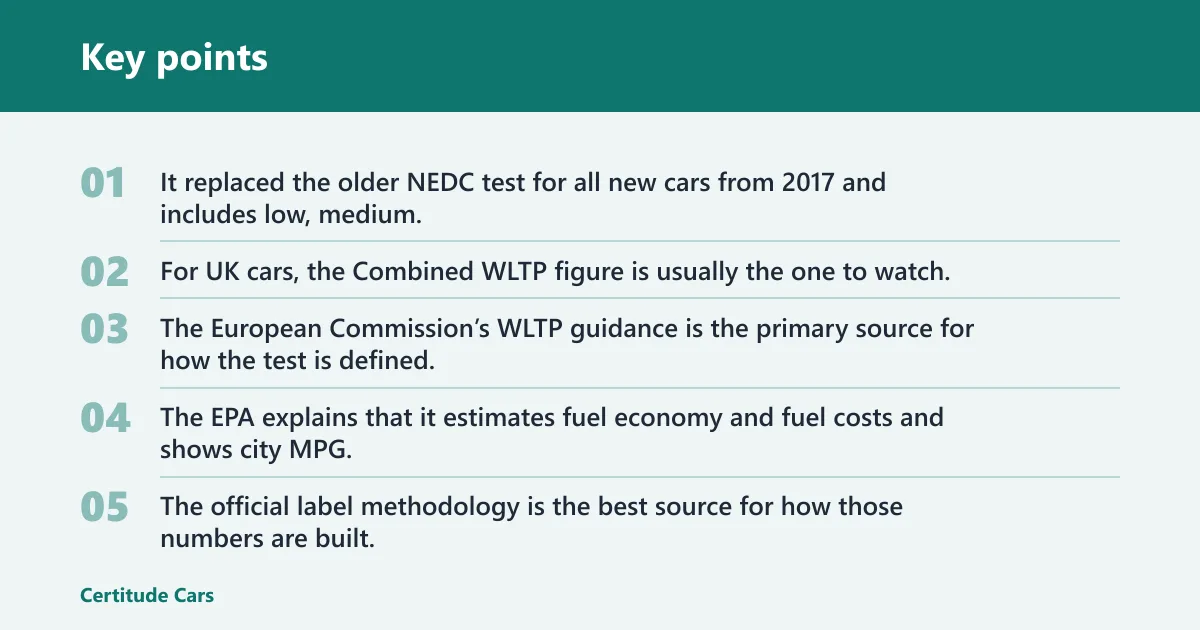
WLTP is the official UK test procedure. It replaced the older NEDC test for all new cars from 2017 and includes low, medium, high, and extra-high phases. For UK cars, the Combined WLTP figure is usually the one to watch. The European Commission’s WLTP guidance is the primary source for how the test is defined.
The EPA fuel economy label is the US system. The EPA explains that it estimates fuel economy and fuel costs and shows city MPG, highway MPG, combined MPG, and annual fuel cost; its testing framework also uses multiple cycles, including city, highway, high-speed, cold-weather, and air-conditioning testing. The official label methodology is the best source for how those numbers are built.
Do not mix WLTP and EPA figures as if they come from the same test. The numbers can both be useful, but they answer slightly different questions. If you are comparing cars from different markets, check which standard each figure uses first.
How to read city and highway MPG
City MPG matters if you sit in traffic or make short urban trips. Highway MPG matters more if your driving is mostly steady-speed A-road or motorway travel. Combined MPG remains the safer comparison when you want one number that roughly reflects mixed driving. For more context, see WLTP explained and EPA label explained.
How much fuel will a 12,000-mile year cost?
For a yearly budget, the same formula still applies: distance divided by mpg, then multiplied by fuel price. The only change is the distance. At 12,000 miles a year, even a modest MPG gap can change the fuel bill by hundreds of pounds.
Worked example at two fuel prices
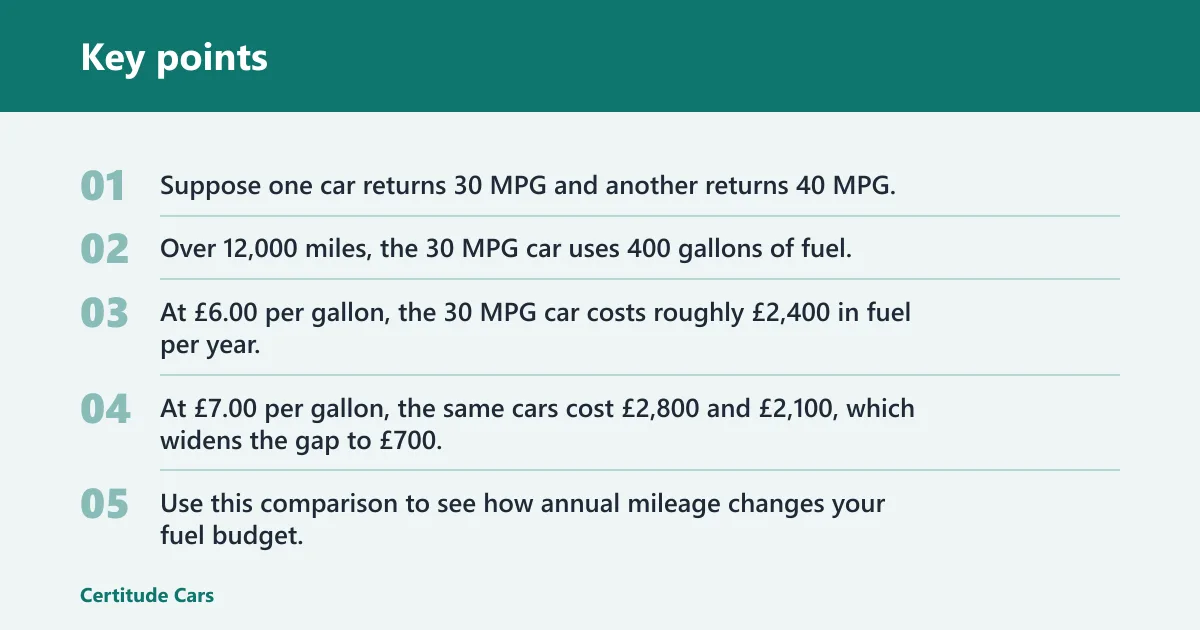
Suppose one car returns 30 MPG and another returns 40 MPG. Over 12,000 miles, the 30 MPG car uses 400 gallons of fuel. The 40 MPG car uses 300 gallons.
At £6.00 per gallon, the 30 MPG car costs roughly £2,400 in fuel per year, while the 40 MPG car costs roughly £1,800. That is a £600 difference. At £7.00 per gallon, the same cars cost £2,800 and £2,100, which widens the gap to £700.
| Annual miles | MPG | Fuel used per year | Cost at £6.00 per gallon | Cost at £7.00 per gallon |
|---|---|---|---|---|
| 12,000 | 30 MPG | 400 gallons | £2,400 | £2,800 |
| 12,000 | 40 MPG | 300 gallons | £1,800 | £2,100 |
Annual fuel cost at 8,000, 12,000, and 15,000 miles
Use this comparison to see how annual mileage changes your fuel budget. The same MPG and fuel price can create very different yearly costs depending on how far you drive. For quick planning, compare the rows that match your mileage and local fuel price.
| Annual miles | 30 MPG at £6.00/gal | 30 MPG at £7.00/gal | 40 MPG at £6.00/gal | 40 MPG at £7.00/gal | 50 MPG at £6.00/gal | 50 MPG at £7.00/gal |
|---|---|---|---|---|---|---|
| 8,000 | £1,600 | £1,866.67 | £1,200 | £1,400 | £960 | £1,120 |
| 12,000 | £2,400 | £2,800 | £1,800 | £2,100 | £1,440 | £1,680 |
| 15,000 | £3,000 | £3,500 | £2,250 | £2,625 | £1,800 | £2,100 |
Quick break-even comparison between two cars
If Car A returns 30 MPG and Car B returns 40 MPG, Car B saves one-third of the fuel. If Car B costs more to buy, divide the extra purchase price by the yearly saving to estimate how long it takes to break even.
| Comparison point | Car A | Car B | Difference |
|---|---|---|---|
| MPG | 30 MPG | 40 MPG | Car B is 10 MPG better |
| Annual fuel cost at 12,000 miles and £6.00/gal | £2,400 | £1,800 | £600 saved per year |
That is why a small MPG difference matters. A 10 MPG gap between two cars can look minor on a spec sheet, but over a year it changes the fuel budget enough to matter for real shopping decisions.
For shoppers comparing petrol, diesel, hybrid, and plug-in hybrid cars, the right question is not only “Which one has the higher MPG?” It is also “Which one returns that MPG in the kind of driving I actually do?”
Frequently asked questions
What does mpg mean for a car?
For a car, MPG tells you how much fuel it needs to cover a given distance. A car with higher MPG is cheaper to run per mile than a similar car with lower MPG, assuming fuel price and driving conditions are the same. It is a budget tool, not a guarantee.
What is a car mpg?
Car MPG is the miles-per-gallon figure shown by the manufacturer or test authority. It helps you compare fuel use between cars and estimate trip or annual fuel costs. Combined MPG is usually the most useful single figure because it blends city and highway driving.
What is mpg in fuel consumption?
In fuel consumption terms, MPG shows how efficiently a car turns fuel into distance. A higher MPG means lower fuel consumption for the same trip. You can convert it into money by dividing the distance by MPG and multiplying by the fuel price per gallon.
Why is my real-world mpg lower than the sticker figure?
Real-world MPG can be lower because the label is based on a test cycle, not your exact route. Traffic, speed, cold weather, tyre pressure, extra load, roof racks, and hard acceleration all reduce efficiency. Even a well-maintained car can return less than its official figure.
How do I estimate fuel cost from mpg?
Use the formula: distance divided by MPG, then multiplied by fuel price. That gives you fuel used and estimated cost for a trip, a month, or a year. For easier comparison, also calculate cost per 100 miles by multiplying fuel used per mile by 100.
How much fuel will my commute use at a given mpg?
Take your annual commute miles and divide by MPG to find gallons used. Then multiply by fuel price to find cost.
Sources
- EU Commission: Worldwide harmonised Light vehicles Test Procedure (WLTP)
- U.S. EPA / FuelEconomy.gov: Learn More About the Fuel Economy Label
- U.S. EPA / FuelEconomy.gov: Fuel Economy Test Schedules
- U.S. EPA / FuelEconomy.gov: Why is my MPG lower than the estimate?
- U.S. Department of Energy: Fuel Economy
- U.S. EPA / FuelEconomy.gov: MPG and Fuel Cost Calculations