What Does Tire Size Mean on a Car Tire?
Tire size is the code on the sidewall, such as P215/65R17. It tells you tire width, aspect ratio, construction, and wheel diameter. For replacement, the rim diameter must match exactly, and the load index and speed rating must meet or exceed the vehicle spec. Wrong sizing can cause rubbing, speedometer error, poor handling, and unsafe load capacity. This guide explains each part of the code, what must stay the same, what can change, and where to confirm the correct size on your car.
Tire size basics
Tire size is a fitment code, not a random label. It tells you whether the tire matches the wheel, the vehicle’s load needs, and the speed capability the maker expects. A sidewall code such as P225/65R17 or 225/55R17 97H may look simple, but each part controls a different fitment check.
What the code looks like
The size is printed on the tire sidewall in a standardized format. The first letter or letters can identify tire type, then come the width, aspect ratio, construction, wheel diameter, and often load and speed information. If you are replacing tires, treat the code as a checklist. Do not treat it as a suggestion.
A common first-timer mistake is to shop by a size that “looks close.” For example, a tire marked 225/55R17 may fit a 17-inch wheel, but that does not mean it is approved for your vehicle. The door jamb placard and owner’s manual decide that.
What do the numbers on the sidewall mean?
The numbers and letters on the sidewall tell you the tire’s width, sidewall proportion, construction type, and wheel diameter. In a code like P225/65R17, the first number is width, the second is aspect ratio, the letter shows construction, and the last number is wheel diameter. Those pieces must fit the wheel and the vehicle together.
Width in millimeters
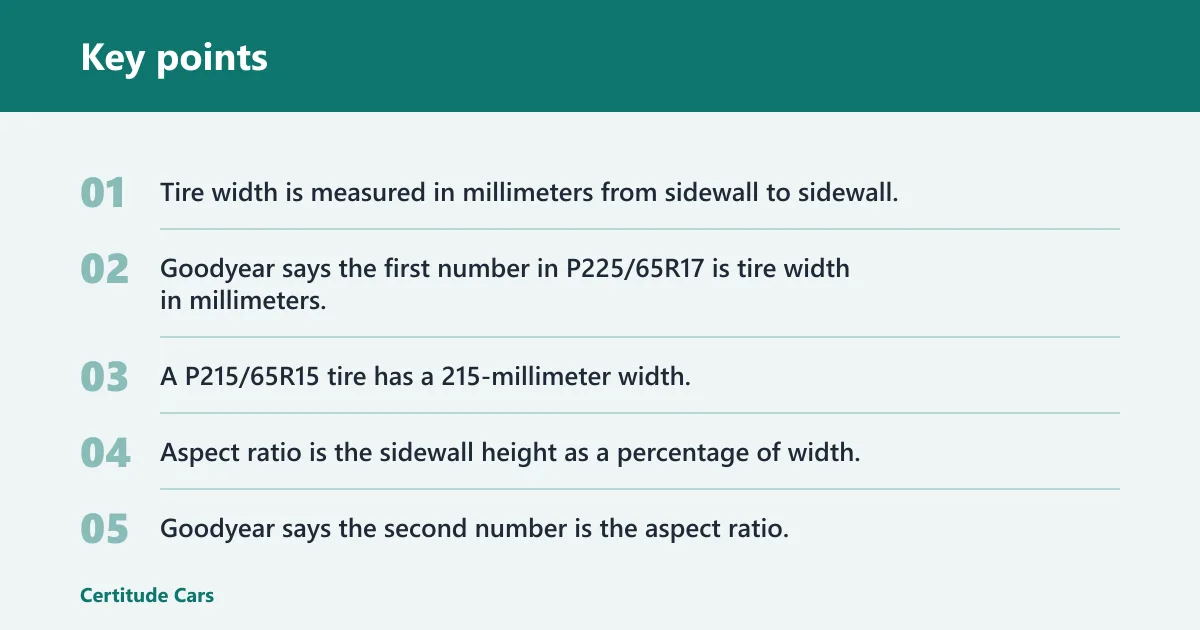
Tire width is measured in millimeters from sidewall to sidewall. Goodyear says the first number in P225/65R17 is tire width in millimeters, and Car and Driver notes that 225 indicates the tire width at its widest point. A P215/65R15 tire has a 215-millimeter width.
Aspect ratio as sidewall height
Aspect ratio is the sidewall height as a percentage of width. The same source says the second number is the aspect ratio. Car and Driver says 55 means the sidewall height is 55 percent of width. Lower numbers mean shorter sidewalls, which usually change steering feel and ride quality. (Caranddriver)
Radial construction and wheel diameter
R stands for radial construction, and most modern passenger tires use radial construction. The final number is the wheel diameter in inches. A P215/65R15 tire fits a 15-inch wheel, so the rim diameter must match exactly. If the wheel is the wrong diameter, the tire will not seat correctly.
Picture a sedan that wears 215/65R17 tires from the factory. If someone orders 215/65R16 tires by mistake, the tire may look close on paper, but it will not fit the 17-inch wheel. That is a wheel-diameter mismatch, and it stops the replacement before anything else matters.
What do load and speed ratings mean?
Load index and speed rating are part of the tire’s safety code. The load index is the maximum weight per tire when properly inflated, and the speed rating is the tire’s maximum sustained speed capability. They are not decoration. Continental says approved tire size must match load index and speed rating.
Load index
The load index is a numeric rating for how much weight one tire can carry at the specified inflation pressure. It should not be lower than the vehicle specification. If you go below the placard or manual spec, you reduce the margin the vehicle designer built into the setup.
Speed rating
The speed rating is a letter rating such as H, V, W, or Y. An H-speed rating has a maximum speed capability of 130 mph. That does not mean you should drive at that speed; it means the tire is built and tested for that capability when used as intended.
Say your door placard calls for a 225/55R17 97H tire and a shop offers 225/55R17 94T because it is cheaper. The size may look similar, but the load and speed ratings no longer match the vehicle spec. That is a mismatch to avoid, even when the width and wheel diameter are the same.
What do P, LT, and Euro-metric markings mean?
These markings identify tire type and intended use. The same nominal size can still vary by service type, load capacity, and application. The letter before the size, or a Euro-metric format, helps tell you whether the tire is meant for a passenger car, light truck, or a different metric standard.
Passenger tire markings
The first letter can identify a P-Metric tire for passenger vehicles. That prefix matters because it signals the tire’s intended use and rating structure. A P-metric tire is common on cars, crossovers, and many SUVs that are set up with passenger-type tires.
Light-truck markings
LT indicates a light-truck tire. LT tires are built for different service needs than passenger tires, and the load capacity and ride characteristics can differ. A tire that fits the wheel physically may still be the wrong type for the vehicle’s intended use.
Euro-metric and why type matters
Euro-metric tires do not use the same prefix as P-metric tires, but they still need the same fitment checks. The type marking affects load capacity and intended use, so do not assume that two tires with the same width and wheel diameter behave the same way. Always check the vehicle placard and manual.
Where to find your tire size
The driver’s door jamb placard and the owner’s manual are the most reliable sources. The same source says the correct tire size can be found on the driver’s door jamb. The sidewall can tell you what is mounted now, but it may not be the right replacement size if someone changed the wheels or tires before.
Door jamb placard
The door jamb placard is the vehicle-specific reference for recommended tire size and inflation pressure. Use it first. If the sidewall size on the car differs from the placard, the placard wins for replacement decisions unless the owner’s manual gives a different approved fitment for a specific wheel or package.
Owner’s manual
The owner’s manual lists approved tire sizes and inflation specs. It is useful when the sidewall size on the vehicle does not answer the full question, or when the vehicle offers more than one approved wheel and tire combination. Use the manual to confirm that the replacement size is actually allowed.
Suppose your car wears 225/60R18 tires, but the placard lists 235/55R18. The sidewall tells you what is on the car now, not necessarily what the vehicle should keep. That is why the placard and manual come first when you shop for replacements.
Tire size decoding checklist
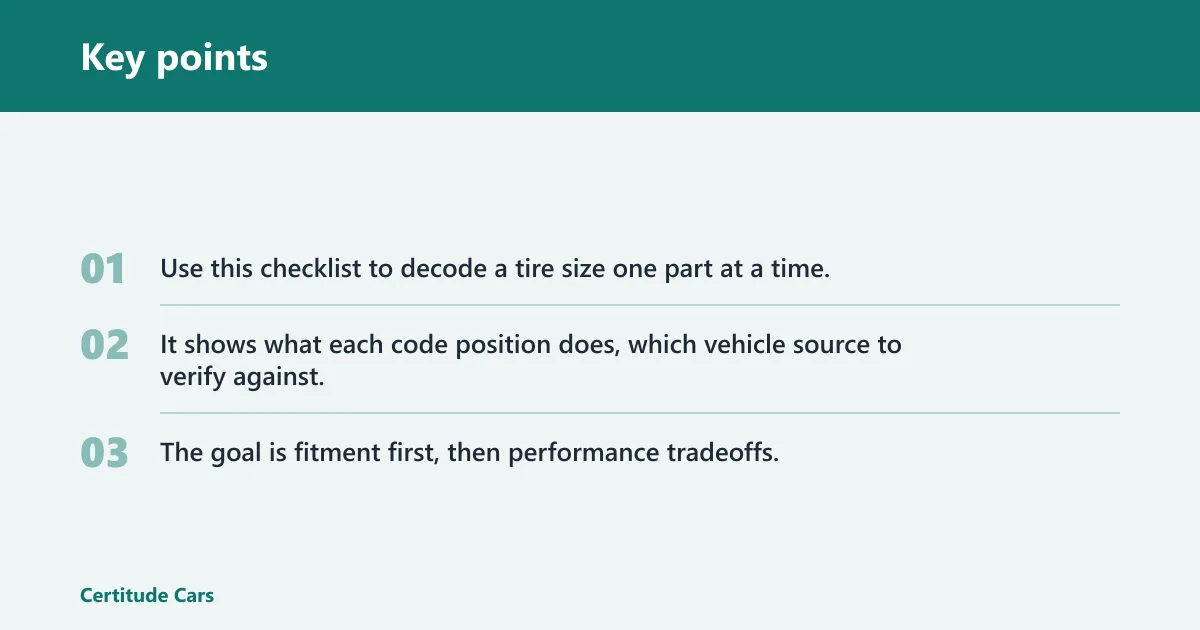
Use this checklist to decode a tire size one part at a time. It shows what each code position does, which vehicle source to verify against, what mismatch to avoid, and what to check if you want to change size. The goal is fitment first, then performance tradeoffs.
| Code position | What it does | Verify against | Red-flag mismatch | If you change size |
|---|---|---|---|---|
| Prefix or type mark, such as P or LT | Shows tire type and intended use | Door jamb placard, owner’s manual | Passenger tire swapped for LT without approval | Confirm the vehicle accepts that tire type before buying |
| First three-digit number | Tire width in millimeters | Sidewall, door jamb placard, owner’s manual | Width that contacts suspension or fender parts | Check clearance and speedometer effect |
| Second number after the slash | Aspect ratio, or sidewall height as a percentage of width | Sidewall, owner’s manual | Sidewall too tall or too short for wheel well space | Confirm ride, clearance, and speedometer impact |
| Letter R | Radial construction | Sidewall, door jamb placard | Non-matching construction for the wheel or spec | Keep construction type aligned with the approved fitment |
| Final number | Wheel diameter in inches | Door jamb placard, owner’s manual | Tire diameter that does not match the wheel exactly | Wheel diameter must stay exact unless the wheel is changed too |
| Load index | Maximum weight per tire when properly inflated | Door jamb placard, owner’s manual | Load index below vehicle spec | Do not go lower than the placard or manual rating |
| Speed rating | Maximum sustained speed capability | Door jamb placard, owner’s manual | Speed rating below vehicle spec | Meet or exceed the listed rating |
What changes if you choose another size?
Changing tire size can change handling, ride comfort, clearance, and speedometer reading. It can also change load capacity if the replacement tire uses a different load index. Some changes are technically compatible only when the wheel, vehicle, and approved fitment all line up. A similar size is not automatically acceptable.
Width and clearance
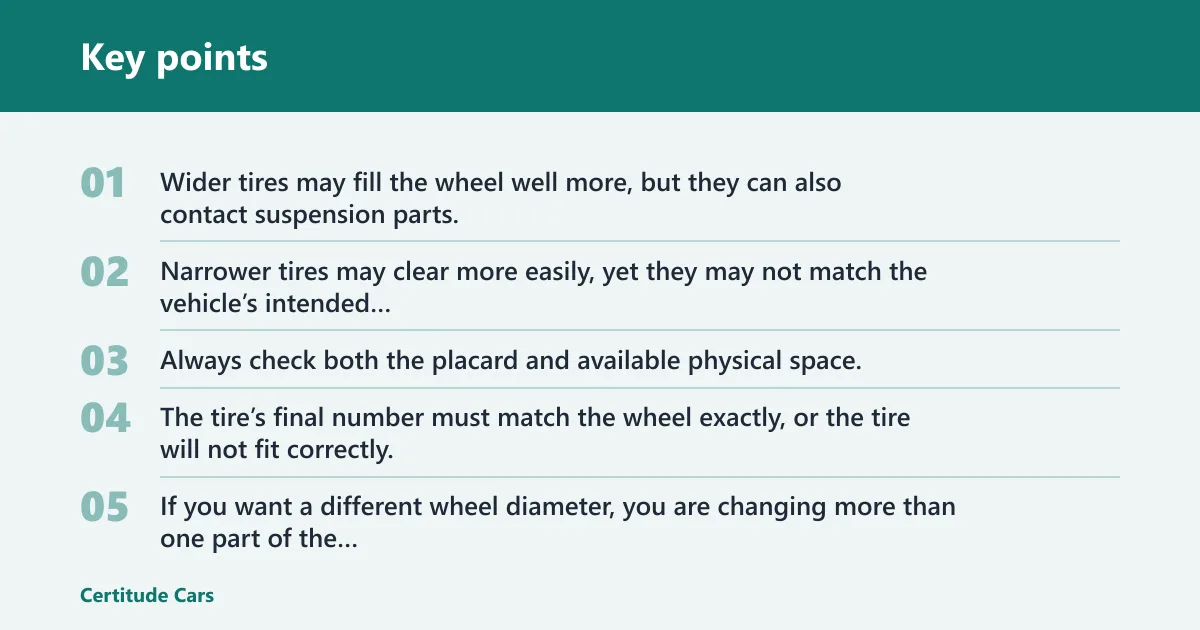
Wider tires may fill the wheel well more, but they can also contact suspension parts, fender liners, or the outer body. Narrower tires may clear more easily, yet they may not match the vehicle’s intended footprint. Always check both the placard and available physical space.
Wheel diameter and fitment
Wheel diameter is the hardest limit. The tire’s final number must match the wheel exactly, or the tire will not fit correctly. If you want a different wheel diameter, you are changing more than one part of the package, and the new combination must still meet the vehicle’s approved spec.
Speedometer and load capacity
A different overall tire diameter can change speedometer reading, because the tire travels farther or less far with each rotation. Load capacity can also change if the load index changes. That is why replacement size should be checked against the placard, not chosen by appearance alone.
What does tire size change in daily driving terms? It affects how the car turns, how much road feel reaches the cabin, and how close the speedometer stays to true road speed. Those effects are small when the approved size is followed, and larger when the size strays far from spec.
Frequently asked questions
What does a tire size mean?
A tire size is the code that tells you the tire’s width, sidewall proportion, construction, wheel diameter, load index, and speed rating. It is a fitment code first. For replacement, you need the vehicle’s approved size from the door jamb placard or owner’s manual, not a guess from the sidewall alone.
What does the size on tires mean?
The size on tires means the tire’s physical dimensions and service limits in one standardized format. The width, aspect ratio, and wheel diameter control fitment. The load index and speed rating control whether the tire meets the vehicle’s requirements. A matching wheel diameter is non-negotiable.
What tire size is on my car?
Check the driver’s door jamb placard first. The same source says the correct tire size can be found there, and the placard also lists inflation pressure. If the current sidewall size differs from the placard, confirm the approved size in the owner’s manual before you buy replacements.
What size tires are on my car?
The tires on your car are the size printed on the sidewall now, but that is not always the correct replacement size. Use the sidewall to identify what is mounted, then use the door jamb placard and owner’s manual to verify what the vehicle should actually carry.
What does tire size mean on a car tire?
On a car tire, the size tells you how wide the tire is, how tall the sidewall is relative to the width, what construction it uses, and what wheel it fits. It also includes ratings for load and speed. Those values control fitment and safety, not just appearance.
What difference does tire size make?
Tire size affects handling, ride quality, clearance, and speedometer reading. A wider or shorter sidewall tire can change steering response, while an overall diameter change can alter indicated speed. If the load index or speed rating drops below spec, the tire may no longer match the vehicle’s requirements.