What Is Fuel Grade and What Do the Numbers Mean?
Fuel grade is the pump label for octane rating. A higher number means more knock resistance, not more power. Use the grade your owner’s manual names. Using the wrong grade can cause knock, rough running, extra fuel cost, or damage in some engines. This guide explains the numbers, the country-to-country differences, and how to choose the correct pump grade.
What is fuel grade?
Fuel grade is the label on a gasoline pump that groups fuels by octane rating. It does not mean cleaner fuel, fresher fuel, or better fuel in a broad sense. It tells you how well the fuel resists engine knock, which is why some engines need a higher number.
Regular, mid-grade, and premium
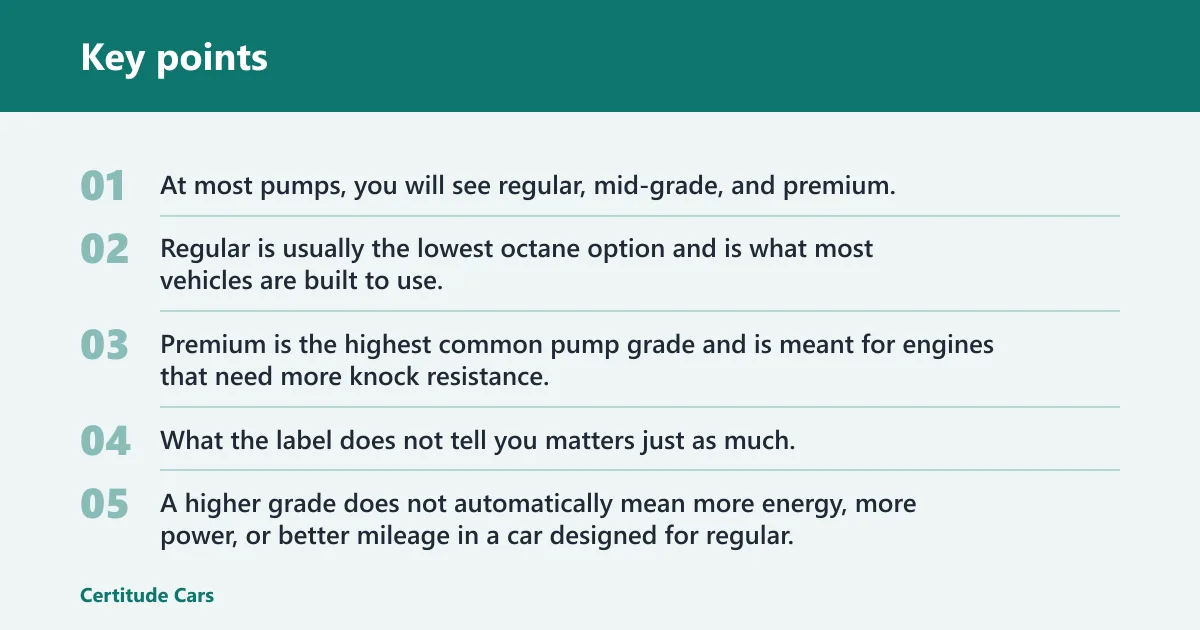
At most pumps, you will see regular, mid-grade, and premium. Regular is usually the lowest octane option and is what most vehicles are built to use. Mid-grade sits between regular and premium. Premium is the highest common pump grade and is meant for engines that need more knock resistance.
What the label does not tell you matters just as much. A higher grade does not automatically mean more energy, more power, or better mileage in a car designed for regular.
What do the numbers on the pump mean?
The number on the pump is an octane rating. It measures how well the fuel resists knock under pressure, heat, and load. Higher octane does not mean more chemical energy. It means the fuel can handle harder combustion conditions before knock starts.
Why higher numbers are not more energy
Gasoline grades are about knock resistance, not fuel strength in the everyday sense. A car designed for 87 octane usually does not gain extra power from using 91 or 93. In an engine that does need higher octane, the correct grade lets the engine keep its intended timing and output.
Why the number is only one part of the choice
The number on the pump matters, but engine design matters too. Compression ratio, turbocharging, ignition timing, and boost levels all affect knock risk. That is why two vehicles can react very differently to the same grade.
AKI vs RON
The same fuel can show different numbers depending on the rating method used in the market. In the United States, pump labels often show AKI, or Anti-Knock Index. In many other countries, pumps show RON, or Research Octane Number. RON is usually higher than AKI for the same fuel.
United States pump labels
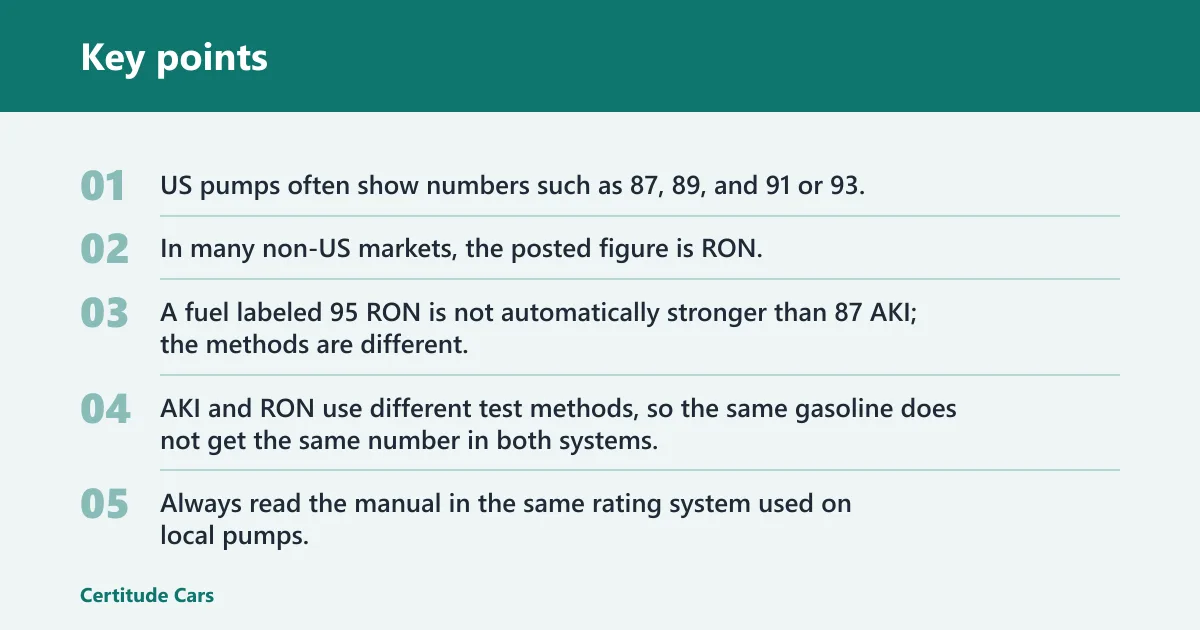
US pumps often show numbers such as 87, 89, and 91 or 93. Those figures are AKI values. They are the numbers most US owner’s manuals use when they specify minimum fuel grade.
Many non-US pump labels
In many non-US markets, the posted figure is RON. That can make fuel look “better” on paper even when it is the same general grade. A fuel labeled 95 RON is not automatically stronger than 87 AKI; the methods are different.
Why the same fuel can show different numbers
AKI and RON use different test methods, so the same gasoline does not get the same number in both systems. That is why the number alone means less if you do not know the market. Always read the manual in the same rating system used on local pumps.
As a rough guide, 87 AKI is about 91 RON, 89 AKI is about 93 RON, and 91–93 AKI is about 95–98 RON. The exact equivalence is approximate, and labels differ by market, so the owner’s manual and local pump system still control the final choice.
| Grade name | Typical pump octane label | Market naming | What it resists | When to use it | Driver decision rule |
|---|---|---|---|---|---|
| Regular gasoline | 87 AKI in the US; often 91 RON in many other markets | Base grade | Normal knock resistance for most engines | Use when the owner’s manual lists regular or a lower minimum grade | Choose regular if the manual says it is acceptable |
| Mid-grade gasoline | 89 AKI in the US; often a midpoint RON value in other markets | Intermediate grade | More knock resistance than regular, less than premium | Use only if the manual allows or recommends a middle grade | Buy it only when the manual or fuel door label points to it |
| Premium gasoline | 91-93 AKI in the US; often 95-98 RON elsewhere | Top common pump grade | Highest common pump knock resistance | Use when the engine is designed to require higher octane | Use premium only when the manual calls for it |
Which fuel grades are at the pump?
Most stations offer three broad gasoline grades: regular, mid-grade, and premium. The names are common, but the octane numbers behind them vary by country and brand. The right choice depends on what your vehicle’s manufacturer asks for, not on the most expensive nozzle.
Regular gasoline
Regular is the most common base grade at the pump. It is usually the lowest octane option and the grade most vehicles are built around. For many cars, it is the correct fuel and the only grade you need.
Mid-grade gasoline
Mid-grade is the middle option, often priced between regular and premium. It is sometimes a blend of lower and higher grades, depending on the station. For many drivers, it is a pricing middle ground rather than a fuel the engine needs.
Premium gasoline
Premium is the highest common pump grade. It is recommended for some turbocharged, high-compression, or performance-oriented engines. It is not automatically more powerful for every vehicle, and it does not replace the fuel grade named in the owner’s manual.
Say your sedan’s manual says “minimum 87 AKI” and the fuel door repeats that number. Regular is the right choice. Buying premium will not change the engine’s design requirement, so the extra cost usually buys nothing for that car.
Why do some engines need higher octane?
Some engines need higher octane because their design raises knock risk. Higher compression ratio, more boost from turbocharging, and more aggressive timing can make the air-fuel mixture more likely to ignite in an uncontrolled way. Higher octane helps resist that knock.
Engine knock in simple terms
Engine knock is abnormal combustion. Instead of burning in a controlled sequence, part of the mixture ignites at the wrong time or in the wrong way. That can make noise, reduce performance, and force the engine control system to pull timing to protect the engine.
Compression ratio and knock risk
Compression ratio matters because squeezing the air-fuel mixture harder raises temperature and pressure before ignition. Higher compression often means higher octane is needed to avoid knock. That is why some naturally aspirated engines need premium even without a turbo.
Turbocharged engines and octane needs
Turbocharging increases the amount of air entering the engine, which raises cylinder pressure. More pressure can increase knock risk. Many turbocharged engines are tuned to run on regular fuel, but some need premium to keep their designed timing, output, and protection strategy.
For example, a compact SUV with a turbo engine may run on 87 AKI, but the manual may recommend 91 AKI for full output. That means regular may still be acceptable, yet premium can help the engine reach its intended performance calibration. The manual decides which case applies.
How should you choose the right grade?
The owner’s manual is the source for the correct fuel grade. The fuel door label often repeats the same requirement. If the manual lists a minimum octane, use at least that number in the rating system shown on local pumps. Guessing costs more than checking.
Read the owner’s manual
Look for fuel requirements in the fuel, specifications, or maintenance section. Many manuals list a minimum octane and sometimes a recommended octane. The minimum is the floor you should not go below; the recommendation may give the engine its best calibration.
Check the fuel door label
Many vehicles print the required octane on the inside of the fuel door or near the filler cap. That label is handy at the station, but it should match the manual. If the two disagree, the manual is the better reference.
Minimum versus recommended octane
A minimum octane rating means the engine can safely run on that grade. A recommended higher octane may improve how the engine performs under load, even if the car can still run on the lower grade. If the manual says “premium recommended,” that is different from “premium required.”
Use this quick decision framework: if the manual says regular is acceptable, buy regular; if it says premium required, buy premium; if it says premium recommended, weigh the performance benefit against the extra cost. For towing, high heat, heavy load, mountain driving, or a persistent knock problem in an older engine, use the manual’s higher-octane guidance rather than guessing at the pump.
Quick checklist
- Check the owner’s manual first.
- Confirm the fuel door label.
- Match the rating system used on local pumps.
- Use the minimum listed grade or higher.
- Do not assume premium is better if the engine does not need it.
Plain-text decision guide
If the manual says regular is acceptable:
- Buy regular.
- Mid-grade is usually optional.
- Premium is usually unnecessary.

If the manual says premium required:
- Buy premium.
- Regular may cause knock control to reduce performance.

If the manual says premium recommended:
- Regular may be usable if the manual allows it.
- Premium may preserve full performance under load.

Edge cases:
- Towing, high heat, heavy load, or mountain driving can increase knock risk.
- Older engines with persistent knock may need the higher grade named by the manual.
A common mistake is assuming the highest octane pump is always the right match for every engine. If the vehicle calls for regular, premium does not usually add value. If the vehicle calls for premium, regular may trigger knock control strategies that reduce power.
A simple mixed-grade rule also helps: blending two grades in the tank gives you an in-between octane level, not a magic upgrade. That can be useful if you are topping off and need to move the average upward, but it does not replace the manufacturer’s minimum requirement.
| AKI | RON | Where it is commonly used | What to remember |
|---|---|---|---|
| Anti-Knock Index | Research Octane Number | AKI: United States and Canada; RON: many other markets | RON usually reads higher than AKI for the same fuel |
Frequently asked questions
What are the grades of fuel?
The common gasoline grades at the pump are regular, mid-grade, and premium. Regular is usually the lowest octane option, mid-grade sits in the middle, and premium is the highest common grade. The exact numbers depend on whether the market uses AKI or RON.
What is the difference between fuel grades?
The main difference is octane rating, which changes knock resistance. Higher grades resist knock better under high load, higher compression, or turbo boost. For most cars, the grade difference does not mean a difference in power, energy content, or cleanliness.
What are the gasoline grades?
Gasoline grades are the labeled pump options you choose from, usually regular, mid-grade, and premium. In the United States, those labels are typically AKI numbers such as 87, 89, and 91 or 93. In many other countries, the labels are usually RON values.
What fuel grade should I use in my car?
Use the grade listed in the owner’s manual, then confirm it on the fuel door if needed. If the manual says regular is acceptable, use regular. If it says premium required, use premium. If it says premium recommended, that may matter for full performance.
Can you mix fuel grades in the same tank?
Yes. Mixing fuel grades in the same tank is generally fine because the result is simply an in-between octane level. That can be useful if you need to raise the average grade slightly, but it is not a substitute for using the proper minimum grade listed by the manufacturer.
What does fuel stand for?
Fuel does not stand for a technical acronym in this context. On a pump, the important term is fuel grade, which refers to the octane-based label on gasoline. The label helps you pick the right grade for the engine, not the “best” one in the abstract.