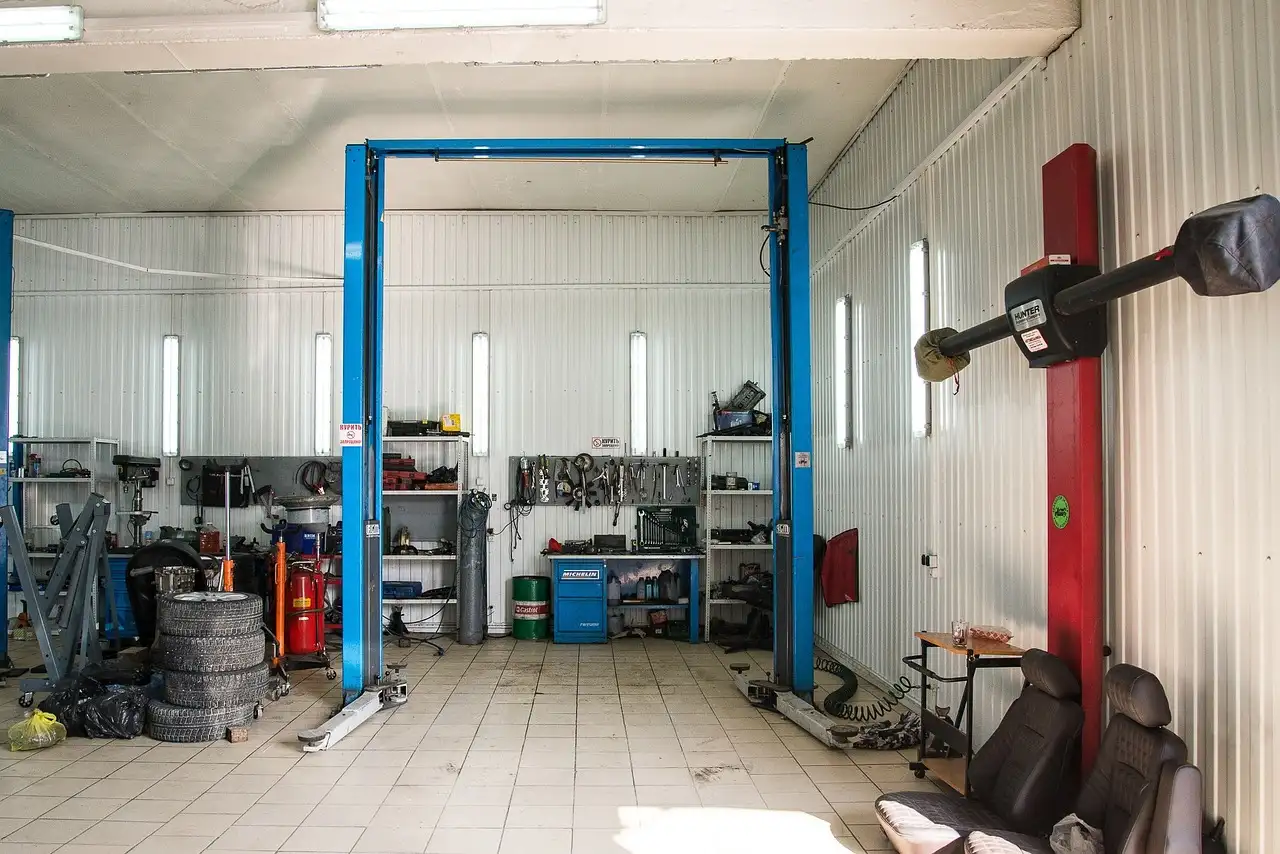
Maintenance Costs for Cars: What to Expect
Expect car maintenance and repair costs to average roughly 9 to 15 cents per mile, but a usable budget is often a baseline of about $600 to $1,200 a year, plus a repair reserve that tends to rise with age and mileage. A single average can miss oil, tires, brakes, battery, and age-related repairs by hundreds or thousands in one year. This guide breaks costs into fixed routine service, mileage-driven wear, and age-related repair risk so you can build a monthly and annual budget.
What does car maintenance cost actually include?
Car maintenance cost is not one bill. For budgeting, split it into fixed ownership costs, mileage-linked running costs, scheduled service, and age-triggered repair risk. That gives you a more useful monthly and yearly number than one broad average, because insurance, fuel, oil service, tires, and older-car failures do not show up on the same schedule.
Routine maintenance, repairs, and broader ownership costs
Routine maintenance is planned service: oil changes, tire rotations, fluid checks, filters, spark plugs, and brake fluid service at scheduled intervals. Repairs are fault-driven or wear-driven fixes after something fails or reaches its limit, such as a leaking water pump, a seized brake caliper, or an electrical fault in a driver-assistance sensor.
Broader ownership costs go beyond maintenance. Elvia separates maintenance into fixed costs and variable costs, and that split helps because some bills arrive even when the car barely moves. Insurance, road tax, motorway sticker, and parking space fit the fixed bucket. Fuel, oil, tyres, brake pads, lights, repairs, and depreciation belong on the variable side.
The four cost buckets that most averages blur together
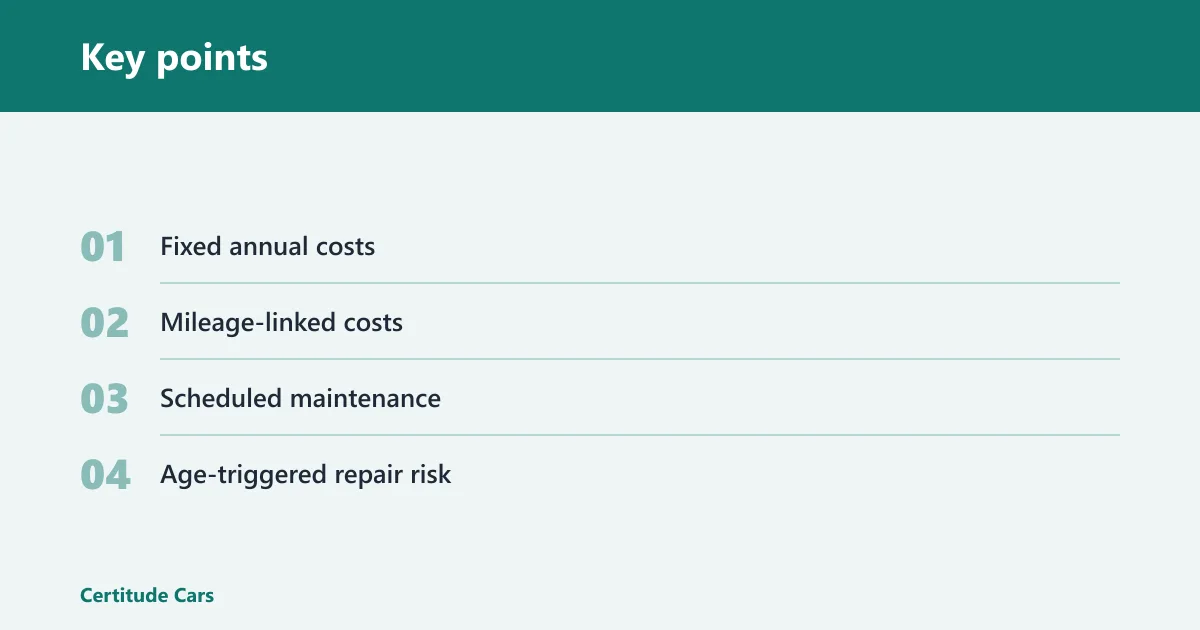
Use four buckets.
- Fixed annual costs: insurance, registration or road tax, motorway sticker where relevant, parking permit or rented space.
- Mileage-linked costs: fuel, oil top-ups, washer fluid, tyres, brake pads, bulbs, and depreciation.
- Scheduled maintenance: oil services, rotations, inspections, filters, spark plugs, and brake fluid at mileage or time intervals.
- Age-triggered repair risk: battery replacement, hoses, seals, suspension wear, cooling-system leaks, and electronic faults that become more likely with years and mileage.
That split matters because each bucket behaves differently. Fixed costs hit on the calendar. Mileage-linked costs rise with use. Scheduled service clusters around mileage checkpoints. Age-triggered repair risk can stay low for a while, then jump after warranty and complimentary maintenance end.
📊 Car and Driver says some long-term test cars cost $0 in scheduled maintenance. Source: Caranddriver.
The budget model that fits real ownership
Fixed baseline first
Start with the costs that arrive whether you drive or not. Elvia includes road tax, insurance, motorway sticker, and parking space in fixed costs, and it notes that road tax can cost a few hundred francs a year. Elvia also cites CHF 29 per month as a premium example. That premium figure is only an example, but the budgeting method travels well: convert every annual bill into a monthly amount, then add them together.
If insurance renews once a year, divide it by 12. If your parking permit is paid quarterly, divide by three, then by the relevant months. This gives you a true ownership baseline before fuel or service enters the picture.
Mileage-linked spend next
The second layer rises with use. A 6,000-mile commuter and an 18,000-mile ride-share car do not wear through tyres, brake pads, and oil at the same pace. Even when two owners drive the same model, tire size, oil capacity, turbocharging, all-wheel drive hardware, climate, and traffic conditions change the bill.
Depreciation belongs here too if you want a full ownership budget rather than a service-only budget. A car driven more miles usually loses value faster, even if the maintenance record is perfect.
Age-related risk last
The third layer is the one broad averages miss. An older car may still have modest fixed costs and moderate fuel use, yet throw one expensive repair into the year. Rubber seals harden with time. Suspension bushings wear. Batteries weaken. Tech-heavy models add risk from sensors, modules, screens, and wiring.
Suppose a seven-year-old crossover has had regular oil changes but skipped brake-fluid service and cooling-system checks. You might save a little in year one, then face a stuck caliper or overheating problem later. Skipped service rarely stays cheap.
Which fixed costs should you budget every year?
Budget fixed costs as the ownership floor: insurance, registration or road tax, motorway stickers or vignettes where required, and parking permits or rented spaces. These costs do not fall much when the car sits, so convert them into one monthly baseline before you estimate fuel, service, or repair risk.
Insurance, registration, and road tax
Insurance is usually the largest fixed line. Registration and road tax vary by location, engine size, emissions class, and vehicle weight. Elvia says road tax can cost a few hundred francs a year, a useful reminder that taxes are not minor add-ons.
If you want a realistic yearly budget, do not bury these in “ownership overhead.” Put them on the same worksheet as oil service and tyres. Then the monthly number reflects what actually leaves your account.
Parking permits, paid spaces, and motorway stickers
Paid parking is easy to miss because it may be bundled into rent, a workplace pass, or a city permit. Yet for some owners, that charge exceeds a yearly oil-service budget. In countries that use motorway stickers or road-use vignettes, that fee belongs in fixed costs too because it is time-based, not mileage-based.
Converting annual bills into a usable monthly baseline
- List every fixed annual or recurring ownership bill.
- Convert each one to a monthly amount.
- Add the monthly amounts for your fixed baseline.
- Add a separate monthly service and repair reserve.
Picture a car driven only on weekends but kept in a paid city space. Fuel stays low. Tire wear stays low. The parking permit and insurance still keep the monthly ownership floor high, which is exactly why fixed costs need their own bucket.
What variable costs change with mileage?
Variable costs rise as miles rise. Fuel is the obvious one, but oil top-ups, washer fluid, tyres, brake pads, bulbs, wear-related repairs, and depreciation also move with use. Annual mileage matters because many service items arrive by distance, and stop-start traffic can make wear faster than mileage alone suggests.
Fuel, oil top-ups, and washer fluid
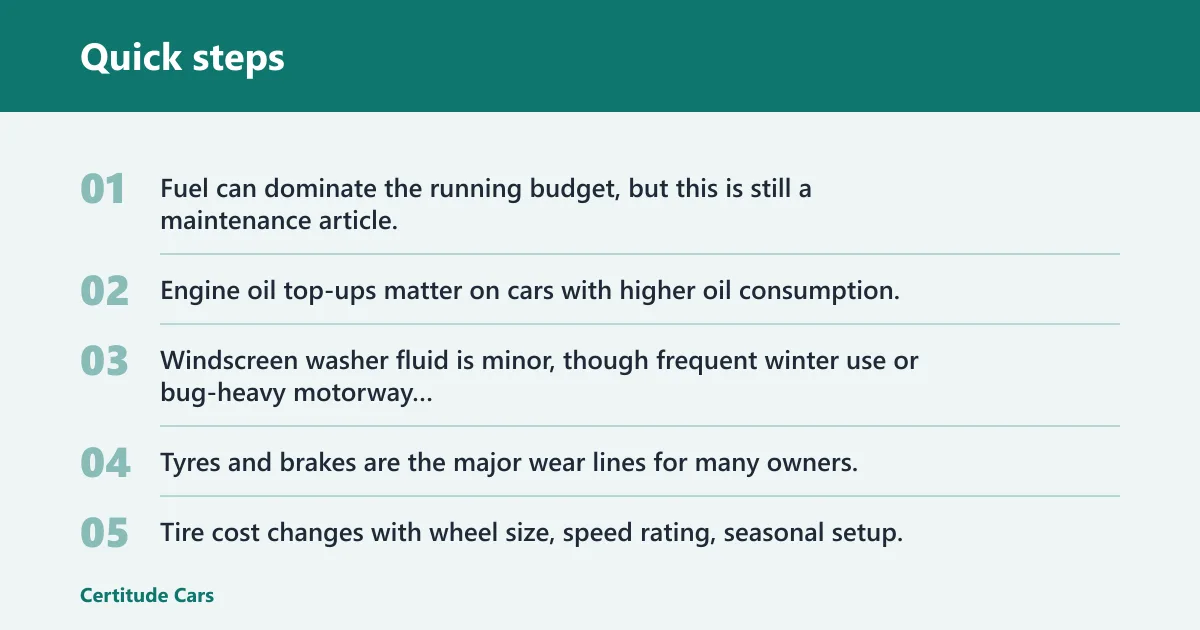
Fuel can dominate the running budget, but this is still a maintenance article, so treat fuel as one variable line rather than the whole story. Engine oil top-ups matter on cars with higher oil consumption, especially turbocharged engines or older high-mileage engines. Windscreen washer fluid is minor, though frequent winter use or bug-heavy motorway driving can turn it into a recurring purchase.
Tyres, brake pads, bulbs, and other wear items
Tyres and brakes are the major wear lines for many owners. Tire cost changes with wheel size, speed rating, seasonal setup, and whether the car uses run-flats or standard tyres. Brake-pad life changes with traffic density, terrain, towing, and regenerative braking on hybrids and EVs.
CarVertical says tire rotation can cost from $30, and it recommends rotation every 6 months or 6,000 to 8,000 miles. That schedule matters because skipped rotations can shorten tyre life and force you to replace a pair or full set earlier than planned.
A common first-timer mistake is to budget for one oil change and ignore consumables. On a heavy SUV with large wheels, one set of tyres can cost more than a basic service visit. On a smaller car, tyres may be moderate, but brake work can still arrive sooner if the car spends most of its life in urban traffic.
Unexpected repairs and depreciation as variable ownership costs
Unexpected repairs are variable because they rise with use, age, and stress. A car that regularly sees potholes, short cold trips, towing, or rough roads tends to wear suspension, brakes, battery, and tyres sooner. Depreciation works the same way in budgeting terms: more mileage usually means less resale value, which is a real ownership cost even though it is not a workshop invoice.
Scheduled maintenance by mileage
5,000 to 10,000 miles
Many owners first see meaningful scheduled service costs in this range. The same source says a Toyota RAV4 5,000-mile service includes an oil change costing $80 to $140.
Most manufacturers now use either fixed intervals, oil-life monitors, or both. That makes a 5,000-mile example useful for budgeting, but the owner manual still controls the actual schedule.
20,000 miles
By 20,000 miles, many cars have had multiple oil changes and rotations, plus repeated fluid and wear inspections. Cabin and engine air filters often enter the bill around this stage, depending on environment and manufacturer schedule. Brake wear becomes easier to predict because your driving pattern has had time to show itself.
Say your commute is 14 miles each way through stop-and-go traffic, and the car is on 19-inch tyres. Mileage alone may look modest, but brake use and tyre edge wear can run ahead of the odometer-based expectation. That is why the schedule needs both mileage checkpoints and condition checks.
30,000 miles
The 30,000-mile mark is a useful budgeting checkpoint because multiple service items can stack together. The same source lists brake pads change at 30,000 miles as $110 to $270 per axle, and spark plugs change at 30,000 miles as $120 to $190. Depending on the vehicle, this may land alongside oil service, rotation, filters, and brake-fluid service.
This is also where complimentary maintenance, if included, may be close to ending or already over. The bill can feel like a jump even when the car has been reliable, simply because earlier scheduled service was partly or fully covered.
How do costs change as a car gets older?
Costs usually stay lower in the early years, then step up after warranty and complimentary maintenance end. Consumer Reports says new-car warranties usually last at least three years. After that period, owners carry more of the bill, and age adds risk from wear items, aging rubber, batteries, and electronics. (Consumerreports)
The low-cost early years
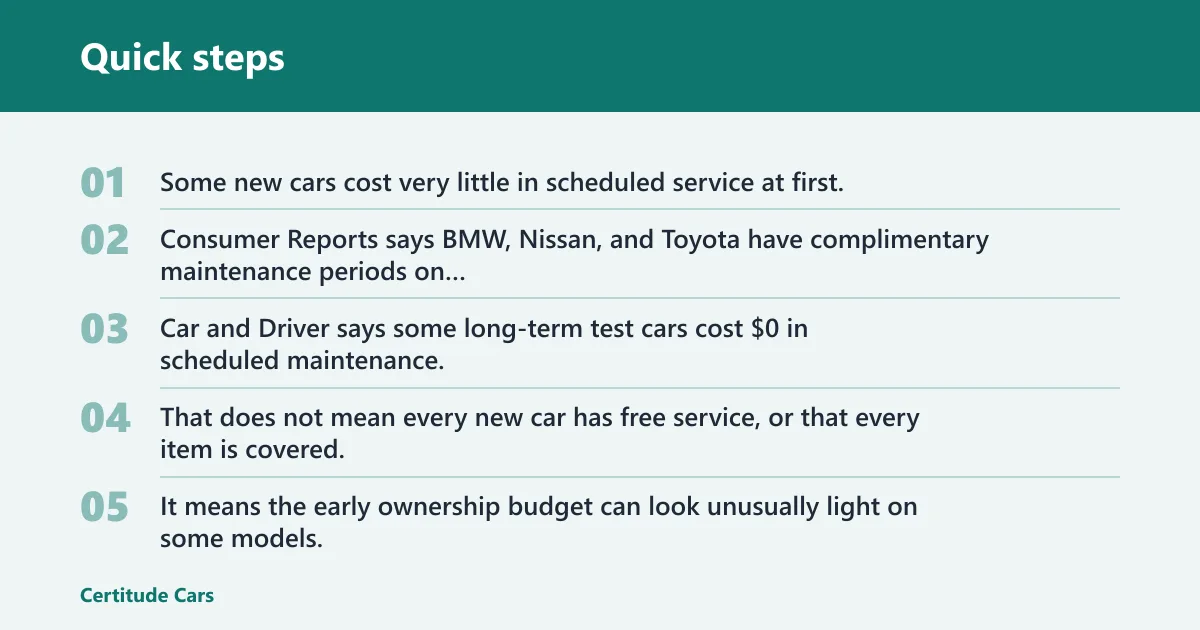
Some new cars cost very little in scheduled service at first. The same source says BMW, Nissan, and Toyota have complimentary maintenance periods on new vehicles. Car and Driver says some long-term test cars cost $0 in scheduled maintenance. That does not mean every new car has free service, or that every item is covered. It means the early ownership budget can look unusually light on some models.
The post-warranty step-up after 3 years or 36,000 miles
Many owners think the car suddenly became expensive when, in reality, the accounting changed. During the first about 3 years or roughly 36,000 miles, warranty coverage and complimentary maintenance can help keep workshop spending low. After that, oil service, tyres, brake work, batteries, and fault diagnosis start landing on the owner’s side of the ledger.
The drop-off after free maintenance ends is especially easy to miss if you shopped by monthly payment and ignored service timing. A car that felt cheap to keep in year two can need a larger reserve in year four without any dramatic reliability problem.
Why age and complexity raise repair risk
Wear and tear does not stay limited to pads and tyres. Rubber coolant hoses, door seals, suspension bushings, and engine mounts age even on lightly driven cars. Complex electrical systems add another layer. More sensors, more modules, and more driver-assistance hardware mean more expensive diagnosis when faults appear.
Luxury cars often pair bigger wheels, performance tyres, higher oil capacity, adaptive suspension, and more electronics. That combination changes the cost curve, especially outside warranty.
Which brands are cheapest to maintain?
Brand rankings are useful only when translated into your own ownership plan. The same source says Buick and Lincoln had the lowest maintenance costs among all automakers, while European luxury marques are among the most expensive to maintain. Over a 10-year horizon, that usually points to lower parts-and-labor exposure in simpler mainstream models.
How to read 10-year maintenance and repair rankings
A 10-year brand result is a direction signal, not a quote for your driveway. It rolls together maintenance and repair patterns across many models, engines, and trim levels. Use it to set an expected range, then refine that range using the exact vehicle’s tyre size, powertrain, service schedule, and known wear points.
Mainstream versus luxury cost patterns
Mainstream models usually use less expensive consumables and have simpler systems. Luxury vehicles often use larger tyres, premium brake components, synthetic oil in greater volumes, adaptive dampers, and more complex electronics. Labor can run higher too because packaging is tighter and diagnostic work takes longer.
Turning brand data into your own expected range
For a mainstream compact sedan, the yearly reserve can sit near the lower end of that $600 to $1,200 baseline in the early years, then rise as tyres, brakes, battery, suspension parts, and cooling-system components come due. For a luxury SUV on large wheels and an advanced suspension setup, budgeting near the top of that baseline, plus a bigger repair reserve, is safer.
Maintenance costs worksheet
Maintenance costs worksheet
| Fixed annual costs | Mileage-linked costs | Age-triggered costs |
|---|---|---|
| Insurance: yearly premium ÷ 12 = monthly amount | Fuel: monthly gallons or liters x local pump price | Battery reserve: add if battery is aging or warranty has ended |
| Road tax or registration: annual bill ÷ 12 | Oil top-ups between services: estimate by engine use pattern | Rubber and seals: hoses, bushings, mounts on older cars |
| Motorway sticker or vignette: annual fee ÷ 12 | Washer fluid: seasonal refill estimate | Cooling-system leaks or pump work: older high-mileage reserve |
| Parking permit or rented space: monthly amount | Tires: annualized from expected life and tire price | Suspension wear: shocks, links, control-arm bushings |
| Other fixed permits or garage fees: monthly amount | Brake pads and rotors: annualized by driving pattern | Electrical faults: sensors, modules, infotainment, wiring |
| Monthly fixed baseline: add this column | Scheduled service reserve: oil changes, rotations, filters, fluids, plugs | Monthly repair reserve: add this column |
Fill-in budget lines
Monthly fixed baseline: ________
Monthly mileage-linked spend: ________
Monthly age-triggered repair reserve: ________
Total monthly ownership budget: fixed baseline + mileage-linked spend + repair reserve = ________
12-month total: total monthly ownership budget x 12 = ________
30,000-mile checkpoint
Use this checkpoint to test whether the reserve is large enough.
- Oil service at 5,000 miles example: $80 to $140.
- Tire rotation from $30, with rotations every 6 months or 6,000 to 8,000 miles.
- Filters and fluid checks according to the owner schedule.
- Spark plugs at 30,000 miles: $120 to $190.
- Brake pads at 30,000 miles: $110 to $270 per axle.
- If complimentary maintenance ends before this point, add the full owner-paid scheduled-service cost.
For a first 30,000-mile estimate, total the fixed costs for the months you expect to own the car, add the scheduled services likely to occur by 30,000 miles, then add a modest repair reserve if the vehicle will be outside warranty for part of that time.
How to keep costs lower without skipping service
The cheapest way to control car maintenance cost is disciplined timing, not neglect. Follow the owner schedule, rotate tyres on time, inspect wear items before they damage other parts, and budget for post-warranty years early. Delaying oil service, brake fluid, tire rotation, or coolant checks often turns a planned bill into a larger repair.
Use the owner schedule and rotation intervals consistently
Stick to the manual and the oil-life monitor where applicable. Keep invoices and dates. A clear record helps you spot patterns, preserve warranty support, and avoid paying twice for missed work.
Catch small wear items before they grow
Neglected oil changes can speed engine wear. Missed tire rotations can create uneven shoulder wear and cut tyre life. Ignored brake noise can turn a pad job into pad-and-rotor replacement. Small misses stack fast because one worn part often damages the next part in line.
Choose parts and timing with total cost in mind
Cheap tyres that wear quickly are not always cheaper per mile. Delayed brake-fluid, coolant, or transmission-fluid service can save money this month, then leave you with a much larger bill later. Budgeting works best when each item is annualized: price divided by expected service life, then converted into a monthly reserve.
Frequently asked questions
How much does a car maintenance cost?
Your real number depends on mileage, tyre size, brake wear, oil-service frequency, warranty status, and vehicle complexity.
What counts as routine maintenance vs repairs?
Routine maintenance is scheduled work such as oil changes, tire rotations, fluid checks, filters, spark plugs, and brake-fluid service. Repairs are fault-driven fixes after wear or failure, such as replacing a brake caliper, fixing a coolant leak, diagnosing an electrical issue, or replacing a failed sensor.
What are the fixed costs of owning a car each year?
Fixed annual costs are the bills that arrive whether you drive much or not: insurance, registration or road tax, motorway stickers or vignettes where required, and parking permits or rented spaces. Convert each one into a monthly amount so you know the ownership floor before fuel and service.
How much do oil changes, tires, and brake service cost?
Tire prices vary more widely because size, type, and brand change the bill fast.
Are warranty and free-maintenance periods lowering early ownership costs?
Yes, often by a lot. The same source says new-car warranties usually last at least three years, and it says BMW, Nissan, and Toyota have complimentary maintenance periods on new vehicles. Early workshop spending can look unusually low, then rise once free scheduled service and warranty coverage end.
What should I expect to spend at 30,000 miles?
At 30,000 miles, expect stacked service rather than one simple visit: oil service, tire rotation, inspections, filters, and on some cars spark plugs and brake pads.