Gas Mileage Calculator: How Much Will This Trip Cost?
To estimate fuel cost, divide the trip distance by MPG, then multiply by the price per gallon. A 300-mile trip at 30 MPG and $3.50 a gallon comes to about $35. Get the MPG wrong, and you can run short on cash, add extra stops, or spend far more than planned. This guide shows the calculator, the formula, and how highway, city, and mixed driving change the total.
How much will this trip cost?
The basic calculator uses trip distance, fuel economy, and fuel price. It accepts miles or kilometers for trip distance, and it uses miles per gallon or kilometers per liter for fuel efficiency. The output includes fuel used and a cost estimate for the trip.
Start with the route you expect to drive, then keep the estimate tied to that same route. Use planned route miles if the drive is still ahead of you. Use odometer or trip odometer miles if the drive is already underway and you want a cleaner check against actual fuel use.
A trip-cost estimate should stay fuel-only. It does not include tolls, parking, insurance, maintenance, or depreciation. That keeps the number useful for deciding how much cash to set aside for gas, and for comparing one route against another.
How to calculate fuel cost
The core trip-cost formula is simple: trip cost = trip miles ÷ MPG × gas price. The same structure works in kilometers if you use kilometers per liter instead of MPG. The fuel-used formula is equally direct: gallons used = trip miles ÷ MPG.
That same math also gives you cost per mile: cost per mile = gas price ÷ MPG. It turns fuel economy into dollars per distance, which is useful for commute planning and business mileage. One calculator example shows cost per mile at $0.05 per mile, which is the kind of output this method produces when gas is cheap or MPG is high.
Say the route is about 240 miles, the vehicle averages around 30 MPG, and local gas is about $3.60 per gallon. The estimate is 240 ÷ 30 × 3.60 = $28.80. The same trip uses about 8 gallons, since 240 divided by 30 comes to 8.
Trip budgeting steps
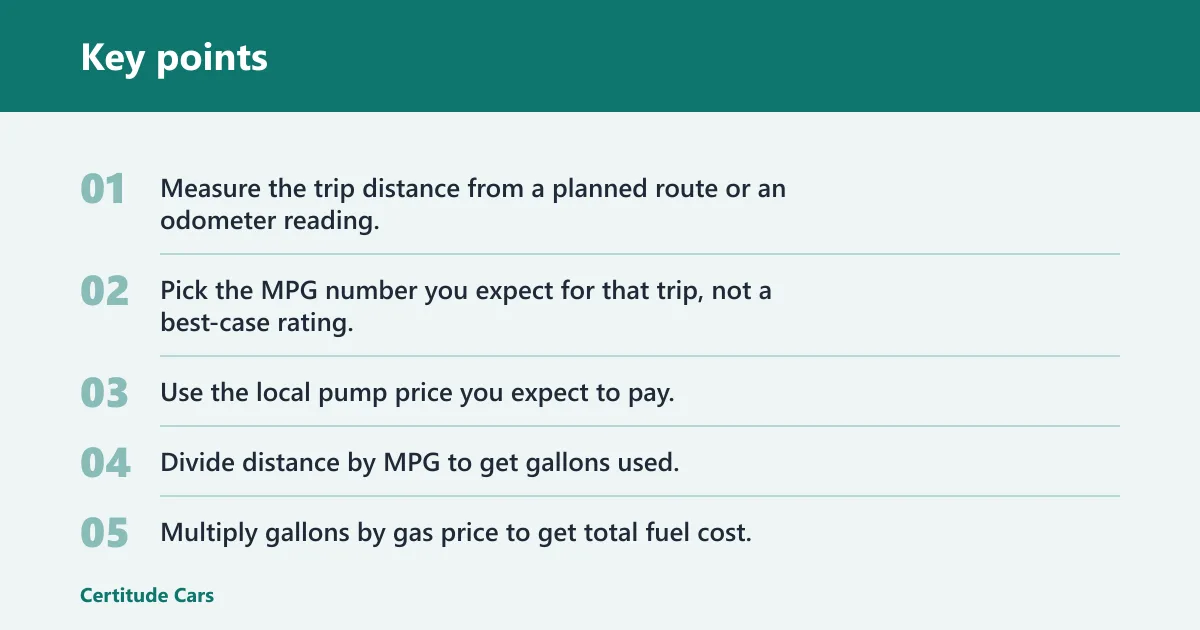
- Measure the trip distance from a planned route or an odometer reading.
- Pick the MPG number you expect for that trip, not a best-case rating.
- Use the local pump price you expect to pay.
- Divide distance by MPG to get gallons used.
- Multiply gallons by gas price to get total fuel cost.
- Check whether tolls or parking should be added outside the fuel estimate.
What numbers should you enter?
Use three inputs: trip distance, fuel economy, and gas price. Trip distance should come from the planned route or from actual miles on the odometer. Fuel economy should be the MPG, km/L, or L/100 km figure that best matches your vehicle and driving pattern. Gas price should be the local station price you expect to pay.
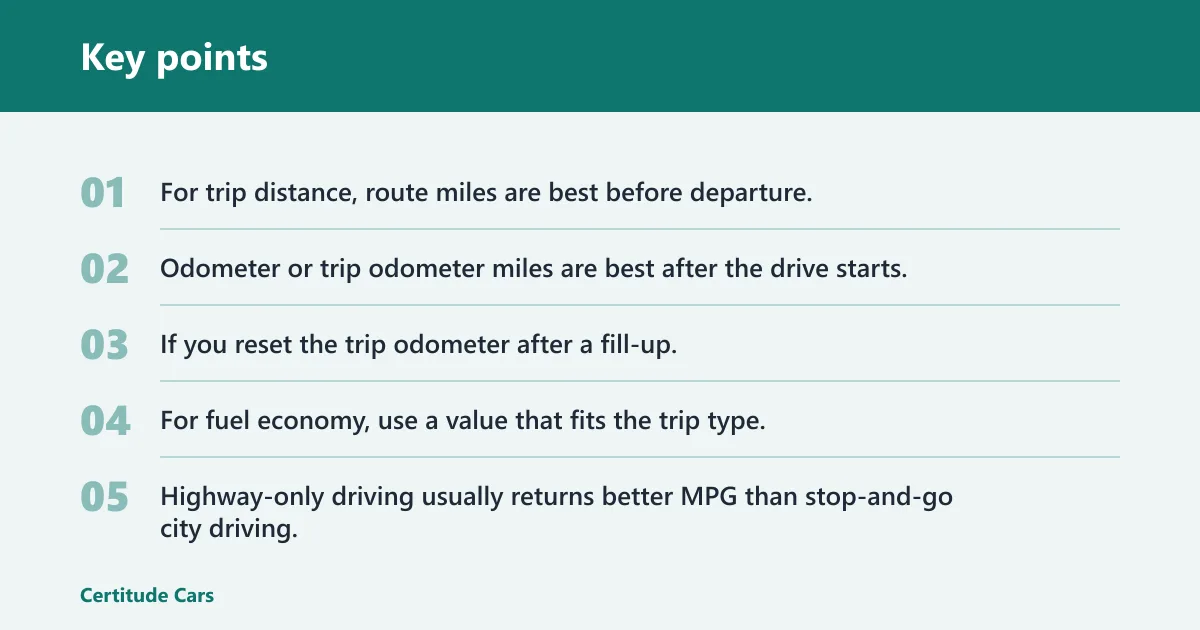
For trip distance, route miles are best before departure. Odometer or trip odometer miles are best after the drive starts. If you reset the trip odometer after a fill-up, the reading tracks the miles tied to one tank, which makes your later MPG check more accurate.
For fuel economy, use a value that fits the trip type. Highway-only driving usually returns better MPG than stop-and-go city driving. Mixed trips sit in between. If your dash shows a trip computer number, treat it as a starting point and compare it with your own fill-up log when you can.
For gas price, use the pump price at the station where you expect to buy fuel. Prices swing from one area to another and from one day to the next, so a stale price can shift the estimate enough to matter on a long drive.
How many gallons will you use?
Gallons used equals trip miles divided by MPG. That gives a direct estimate of fuel burned on the trip, which is the key step before converting fuel use into dollars. If you prefer liters, the same idea works with kilometers and km/L.
The full-tank method gives the cleanest real-world MPG check. Fill the tank, reset the trip odometer, drive normally, then refill and note the gallons needed to top off. Divide miles driven by gallons added. That gives a better MPG figure than guessing from the gauge alone.
A common first-timer mistake is to use only a dash estimate for MPG and then assume it will hold on every road. A 20-mile city segment with traffic, lights, and short stops can use more fuel per mile than a 20-mile highway segment at steady speed.
Picture a 500-mile road trip with 300 highway miles and 200 city miles. If the highway portion returns 34 MPG and the city portion returns 24 MPG, the trip uses more fuel than a single blended MPG number might suggest. Segment changes matter because speed, terrain, traffic, wind, and air conditioning all pull the number around.
Fuel cost sensitivity table
This sample uses a 600-mile trip and shows how the same drive changes when MPG and gas price change. It also shows gallons used and cost per mile, so you can see the fuel math in more than one form. The table is a model, not a live quote.
| MPG | Gas price per gallon | Gallons used | Total fuel cost | Cost per mile |
|---|---|---|---|---|
| 20 | $3.25 | 30.0 | $97.50 | $0.1625 |
| 20 | $4.00 | 30.0 | $120.00 | $0.2000 |
| 20 | $4.75 | 30.0 | $142.50 | $0.2375 |
| 20 | $5.25 | 30.0 | $157.50 | $0.2625 |
| 25 | $3.25 | 24.0 | $78.00 | $0.1300 |
| 25 | $4.00 | 24.0 | $96.00 | $0.1600 |
| 25 | $4.75 | 24.0 | $114.00 | $0.1900 |
| 25 | $5.25 | 24.0 | $126.00 | $0.2100 |
| 30 | $3.25 | 20.0 | $65.00 | $0.1083 |
| 30 | $4.00 | 20.0 | $80.00 | $0.1333 |
| 30 | $4.75 | 20.0 | $95.00 | $0.1583 |
| 30 | $5.25 | 20.0 | $105.00 | $0.1750 |
| 35 | $3.25 | 17.1 | $55.71 | $0.0929 |
| 35 | $4.00 | 17.1 | $68.57 | $0.1143 |
| 35 | $4.75 | 17.1 | $81.43 | $0.1357 |
| 35 | $5.25 | 17.1 | $90.00 | $0.1500 |
The table shows two simple truths. Higher MPG lowers gallons used, and higher gas prices raise the total directly. It also shows why cost per mile is useful: it turns every MPG change into a dollar-per-mile change you can compare across routes or vehicles.
Why real trip cost drifts
Real trip cost drifts because MPG is not fixed. Highway stretches usually consume less fuel per mile than city stretches. Stop-and-go traffic, hills, headwinds, colder weather, a full cabin, and heavy air conditioning can all move the number away from the estimate.
The estimate can also drift when a route changes mid-trip. A faster route may save time but cost more fuel if it adds high-speed miles, steeper grades, or more lane changes. A slower route can do the opposite. That tradeoff matters when you are choosing between arrival time and fuel spend.
Suppose two routes are both 180 miles. One is mostly highway at a steady pace. The other cuts through a city center with lights and congestion. Even if the distance is the same, the city route can use more gallons because the engine spends more time in lower-efficiency conditions.
Competitor pages often stop at the formula. They do not separate highway, city, and mixed segments, so they miss the point where the estimate starts to drift. If you need a tighter budget, estimate each segment with its own MPG and add the fuel costs together.
Segment-based budgeting
Break the trip into highway, city, and mixed sections when the route changes character. Then estimate each section with the MPG that fits that section, not one average value for the whole drive. This is the cleanest way to see where a calculator underestimates or overestimates fuel spend.
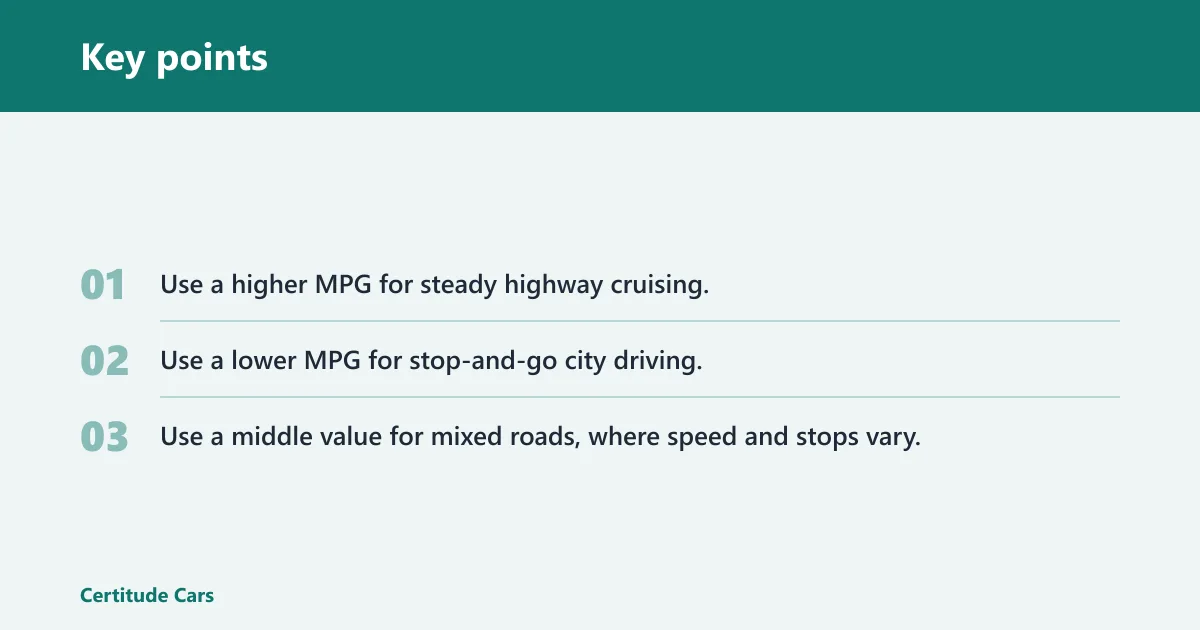
- Use a higher MPG for steady highway cruising.
- Use a lower MPG for stop-and-go city driving.
- Use a middle value for mixed roads, where speed and stops vary.
MPG, km/L, and L/100 km conversions
You can keep the same trip budget math and still switch units. MPG and km/L both describe fuel efficiency, and L/100 km is the common metric cost-and-efficiency view. One calculator uses the exact conversion factor 235.215 ÷ MPG for L/100 km.
To convert MPG to km/L, use the unit relationship built into the numbers you already have. If you need L/100 km from MPG, divide 235.215 by the MPG value. Higher MPG means lower fuel use, so the L/100 km result falls as MPG rises.
For example, 27.8 MPG converts to about 8.47 L/100 km using 235.215 ÷ 27.8. That same MPG can also be expressed as km/L if you prefer a metric efficiency number for your calculator or logbook.
Some calculators also accept kilometers directly for distance and kilometers per liter for efficiency. That lets you keep the same trip-cost approach without converting the route to miles first.
Frequently asked questions
How much will my trip cost in gas?
Use trip distance, MPG, and gas price. Divide miles by MPG to get gallons, then multiply by the pump price. That gives a fuel-only estimate. It does not include tolls, parking, insurance, or maintenance, so add those separately if you need a full travel budget.
How do I calculate fuel cost from MPG?
Use the formula trip miles ÷ MPG × gas price. The same setup also gives gallons used with trip miles ÷ MPG. If you want cost per mile, use gas price ÷ MPG. That is useful for commute math and business mileage.
How many gallons will I use on this trip?
Divide the planned miles by your expected MPG. A 450-mile trip at 30 MPG uses about 15 gallons. If the route mixes highway and city driving, split it into segments and estimate each one separately, because MPG can change with speed, traffic, terrain, and AC use.
What gas price should I use in a trip cost calculator?
Use the local pump price you expect to pay on the trip, not a national average. Gas prices can change from town to town and station to station. If you will buy fuel in several places, use the highest likely price or run a range so the budget does not come up short.
How do I convert MPG to cost per mile?
Divide gas price by MPG. At $4.00 per gallon and 25 MPG, cost per mile is $0.16. That number makes route comparison easier because it converts fuel economy into dollars per distance. It is especially useful when one route is longer but more efficient.
Why is my trip cost estimate different from real-world fuel spend?
Real fuel use shifts with traffic, terrain, wind, speed, weather, payload, and air conditioning. A calculator gives a clean estimate, but highway, city, and mixed segments do not all burn fuel at the same rate. Segment-by-segment budgeting usually gets closer than one blended MPG value.