How to Read Tire Size Numbers on a Tire Sidewall
A tire sidewall code is typically read left to right as section width, aspect ratio, construction, rim diameter, then load index and speed rating. For fit, match those marks to the vehicle placard or an approved replacement spec. Get it wrong, and you can buy a tire that rubs, reads speed wrong, or fails load requirements. This guide explains each marking and how to compare it with your door placard and owner’s manual.
Sidewall cheat sheet
This table gives you a fast way to decode the most common formats before you buy. Treat each code as separate clues, not one number. The same pattern appears on the sidewall, the door placard, and often the owner’s manual. For a related fitment check on wheel sizing, see wheel size vs tire size and which wheel width fits your car.
| Example | Symbol | Meaning | Practical implication | Common mistake to avoid |
|---|---|---|---|---|
| 225/55R17 97H | 225 | Section width in millimeters | Helps determine fit and clearance in the wheel well | Assuming a wider tire always fits the same wheel |
| 225/55R17 97H | 55 | Aspect ratio as a percentage | Shows sidewall height relative to width | Reading it as a millimeter value |
| 225/55R17 97H | R | Radial construction | Identifies the modern standard for most passenger and light-truck tires | Thinking R means “rear” or another trim code |
| 225/55R17 97H | 17 | Rim diameter in inches | Must match the wheel diameter | Mixing up rim diameter with overall tire height |
| 225/55R17 97H | 97 | Load index | Shows the tire’s load carrying capacity | Confusing it with the vehicle’s payload rating |
| 225/55R17 97H | H | Speed rating | Shows the tire’s sustained speed capability | Treating a higher letter as a blanket safety upgrade |
| LT265/70R17 121/118S LRE | LT | Light Truck designation | Used on many SUVs, minivans, and pickups; often paired with load range and dual/single load ratings on the sidewall | Assuming it behaves like a P-metric tire at the same pressure |
| LT265/70R17 121/118S LRE | 265 | Section width in millimeters | Width still reads in metric even though the tire is an LT tire | Assuming LT means inch-based sizing |
| LT265/70R17 121/118S LRE | 121/118 | Load index, single/dual fitment | Shows the carrying capacity when used in single or dual applications | Ignoring the dual rating on a tire that will run in a dual setup |
| LT265/70R17 121/118S LRE | S | Speed rating | Shows the tire’s sustained speed capability | Assuming an LT tire has no speed rating if the full service description is split across the sidewall |
| LT265/70R17 121/118S LRE | LRE | Load Range E | Signals a higher-load construction commonly associated with LT tires | Assuming load range and load index mean the same thing |
| XL 235/55R19 105H | XL | Extra Load capacity | Signals added load carrying ability, often with a higher load index | Assuming XL means a bigger tire in every dimension |
| XL 235/55R19 105H | 105 | Load index | Shows the tire’s load carrying capacity at the specified service conditions | Thinking XL alone guarantees the right load for the vehicle |
| XL 235/55R19 105H | 19 | Rim diameter in inches | Matches a 19-inch wheel | Putting it on the wrong wheel size |
Example 1: 225/55R17 97H
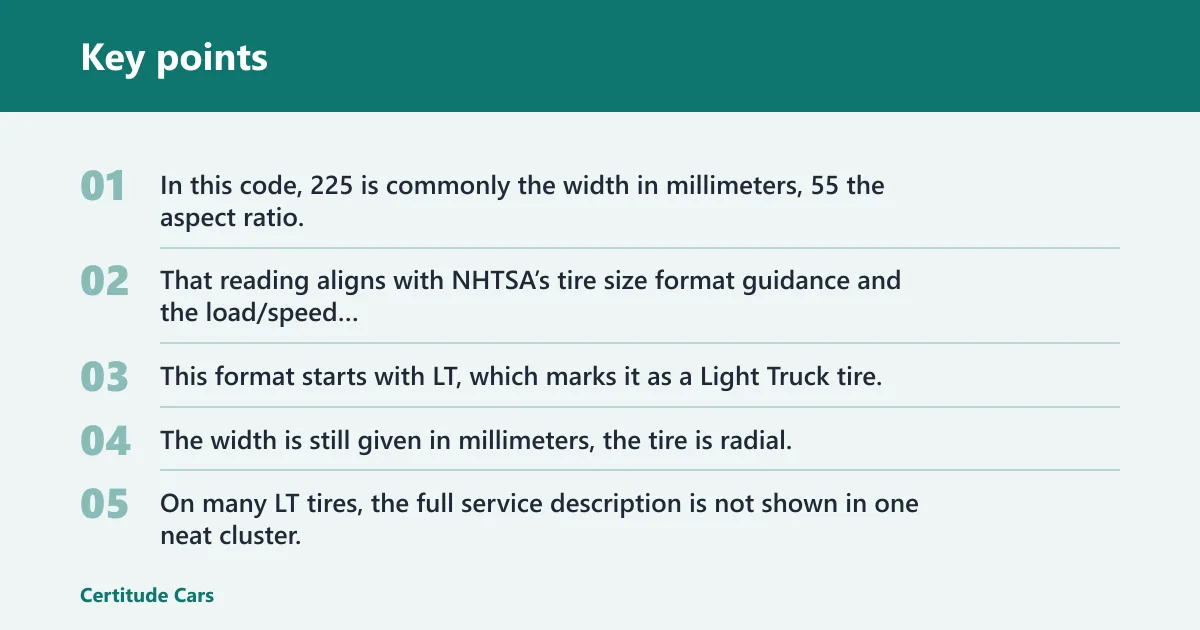
In this code, 225 is commonly the width in millimeters, 55 the aspect ratio, R radial construction, 17 the rim diameter in inches, 97 the load index, and H the speed rating. That reading aligns with NHTSA’s tire size format guidance and the load/speed conventions used in industry reference standards.
Example 2: LT265/70R17
This format starts with LT, which marks it as a Light Truck tire. The width is still given in millimeters, the tire is radial, and the wheel diameter is 17 inches. On many LT tires, the full service description is not shown in one neat cluster; load index, speed rating, and load range may be spaced apart on the sidewall or shown together in the product listing. For LT tires, load range or ply-rating conventions are still commonly used alongside the load index, so read the full sidewall, not just the beginning of the size code.
Example 3: XL 235/55R19
XL means Extra Load capacity. It does not change the width, aspect ratio, or wheel diameter by itself. It often appears on tires with a higher load index, so you still need to compare the complete service description with your vehicle placard before buying. On a vehicle that specifies XL or requires a certain load index, the load marking matters as much as the size code.
What each symbol means in plain terms
Read the code as a shopping checklist. Size tells you whether the tire fits the wheel and clears the body. Load index tells you whether it can carry what the vehicle expects. Speed rating tells you the tire’s sustained speed capability. Do not guess any of those from tread pattern or sidewall styling.
How do you read a tire sidewall?
Find the full service description on the outer sidewall, then separate the size code from the other markings around it. Start with width, aspect ratio, construction, and rim diameter. After that, look for the load index, speed rating, DOT code, and any extra markings such as XL or LT. Not every tire prints the service description in one place, so read the whole sidewall before deciding.
Find the size code first
The size code is usually the easiest part to spot because it appears as a compact sequence such as 205/55R16 or 225/55R17 97H. The numbers and letters are not random. They tell you the tire’s width, sidewall shape, construction, wheel diameter, load capacity, and speed capability.
Separate size, load, speed, and date markings
Do not treat every marking on the sidewall as part of the size. The size code tells you fit. The load index and speed rating tell you capability. The DOT code tells you the tire’s manufacturing details and age. They are related, but they are not the same thing. The DOT date format is the final four digits: week and year of manufacture, as defined in U.S. DOT tire identification rules.
Check the placard before you buy
For a replacement tire, the vehicle placard and owner’s manual override guesswork. A tire may fit the wheel but still be wrong for the car if the load index is too low, the speed rating is below the specified minimum, or the format does not match the approved replacement spec.
Say your door placard calls for 225/55R17 97H, but the tire shop offers a 225/55R17 tire with a lower load index and a different speed letter. The size looks right at a glance. The full service description does not. Stop there and compare the spec, not the tread pattern.
What do the numbers on a tire sidewall mean?
The core numbers on a tire sidewall usually describe width, aspect ratio, and wheel diameter. In a common code such as 205/55R16, the first number is width, the second is sidewall height as a percentage of width, and the last number is wheel diameter in inches. The letter between them identifies construction. This is the standard metric passenger format used by the Tire and Rim Association and reflected in consumer tire guides.
Width in millimeters
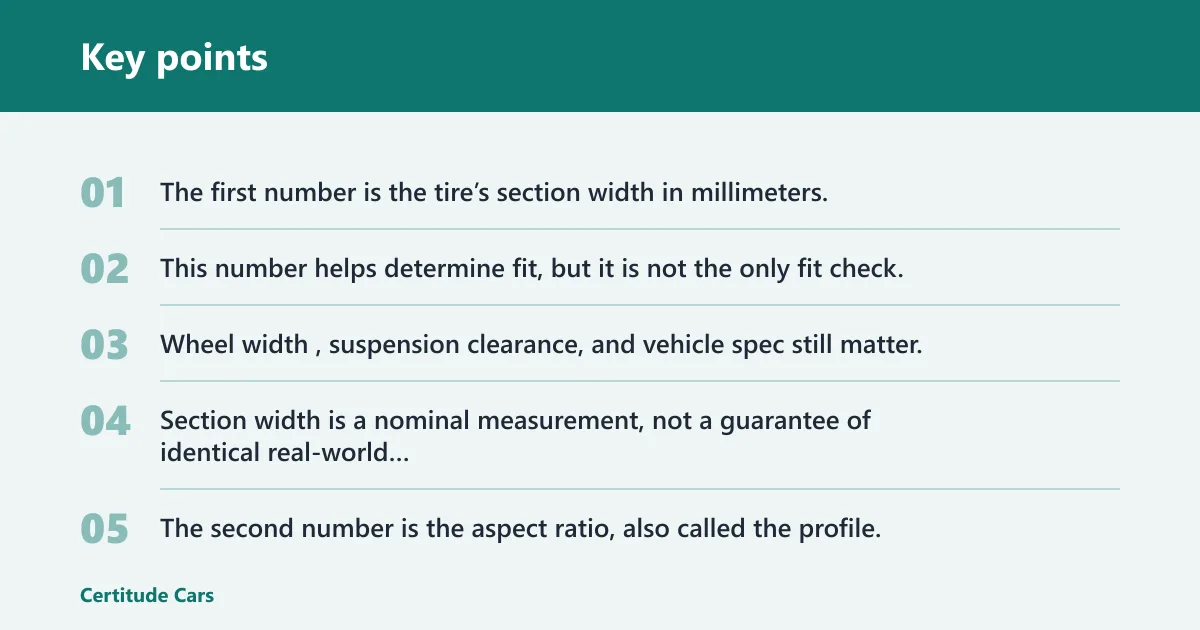
The first number is the tire’s section width in millimeters. 235, 205, and 225 all follow the same rule. This number helps determine fit, but it is not the only fit check. Wheel width, suspension clearance, and vehicle spec still matter. Section width is a nominal measurement, not a guarantee of identical real-world clearance across brands.
Aspect ratio as a percentage
The second number is the aspect ratio, also called the profile. 55 is the profile or sidewall height as a percentage of width. A 55 series tire has a sidewall height equal to 55% of its width, so the sidewall shape changes even when the overall diameter stays close.
R for radial construction
R denotes radial construction in the standard tire size code. Radial construction is the modern standard for most passenger and light-truck tires. It is not a load code or a trim mark. It tells you how the tire is built.
Rim diameter in inches
The last number in the main size code is the wheel diameter in inches. 19 indicates the wheel diameter in inches for that tire. A tire marked for a 19-inch wheel will not fit a 17-inch wheel. That mismatch is immediate and practical, not theoretical.
Are all tire sizes in millimeters or inches? No. Many modern passenger and light-truck codes mix both systems in one line. Width and aspect ratio are usually metric, while rim diameter is in inches. Some truck and off-road formats use inch-based sizing more heavily, including flotation-style sizes such as 31×10.50R15LT, so do not assume every size follows the same pattern.
What do P, LT, R, and XL mean?
P, LT, R, and XL each answer a different question. P and LT tell you what kind of tire it is. R tells you how it is built. XL tells you it has extra load capacity. If you blur those together, you can buy the wrong tire even when the size numbers look correct. These meanings are defined across industry size standards and tire safety references, including NHTSA guidance and Tire and Rim Association sizing conventions.
P-metric passenger tire
P indicates a passenger-car P-metric tire. That matters because P-metric and LT tires can carry different loads at the same pressure. A P-metric tire is not automatically interchangeable with an LT tire of the same size code.
LT tire for light trucks and SUVs
LT means Light Truck tires, commonly found on SUVs, minivans, or pickups. Many LT tires are built for higher inflation pressures and heavier-duty use. That does not make them the correct choice for every SUV. It means their load and pressure behavior may differ from P-metric tires.
Radial construction versus bias-ply construction
R marks radial construction. That matters because radial and bias-ply tires are built differently. Radial is the norm for today’s passenger and light-truck market, while bias-ply construction is a different design used less often in modern road applications. If the sidewall says R, you are reading a radial tire.
XL marking and extra load capacity
XL means Extra Load capacity. It is not a size increase, and it is not a speed upgrade. It often appears with a higher load index because the tire is built to carry more than a standard-load version in the same nominal size. Check the whole service description, not the letters alone.
Suppose a crossover calls for a 235/55R19 tire, and you find one marked XL with the correct size but a lower speed rating than the placard requires. The XL marking does not fix that problem. Load capacity and speed capability are separate checks, and both need to line up.
How load index and speed rating work
Load index and speed rating sit near the size code, often after the rim diameter. They are part of the tire’s service description, and they matter for fit as much as width and diameter. A tire that matches the size but misses the load index or speed rating is still the wrong tire for the vehicle. Speed-rating values such as H, V, W, and (Y) are standardized in tire industry references and consumer safety guidance.
Where to find the load index
The load index usually appears as a number after the rim diameter, such as the 97 in 225/55R17 97H. A load index is not the vehicle’s payload rating; it is the tire’s load-carrying code. The tire’s allowable load depends on inflation and the specific tire service description, so it must meet the vehicle requirement.
Where to find the speed rating
The speed rating appears as a letter after the load index. H is commonly listed at 130 mph, V at 149 mph, and W at 168 mph in widely used tire-rating tables; (Y) indicates above 186 mph. Those are sustained test-speed categories, not casual driving targets.
When a higher rating matters
A higher load index or speed rating can be acceptable if it still matches the vehicle’s approved spec and does not create a fitment issue. For example, a tire with a higher load index may be fine when the vehicle requires extra capacity. The key is compatibility, not automatic upgrade logic.
When a lower rating is not acceptable
A lower load index is not acceptable if it falls below the vehicle requirement. A lower speed rating is also not acceptable when the vehicle placard or manual calls for a specific minimum. V means the tire is rated to 149 mph; it does not mean a tire will perform better in every condition. The letter is a capability limit, not a promise of better grip.
A common first-timer mistake is to look at the load index and think it describes how much the vehicle can carry. It does not. The tire load index is only one piece of the puzzle. Passenger load, cargo, axle distribution, and the vehicle placard all matter when you decide whether the tire is right.
Tire age and the DOT code
The DOT marking tells you the tire’s compliance and manufacturing details, and the four-digit date code tells you when it was made. That date matters even if the tread still looks deep. Rubber ages with time, storage, heat, and use, so sidewall age should be part of the replacement decision. U.S. DOT marking rules place the date code at the end of the identification number, with the week and year shown in four digits for tires made after 2000.
Where the DOT code appears
The DOT sidewall symbol indicates compliance with Federal Motor Vehicle Safety Standards in the U.S. The DOT sequence is usually on one sidewall only. If you cannot see it at first, you may need to inspect the inside-facing sidewall or rotate the tire slightly to find the full marking.
How to read the four-digit date code
The last four digits of the DOT code show the week and year of manufacture. The first two digits are the week, and the last two digits are the year. That makes the code useful for age checks before installation, during used-tire inspection, or when comparing stock that has sat in storage.
How week and year affect replacement decisions
Age is not the only factor, but it is a real one. A tire with deep tread can still be too old to trust for long-term use. If the date code shows the tire was made years ago, ask whether the tire is still a sensible buy, especially for daily driving or heavy loads.
How to check fit before you buy
Use the door placard and owner’s manual as the final check. Match the size first, then confirm the load index and speed rating, then look for LT, P, XL, and inch-based differences that change the meaning of the code. Do not confuse maximum sidewall pressure with the vehicle’s recommended cold inflation pressure. The load index, load range, and inflation recommendations work together, especially on LT tires.
Match the size to the door placard
Start with the placard on the driver’s door jamb. It lists the approved size and recommended cold inflation pressure. If the size on the tire does not match the placard or a clearly approved replacement spec, stop there. A correct-looking tire on the wrong vehicle is still wrong.
Confirm load index and speed rating
Check that the tire’s load index meets or exceeds the vehicle requirement, and that the speed rating meets the minimum listed for the vehicle. A tire with a 94 load index is commonly listed at 1477 lb or 670 kg in published tire-load tables. That number should be checked against the vehicle’s required rating, not guessed from the size alone.
Watch for XL, LT, and inch-based sizing differences
XL, LT, and P-metric tires can share a nominal size but behave differently under load. That is why you should not assume every tire in the same size is interchangeable. If a tire uses inch-based sizing instead of the familiar metric pattern, compare it with the approved replacement spec before you buy. For example, some off-road and truck tires use flotation-style formats such as 31×10.50R15LT rather than a metric-first pattern.
Do not confuse maximum pressure with placard pressure
The sidewall maximum pressure is not the same as the vehicle’s recommended cold inflation pressure. Max pressure is a tire limit. Placard pressure is what the vehicle asks for in normal use. Those numbers can differ, and the placard and owner’s manual should guide inflation after installation.
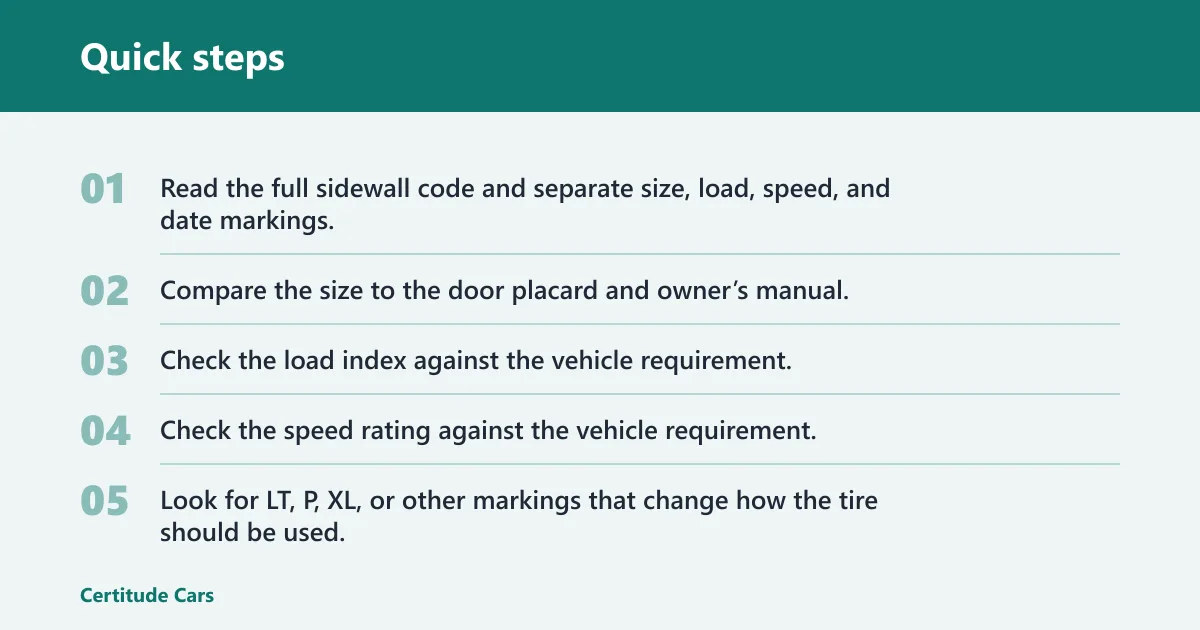
- Read the full sidewall code and separate size, load, speed, and date markings.
- Compare the size to the door placard and owner’s manual.
- Check the load index against the vehicle requirement.
- Check the speed rating against the vehicle requirement.
- Look for LT, P, XL, or other markings that change how the tire should be used.
- Verify the DOT date code if the tire is new old stock or a used tire.
- Set inflation to the placard pressure, not the sidewall maximum.
Frequently asked questions
What does 225/55R17 mean on a tire?
225 is the width in millimeters, 55 is the aspect ratio, R means radial construction, and 17 is the wheel diameter in inches. If the tire also shows a load index and speed rating, those are separate service details that still need to match the vehicle’s requirement.
What do the letters P, LT, R, and XL mean on a tire?
P means a passenger-car P-metric tire, LT means Light Truck, R means radial construction, and XL means Extra Load capacity. These are not decorative marks. They change what the tire is intended to do, how it carries load, and how it should be matched to the vehicle.
Where do I find the tire load index and speed rating?
They usually appear after the rim diameter in the size code. In a marking such as 225/55R17 97H, 97 is the load index and H is the speed rating. If the tire is LT-marked, the service description may appear in a slightly different format, so read the full sidewall line carefully.
What is the DOT code on a tire sidewall?
The DOT code is the sidewall marking that identifies compliance with Federal Motor Vehicle Safety Standards in the U.S. The last four digits show the week and year of manufacture. That date helps you judge tire age, which matters even when tread depth still looks acceptable.
How do I decode a tire manufacture date?
Look at the last four digits of the DOT code. The first two digits are the week of manufacture, and the last two digits are the year. For example, 3523 means the tire was made in the 35th week of 2023. If the code has only three digits, it is an older tire format that needs closer age scrutiny.
Are all tire sizes metric, or are some inch-based?
No. Many passenger and light-truck sizes use a metric width and aspect ratio with an inch-based rim diameter, such as 225/55R17. Some truck and off-road sizes use flotation or inch-based formats, such as 31×10.50R15LT. Always read the full service description rather than assuming one format covers every tire.