How to Calculate Your Car’s Annual Maintenance Costs
Add every scheduled service due this year, estimate wear items likely to come due by mileage, then add a common 10% to 20% repair buffer. That total is your annual maintenance budget. Skip that step, and small services turn into surprise bills, missed maintenance, and faster wear. This guide shows how to calculate the number, update it as mileage changes, and split it into monthly savings.
What annual maintenance costs include
Annual maintenance costs cover scheduled service and wear items, not surprise repairs. Build the budget from oil changes, tire rotation, inspections, filters, brakes, belts, and similar items, then add a separate buffer for failures. Mileage, vehicle age, vehicle type, and driving conditions all change the total.
Maintenance vs. repair
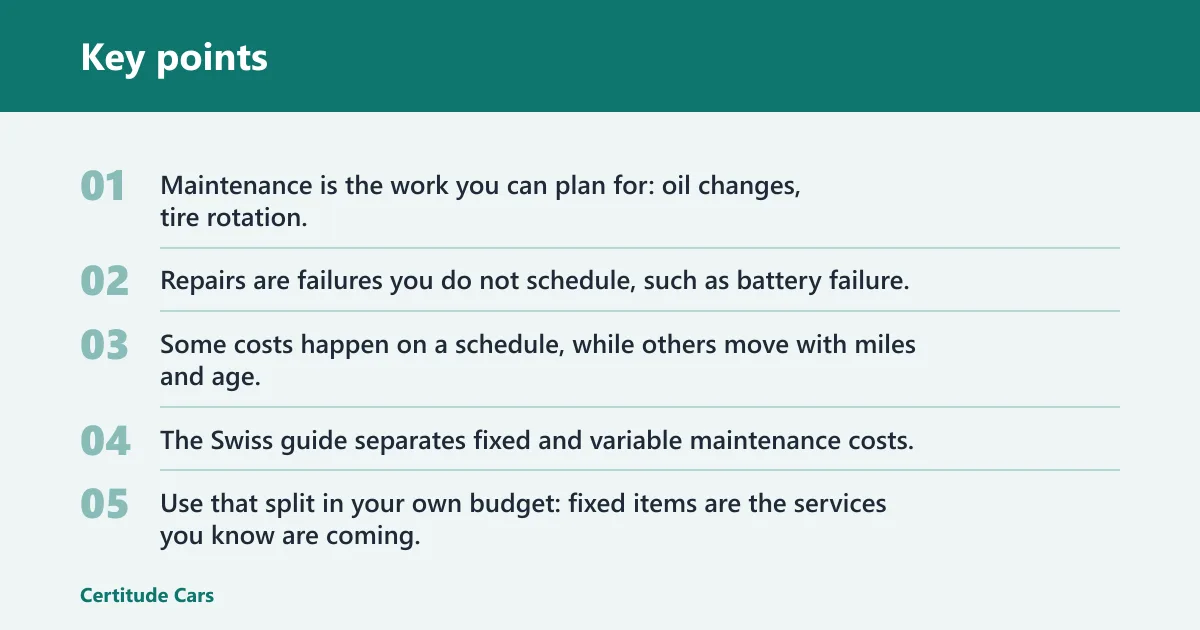
Maintenance is the work you can plan for: oil changes, tire rotation, multipoint inspections, wiper blade replacement, air filters, brake pads, wheel alignment, and timing belt service when it is due. Repairs are failures you do not schedule, such as battery failure, alternator replacement, catalytic converter replacement, transmission replacement, suspension work, engine repair, tire replacement after damage, or body damage.
Fixed and variable costs
Some costs happen on a schedule, while others move with miles and age. The Swiss guide separates fixed and variable maintenance costs; variable costs include tyres, brake pads, lights, and unexpected repairs. Use that split in your own budget: fixed items are the services you know are coming, and variable items rise when driving increases or parts age out.
Why mileage and age matter
Annual miles driven is the main scaling factor. More miles usually mean more oil changes, tire rotations, inspections, brakes, and filters. Age matters too, because older vehicles often need service more often as parts wear out, rubber hardens, and small failures become more common. A low-mileage car can still cost more than a newer, higher-mileage one.
What you’ll need
- Owner’s manual or factory service schedule
- Current mileage and expected miles per year
- Price quotes for DIY, independent shop, and dealership service
- A worksheet or calculator with room for intervals and dates
- Vehicle age in years
- Notes on driving conditions such as stop-and-go traffic or unpaved roads
How do you calculate annual maintenance costs?
Start with the service interval for each item, convert that interval into how many times it will happen this year, then add the cost of wear items and a repair buffer. A simple estimate works best when you use your mileage, not a generic average, because the same car can land in different service bands.
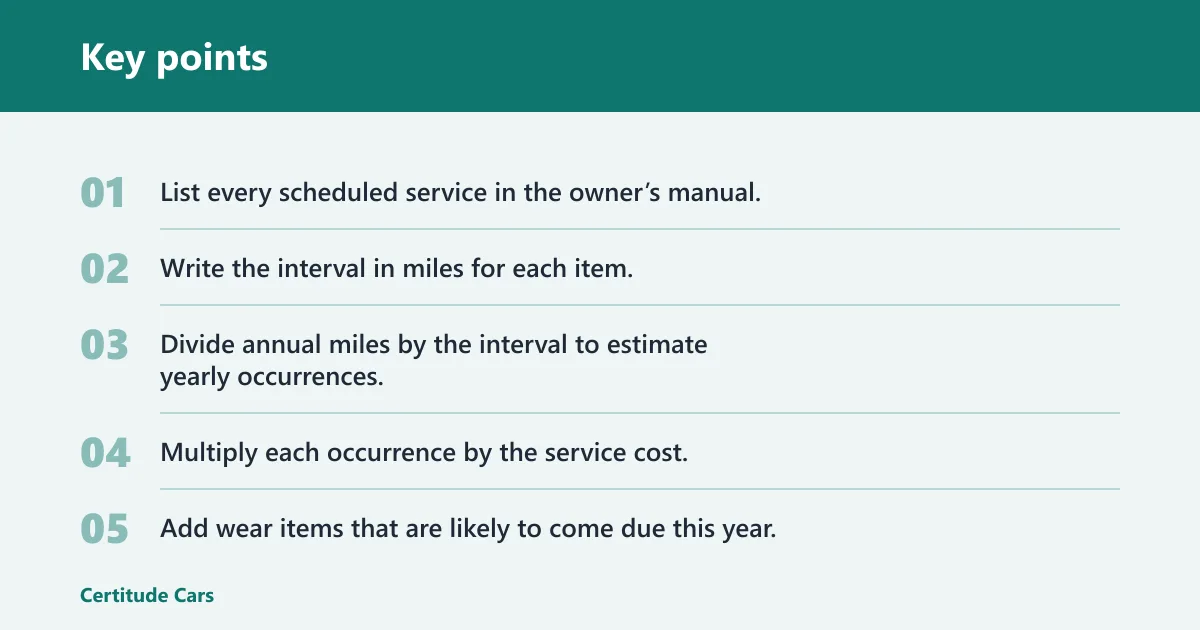
- List every scheduled service in the owner’s manual.
- Write the interval in miles for each item.
- Divide annual miles by the interval to estimate yearly occurrences.
- Multiply each occurrence by the service cost.
- Add wear items that are likely to come due this year.
- Add a repair contingency of 10% to 20%.
Step 1: list services by interval
Use the owner’s manual first. AAA lists oil changes every 5 to 7,500 miles at $35 to $125, tire rotation every 5 to 7,500 miles at $20 to $100, brake pad replacement every 10 to 20,000 miles at $100 to $300, and timing belt replacement every 60 to 100,000 miles at $400 to $900. Those are interval examples, not universal prices. (AAA)
Step 2: convert each service into a yearly cost
Use this formula: annual service cost = service price × yearly service count. If you drive about 15,000 miles a year and your oil change interval is about 7,500 miles, that item appears twice. If a timing belt is due at 90,000 miles and you will cross that point this year, include the full service cost in the annual total.
Step 3: add wear items and mileage-triggered parts
Wear items do not fit neatly into one exact month, so budget for the year they are likely to be needed. Include wiper blades, air filters, brake pads, wheel alignment when tires wear unevenly, tire replacement, and the timing belt when the mileage window is near. Say your sedan averages 12,000 miles a year and spends a lot of time in stop-and-go traffic. Brake pads and tires should sit higher in the budget than they would for mostly highway driving.
Step 4: add a repair contingency
Keep repairs separate from maintenance, then add a buffer anyway. A 10% to 20% contingency helps cover battery failure, alternator replacement, suspension work, tire damage, and other failures that do not line up with a service calendar. Picture an older SUV with 9,000 annual miles but 12 years of age; the mileage load is modest, yet age can still push the repair buffer higher.
How do mileage and age change the budget?
Annual mileage sets the base, and age changes the slope. Low-mileage cars may skip some mile-based services in a given year, but older parts can still fail. High-mileage cars usually need more frequent service, more wear items, and a larger repair buffer. Used cars often need an age-first budget, not a mileage-only budget.
Low-mileage drivers
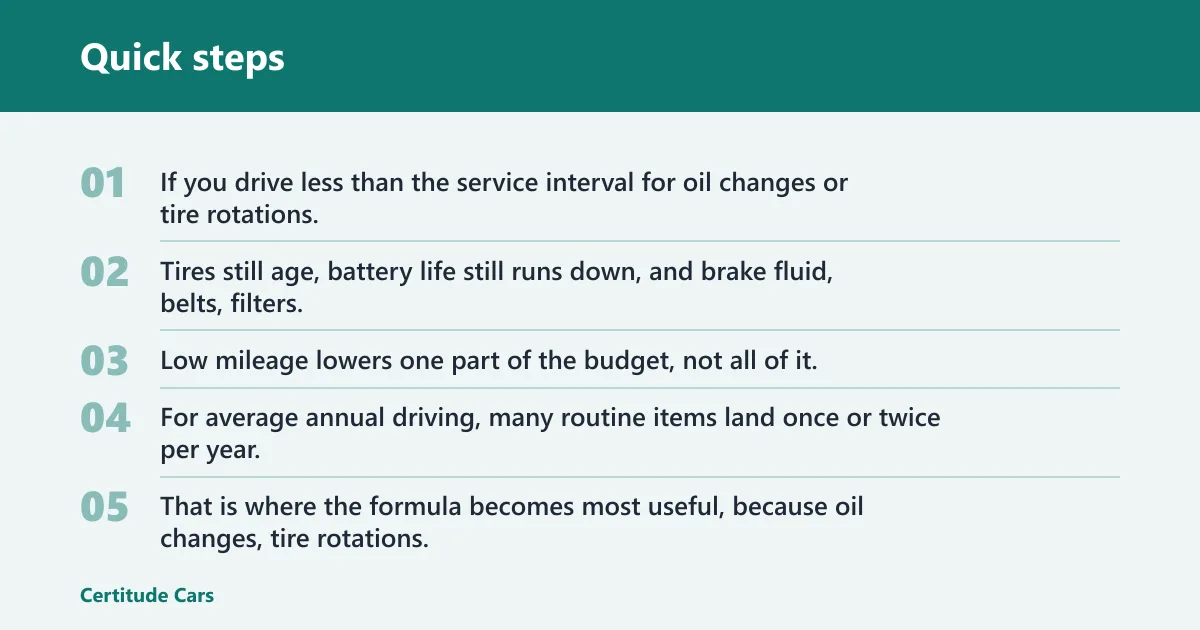
If you drive less than the service interval for oil changes or tire rotations, some routine items may happen only once a year or not at all. Do not cut the budget to zero. Tires still age, battery life still runs down, and brake fluid, belts, filters, and wiper blades can still need attention. Low mileage lowers one part of the budget, not all of it.
Average-mileage drivers
For average annual driving, many routine items land once or twice per year. That is where the formula becomes most useful, because oil changes, tire rotations, inspections, and filters can be counted with ordinary mileage bands. Use your annual miles as the scaling factor, then add age and driving conditions only after the mileage total is set.
High-mileage drivers
High-mileage drivers should expect more than routine service. Brakes, tires, filters, and alignments come up faster, and the odds of a repair buffer claim rise with use. If the vehicle also sees unpaved roads, towing, or heavy stop-and-go traffic, move the wear-item line upward before you settle on the final annual number.
Older vehicles and used cars
For a used car, age can matter more than mileage if the prior owner stretched service. More years mean more rubber, seals, hoses, and accessory parts nearing the end of their useful life. A 7-year-old car with low miles can still need more budget than a 3-year-old car with higher miles, especially if the service history is thin.
How much should you set aside each month for car maintenance?
Divide the annual total by 12 to get a monthly average. Then raise the monthly set-aside when the car is older, when the next major service is due soon, or when your driving pattern is severe. This method keeps the budget steady even when service costs arrive unevenly through the year.
Annual total to monthly average
Use this formula: monthly set-aside = annual maintenance total ÷ 12. If the annual number is around $636.00, the monthly figure is about $53.00. That is the amount to move into a separate savings line each month so routine service does not compete with rent, fuel, or insurance.
When to increase the monthly set-aside
Increase the monthly amount if the vehicle is older than your usual replacement window, if the next timing belt or brake job is close, or if severe driving shortens service intervals. Stop-and-go traffic, unpaved roads, and frequent short trips all push wear higher. A larger monthly set-aside keeps the annual plan from breaking when costs bunch up.
How to adjust after a major repair
After a major repair, rebuild the annual budget from the next service milepost instead of keeping the old number. If a battery, alternator, or tire replacement already happened this year, the repair buffer should still remain in place, because one failure does not remove the next one. Recheck the total after the repair invoice is paid.
Maintenance budget worksheet
Use this worksheet to turn intervals into a yearly number. Keep separate columns for low-, average-, and high-mileage drivers, then choose the one that matches your annual miles. Add the routine service column, the wear-item column, and the repair buffer column before you total the budget.
| Line item | Interval or trigger | Low-mileage driver | Average-mileage driver | High-mileage driver |
|---|---|---|---|---|
| Oil change | 5,000 to 7,500 miles | 1x per year | 2x per year | 3x per year |
| Tire rotation | 5,000 to 7,500 miles | 1x per year | 2x per year | 3x per year |
| Multipoint inspection | At service visits | 1x per year | 2x per year | 3x per year |
| Wiper blades | Wear or visibility drop | 1 set | 1 set | 1 to 2 sets |
| Brake pads | 10,000 to 20,000 miles | 0 to 1 set | 1 set | 1 to 2 sets |
| Air filter | Service schedule or dusty roads | 1x per year | 1x per year | 1 to 2x per year |
| Wheel alignment | Tire wear or pull | As needed | 1x per year | 1 to 2x per year |
| Timing belt | 60,000 to 100,000 miles | Maybe due | Check mileage | Likely due sooner |
| Repair contingency | 10% to 20% | Yes | Yes | Higher end |
What routine services should I include in annual maintenance?
Include the services you can schedule before they fail: oil changes, tire rotation, multipoint inspection, wiper blades, brake pads, air filters, wheel alignment, and timing belt service when the mileage window is near. Some cars will also need coolant, brake fluid, or transmission service on the manufacturer’s schedule.
Vehicle type changes the mix. Sedans often sit near a baseline budget. SUVs and trucks usually need more tire, brake, and suspension attention because they carry more weight or work harder. Luxury vehicles can cost more because parts and labor are often higher. Hybrids and electric vehicles may skip some engine-related items, but they still need tires, brakes, fluids where applicable, cabin filters, and suspension service.
Should I include repairs in annual maintenance costs?
Yes, but keep them in a separate buffer, not inside the routine service total. Repairs are the financial shock absorbers for battery failure, tire replacement, alternator replacement, catalytic converter replacement, transmission replacement, suspension replacement, engine repair, and body damage. A repair buffer makes the annual number realistic instead of optimistic.
DIY, independent shop, and dealership pricing
Use three pricing inputs if possible. DIY usually lowers labor cost but still requires parts and tools. Independent shops often land between DIY and dealership pricing. Dealership service is not the only benchmark, and it should not be the only number in your budget. Build the worksheet with the price level you actually expect to use.
Common mistakes
- Mixing repairs into routine service: keep the repair buffer separate so the maintenance total stays clear.
- Ignoring driving conditions: stop-and-go traffic, unpaved roads, and severe use shorten intervals.
- Forgetting age-related wear: older cars often need more frequent service even at low mileage.
- Using one budget for every vehicle type: a sedan, SUV, truck, luxury car, hybrid, and EV do not wear the same way.
- Skipping wear items: tires, brakes, filters, wiper blades, and belts still need room in the budget.
Frequently asked questions
How do I calculate my car’s annual maintenance costs?
List every scheduled service, estimate how many times it will happen this year based on annual miles, then add wear items and a 10% to 20% repair buffer. Divide the total by 12 for a monthly set-aside. If a major service is due soon, include it in full.
What counts as car maintenance costs in a yearly budget?
Maintenance includes oil changes, tire rotation, inspections, filters, wiper blades, brake pads, alignments, and timing belt service when due. It also includes wear items that are likely to be replaced this year. Repairs stay in a separate buffer so the budget does not blur routine service with failures.
How do mileage and age affect maintenance costs?
Higher mileage usually increases service frequency and wear-item costs. Age raises the chance of parts wearing out, even when miles are low. A used car with limited mileage can still need a larger budget if the service history is incomplete or the parts are old enough to fail.
What maintenance costs are fixed vs variable?
Fixed costs are the planned services on your schedule. Variable costs change with mileage, road conditions, age, and failure risk. The Swiss guide separates fixed and variable maintenance costs, and its variable category includes tyres, brake pads, lights, and unexpected repairs.