Average Car Repair Cost: What Do Common Fixes Cost?
Common repairs often range from about $100 for diagnostics to $1,000 or more for brakes, while major engine or transmission work can sometimes reach about $3,000-$7,000. Quotes above local averages should explain parts and labor. Bad estimates can hide repeat failures, unnecessary parts, or labor that adds hundreds more than needed. This guide breaks down common repair costs and the factors that move each quote up or down.
Average car repair cost: what it really means
Why there is no single average bill
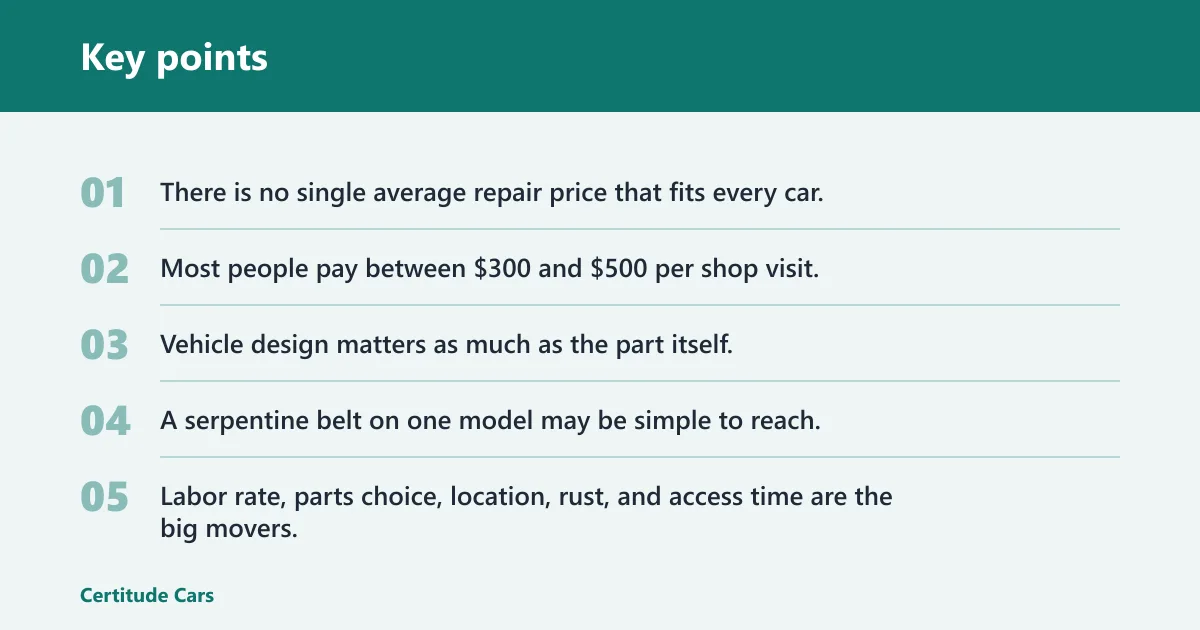
There is no single average repair price that fits every car. Most people pay between $300 and $500 per shop visit, but that broad figure blends cheap maintenance, small electrical fixes, and larger mechanical jobs that can climb past $1,000 and sometimes hit $5,000 or more.
Vehicle design matters as much as the part itself. A serpentine belt on one model may be simple to reach, while the same job on a compact transverse V6 may require more disassembly, more labor time, and extra hardware.
What changes a quote from one car to the next
Labor rate, parts choice, location, rust, and access time are the big movers. Shop labor may run $120–$159 per hour on average, and some shops post $100 to $200+ per hour depending on region and specialty.
That rate is only part of the bill. Flat-rate billing means the shop may charge book time for a job even if the technician finishes faster, while a rusted or broken fastener can turn a short repair into a long one.
When a rough average is still useful
A rough average helps you spot a quote that is far outside the normal range. It works best when you pair it with the job type, the vehicle, and the likely add-ons, such as fluids, alignment, calibration, seals, or relearns.
Suppose a small sedan needs front brake service and the estimate is close to the listed range, but the shop also adds brake fluid exchange and hardware. That may be reasonable. If the same quote includes rotor replacement on both axles without a clear reason, it deserves a second look.
Why repair quotes vary so much
Repair quotes move because the bill is built from several pieces: labor, parts, access time, and shop policy. The same repair can cost hundreds more when the parts are buried behind other components, when the car needs OEM parts, or when calibration and fluids are added to the work order.
Labor rate and flat-rate billing
Labor is the main cost driver on many repairs. A shop may charge by a published labor guide, not by the clock on the wall, so the customer pays for the job’s standard time even if the actual repair goes faster.
Dealer labor often sits above independent-shop pricing, and chains usually fall somewhere in between. The range matters more than the label. A dealership with brand-specific tools may be the right call for software work, while a local independent may be the better fit for brakes, suspension, and many routine repairs.
Parts choice: OEM vs aftermarket
OEM parts usually cost more than aftermarket parts, and that gap can change the total estimate quickly. On some jobs, parts are a small slice of the bill; on others, the part price is the main reason the quote is high.
OEM parts make more sense when fit, finish, or software integration matter, such as sensors, modules, or late-model electronics. Aftermarket parts often fit routine wear items like pads, rotors, filters, and many suspension components, especially when the vehicle is older and the customer wants to keep the bill down.
Access time, layout, and vehicle complexity
Engine layout changes labor time. A transversely mounted engine with tight packaging can turn a basic sensor or starter replacement into a labor-heavy job. Hybrid systems can add high-voltage safety steps, extra diagnosis, and software checks.
Location also matters. Rust belt cars often need more time for seized fasteners, corroded lines, and broken clips. That hidden labor does not show up in the part price, but it can move the final invoice sharply higher.
Location and add-on work
Shop labor can run $100 to $200+ per hour, and that spread alone can change the quote by a meaningful amount. Add-on work matters too: alignments, calibration, wheel-speed sensor relearns, drain-and-fill fluids, and gaskets often appear only after the technician opens the job.
A common first-timer mistake is comparing only the headline repair price. If one estimate includes new hardware, fluids, and calibration and another does not, the cheaper quote may not be cheaper at all once the work is complete.
Average car repair cost table
This table shows how to read a common estimate. The labor share is the portion that usually goes to time, access, or setup, not the part box alone.
| Repair | Usual price range | Mostly labor | Common hidden add-on | Red-flag wording |
|---|---|---|---|---|
| Diagnostic fee | $100–$200 | Yes | Scan, pinpoint test, or smoke test | “We have to start replacing parts” |
| Brake pads and rotors, per axle | $548–$629 | About half | Brake fluid, hardware, machining, sensor | “Both axles need everything” |
| Alternator replacement | $754–$850 | About half | Belt, tensioner, battery test | “While we are in there, replace the battery” |
| Timing belt replacement | $700–$1,500 | Mostly yes | Water pump, tensioners, seals | “Cheap belt only” |
| Head gasket repair | $1,500–$4,000+ | Mostly yes | Head machining, coolant, oil, head bolts | “No need to check the head” |
| Transmission replacement | $2,500–$6,000 | Mostly yes | Fluid, cooler flush, mounts, programming | “Used unit, same as new” |
| Wheel alignment | $168–$197 | Yes | Camber bolts, seized adjusters | “Alignment with no inspection” |
| Battery replacement | $150–$350 | No | Battery registration, terminal service | “Any battery works” |
| Starter replacement | $350–$900 | About half | Battery test, cable repair | “It just needs a starter” |
| Water pump replacement | $400–$1,200 | Mostly yes | Coolant, thermostat, drive belt | “Pump only, no coolant change” |
| Oxygen sensor replacement | $150–$450 | Moderate | Exhaust rust removal, reflash | “Replace all sensors at once” |
| Control arm or bushing repair | $300–$900 | Mostly yes | Alignment, seized bolts, hardware | “Suspension refresh kit” |
How to read labor share and add-ons
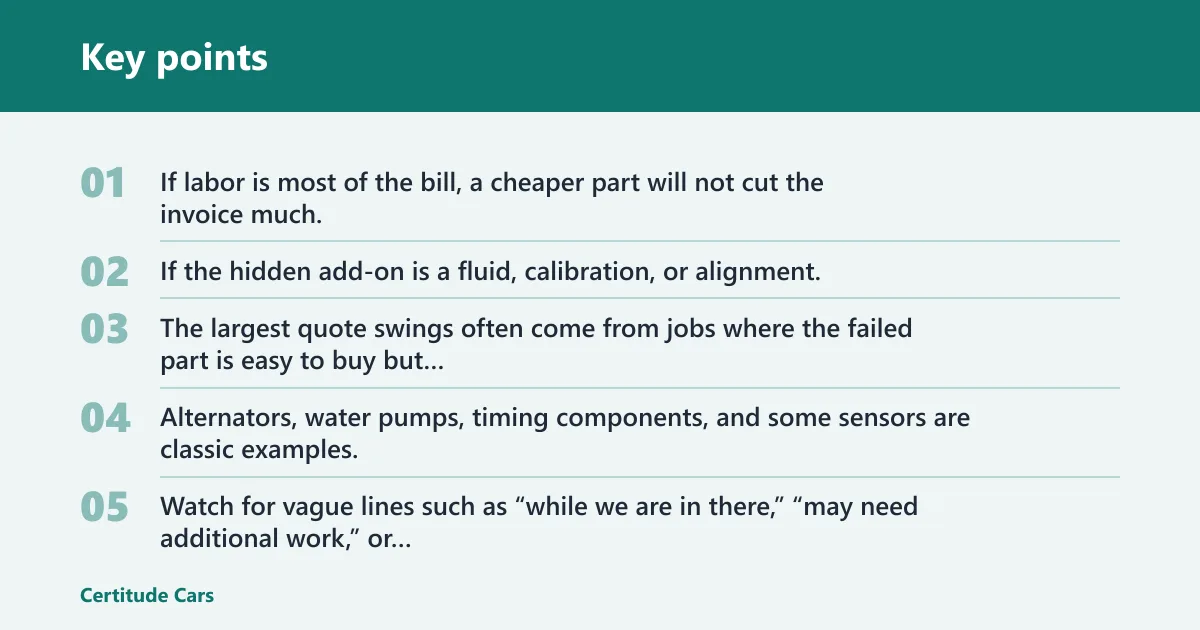
If labor is most of the bill, a cheaper part will not cut the invoice much. If the hidden add-on is a fluid, calibration, or alignment, that item may be required for the repair to work correctly and should be listed separately.
The largest quote swings often come from jobs where the failed part is easy to buy but hard to reach. Alternators, water pumps, timing components, and some sensors are classic examples.
Red-flag wording that deserves a second look
Watch for vague lines such as “while we are in there,” “may need additional work,” or “not responsible if more damage is found” when the estimate gives no ceiling. Those phrases are not automatically wrong, but they should be tied to a clear reason, a price cap, or both.
Say your SUV needs brake work and the estimate adds pads, rotors, fluid, and hardware on both axles. That can be normal. If the shop also wants to replace calipers with no leak, sticking piston, or uneven wear, ask why before approving it.
How much should brake repair cost?
Brake pads and rotors were listed at $548–$629, which is a useful per-axle reference for many passenger vehicles. The price can be lower on simple front-pad jobs and higher when the rotors, sensors, fluid, or seized hardware add time.
Brake pads and rotors by axle
For a typical per-axle brake job, labor is a major part of the total. The technician must remove the wheel, inspect the caliper and slide pins, swap the wear parts, torque everything correctly, and road-test the vehicle.
On some vehicles, rear brakes cost more than front brakes because of electronic parking brakes, tighter packaging, or additional reset steps. On others, the front axle costs more because the brake package is larger and wears faster.
Dealer vs independent pricing spread
Dealer quotes are often higher than independent-shop quotes for the same brake job. The difference usually comes from labor rate, OEM parts use, and shop overhead, not from a different brake process.
A fair comparison needs the same axle, the same part type, and the same add-ons. If one quote includes rotors and the other does not, they are not the same repair.
What often gets added to the bill
Brake fluid service, hardware, pad wear sensors, and caliper replacement can all change the final number. Alignment may also be recommended if the vehicle has uneven tire wear or suspension issues that affect stopping stability.
The cleanest way to review a brake estimate is to separate parts, labor, and extras line by line. If the total rises because the shop found a stuck caliper or a worn hose, that is a real repair need, not an upsell by itself.
How much does an alternator replacement cost?
Alternator replacement was listed at $754–$850, and that range fits a repair where the part itself is only part of the bill. The job often includes diagnosis, belt inspection, charging-system testing, and installation labor that varies a lot by engine layout.
Typical national price range
The quoted range can move up when the alternator sits low in the engine bay, when a serpentine belt or tensioner must come off with it, or when battery charging issues require extra testing. Some vehicles also need software checks after the repair.
Common symptoms and diagnosis path
Common symptoms include a battery warning light, dim headlights, slow cranking, electrical glitches, or a dead battery that keeps returning after a jump start. Those symptoms do not prove the alternator is bad, which is why diagnosis matters.
A diagnostic fee is different from a code scan. A scan may show a charging-system code, but a proper diagnosis checks output, voltage drop, battery condition, belt drive, and wiring before replacing the alternator.
Parts and labor split
Alternator jobs often split close to even between parts and labor, but not always. A hard-to-reach alternator can make labor the larger share, while a common passenger-car unit may keep labor moderate.
Ask whether the quote includes belt replacement, tensioner inspection, and battery testing. If the shop leaves those out, the final invoice can rise after the vehicle is already apart.
How much does a timing belt replacement cost?
A timing belt replacement commonly lands in the $700–$1,500 range, depending on engine layout and what else is included. The job is labor-heavy because the belt sits behind covers and often shares space with mounts, pulleys, and accessory drive components.
Why timing belt jobs are labor-heavy
The belt itself is not the expensive part. Labor rises because the technician may need to remove covers, accessory belts, engine mounts, and other components to reach the timing drive safely and set the engine back in time correctly.
That is why timing belt quotes can swing widely between vehicles that look similar from the outside. A four-cylinder with open access is one thing; a packed V6 with tighter clearances is another.
Why the water pump is often done at the same time
Many shops recommend the water pump, tensioners, idlers, and seals while the timing area is already open. That is not a trick. It is often cheaper to replace wear items together than to pay the same labor twice later.
The cost rises when the quote includes new coolant, drive belts, or coolant hoses. If the shop leaves the water pump out on a car where the pump is driven by the timing belt, ask whether a future pump failure would force the same labor again.
When the quote can rise
Quotes climb when the engine is interference design, when the shop finds oil leaks near the belt, or when seized fasteners slow the job. Extra labor for a crank seal, cam seal, or broken bolt can add up fast.
For approval, the key question is whether the job includes all wear parts that share the same labor path. If it does, the higher estimate may be better value than a cheaper belt-only quote.
How much does a transmission replacement cost?
Transmission replacement was listed at $2,500–$6,000, and the final number depends on whether the unit is rebuilt, remanufactured, or new. This is one of the clearest examples of a repair where labor, programming, and fluid work are only part of the bill.
Rebuilt, remanufactured, and new pricing
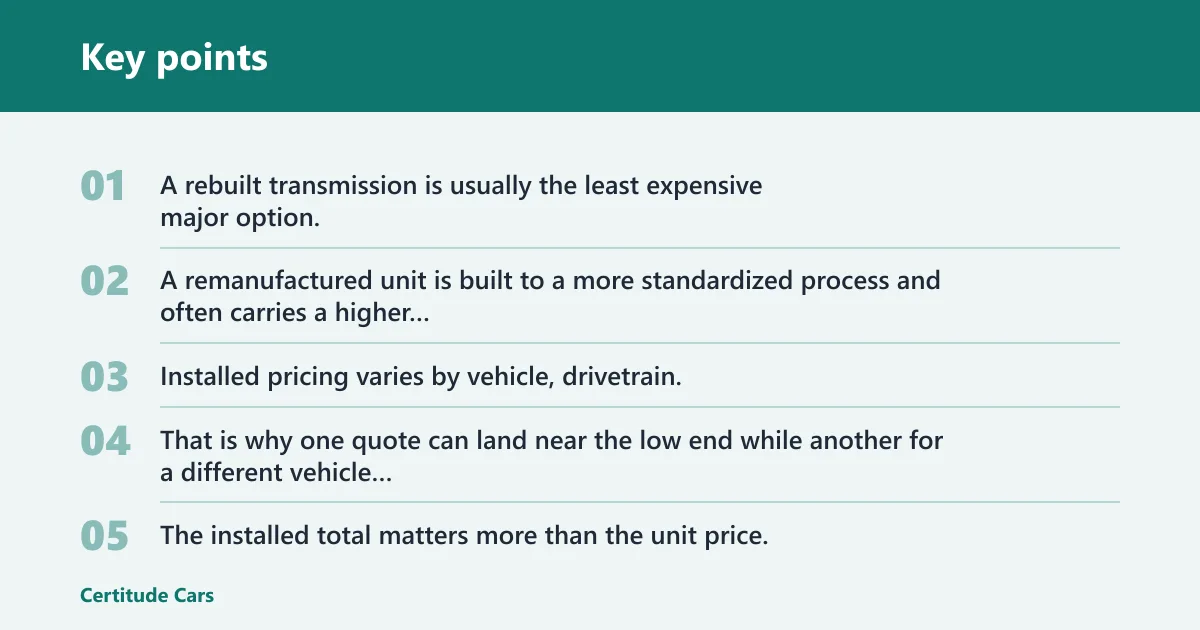
A rebuilt transmission is usually the least expensive major option, but the quality depends on who did the rebuild and what was replaced inside. A remanufactured unit is built to a more standardized process and often carries a higher price. A new unit is usually the most expensive.
Installed pricing varies by vehicle, drivetrain, and whether the shop must also replace mounts, axles, cooler lines, or software-linked components. That is why one quote can land near the low end while another for a different vehicle reaches several thousand more.
Installed cost range
The installed total matters more than the unit price. A transmission sitting in a crate is not road-ready until the shop removes the old unit, installs the replacement, fills it with the correct fluid, checks for leaks, and often programs or relearns the control system.
That is also why a cheap used unit is not automatically a bargain. If it adds little warranty coverage and still requires the same labor, the savings can disappear quickly.
When repair stops making sense
When the transmission quote approaches the car’s market value, the decision shifts from repair to economics. A practical threshold is any major drivetrain repair that pushes close to, or above, the vehicle’s value after you include taxes, registration, and future wear.
Head gaskets, transmissions, and engines often sit in the $1,500 to $10,000 and up zone. At that level, a second estimate is smart, and a sale or replacement decision may make more sense if the car already needs additional work.
How much does a diagnostic fee cost?
A diagnostic fee usually runs $100–$200, but that fee is not the same as a code scan. A code scan reads stored faults; diagnosis traces the cause. For check-engine, electrical, and intermittent complaints, the diagnostic step is what keeps parts replacement from becoming guesswork.
Diagnostic vs code scan
A scan tool can point to a system. It does not prove the failed part. Good diagnostic work may include live-data review, pinpoint tests, smoke testing, pressure checks, wiring checks, and road testing.
That extra time is why a proper diagnostic has value beyond the first code read. The average check-engine repair cost was $554 in 2025, which shows how diagnosis and repair can combine into one moderate bill before the real fix is even chosen.
When the fee is credited toward repair
Some shops credit the diagnostic fee toward the repair if you approve the work. Others treat it as a separate charge. Ask before you sign, because a credited fee lowers the effective repair total.
If the estimate says the diagnosis is “free,” read the line carefully. Free diagnostics often come with a larger repair quote or a limited scope that still charges for more complex testing.
What good diagnostic work includes
Good diagnostics identify the failed component, the cause, and any related damage. That matters on electrical jobs, where a bad alternator can damage a battery, or on overheating jobs, where a head gasket can fail because of a thermostat or cooling-system problem.
The goal is a repair that solves the symptom and the cause. Replacing a part without checking the rest of the system can lead to the same warning light coming back.
Frequently asked questions
How much does a typical car repair cost?
Most people pay between $300 and $500 per shop visit, but that range mixes small and large jobs. Many routine mechanical repairs such as brakes, batteries, sensors, and alignments usually run $100 to $600, while major repairs can move far beyond that when labor or access time is high.
What do common car repairs cost in 2026?
Most common car repairs cost between $150 and $1,500 in 2026, with many routine jobs sitting near the lower half of that range. The bill rises when the repair needs more labor, dealer programming, premium parts, or extra work such as fluids, alignment, or calibration.
How do I know if a repair quote is fair?
A fair quote should separate parts, labor, and add-ons. Compare the same repair on the same axle or system, confirm whether OEM or aftermarket parts are included, and ask whether the diagnostic fee is credited toward the repair. If the estimate is vague, get a second written quote from another shop.
Is it cheaper to use an independent mechanic or dealer?
Independent shops are usually cheaper than dealers because labor rates are often lower and parts choices can be more flexible. Dealers may be the better fit for software-heavy, warranty, or brand-specific work, but for many routine repairs, an independent quote is the less expensive starting point.
What car repairs cost the most?
Transmissions, engines, and head gaskets are among the most expensive common repairs, and they often land in the $1,500 to $10,000 and up range. These jobs cost so much because the part, the labor, the teardown, and the related fluids or machining can all stack together.
What repair costs mean my car is not worth fixing?
If the repair estimate is close to or above the car’s value, the decision deserves a hard look. Add the quote, likely follow-up work, and the car’s age or condition. If the vehicle still needs tires, brakes, or suspension work, replacement may be the better financial move.